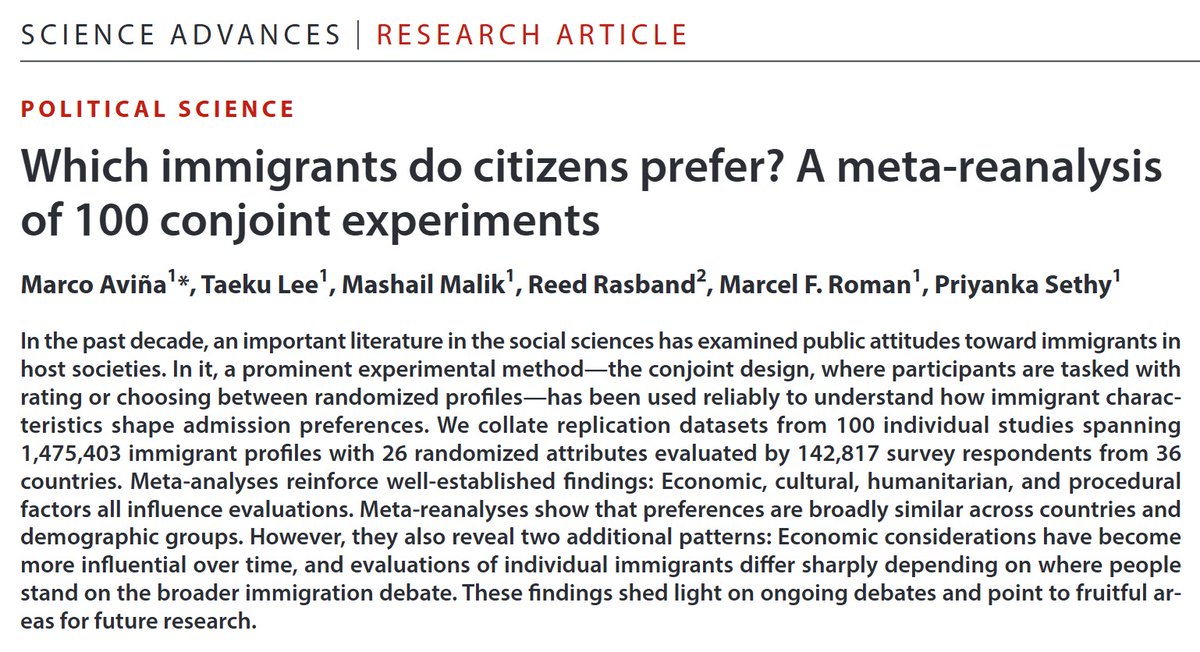
NEW in @ScienceAdvances, after 3 years of work with a great team:
We review and meta-analyze 100 immigrant conjoint experiments in 36 countries.
Immigration preferences are surprisingly similar across people and countries, but changing over time and structured by politics.
🧵
A monumental loss. Ran was not only a trailblazing and brilliant scholar; he was also a remarkably generous colleague and, what's more, a dear friend.
https://t.co/ZlwBT1pkV3
So excited to finally share my job market paper!
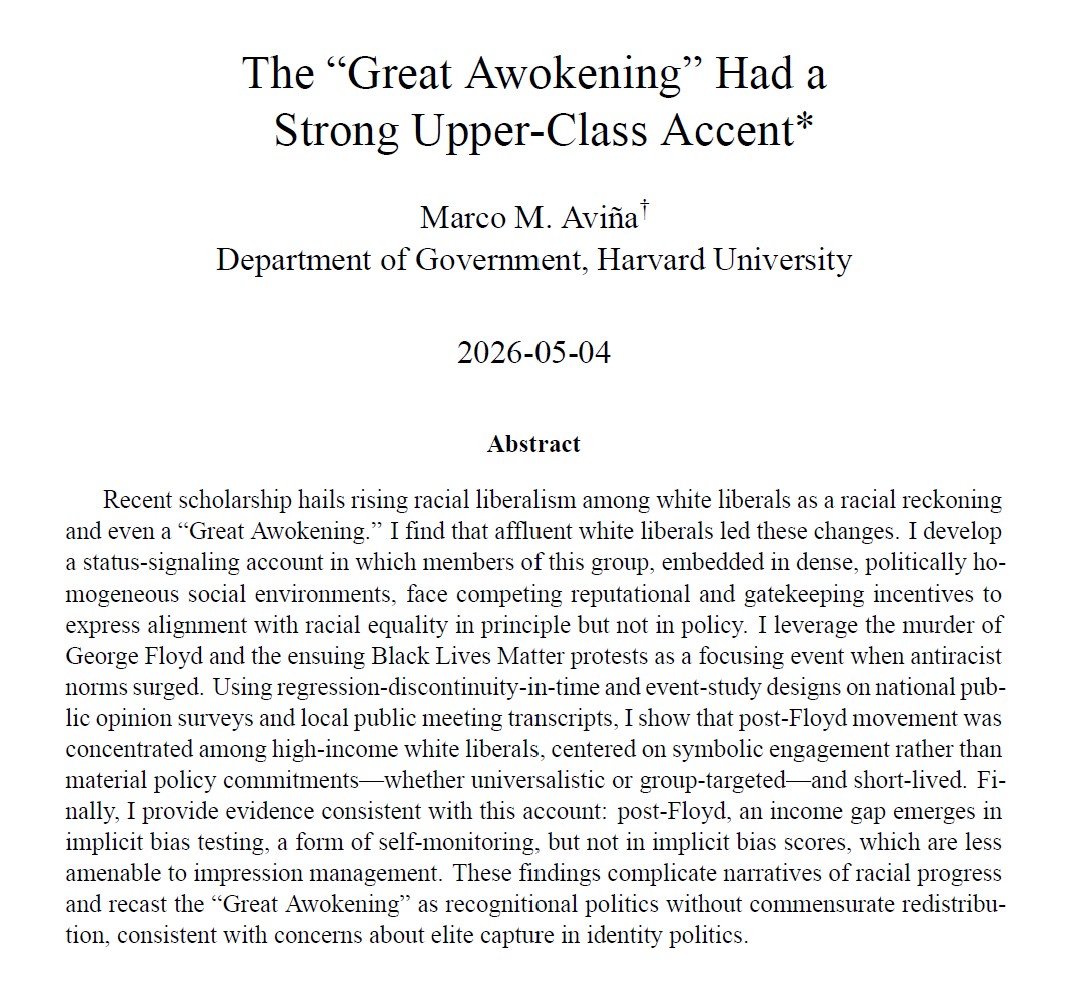
The post-Floyd “Great Awokening” was driven by affluent white liberals and emphasized recognition over redistribution.
Consistent with elite capture of identity politics.
Feedback very welcome! Link below.
Excited to present my JMP at MPSA!
The post-Floyd “Great Awokening” was driven by affluent white liberals and emphasized recognition over redistribution.
Evidence from surveys, public discourse, and implicit bias data.
Consistent with elite capture of identity politics.
⬇️
Turns out most Canadians vote the party, not the person. Local candidates were decisive for just 5-8% of voters outside Quebec and 2-5% in Quebec. The data don't lie! /w @marcomavina & @ablais_ See paper here: https://t.co/YqiSUPoxfl
My work with @marcomavina & @ablais_ shows that most Canadians vote the party, not the person! Local candidates were a decisive factor for 5-8% of voters outside Quebec, and just 2-5% in Quebec. See: https://t.co/YqiSUPoxfl
Regardless of what you think, you’re voting for a person in Canada, not a party. There’s a reason why the name is the one in bolder font and not the party!
@Nature has published three groundbreaking papers on reproducibility, analytical robustness, and replicability across the social sciences. Sincere thanks are due to the many folks who contributed to these projects. It’s painstaking work, and a great service to social science.
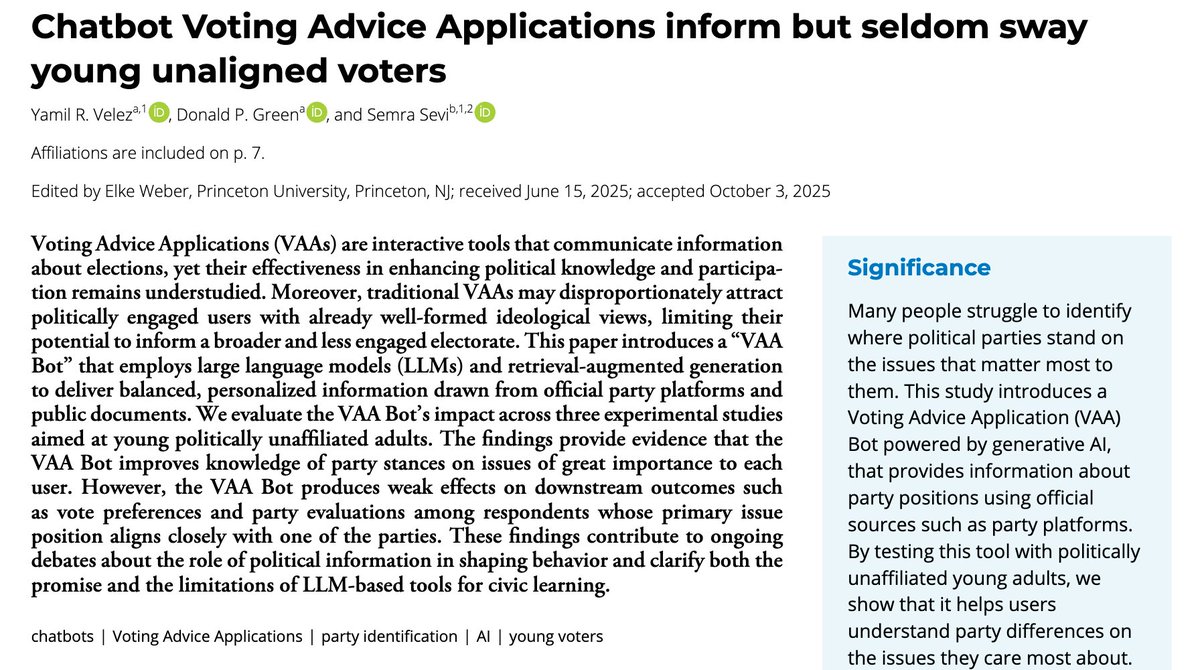
Our PNAS paper (@SemraSevi + Don Green) is a small step toward building this information layer, but as RAG gives way to massive context windows and agentic retrieval, the central challenge becomes curating and prioritizing high-quality information.
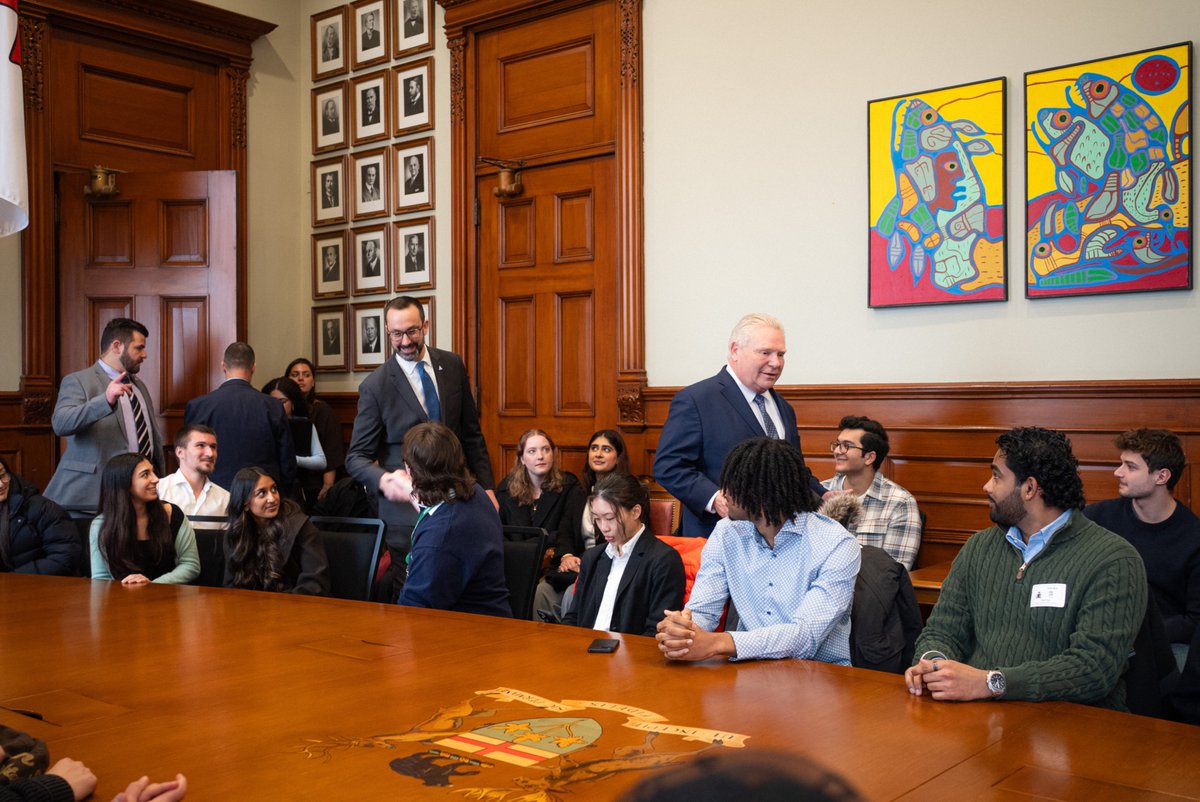
Great to welcome @UofT Professor Sevi’s 3rd-year political science class to #QueensPark this week!
From the gallery during Question Period to a conversation in the council chamber with Premier @fordnation, they got a front row look at how provincial politics works.
It was clear from their insightful questions that these students are receiving a world-class education that will set them up for success. I look forward to seeing all they will accomplish in their future careers!
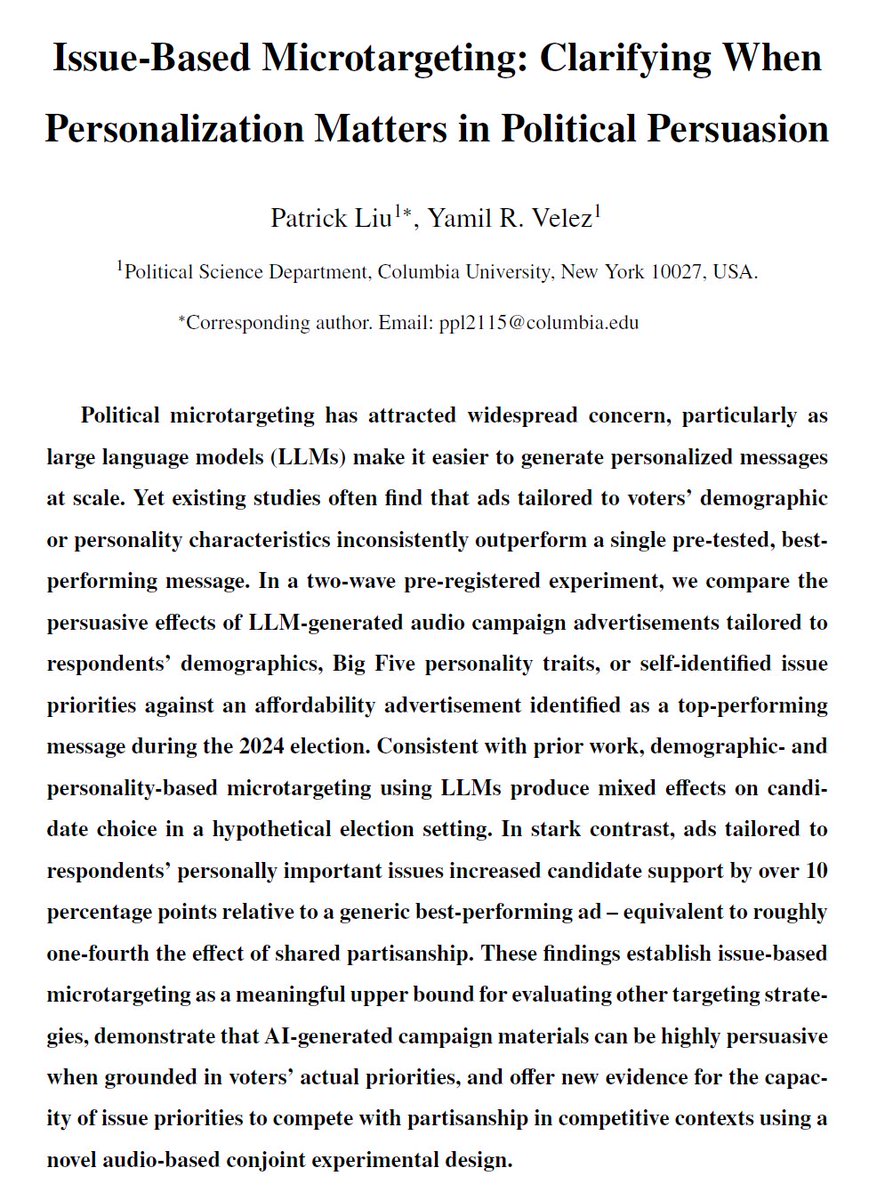
New paper w/ @YamilRVelez! A lot of great research on political microtargeting discounts personalization: tailored ads (using AI or not) rarely beat a single-best message. We define two types of microtargeting, clarify when tailoring matters, & showcase a novel audio-based design
1/ Will voters participate in the primary of a party they oppose to prevent the nomination of a candidate they fear?
In a new paper in AJPS with @HayleyCohen, we study crossover voting using surveys and a large field experiment (N=83,902) in the 2024 New Hampshire Republican presidential primary.
https://t.co/9QjZGpgyeM
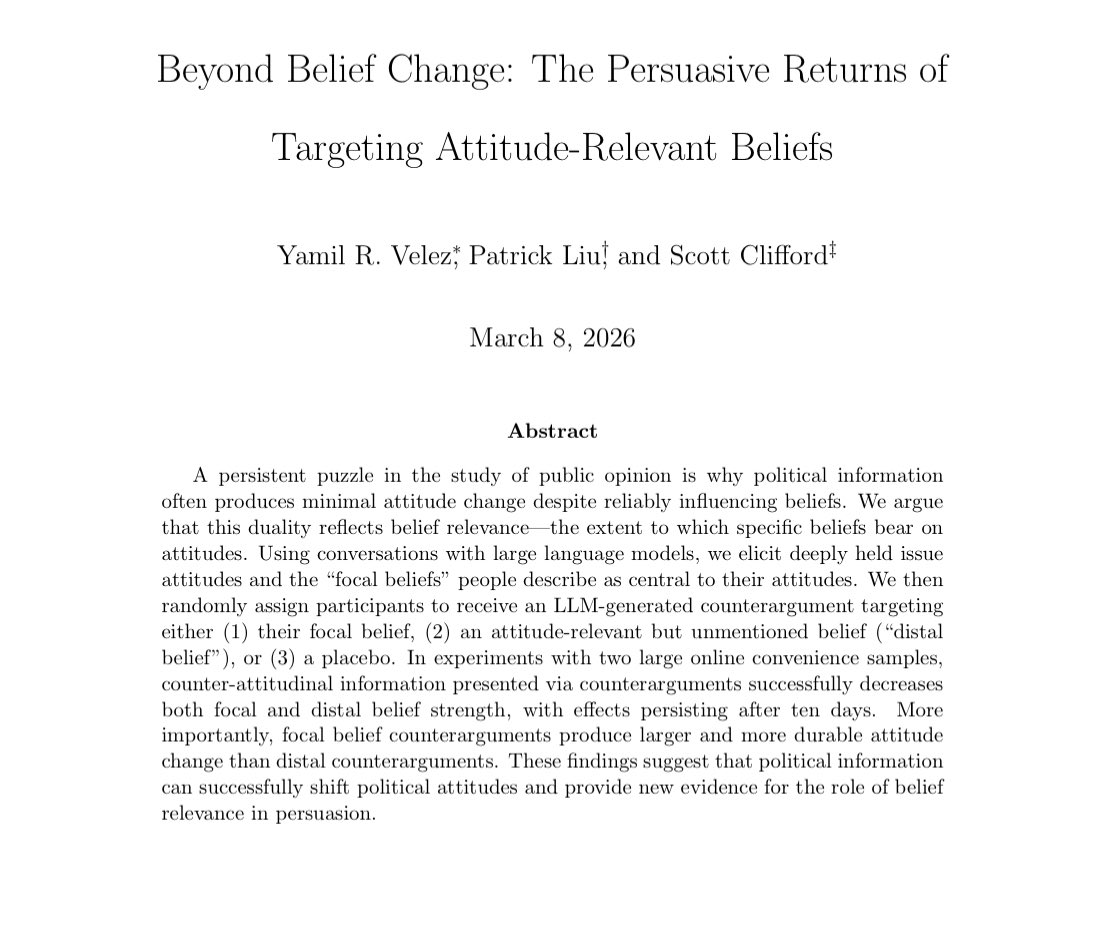
Conditionally accepted at the APSR (w/ @scottclifford & @patrickpliu):
Why does political information so often change beliefs but NOT attitudes? We highlight the role of belief relevance, or the extent to which beliefs bear on attitudes.
Science communication has never been more important.
In this animation, @YamilRVelez , Donald Green and I explain whether AI chatbots can boost political engagement among unaligned young voters.
Link to animation: https://t.co/IckrqVAznh
Excited to share our new paper published in PNAS (joint with @SemraSevi and Don Green)! AI can enhance political knowledge and provide balanced information about politics with proper guardrails and vetted sources (e.g., party platforms).
https://t.co/xKA0cFyATW