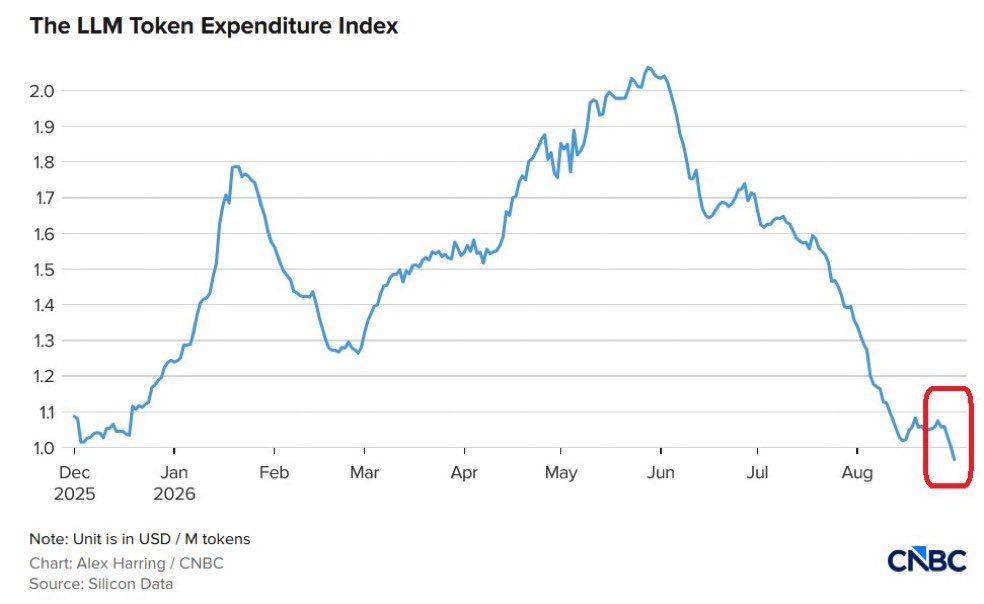
Whatever the motives, a slowing AI build-up seems to have been already decided.
Security is partly an issue. Another issue might be the fact that adoption of frontier is falling way behind models (see below).
Weirdly, this + Fed hike are reversal triggers for USTs.
The whole point is the capex spend cycle is over. We were anticipating ongoing spending at the current rate. That is not gonna happen now. The market had priced in that liquidity as going to AI companies. It’s not gonna happen.
They’re presenting it as a safety story. “We will stop the rate of advancement of model design”. But this is a false narrative. The capex spend was about purposeful moating after ai model advancement got matched by deepseek at a fraction of the cost. Models became commoditised at that point. The legacy models still had an edge providing they could throw insane capital at scaling to reduce token cost on the usage side. Loss leading your way to market share. Same as Chinese did with solar. The tech was comparable to US but Chinese still took over the market because they were prepared to operate uneconomically until they had run everyone out of business.
In this case the US hyperscalers also had access to the equivalent of the rare earths that China did not (cutting edge chips).
Hence the tokenization price collapse.
But what happened with Kimi shows that the open weight models can keep up without losing market share even with less powerful chip infrastructure and less capital expenditure.
This kills the point of trying to win the race that way. It’s a waste of capital. And the liquidity was being totally sucked out of Western government bond markets.
So now that eases the rate of liquidity absorption.
The market meanwhile will have to write down their ai assets. To stabilise the market the government will takeover the ai firms. So it’s just a question of what rate does the private sector exchange now totally underwater AI paper for USG paper.
That’s the asymmetric knowledge.
GERMANY, factory orders 🇩🇪
German factory orders +2.5% m/m in July, crushing the 0.3% consensus.
But the internals are weak:
(1) Ex-large orders: -1.4% m/m, and -2.2% on the smoother 3M basis
(2) The entire beat is one line: ships, rail and aircraft +126.4% (-> hello Russia, sponsored by government)
(3) Autos -12.5%
(4) Consumer goods -4.8%
(5) Foreign orders -2.1%, with non-euro area demand -10.1%
Domestic demand (+9.1%) flatters the headline, and it's the same lumpy contracts showing up twice.
-> Strip them out and there's still no underlying recovery in German manufacturing demand.
Do yourself a favour and follow my friend Lakshmi if you are into oil — and add a bit of motivation for her to become an active member of this community.
She is one of the most authoritative oil-market voices I know, with a depth of understanding few in the market can match. She probably also has the most no-nonsense tone in the business: says it exactly as she sees it, whichever way the conclusion points: long or short; and she doesn’t mince her words. I love that.
Best of all, among many other things, she does her own proprietary barrel tracking across the hottest spots comme il faut: SoH, BeM, Chinese consumption, Russian refinery runs — and a growing list beyond.
Thanks to her sharing her dark-fleet numbers with me — incredibly time-consuming and expensive work if done comme il faut — I was finally able to make sense of the oil puzzle in July. I’m not famous for requiring handholding. But in this new age of dark transportation at scale, we all need to up our game. The old tools simply aren’t good enough anymore.
Serious brain. Serious work. Serious insight.
@LSREnergy
PS: Please repost this recommendation. The new X algo only really gets things moving with a bit of help from the crowd.
As CIA chief John Ratcliffe is visiting Moscow today, it may be interesting to consider the recent leak from the Russian state-owned bank "Sberbank" that discusses eight scenarios for how the Russian war against Ukraine might end. Each scenario has its own probability in %. 1/9
Nah. Defending groupthink by appealing to groupthink? Consensus carries weight when observations are independent.
Seaborne commodity trackers are a textbook example of a commodity product (nomen est omen). They rely on the same underlying AIS shipping data, while their methodologies were never designed for sustained dark-fleet tracking at scale. In other words, they share the same blind spots and, frankly, complacency.
Fixing it is an investment: one needs to basically rebuild the company at the core: fuse AIS with frequent satellite imagery, vessel identification, draft/loading changes and near-real-time route reconstruction, ideally in two-hour increments, across a lot of vessels. Success will require quality sector and tech team work to optimizing the algorithm over time.
Not doing that means one’s aggregate data has zero real time value left as revisions over weeks often more than double the original publication. 5mbpd can easily become 12mbpd in 7-14 days. Let be repeat: Zero real time value!
I interact with some of these firms and find their collective response function shockingly insufficient so far. The same goes for tracking Russian refining, which obviously requires massive adaptations to capture this new dynamic.the core mistake? They treat dark and drone activity as anomalies rather than structural features at scale of what I like to call the new war economy.
Little, if any, C-level attention. No profound discussion. No recognition of the gravity of the moment. Amateur hour from A to Z. Boy, are they ready for disruption.
So far, nobody offers materially better commercial data, as far as I know, so they get away with it. And of course it’s a lot more profitable to cheaply buy, reshuffle and expensively sell standardised AIS data, padded with B- and C-grade stuff, than to solve genuinely difficult problems with A-people on both the sector and tech sides, while having to buy high-frequency satellite imagery on top.
I don’t make the rules. Going dark is the new normal when the SoH, BeM and much of Russia are involved. Meanwhile, tracker errors run into millions of barrels per day and often resolve only weeks later, if at all. Their approach? It’s dark and what we show is the “floor”. It’s the cardinal sin in commodities which prices everything at the margin. Which part of that do they not understand?
The Buy Side does not have the luxury of complacency. So they do their proprietary models, comme il faut - no short cuts..! The first are now complete. And they make the traditional vendors I know look real bad. Given their price points, it’s quickly becoming an insult.
Gutsy, selling rubbish as real time insight in the age of AI. Good luck to them. The Sell Side will have to adapt or die over the next few months. My hunch is that AI-native models will offer vastly better data at a fraction of today’s cost, and soon. Let’s see. But here is your business plan if you are young & hungry: deliver robust commodity data in real time.
I cannot share my third-party proprietary insights, obviously, but my best advice to the blind at this stage is to keep an open mind instead of putting blinders on. Alternatively, build it yourself.
Where I sit, key shuttle operators such as ADNOC appear to be doing a great job. i cannot judge the job of the US Navy but there are now convoys with US guns patrolling them. I salute them 🫡 and sincerely thank them for their services.
For now, Iran has lost control of the Strait of Hormuz. If Team Trump turns that into a consistent long-term strategy instead of contemplating another Memorandum of Misunderstandings, the regime is hopefully in its endgame.
Early days, but it’s the first time since March that I’m cautiously optimistic here. For the benefit of humanity.
@POTUS@JDVance@SecRubio@USNavy@CENTCOM
I think it is possible that Hyperscaler earnings are materially overstated because the core IT infrastructure has not yet begun to be amortized (see e.g. ASC 360, ASC 835-20). They already have tons of compute but cannot power it on yet because of the lagging datacenter buildout.
Few words on $TENX ahead of the readout. Don't shoot the messenger, no position. I am not long or short.
Levosimendan can't reverse LV diastolic dysfunction especially when cardiac remodeling is there.
Levosimendan can't do much for pulmonary vascular remodeling.
Cardiac output is decreased even with preserved EF so levosimendan mediated systemic blood pressure drop could cause problems like hypotension.
Enrichment for acute hemodynamic responders in Phase 2 (HELP), not the same exact setting in Phase 3.
No hierarchical stratification by HFpEF subtype according to SAP, so there is no safety net like finding a sub-population where levosimendan might work.
Watch out and play safe. Hope it works though.
@monaco_biotech@Lucy3370@plainyogurt21 I meant that someone might have come to the conclusion that they are sitting on bad data and bought a sizeable amount of Aug puts over the last days