Scientists have achieved the restorative benefits of deep sleep in awake mice, without them actually sleeping. In a groundbreaking study published in Nature Neuroscience, researchers at the University of Wisconsin-Madison used optogenetics, a technique that uses light to control genetically modified neurons, to induce slow-wave “on/off” patterns characteristic of non-REM sleep in localized regions of the animals’ brains.
Sleep-deprived but active mice that received this artificial stimulation performed as well on memory and learning tasks as fully rested mice. The results support the idea that specific neural activity patterns, rather than unconsciousness itself, drive synaptic restoration and cognitive recovery.
This discovery suggests it may one day be possible to develop targeted therapies that counteract the effects of sleep deprivation and help treat cognitive decline in humans.
[Driessen, K., Squarcio, F., Tononi, G., & Cirelli, C. (2026). Induction of cortical on/off periods in awake mice fulfills sleep functions. Nature Neuroscience]
Researchers at Stanford University have elucidated a mechanism behind the occurrence of myocarditis following mRNA COVID-19 vaccination, particularly in young males.
Analysis of blood samples from vaccinated individuals revealed elevated levels of two cytokines—CXCL10 and interferon-gamma (IFN-γ)—in those who developed post-vaccination myocarditis.
These signaling proteins initiate a two-step inflammatory cascade: CXCL10, primarily produced by macrophages in response to the vaccine, recruits T cells that release IFN-γ, which in turn attracts aggressive immune cells (such as neutrophils and macrophages) to the heart, leading to tissue damage.
In preclinical models (including mice and human cardiac tissue), neutralizing CXCL10 and IFN-γ significantly reduced cardiac injury and immune cell infiltration without impairing the vaccine's overall immunogenicity.
Additionally, pretreatment with genistein—a soy-derived anti-inflammatory compound—attenuated the cytokine surge and mitigated heart damage in these models.
Vaccine-associated myocarditis typically presents with symptoms like chest pain, shortness of breath, and palpitations shortly after the second dose and remains exceedingly rare.
Importantly, SARS-CoV-2 infection itself poses a substantially higher risk of myocarditis—along with severe multisystem complications—reinforcing that the benefits of mRNA vaccination far exceed the risks.
Statistics report 1 case of myocarditis in 9,000–25,000 doses for the highest-risk groups, adolescent and young adult males, particularly after the second dose. Rates were much lower in females, older adults, and after first or booster doses. For context, myocarditis risk from actual COVID-19 infection was substantially higher—often 10 times or more in comparable age groups.
[Cao, X., Manhas, A., Chen, Y.-I., et al. (2025). Inhibition of CXCL10 and IFN-γ ameliorates myocarditis in preclinical models of SARS-CoV-2 mRNA vaccination. Science Translational Medicine. DOI: 10.1126/scitranslmed.adq0143]
Noninvasive 40 Hz gamma sensory stimulation uses rhythmic pulses of light and sound to entrain the brain’s natural gamma oscillations, which are linked to memory, attention, and cognitive processing. This approach, often called GENUS (Gamma Entrainment Using Sensory stimuli), has shown promise in reducing the accumulation of amyloid-beta and tau proteins, the two primary pathological hallmarks of Alzheimer’s disease.
In multiple preclinical studies, daily one-hour exposure to 40 Hz light and sound reduced amyloid plaque burden, decreased tau pathology, protected neurons, preserved synaptic connections, and improved memory performance in mouse models of Alzheimer’s. Researchers observed that the stimulation enhances clearance of toxic proteins through the brain’s glymphatic system, its waste-removal “plumbing” network.
A pivotal 2024 study from MIT demonstrated a key mechanism: 40 Hz multisensory stimulation activates vasoactive intestinal peptide (VIP)-expressing interneurons, which promote increased cerebrospinal fluid influx and interstitial fluid efflux. This boosts glymphatic flow and accelerates the removal of amyloid proteins from brain tissue.
Human research has progressed from early feasibility trials to larger studies. In a Phase 2A pilot trial, patients with mild Alzheimer’s who received daily 40 Hz audiovisual stimulation for three months showed reduced brain atrophy (less ventricular enlargement and hippocampal volume loss), improved functional connectivity, better performance on memory tasks, and more stable daily activity rhythms compared to controls. Longer-term open-label extensions suggest sustained safety and potential cognitive benefits over two years in some participants.
A large Phase III clinical trial is currently underway to rigorously evaluate efficacy. While results remain preliminary and the therapy is not a cure, it represents a novel non-pharmacological strategy that aims to harness the brain’s own rhythms to activate natural cleanup and repair processes.
Early evidence also hints at broader applications for other neurological conditions, including Parkinson’s disease, stroke, and epilepsy, though further research is required.
[Tsai, L.-H., et al. (2025). Review: Evidence that 40Hz gamma stimulation promotes brain health. PLOS Biology]
Stop trusting internet strangers with your health.
Their number of followers or degrees mean nothing.
Read primary sources, not people who regurgitate studies for clout.
You cannot outsource critical thinking.
The Trump family generated at least $2.3 billion in profit from their main crypto ventures, while more than a million investors had net losses totaling $2.3 billion, a Reuters examination finds https://t.co/N8DvTPc6SM @specialreports
@simongerman600 Interesting but what about the study that show bananas could cancel out the polyphenols from other fruits if eaten together (due to the POO enzyme). When is the POO enzyme the highest/lowest during the bananas shelf life?!??
Finings of an exhaustive review of alcohol effects on 20 health outcomes from 843 studies
https://t.co/Xnzg1LGpGp
—"Current evidence does not support a universally
applicable threshold for alcohol consumption that maximizes health for all."
Associations:
—Increased risk of 10 cancers, pancreatitis, cirrhosis, tuberculosis, atrial fibrillation, pneumonia
—Decreased risk of ischemic heart disease, Type 2 diabetes, Alzheimer's disease, ischemic and hemorraghic stroke (with low-moderate intake)
"Our findings should not be interpreted as endorsing alcohol consumption for health benefits."
@DrDiGiorgio@mcuban Yeah but we can write an order for a MRI or study that pts can take anywhere (provided we do it right). Same for labs, etc and pharmacy. You can escape the captive system.
An exercise hormone derived from muscle—irisin— is neuroprotective, preventing brain cell loss, as seen in the experimental model of multiple sclerosis
@NatMetabolism
https://t.co/CC4KDOJTn1
https://t.co/9bbcLpW4g6
Check this out: Effects of a ketogenic diet on mitochondria 🔥
In animals, a ketogenic diet was sufficient to increase energy expenditure and induce weight loss by increasing brown fat activity.
What is shown is electron microscopy of brown fat tissue. The key feature I want you to focus on is “M” which stands for mitochondria.
Under ketogenic diet conditions, shown on the right, the mitochondria are larger and more abundant compared to those in animals on a standard chow diet.
They contain more mitochondrial proteins and more uncoupling protein, indicating greater thermogenic – heat producing and energy-burning capacity.
Now, look at “L.” These lipid droplets become smaller and more numerous, increasing their surface area and making them more readily accessible for energy use.
In other words, the ketogenic diet forced the brown fat tissue to undergo structural remodeling.
The mitochondria essentially bulk up, increasing their energy-burning capacity, while fat droplets become more accessible fuel sources.
The net result was that the animals burned more energy despite consuming the same number of calories.
And I’m sorry if makes some bomb calorimeters cry.
Details in today's full letter, linked at the end of the attached thread. 🔗👇
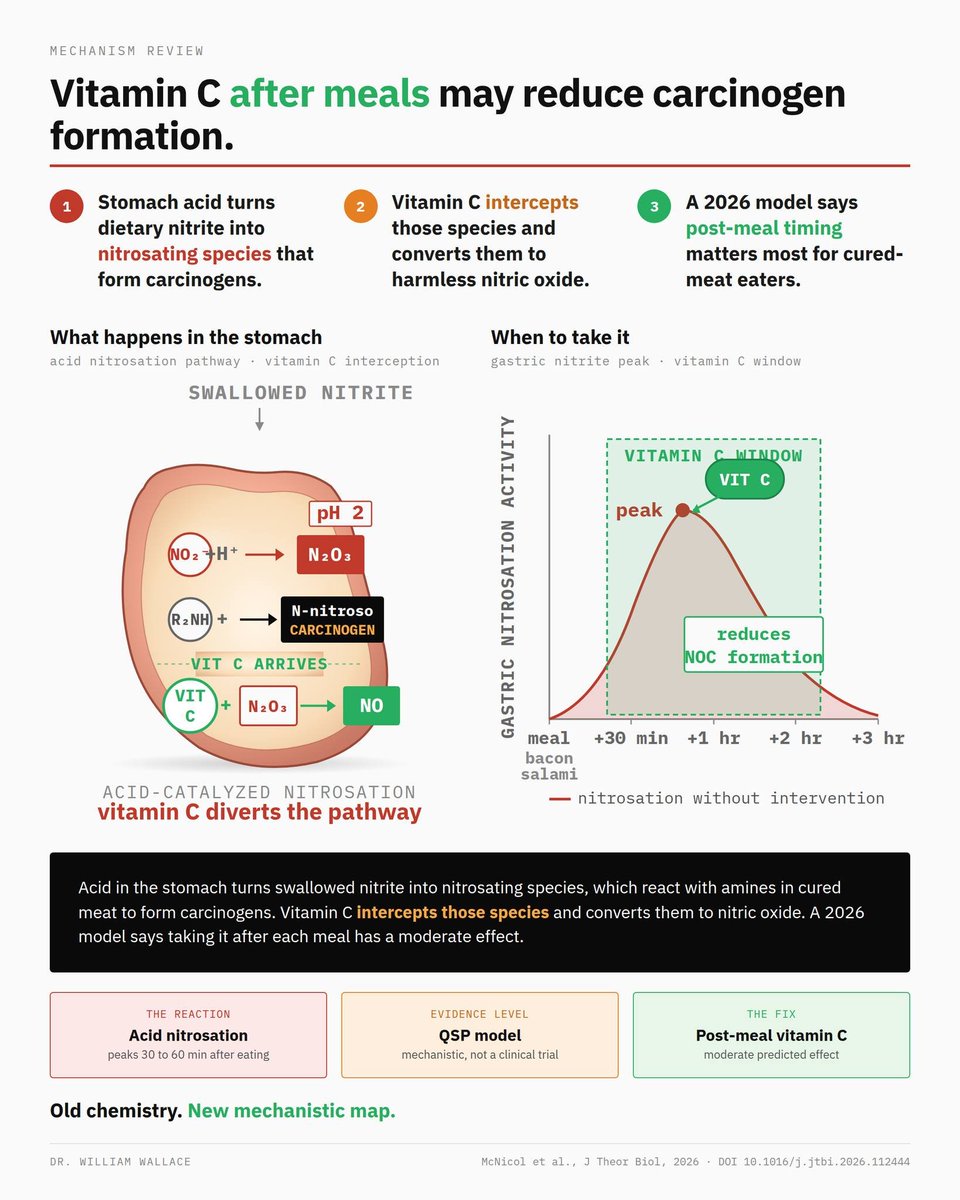
If you eat bacon, ham, salami, or hot dogs, this is for you.
A new paper published last week in the Journal of Theoretical Biology mapped out what actually happens in your stomach when you eat processed meat, and offers something practical you can do about it.
Cured meats contain sodium nitrite, added as a preservative and to fix the pink color. In your stomach, that nitrite meets stomach acid and turns into a reactive form. That reactive form attacks proteins from the meal and produces a class of compounds called nitrosamines. NDMA, NDEA, and NMBA are the most studied. They are the same compounds that triggered the FDA recalls of valsartan, ranitidine, and metformin in recent years. The International Agency for Research on Cancer classifies them as probable human carcinogens, and they are a leading hypothesis for why processed meat consumption tracks with elevated risk of stomach and colorectal cancer in large epidemiologic studies.
Vitamin C disarms this reaction. It converts the reactive nitrite compound back into nitric oxide, which is harmless and diffuses away. This chemistry has been known since the 1970s, which is why the meat industry already adds ascorbic acid during processing. The question is whether you can do anything on your end, after the meat is already in your gut. That is what the new model addressed.
McNicol, Basu, and Layton at the University of Waterloo built a mathematical model that tracks how nitrite, vitamin C, and the resulting chemistry move through saliva, stomach, and intestine over the hours after a meal. They ran simulations across realistic dietary patterns and found two things.
First, when vitamin C is naturally present in the meal, as it is in leafy greens and most fruits and vegetables, the protective effect is substantial. The vitamin C is right there when the chemistry happens. This is likely why dietary nitrate from vegetables does not track with cancer risk the way nitrite from processed meats does.
Second, for meals where vitamin C is not naturally present, like a bacon sandwich or a charcuterie board, taking vitamin C after the meal produced a moderate predicted reduction in nitrosamine formation. Not transformative. Measurable.
A few important things to know. This is a modeling study, not a clinical trial. The model is calibrated against decades of published chemistry, but no trial has yet measured nitrosamine biomarkers in people randomized to take vitamin C after meals versus placebo. Treat the predicted effect as a reasonable hypothesis backed by mechanism, not as proven outcome.
Practical version. If you regularly eat vegetables with your meals, the vitamin C is already there and you are doing most of the work. If you eat cured meats without vegetables in the same sitting, taking 200 to 500 mg of vitamin C with water 30 to 60 minutes after the meal has a defensible mechanistic basis and a modest predicted effect. The dose matters less than the timing. Above about 200 mg in a single oral dose, absorption efficiency drops sharply, so megadoses are not the answer.
The bigger idea is that a meal is a chemical environment you can shape. The same food can be a problem or a non-event depending on what else is in the gut at the same time, and when.
McNicol et al., J Theor Biol, 2026 Tannenbaum & Wishnok, Am J Clin Nutr, 1991 Hord,
Tang & Bryan, Am J Clin Nutr, 2009
Had a wealthy friend tell me that the ability to decrease time to any outcome is the one skill behind every successful person he knows.
A few I apply constantly:
- Decreasing the time it takes you to get out of a bad state will make you emotionally resilient
- Decreasing the time it takes you to go from idea to executive will make you wealthy
- Decreasing the time it takes you to turn a failure into a lesson will thicken your skin faster than anything else
Physical capacity doesn't peak at one age. It peaks in three separate windows years apart.
- Leg power: late teens to late twenties.
- Aerobic capacity: late twenties to early thirties.
- Upper-body endurance: mid-thirties.
By 63, the average person has lost 30-48% of their peak. Master athletes the same age hold over 80%. The gap is physical activity. Starting in adulthood still raised performance at every follow-up.
Here is one to piss you off even more Ryan. What if @elonmusk and @DOGE rather than focusing exclusively on FWA, set their goal to use AI in government as effectively , productively or even better than business can ?
What if they made it their “moon shot” and hired the best technologists and engineers with the goal of making the federal government as “AI Native “ as possible ?
Reducing the cost to run, eliminating friction for Americans in all interactions ? Using AI to reduce permitting and licensing and NEPA like approvals from years to days or weeks ?
Cutting the number of employees, while also increasing the benefits available to citizens that need the most help ? Saving taxpayers money, reducing taxes while improving benefits
Bottom line. Every single benefit that AI can provide to private enterprise, it can provide to government
I’m not saying this will ultimately happen. I am saying that with the right approach, AI can change the narrative of “government sucks at everything “ to “with AI, the cost of running government can be reduced , the output and productivity can go up, the friction can go down”
Capitalism. Make everyone compete. If AI can be used to leverage government scale. Why not ?
If a lobby can buy an election, it's not a democracy, period.
And if an evil lobby can buy an election, it's far worse than any form of autocracy.
Let that sink in.
In November 2024, Adani and two executives were indicted for allegedly paying $250 million in bribes to Indian officials to secure energy contracts, while misleading U.S. investors about the company's anti-bribery policies.
Read more: https://t.co/AB0OJsOzAP







![Rainmaker1973's tweet photo. Scientists have achieved the restorative benefits of deep sleep in awake mice, without them actually sleeping. In a groundbreaking study published in Nature Neuroscience, researchers at the University of Wisconsin-Madison used optogenetics, a technique that uses light to control genetically modified neurons, to induce slow-wave “on/off” patterns characteristic of non-REM sleep in localized regions of the animals’ brains.
Sleep-deprived but active mice that received this artificial stimulation performed as well on memory and learning tasks as fully rested mice. The results support the idea that specific neural activity patterns, rather than unconsciousness itself, drive synaptic restoration and cognitive recovery.
This discovery suggests it may one day be possible to develop targeted therapies that counteract the effects of sleep deprivation and help treat cognitive decline in humans.
[Driessen, K., Squarcio, F., Tononi, G., & Cirelli, C. (2026). Induction of cortical on/off periods in awake mice fulfills sleep functions. Nature Neuroscience]](https://pbs.twimg.com/media/HLgovTFa4AAAWsP.jpg)
![Rainmaker1973's tweet photo. Researchers at Stanford University have elucidated a mechanism behind the occurrence of myocarditis following mRNA COVID-19 vaccination, particularly in young males.
Analysis of blood samples from vaccinated individuals revealed elevated levels of two cytokines—CXCL10 and interferon-gamma (IFN-γ)—in those who developed post-vaccination myocarditis.
These signaling proteins initiate a two-step inflammatory cascade: CXCL10, primarily produced by macrophages in response to the vaccine, recruits T cells that release IFN-γ, which in turn attracts aggressive immune cells (such as neutrophils and macrophages) to the heart, leading to tissue damage.
In preclinical models (including mice and human cardiac tissue), neutralizing CXCL10 and IFN-γ significantly reduced cardiac injury and immune cell infiltration without impairing the vaccine's overall immunogenicity.
Additionally, pretreatment with genistein—a soy-derived anti-inflammatory compound—attenuated the cytokine surge and mitigated heart damage in these models.
Vaccine-associated myocarditis typically presents with symptoms like chest pain, shortness of breath, and palpitations shortly after the second dose and remains exceedingly rare.
Importantly, SARS-CoV-2 infection itself poses a substantially higher risk of myocarditis—along with severe multisystem complications—reinforcing that the benefits of mRNA vaccination far exceed the risks.
Statistics report 1 case of myocarditis in 9,000–25,000 doses for the highest-risk groups, adolescent and young adult males, particularly after the second dose. Rates were much lower in females, older adults, and after first or booster doses. For context, myocarditis risk from actual COVID-19 infection was substantially higher—often 10 times or more in comparable age groups.
[Cao, X., Manhas, A., Chen, Y.-I., et al. (2025). Inhibition of CXCL10 and IFN-γ ameliorates myocarditis in preclinical models of SARS-CoV-2 mRNA vaccination. Science Translational Medicine. DOI: 10.1126/scitranslmed.adq0143]](https://pbs.twimg.com/media/HK_7ANSXUAAzckG.jpg)
![Rainmaker1973's tweet photo. Noninvasive 40 Hz gamma sensory stimulation uses rhythmic pulses of light and sound to entrain the brain’s natural gamma oscillations, which are linked to memory, attention, and cognitive processing. This approach, often called GENUS (Gamma Entrainment Using Sensory stimuli), has shown promise in reducing the accumulation of amyloid-beta and tau proteins, the two primary pathological hallmarks of Alzheimer’s disease.
In multiple preclinical studies, daily one-hour exposure to 40 Hz light and sound reduced amyloid plaque burden, decreased tau pathology, protected neurons, preserved synaptic connections, and improved memory performance in mouse models of Alzheimer’s. Researchers observed that the stimulation enhances clearance of toxic proteins through the brain’s glymphatic system, its waste-removal “plumbing” network.
A pivotal 2024 study from MIT demonstrated a key mechanism: 40 Hz multisensory stimulation activates vasoactive intestinal peptide (VIP)-expressing interneurons, which promote increased cerebrospinal fluid influx and interstitial fluid efflux. This boosts glymphatic flow and accelerates the removal of amyloid proteins from brain tissue.
Human research has progressed from early feasibility trials to larger studies. In a Phase 2A pilot trial, patients with mild Alzheimer’s who received daily 40 Hz audiovisual stimulation for three months showed reduced brain atrophy (less ventricular enlargement and hippocampal volume loss), improved functional connectivity, better performance on memory tasks, and more stable daily activity rhythms compared to controls. Longer-term open-label extensions suggest sustained safety and potential cognitive benefits over two years in some participants.
A large Phase III clinical trial is currently underway to rigorously evaluate efficacy. While results remain preliminary and the therapy is not a cure, it represents a novel non-pharmacological strategy that aims to harness the brain’s own rhythms to activate natural cleanup and repair processes.
Early evidence also hints at broader applications for other neurological conditions, including Parkinson’s disease, stroke, and epilepsy, though further research is required.
[Tsai, L.-H., et al. (2025). Review: Evidence that 40Hz gamma stimulation promotes brain health. PLOS Biology]](https://pbs.twimg.com/media/HKsNjT5XkAA-teq.jpg)