Marie Curie was the first woman to win the Nobel Prize. This didn't happen because she herself fought for it -- although she did fight hard the whole way to even get to that point. 👩🔬
What happened was that the award was offered to her husband, Pierre. (1/n) 🧵
The irony of her name being ROSALIND is blowing my freaking mind.
She’s the FIRST AUTHOR OF THE PAPER. And today she gets to celebrate HER HUSBAND.
And the men wonder why we’re all so FUCKING ANGRY
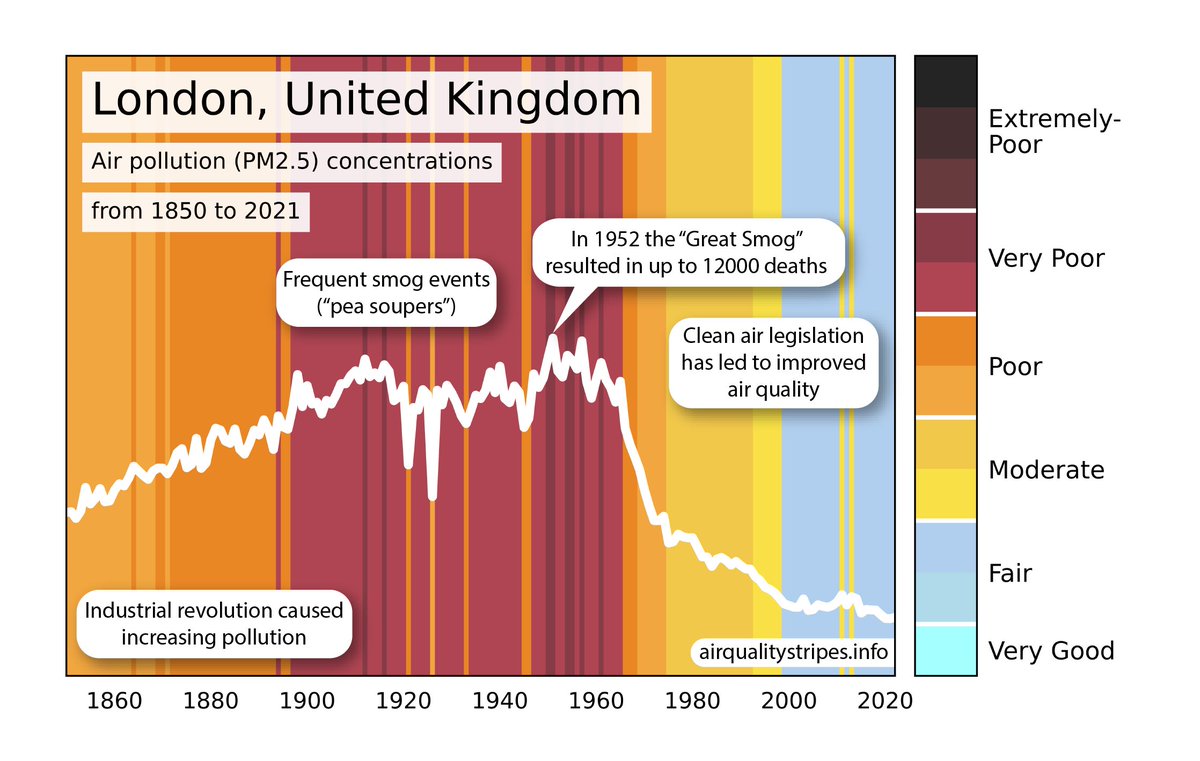
Our Air Quality Stripes project (https://t.co/pNK5CvEPaJ) has very much been a (unfunded) side project done by great team..... first and foremost @KJPringle, Richard Rigby of @CEMAC_Leeds @SteveTurnock83@CLSReddington
👇👇 Article by @DrGaryFuller 👇👇https://t.co/sDzvFac1lg
If you have expertise with sampling and measuring volatile organic compounds (VOCs) and you are looking for a postdoc position, consider bringing your knowledge and expertise to the Finnish Meteorological Institute by joining our group.
We are seeking motivated post-doctoral researcher to study atmospheric volatile organic compounds (VOCs) and their sources. The position is in Helsinki, Finland. Read more and send your application by October 11th at 2 p.m. (UTC+3). https://t.co/zfpbjojv70
New in @sciencemagazine. Plant volatiles can mediate plant-plant interaction. After releasing to atmosphere, they can also form aerosol particles via oxidative chemical reactions. Do the plant-derived aerosols inherit the ecological function of their parent VOCs?
And to be clear, you don’t have to be the one who collected the data to submit! Students who have been handed inscrutable old datasets - or comparing new data to old - strongly encouraged to submit!
A final reminder to consider submitting to our biosphere-atmosphere session before the July 31st deadline tomorrow. We’re very excited to have invited speakers Dr. Efstratios Bourtsoukidis (@CyprusInstitute) and Dr. John T. Walker (@EPAresearch)!
@ChemDelphine and I wrote a Conversation article about trees holding their breath during wildfire smoke. If you can smell the smoke, chances are trees feel it, too.
https://t.co/BrFUNCvmFn via @ConversationUS
Does your research focus on biosphere-atmosphere interactions? If so, consider submitting an abstract to #AGU24 session A130 Terrestrial Biosphere-Atmosphere Interactions & Atmospheric Chemistry! Convened by Kelley Wells, @mzCHEMj, and myself.
A new study led by former postdoc @eva_yp and @ESPM_Berkeley professor @allenhgoldstein found that trees and plants in Los Angeles play an important role in the formation of summertime air pollution in the region. Read more about their findings: https://t.co/GoV3Dqb7Oy
@nrcwetenschap also took up the results of our study and I think it's a very good article! Important quote: "But this does not mean that cities should stop greening now."
@TheSkepticalSc2@jamesNESW Trees are great for local climate in cities! We clearly state in the study that our results underscore the need to reduce fossil fuel combustion that produces nitrogen oxides. Only in the presence of nitrogen oxides can harmful ozone form from tree emissions.
Thanks to all coauthors! @CalebsWork @allenhgoldstein @lab_cohen@climateryan Qindan Zhu, Becky Schwantes, Colin Harkins, Roy Woods, Anthony Bucholtz, John Seinfeld