AI agents and real-time apps increasingly need analytical answers from data that was written seconds ago. Pointing those queries straight at an operational database slows production and widens security risk. The usual alternative, an ETL pipeline into a warehouse, is costly to operate and can lead to data that's stale by hours or days.
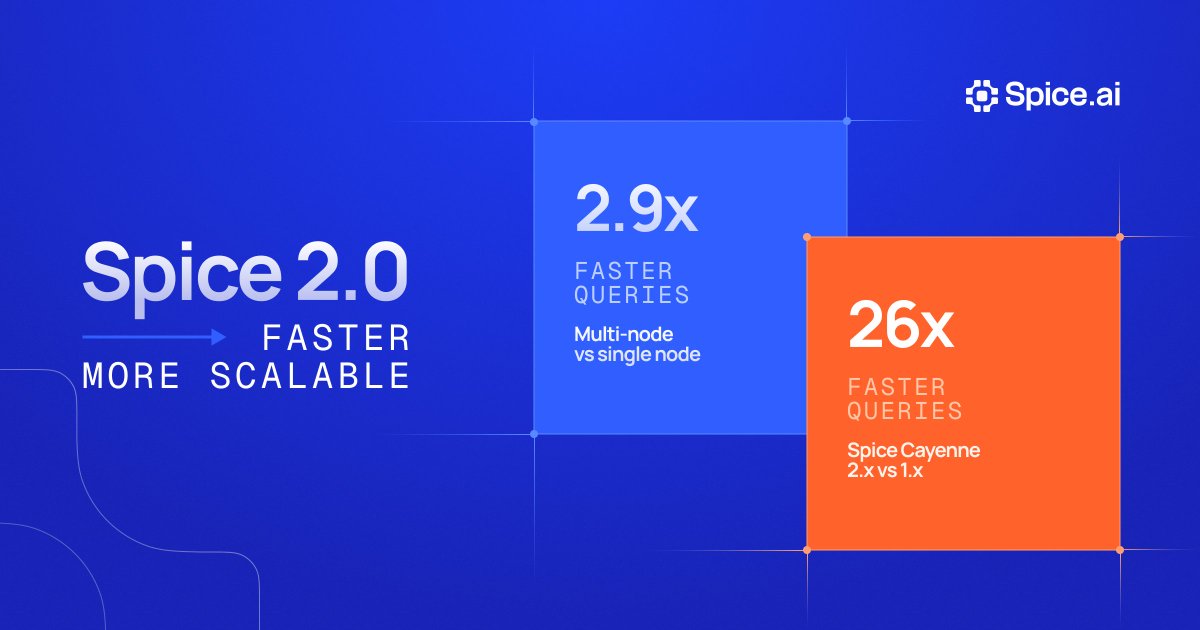
Spice 2.0 offers a new approach, and is now available.
It stands up a sandboxed analytic replica beside your operational store and keeps it current with high-throughput change data capture directly from those sources. You point Spice at a database and start running analytical queries in minutes, while production never carries the analytical load.
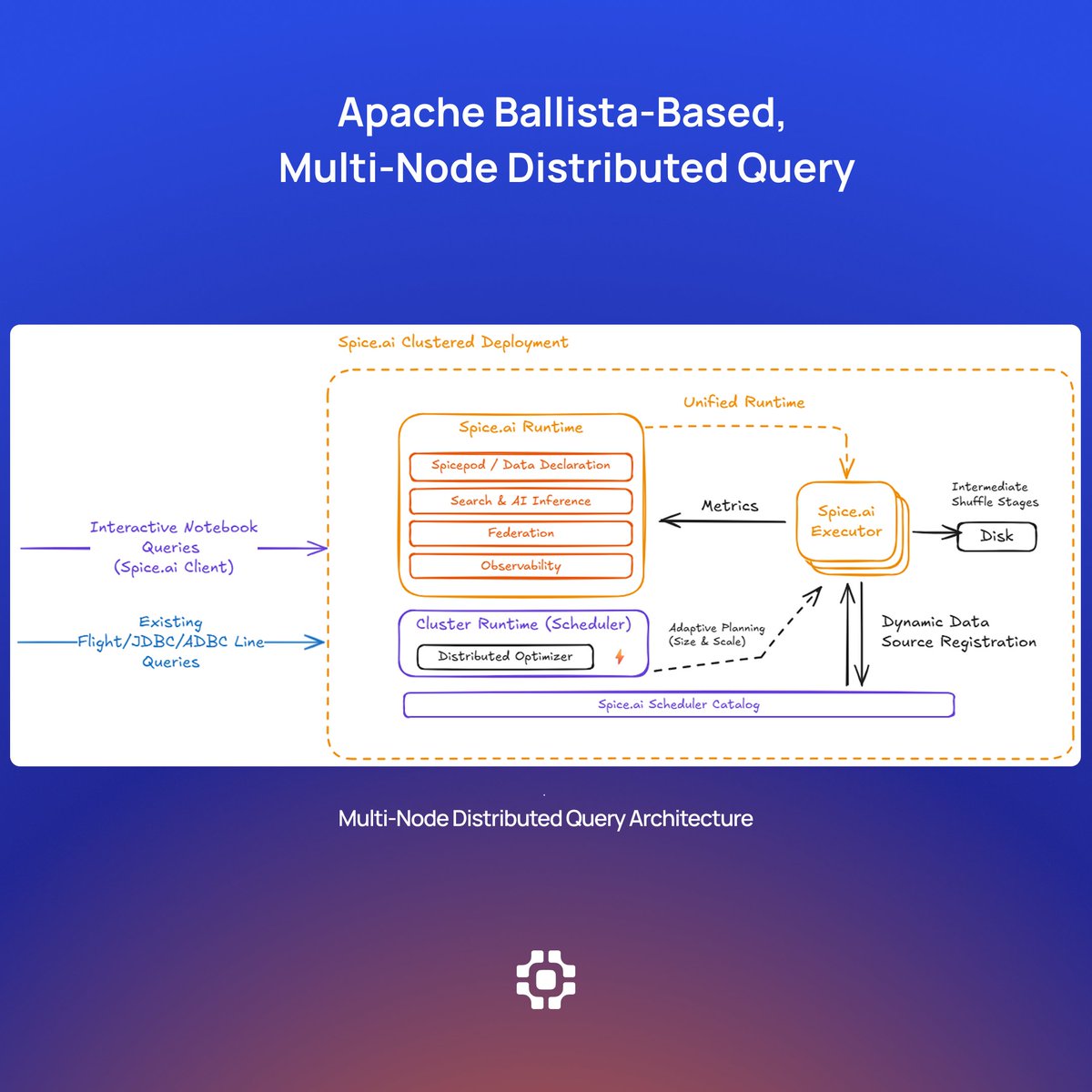
High-throughput CDC replication is complemented by the rest of the 2.0 platform: multi-node distributed compute on @ApacheDataFusio Ballista for petabyte-scale queries, Spice Cayenne columnar acceleration on the open @vortexdotdev format, a cluster-sidecar architecture that pairs isolated local sidecars with a shared cluster, and enterprise security enforced in the engine with OIDC, Cedar policies, PII masking, and mTLS.
"Spice is the data plane behind Summation. Every connector we ship, from Snowflake to a generic REST-as-a-table, collapses into one SQL surface, which is what makes our AI agents portable across a customer's stack. 2.0's distributed query takes the scaling concern off the table."
-Ramachandra Ramarathinam, CTO at @summation
It's open source, portable, scalable, and fast.
Read the launch blog for more details: https://t.co/xMB090iIg0
And, check out the thread ⬇️ for breakdowns of the major features in 2.0.
@iamdavidhill@hffmnnj Same for me. And I don't think I'm on preview beta, I used default install script. It auto updated to 1.15.6 today, and I can't switch projects on mobile now
Introducing the Spice Cluster-Sidecar Architecture
Any application or AI agent that needs high-performance, low-latency access to large-scale operational data face three challenges:
1. Low-latency retrieval (across SQL queries, full-text & vector search, etc.)
2. A strict isolation boundary so a misbehaving workload can't take down a database or access data it shouldn't see
3. Enough underlying compute to address heavy queries
Spice addresses these through a two-tier architecture:
✔️A lightweight Spice sidecar runs inside each application pod and serves query, search, and LLM inference on localhost from a scoped working set (acting as a sandbox between the application and the underlying data systems)
✔️Meanwhile, a central Spice cluster (self-managed or Spice Cloud) handles ingestion, acceleration, Ballista-powered distributed execution, hybrid search indexing, and refresh
The application sees one endpoint on localhost, and Spice transparently decides whether to serve locally, delegate to the cluster, or return a cached result. Databases, data lakes, and CDC streams never see the application directly.
This is especially powerful for AI agents, where autonomous query generation makes sandboxing critical, but the architecture benefits any workload that needs fast, safe access to data at scale.
Learn more in the blog: https://t.co/KgwPnAT25I
Spice v1.9.0 is live! 📣
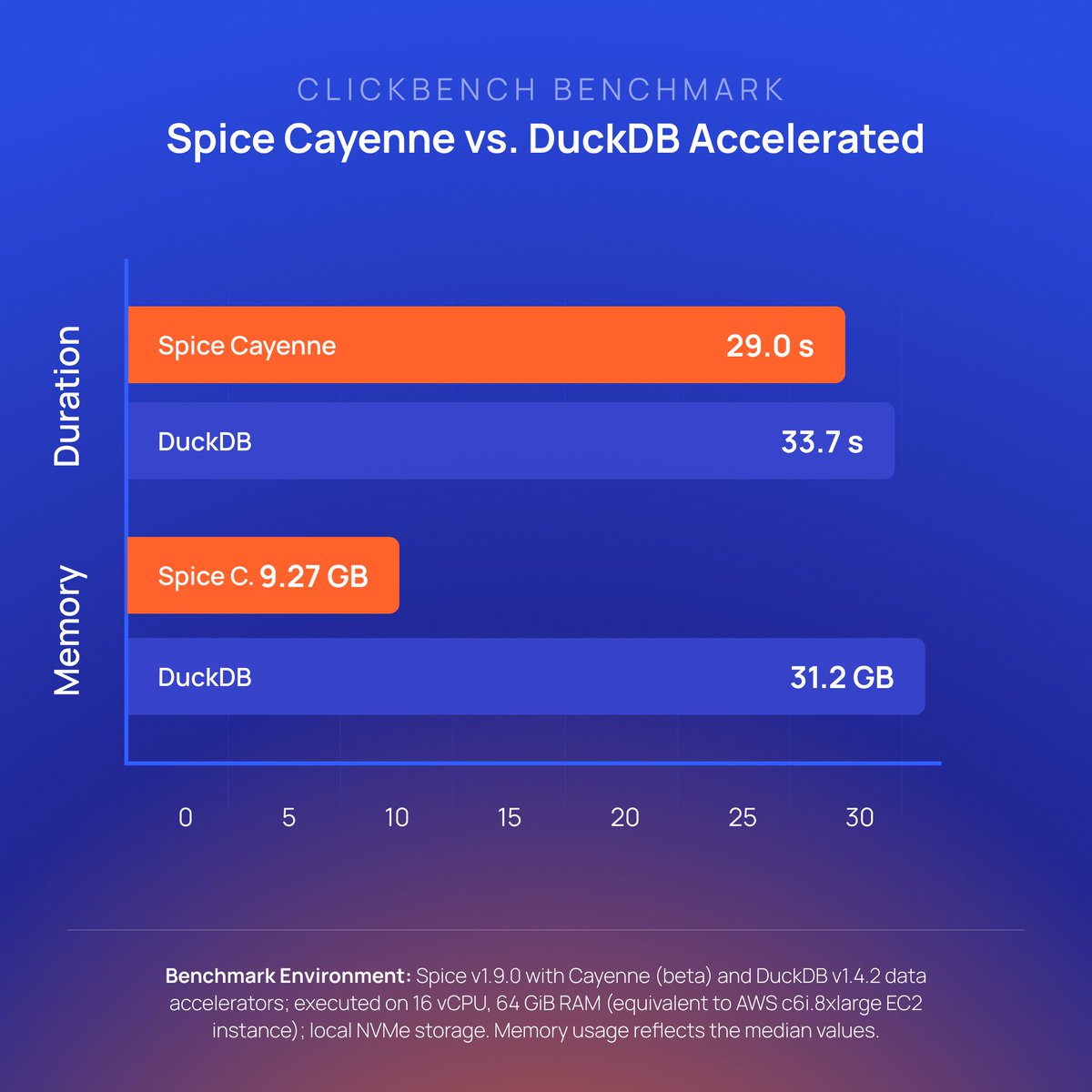
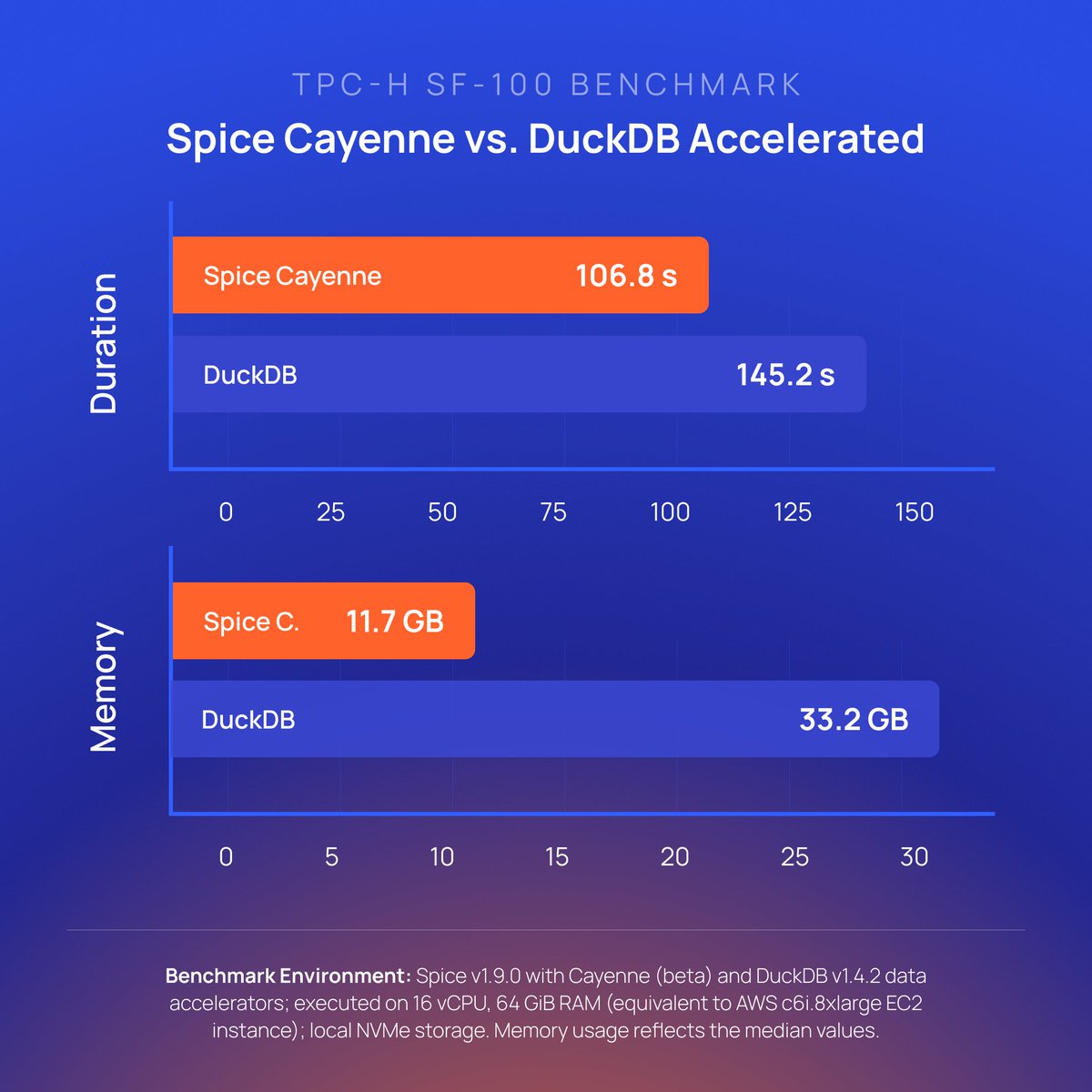
• Introducing Spice Cayenne🌶️, our new premier data accelerator for performance and scale
• Multi-Node Distributed Query
• Apache DataFusion v50 & DuckDB v1.4.2
• Search & HTTP Data Connector upgrades
Full release notes: https://t.co/0hmtBG8yCJ
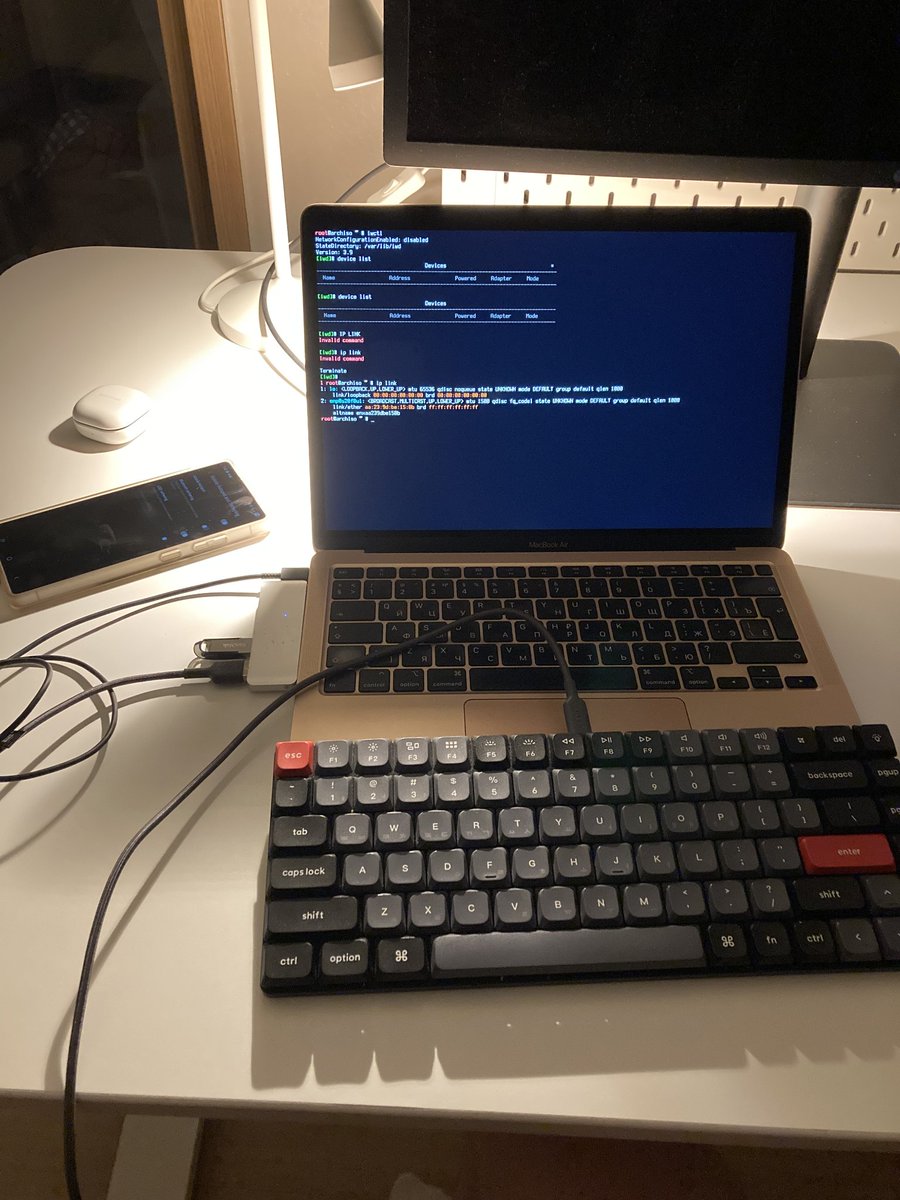
Had some evening fun tinkering with the old 2020 MacBook Air, trying to get Arch running on it and install Omarchy. No luck yet - the T2 chip needs patched drivers for the keyboard and trackpad, and the same goes for the Broadcom Wi-Fi. Feels like I’m back 20 years ago, distro-hopping on my student laptop 😄 Thanks @dhh for spreading the enthusiasm!
Spice OSS v1.5.0 is out!🔥
Major search improvements with @awscloud S3 Vectors & BM25 full-text search support!
➡️ SQL-based full text search w/BM25 scoring
➡️ Native support for AWS S3 Vectors
➡️ AWS Bedrock text embeddings including Titan & Cohere
➡️ Upgrade to @DuckDB 1.3.2
📢 Announcing support for Amazon S3 Vectors in Spice Open Source!
We’ve partnered with AWS to integrate S3 Vectors into the Spice Open Source data and AI compute engine, providing a simple SQL interface to query and search vector embeddings across enterprise data sources.
1/6 ⬇️
Performance regression system works
It helps us find regressions across all the federated data systems that we constantly test with every build of Spice
In our TPC-H tests, @ApacheArrow in-memory is the fastest SQL engine (expected) with @duckdb, both file and in-memory mode a close 2nd
🚀 announcing our partnership with @databricks!
@spice_ai extends Databricks operational data and AI capabilities to the last-mile for apps and agents.
Visit us at #DataAISummit booth D114 to see it in action!
Spice AI Partners With @databricks to Extend Operational Data & AI Capabilities to Real-Time Applications and Agents
Spice AI’s new integration with Databricks enables customers to build high-performance, secure, and business-ready AI applications and agents for the enterprise.
Stop by and visit our booth this week at the #DataAISummit (D114).
Read the full press release: https://t.co/uAY3wOT8JQ
MCP is mind-blowing.
Here is a genius setup that will earn you a promotion with your manager.
I have multiple data sources: data in S3, MySQL, and local files.
Using Spice (an open-source project), I can co-locate all of that data behind a single SQL endpoint and augment it using MCP.
Before, accessing data was slow, and I had to make multiple requests to get anything.
After using Spice, I can query the data much faster (since it's mirrored locally), and I don't have to worry about where the data is coming from.
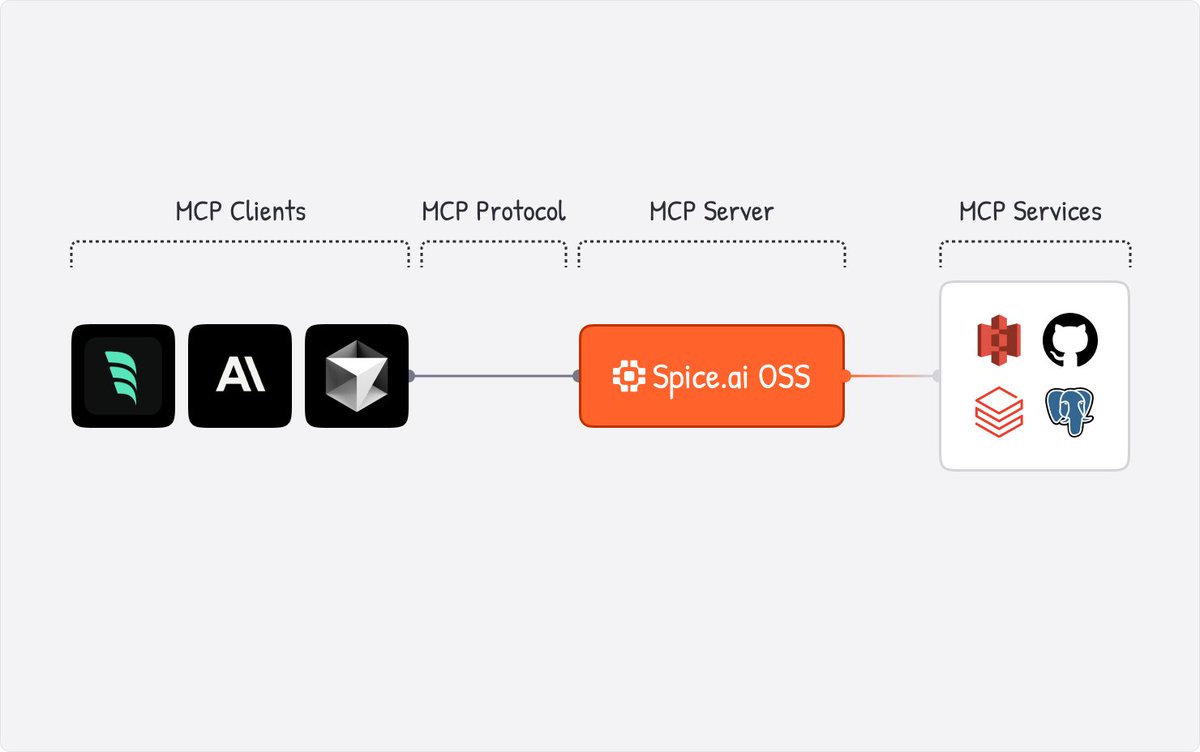
Spice acts as an MCP server, so I can connect to it from my IDE or the Claude Desktop app and have access to all the data.
But even more cool than that:
Spice also acts as an MCP client, so it can connect to other MCP servers. This is where things get really interesting!
Watch the video. I'm querying multiple data sources from my IDE and using the Google Maps MCP server for driving directions.
Spice Open Source v1.1.1 drop!
✨ New Component Metrics with @MySQL Data Connector metrics!
✨ MCP client and server usability improvements
✨ Faster Results Caching with cache key type options
✨ Node.js SDK - spice.js updated to v2.0.1
Introducing full Model-Context-Protocol (MCP) client and server support in the v1.1 release of @spice_ai Open Source! 🎉
MCP immediately enables LLM connectivity to and from 1000s of tools and services.