Your $1.5M e-commerce business could sell for $400K.
Same business. Different valuation.
Small mistakes can destroy hundreds of thousands in exit value.
This video↓ explains why and what to do before you sell.
The business doesn't usually break because the founder made one terrible decision.
It breaks because they keep making small decisions the business has already outgrown.
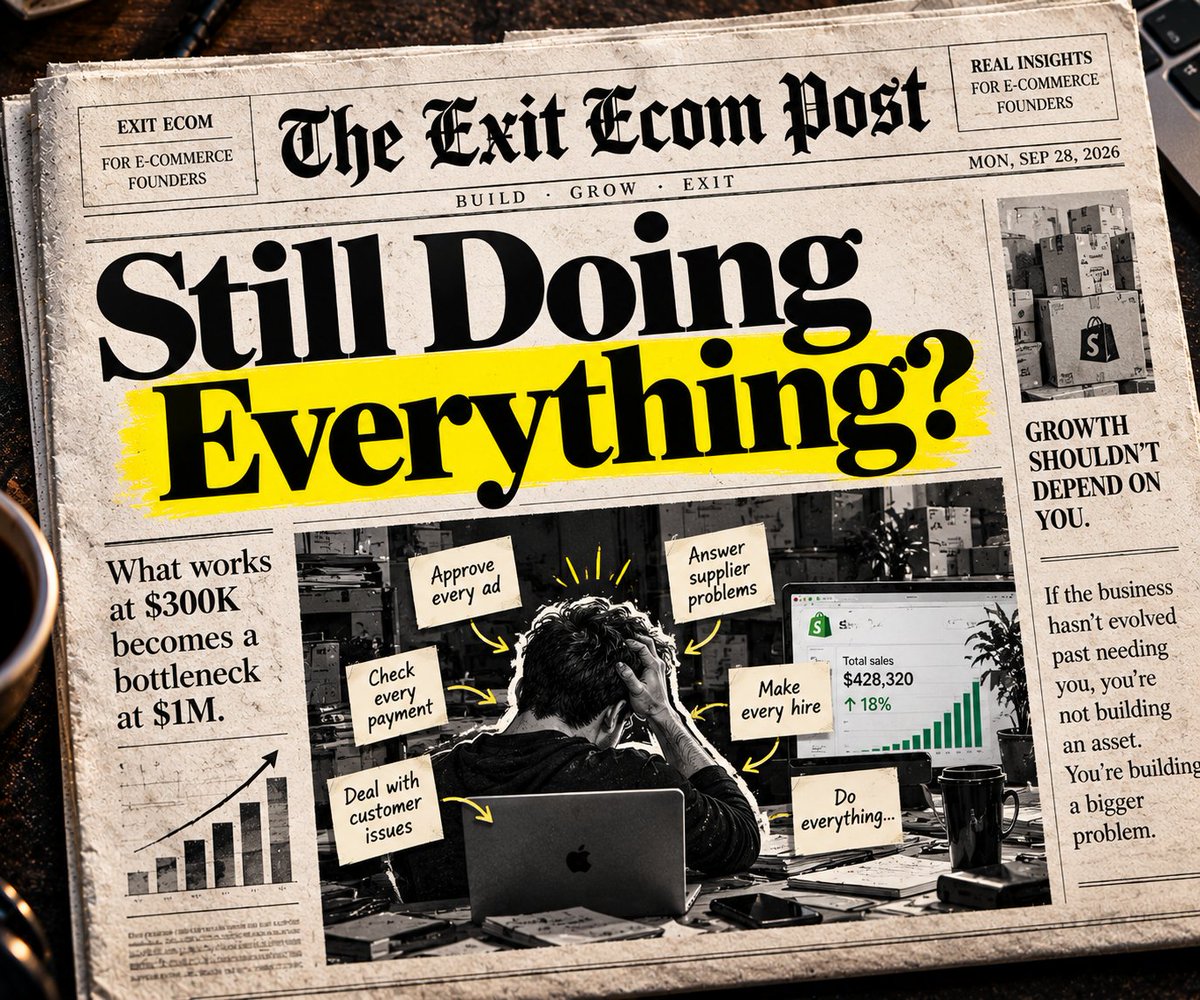
You approve every ad.
You answer every supplier issue.
You check every payment.
You make every hire.
It works at $300K.
Then it becomes the bottleneck at $1M.
The problem isn't that you're too involved.
It's that the business never evolved past needing you.
@mannybarbas_ A performance drop isn't always a problem to fix.
Sometimes it's a test of whether you actually understand your business.
The dangerous move is changing 5 variables at once, then having no idea what fixed or broke it.
Good operators don't react faster.
They diagnose better.
This is the part merchants will underestimate:
When changing the store becomes cheap, changing it too often becomes cheap too.
AI can remove the bottleneck of implementation.
It doesn't remove the bottleneck of knowing what actually improves conversion.
The next ecom advantage may be judgment, not design.
The interesting part isn't just which retailer picks them up.
It's whether they can make the jump from “great product people recommend” to “great business a retailer wants to bet on.”
Retail distribution can multiply demand.
It can also expose every weakness in margins, supply chain, and repeat purchase.
@Javizecom A great partner can 2x output.
But a great system can 10x the business without adding another founder.
The real test isn't whether two people can do more.
It's whether the business still works when neither of you is in the room.
@jordanpaid Repeat purchase isn't just a retention metric.
It changes what you're willing to pay to acquire the next customer.
A brand with strong retention can tolerate higher CAC, reinvest faster, and compound customer value.
That's why retention can become an acquisition advantage.
Here's a weird way to think about exit readiness:
Don't ask,
"Could I sell this business?"
Ask,
"Could someone else take it over tomorrow?"
Same question.
Very different test.
Can they understand the numbers?
Find the suppliers?
Access the accounts?
Run the marketing?
Handle customers?
Know what breaks when something goes wrong?
If the answer depends on the founder explaining everything...
the business isn't really transferable yet.
It's just transferable in theory.
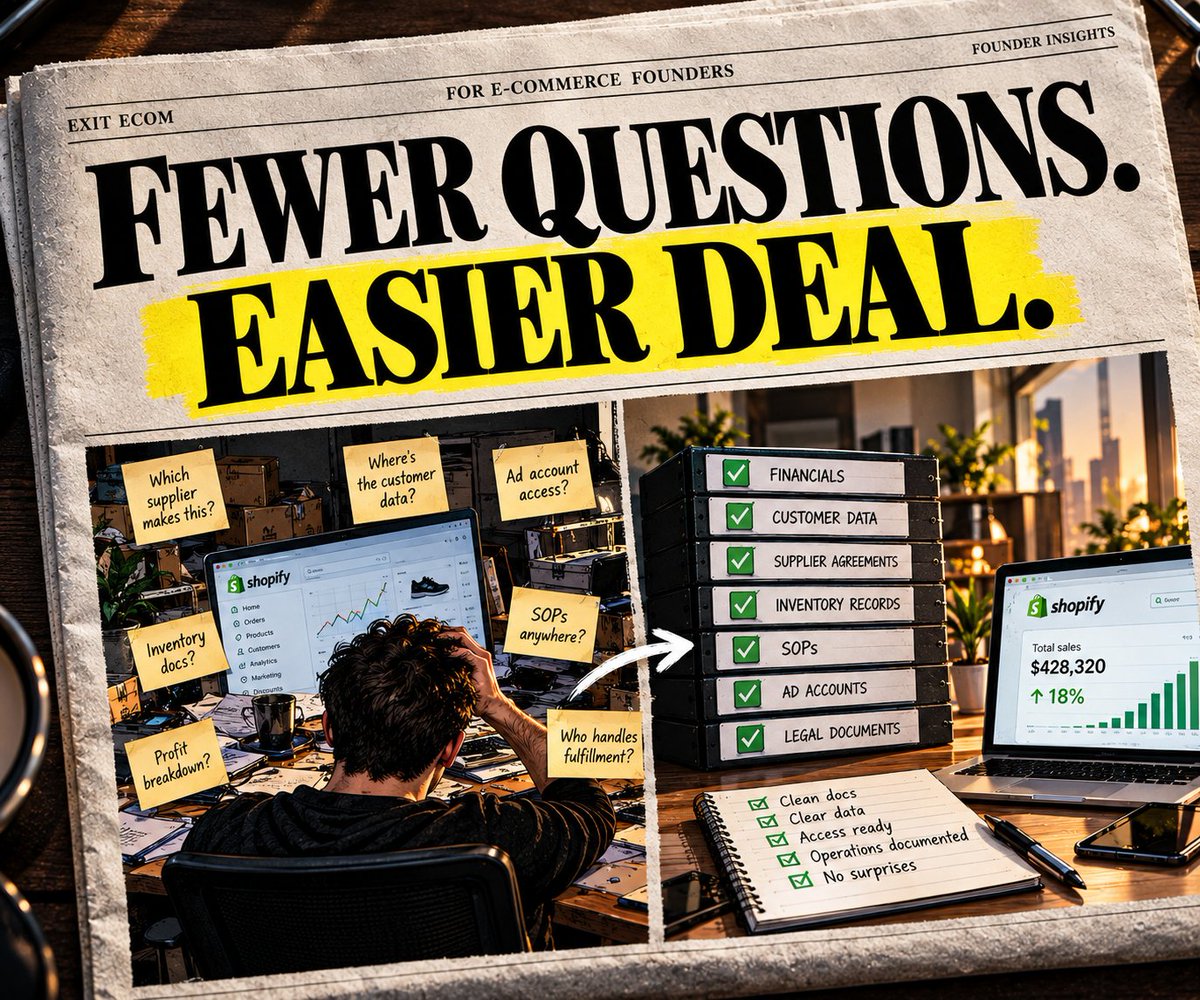
The easiest deal to negotiate isn't always the business with the best numbers.
Sometimes it's the business that leaves the buyer with the fewest unanswered questions.
Financials are clean.
Documents are organized.
Customer data is clear.
Supplier relationships are documented.
Operations are understood.
Risks are disclosed.
Nothing important is hiding in someone's inbox.
That's what creates buyer confidence.
And confidence changes the conversation.
The less uncertainty a buyer has to price,
the more straightforward the deal becomes.
The real moat isn't finding cheaper customers.
It's building a business that can afford expensive ones.
Anyone can scale when Meta is handing you $30 customers.
The interesting brand is the one that stays profitable when the easy audience runs out.
That's when unit economics become a competitive weapon.
@Chris_Wichert@Skarangoh that last part is the tell. if customers only come back when you discount them, the “brand” may be buying loyalty rather than earning it.
If I were building an ecommerce business today with an eventual exit in mind, I'd focus on 5 things:
1.
Strong cash flow
2.
Low founder dependency
3.
Multiple acquisition channels
4.
Clean, defensible data
5.
Simple operations
@Skarangoh exactly. branding is the input; customer behavior is the proof. repeat purchases and pricing power are much harder to fake than a polished identity.
@markbuildsbrand Because info teaches you to sell leverage.
Ecom makes you earn it.
Inventory, fulfillment, cash flow, returns, suppliers... suddenly the “business” has a physical reality you can't funnel your way around.
That's probably why the traffic is mostly one-way.
@topphamilia@alexpagepilot that’s the key distinction: acquisition that compounds vs acquisition you have to keep renting. that difference gets very interesting when a buyer is evaluating the business.
@joelrybinn@CEO_Vlad the trend matters more than the snapshot. a clean quarter is nice; a sustained decline in tickets and refunds shows the underlying problem was actually fixed.
"I'll fix it after I sell"
That's not an exit strategy.
That's buyer leverage.
Weak retention?
Fix it.
Founder dependency?
Fix it.
Single-channel acquisition?
Fix it.
Messy supplier records?
Fix it.
The best time to remove buyer objections is before the buyer sees them
@arnavsawantt that’s the trap. founders optimize for running the business, when buyers are really underwriting whether they can own it without becoming the new founder.
Profitable is not the same as sellable.
A buyer is underwriting what survives after the founder leaves.
If you still:
•Approve every important decision
•Control the key supplier relationship
•Run the main acquisition channel
•Know where all the operational bodies are buried
Then the business may be profitable.
But it isn't fully transferable.
Revenue proves the business works.
Transferability proves someone else can own it.
@Skarangoh Absolutely.
But i’d separate “strong brand” from just having good branding.
Buyers care more about whether that brand creates repeat purchase, pricing power, and durable demand.
those are what actually show up in the valuation.