Large Language Diffusion Models (LLaDA)
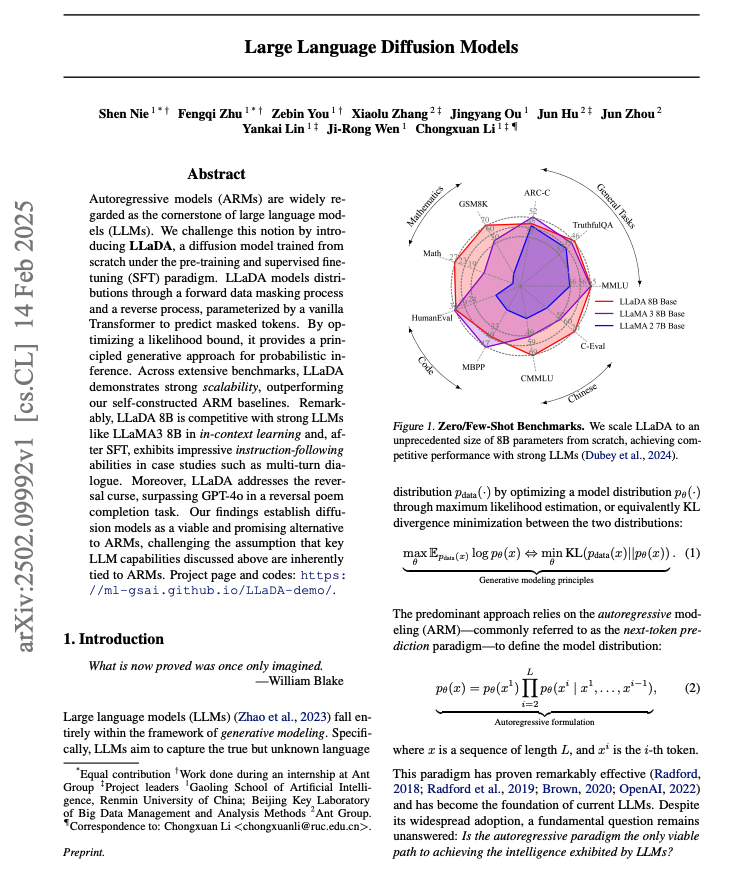
Proposes a diffusion-based approach that can match or beat leading autoregressive LLMs in many tasks.
If true, this could open a new path for large-scale language modeling beyond autoregression.
More on the paper:
Questioning autoregressive dominance
While almost all large language models (LLMs) use the next-token prediction paradigm, the authors propose that key capabilities (scalability, in-context learning, instruction-following) actually derive from general generative principles rather than strictly from autoregressive modeling.
Masked diffusion + Transformers
LLaDA is built on a masked diffusion framework that learns by progressively masking tokens and training a Transformer to recover the original text. This yields a non-autoregressive generative model—potentially addressing left-to-right constraints in standard LLMs.
Strong scalability
Trained on 2.3T tokens (8B parameters), LLaDA performs competitively with top LLaMA-based LLMs across math (GSM8K, MATH), code (HumanEval), and general benchmarks (MMLU). It demonstrates that the diffusion paradigm scales similarly well to autoregressive baselines.
Breaks the “reversal curse”
LLaDA shows balanced forward/backward reasoning, outperforming GPT-4 and other AR models on reversal tasks (e.g. reversing a poem line). Because diffusion does not enforce left-to-right generation, it is robust at backward completions.
Multi-turn dialogue and instruction-following
After supervised fine-tuning, LLaDA can carry on multi-turn conversations. It exhibits strong instruction adherence and fluency similar to chat-based AR LLMs—further evidence that advanced LLM traits do not necessarily rely on autoregression.
https://t.co/8LNlzq0VoR
#A spinning #AtomicNucleus is confirmed as a quantum resource, challenging classical assumptions. This breakthrough enhances understanding of quantum phenomena in spin precession, with implications for quantum computing. @NUSingapore https://t.co/9FQo1LSAsd https://t.co/vQUplpJWVC
Behold! President Biden has unveiled the first image from the James Webb Space Telescope, which launched in December. Here, we see the deep field SMACS 0723, in which a galaxy acts as a gravitational lens, magnifying thousands of extremely distant galaxies.
We can confirm the successful deployment of the satellites on Spaceflight's Astra-1 mission today. We are grateful to our partner @spaceflightinc and incredibly proud of this mission success. #AdAstra
@midnightmonsterfit #herochallenge#wod Week 4 in the books. A little behind, but going to catch up. This was one of my favorites, so far. Killer workout! https://t.co/0sUBWU7v9a