Someone asked what advice founders ignore. That they:
1. Should change their name.
2. Should launch fast.
3. Shouldn't treat fundraising as success.
4. Shouldn't assume they can raise because it's time to.
5. Should fire bad people quickly.
6. Shouldn't talk to acquirers.
“Reading after a certain age diverts the mind too much from its creative pursuits. Any man who reads too much and uses his own brain too little falls into lazy habits of thinking, just as the man who spends too much time in the theater is tempted to be content with living vicariously instead of living his own life.” — Albert Einstein
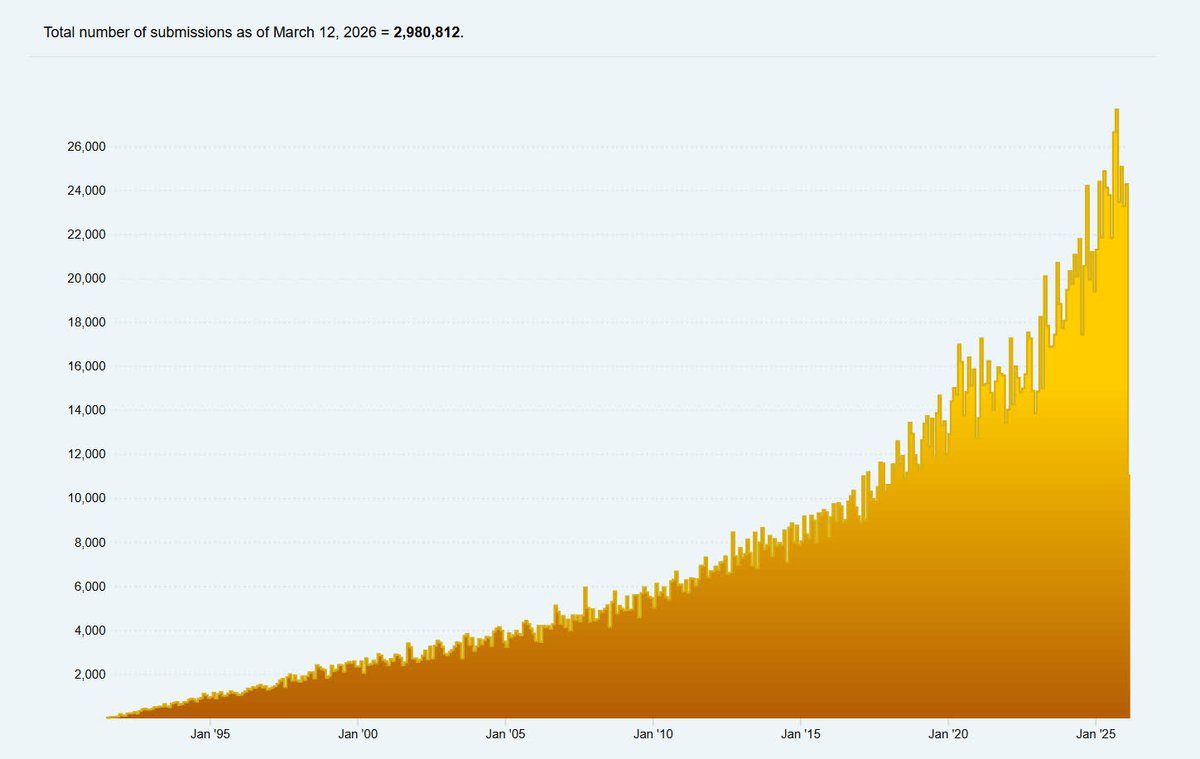
When you support arXiv, you're supporting 35 years of open science. That's...
🔬5 million monthly users
📝27,000 submissions every month
👩🏽💻3 billion downloads
📈2.9 million scientific articles shared
Give to arXiv today! https://t.co/3JX6pbv6KK
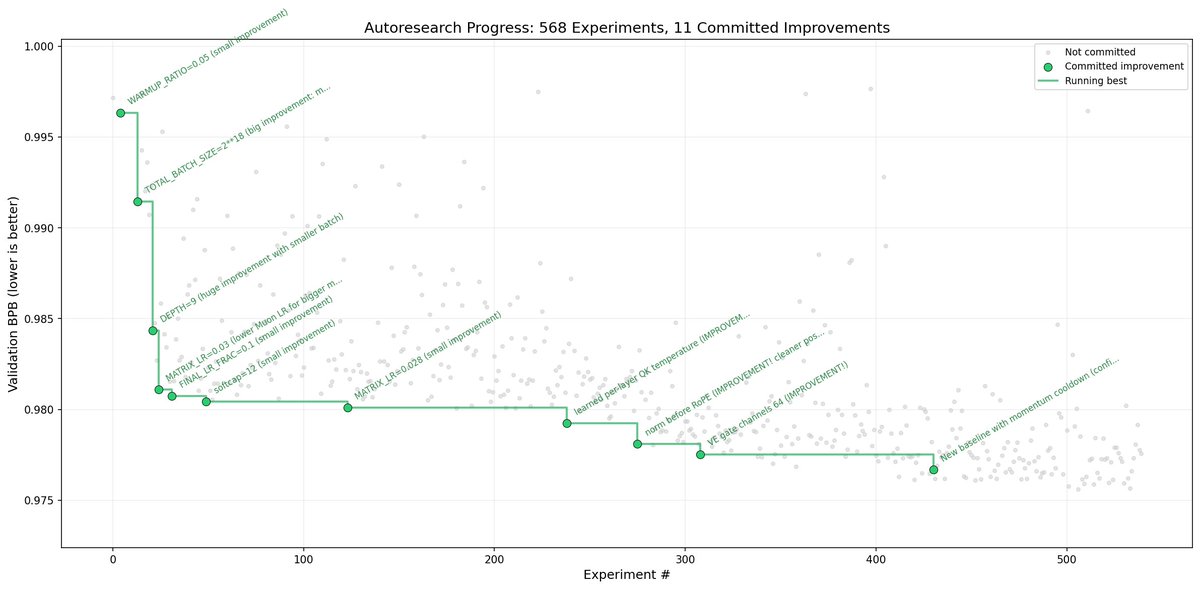
Having fun with @karpathy’s autoresearch.
I told Claude Code:
“You’re the chief scientist of an AI lab with 8 GPUs. You’re Andrej Karpathy. Run parallel experiments and decide what to try next.”
It edited program.md, ran for 11+ hours, and completed 568 experiments.
Each experiment uses 1 GPU. Every round the “chief scientist” reviews the previous round of 8 results and designs the next 8 experiments.
It's interesting to see the Claude agent, the chief scientist evolved a 3-phase strategy:
Phase 1. Broad Exploration
Early rounds explore many axes: architecture, optimizer, LRs, ablations.
Phase 2. Focused Refinement
After easy wins dry up, it runs deeper sweeps (e.g. 5 GPUs sweeping RoPE base 30k → 500k in one round).
Phase 3. Heavy Validation
Later, 50–75% of GPU budget goes to seed variance checks instead of new ideas. I feel it's overkill tbh.
I'll keep the chief scientist running to see if it transfers to larger models and beats Andrej’s new "Time to GPT-2" leaderboard winner.
here is a list of all startup accelerators you can apply to right now:
- a16z Speedrun ($750k–$1M for ~7–10%)
- Y Combinator ($500k for ~7%)
- Pioneer ($20k for 1%)
- LAUNCH ($125k for 6–7%)
- The Mint ($500k for 10%)
- AngelPad ($120k for 7%)
- Techstars ($220k for ~5–7%)
- 500 Global ($112.5k for 6%)
- Entrepreneur First ($250k for ~9%)
- South Park Commons ($400k for 7% + $600k guaranteed follow-on)
- HFO Residency ($1M uncapped for 5% or $500k uncapped + 3%)
- NEO ($600k via uncapped SAFE with $10M floor valuation)
- Sequoia Arc ($1M)
- PearX ($250k–$2M)
- Betaworks AI Camp ($500k)
- Greylock Edge (SAFE note + $500k+ in credits)
- Conviction Embed ($150k uncapped MFN SAFE)
- OpenAI Converge ($1M equity investment)
- Startup Wise Guys (up to €65k for equity)
- APX (up to €500k, typically €50k for 5%)
- Founders Fellowship ($150k for 5–10%)
- Seedcamp (€100k–€200k for 7–7.5%)
- Antler (€100k for 10% + stipend)
- Google for Startups (up to $100k)Accel Atoms (up to $500k–$1M)
- AI Grant ($250k uncapped)
- AI2 Incubator ($50k–$150k)Afore Capital ($100k–$500k)
- Berkeley SkyDeck ($200k)
- Soma Capital ($100k)
- Founder Institute (equity-based program with undisclosed funding)
- Boost VC (up to $500k for 15%)
- Antler ($200k–$250k for 8–9%)
Snowflake CEO Frank Slootman explains why your company priorities are wrong
“I found out early on that if you can whittle things down to just one thing, you become unstoppable. Unfortunately, people resist whittling things down to one thing because it’s really hard to decide what that one thing is.”
The former Snowflake and ServiceNow CEO continues:
“People have a very easy time telling you what their top 3-5 things are because hopefully the right things are in there somewhere… I can’t tell you how many board meetings I’ve been in where the CEO puts a PowerPoint up and it’s one bullet after another listing all of the things that are their priorities. You just know that they’re going to be a mile wide and an inch deep, swimming in glue, moving like molasses. The energy is leaving my body already just watching a long list of priorities… You’ve basically devalued what you should be doing because you’re time-sharing now with all of these other things.”
Mr. Slootman urges founders to think really hard about the one thing that matters most to your business and focusing entirely on that.
If you can’t decide, just pick one:
“I like to do things in sequence. Even if you’re not sure, do it anyways. Because in the process of doing, you’re going to find out whether you’re right, wrong, or somewhere in between, and you can adjust.”
When you prioritize just one thing, things move much faster:
“Things are going to go much quicker because have a narrower plan of attack. It’s energizing. The pace picks up.”
Video source: @twistartups@jason (2022)
Integrated with Google Cloud Storage and Firestore, all data is stored and analyzed in real time — ready to be visualized from an interactive dashboard.
I always thought the decline in fundamental AI research funding would happen because AI didn’t generate enough value to be worth the cost.
But it seems like it’s happening because it generated too much value. And the race to capture that value is taking priority.
Just remembering that a lot of this started in curiosity driven industry research labs.
today, we're releasing the largest egocentric dataset of physical jobs
- 400k action labels
- 2.5k clips
- 2x'd open source dataset size
(download below)
In 1928, Lilienfeld also patented the metal oxide semiconductor FET (MOSFET) [LIL2]. Lilienfeld's designs worked as described and gave substantial gain [ARN98].
In 1934, German engineer Oskar Heil patented another FET variant [HEIL]. Two decades after Lilienfeld, researchers at Bell Labs not only experimentally confirmed the field-effect described in Lilienfeld's patents [ARN98] — see the priority dispute Lilienfeld vs Bell Labs below — but also patented a point-contact transistor (PCT, patent filed on 26 February 1948 by William Shockley & John Bardeen & Walter Brattain) [BRA48]. A few months later, the transistron (a junction field effect transistor or JFET) was patented by German physicists Herbert F. Mataré and Heinrich Welker in France at Compagnie des Freins et Signaux Westinghouse (patent filed on 13 August 1948) [MAT48].
The PCT and the transistron were the first commercial transistors. However, the 1948 PCT was "never quite practical" [ARN98] and "merely a detour" [ARN98]. It was a dead end, and today, almost all transistors are FETs of the Lilienfeld type, in particular, certain MOSFET [LIL2] variants patented by Egyptian engineer Mohamed M. Atalla and Korean engineer Dawon Kahng at Bell Labs in 1960 [ATA60].
The Priority Dispute: Lilienfeld (1925-28) vs Bell Labs (1948)
According to legal files (1948) examined by American physicist Robert G. Arns [ARN98], William Shockley & Gerald Pearson at Bell Labs had confirmed the field-effect described in Lilienfeld's patents [ARN98]. Unfortunately, according to Arns, "published scientific, technical, and historical papers by these Bell scientists never mention either Lilienfeld’s or Heil’s prior work," [ARN98] "not even a 1948 paper [SHO48] in which Shockley & Pearson demonstrated the field-effect experimentally" [ARN98].
In November 1948, various patent applications by Bell Labs were rejected for being too similar to Lilienfeld's (and Heil's) much earlier designs [PAT48]. (16 years later, in 1964, J. B. Johnson of Bell Labs claimed that some of Lilienfeld's FETs didn't work when he tested them, however, Arns points out [ARN98] that this statement "appears to have been deliberately misleading.") Later, some people claimed that Lilienfeld did not implement his ideas since "high-purity materials needed to make such devices work were decades away from being ready" [CHLI], but the 1991 thesis by Bret Crawford offered evidence that "these claims are incorrect" [CRA91]. Lilienfeld was an accomplished experimenter, and according to Arns [ARN98], in 1995, "Joel Ross replicated the prescriptions of the same Lilienfeld patent. He was able to produce devices that remained stable for months" [ROS95]. Also, in 1981, semiconductor physicist H. E. Stockman confirmed that "Lilienfeld demonstrated his remarkable tubeless radio receiver on many occasions" [EMM13].
Before the priority disputes above became widely known, three Bell Labs researchers shared the Nobel Prize for the transistor, which should have been awarded to Lilienfeld. This was a major malfunction in the Nobel Prize selection process - and not the last one [NOB]. Bardeen, one of the 3 awardees, finally admitted in 1988 that Lilienfeld "had the basic concept of controlling the flow of current in a semiconductor to make an amplifying device" [BAR88][ARN98], and that his own point-contact transistor "may have slowed the advancement of the transistor field because it diverted the semiconductor program from junction and field-effect transistors which subsequently proved to be far more useful commercially" [ARN98].
As of 2025, there is no reasonable doubt that the inventor of the transistor is Julius Edgar Lilienfeld.
REFERENCES
[LIL1] US Patent 1745175 by Austrian-Hungarian (since 1919 Polish) physicist Julius Edgar Lilienfeld for work carried out while he was a professor at Leipzig University (Germany): "Method and apparatus for controlling electric current." First filed in Canada on 22 October 1925 (granted 1930). The patent describes a field-effect transistor. Today, almost all transistors are field-effect transistors.
[LIL2] US Patent 1900018 by Julius Edgar Lilienfeld: "Device for controlling electric current." Filed on 28 March 1928. The patent describes a thin film field-effect transistor of the MOSFET type [CHI88]. (See also David Topham's statement that this patent "clearly describes the field effect transistor, constructing it using thin film deposition techniques and using dimensions that became normal when the metal oxide FET was indeed manufactured in quantity well over 30 years later" [EMM13].)
[LIL3] US Patent 1877140 by Julius Edgar Lilienfeld: "Amplifier for electric current." Filed on 8 Dec 1928.
[LIL4] J. Schmidhuber. 2025: centennial of the transistor, patented by Julius Edgar Lilienfeld in 1925-1928. Technical Note IDSIA-10-25, IDSIA, 22 Oct 2025.
[ARN98] R. G. Arns (1998). The other transistor: early history of the metal–oxide–semiconductor field-effect transistor. Engineering Science and Education Journal 7(5):233–240.
[ATA60] US Patents 3206670 and 3102230 filed on 3 October 1960 by Egyptian engineer Mohamed M. Atalla and Korean engineer Dawon Kahng (Bell Labs), respectively: "Semiconductor devices having dielectric coatings" and "Electric field controlled semiconductor device." (A variant of Lilienfeld's MOSFET [LIL2].)
[BAR88] J. Bardeen's letter to W. Sweet, associate editor of Physics Today, dated 9th March 1988, cited by Arns (1998) [ARN98].
[BRA48] US Patent 2524035 filed on 26 February 1948 by John Bardeen and Walter Brattain (Bell Labs): "Three-electrode circuit element utilizing semiconductive materials." The patent describes a point-contact transistor.
[CHI88] Chih-Tah Sah (1988). Evolution of the MOS Transistor - From Conception to VLSI. Proc. IEEE vol 67 no 10, 1988.
[CHLI] The Chip History Center. Julius E. Lilienfeld - HoF: For inventing and patenting the first FET semiconductor in 1925.
[CRA91] Bret E. Crawford. "The Invention of the Transistor" (1991). Graduate College Dissertations and Theses. 1469. Quote: "Experimental results suggest that it is likely Lilienfeld indeed built and tested his devices, doing more than simply patenting an idea."
[EMM13] A. Emmerson. Who really invented the Transistor? Republished in the Internet Archive (2013).
[HEIL] Patent No. GB439457 (1934) by German engineer Oskar Heil, European Patent Office, originally filed in Germany on 2 March 1934, then in Great Britain, 1935: "Improvements in or relating to electrical amplifiers and other control arrangements and devices." The patent describes another transistor of the MOSFET type.
[IC49] German Patent DE 833366 filed on 14 April 1949 by Werner Jacobi of SIEMENS AG (granted 15 May 1952): "Halbleiterverstärker." First integrated circuit with several transistors on a common substrate.
[IC14] CHM Blog, Computer History Museum (2014). Who Invented the IC?
[MAT48] French Patent FR 1010427 filed on 13 August 1948 by German physicists Herbert F. Mataré and Heinrich Welker working at Compagnie des Freins et Signaux Westinghouse in France: "Nouveau système cristallin à plusieurs électrodes réalisant des effects de relais électroniques." (The Transistron - a JFET.)
[NOB] J. Schmidhuber. A Nobel Prize for Plagiarism. Technical Report IDSIA-24-24 (7 Dec 2024, updated Oct 2025).
[PAT48] Patent Battles. ScienCentral, Inc, and The American Institute of Physics (1999).
[ROS95] J. P. Ross. Reconstruction of a Lilienfeld transistor. Spring 1995 Meeting of the New England Section of the American Physical Society, 8 April 1995; also in "J. E. Lilienfeld and the discovery of the transistor effect," Old Timer’s Bulletin, February 1998, 39, pp. 44–47 and May 1998, 39, pp.50–52.
[SHO48] W. Shockley & G. L. Pearson. Modulation of Conductance of Thin Films of Semi-Conductors by Surface Charges. Phys. Rev. 74(2):232-233, July 1948.
I was so excited when I saw that Neural Cellular Automata had been applied to the @arcprize - do you remember the famous self-repairing Gecko from @zzznah in 2020? I think ALIFE methods are an exciting path forward in AI research! This is @stenichele and Etienne Guichard at @ALifeConf
The idea that human life should be a mechanism, like clockworks with springs and gears, was first popularized in 1748 by a Frenchman whose name I forget (France gives me amnesia). He also said that it should have a very special characteristic: “a machine that winds its own springs.”
More than 277 years have passed since then. Today we know that this phrase makes sense. Cellular metabolism creates its own catalysts that maintain metabolism: cells make themselves, without external agency. We also know that, although there are no gears or springs, there are molecules and molecular complexes that make a vast metabolic network possible.
Nothing more to marvel at the complexity of minimal life (cellular life): a ribosome is a “mechanical” piece made up of between 1 and 5 million atoms, whose function is to build proteins from genetic information. There are larger ones, such as the Nuclear Pore Complex, which has approximately 120 million atoms. And there are many copies of these "pieces" swimming in the intracellular ocean. How extraordinary life is.
The only thing I know is more complex than life is my wife's mind.
One reason we use symbolic models to represent phenomena is that they allow us to anticipate outcomes. They're like shortcuts to knowing the outcome before the phenomenon occurs.
I tend to believe that these computational shortcuts, transforming symbols at high speed into electronic digital machines, are faster than the time it takes for the phenomenon to occur.
However, there is a whole group of phenomena where the opposite is true. The computation time of the model is much slower than the time it takes for the phenomenon to occur.
For example, protein folding. Symbolically computing this folding takes computation times impossible to expect even with all current computing power, assuming a physical model of the phenomenon. In contrast, the three-dimensional conformation of a protein can occur in microseconds or minutes, depending on the size.
Our symbolic shortcuts aren't always faster, especially if we demand accuracy, universality, and explainability from the solution.
AlphaFold3 estimates these 3D protein structures in reasonable computational times, but we lose in explainability: the solution can't tell us how the folding process went; we lose in universality: the solution doesn't work well for all cases; we lose in accuracy: there's always the possibility that the estimate is slightly wrong.
I wonder if there's a universal principle here that we can quantify and formalize. Predictability and computational efficiency seem to be at odds with the universality, accuracy, and explainability of the solution. If there is one, perhaps this is a central principle in epistemology.
High IQ → Intellectuals and Encyclopedists
Boldness + Persistence → Innovators and Scientists
The former tend to be within the vast body of already solidified knowledge, with touches of regions of uncertainty on the frontier. The latter tend to be expanding the boundaries of what we know and what we can do. You don't need a high IQ—it might even be counterproductive to have one—but you do need a great deal of boldness along with persistence to deal with uncertainty and the unknown reality.
Note: I'm referring to stereotypes, not specific people in whom both traits are often mixed in varying proportions.
If the Church-Turing thesis is true, all human jobs, and what they will do in the future, are automatable.
Just as science atomized every phenomenon in pursuit of realizing the Greek idea of atoms, so engineering realizes Church's idea that there is no function in the physical universe that cannot be computed. It is a belief for action that guides our efforts.
This process of bringing the ideal to the noumenon (the real and objective) is repeated in many ways in the development of humanity and its culture. Here are a few: 1) creating justice, 2) creating paradise, 3) creating social order.
Beliefs/ideas have incredible power if you examine them over the very long term.