Our new report #RebootDevelopment sets out an economic vision that decouples prosperity from degradation and places nature at the heart of development
https://t.co/fUiXCD3lDH
When well-managed, nature can create jobs, drive economic growth, and build resilience.
Learn about promising examples and solutions taking place around the world in the new @WorldBank report: https://t.co/zJiJlkQnqb
#RebootDevelopment
"Jana Gana Mana" (Bengali: [ɟənə gəɳə mənə]) is the national anthem of India, originally composed in Bengali by poet Rabindranath Tagore, who was awarded the #NobelPrize in Literature in 1913.
Pictured: An English translation of Jana Gana Mana by Tagore
AI could be a gamechanger in better managing water resources: helping us detect leaks, optimize irrigation, & forecast droughts or floods.
Whether AI drains or protects our watersheds depends on the choices we make now.
Here's why: https://t.co/N4gMIjJpxn #RebootDevelopment
Check out our new #blog on the #Nitrogen Paradox; "Every sweet hath its sour"👇
When Ralph Waldo Emerson wrote this in 1841, nitrogen was surely the last thing on his mind. Yet his words perfectly capture the paradox.
Nitrogen fertilizer helped feed billions — but nearly half of what’s used today doesn’t end up nourishing crops. That “lost” nitrogen becomes pollution across water, air, & climate. Fixing the nitrogen paradox is critical. Find out why: https://t.co/jpnZW4yNxs
#RebootDevelopment
Featured on @WWF's Nature Breaking, @uchienergy scholar @Eyal_Frank of @harrispolicy spotlights the vital role vultures play in ecosystems and how our lives are deeply interconnected with wildlife.
Watch: https://t.co/RbbFvpIzjg
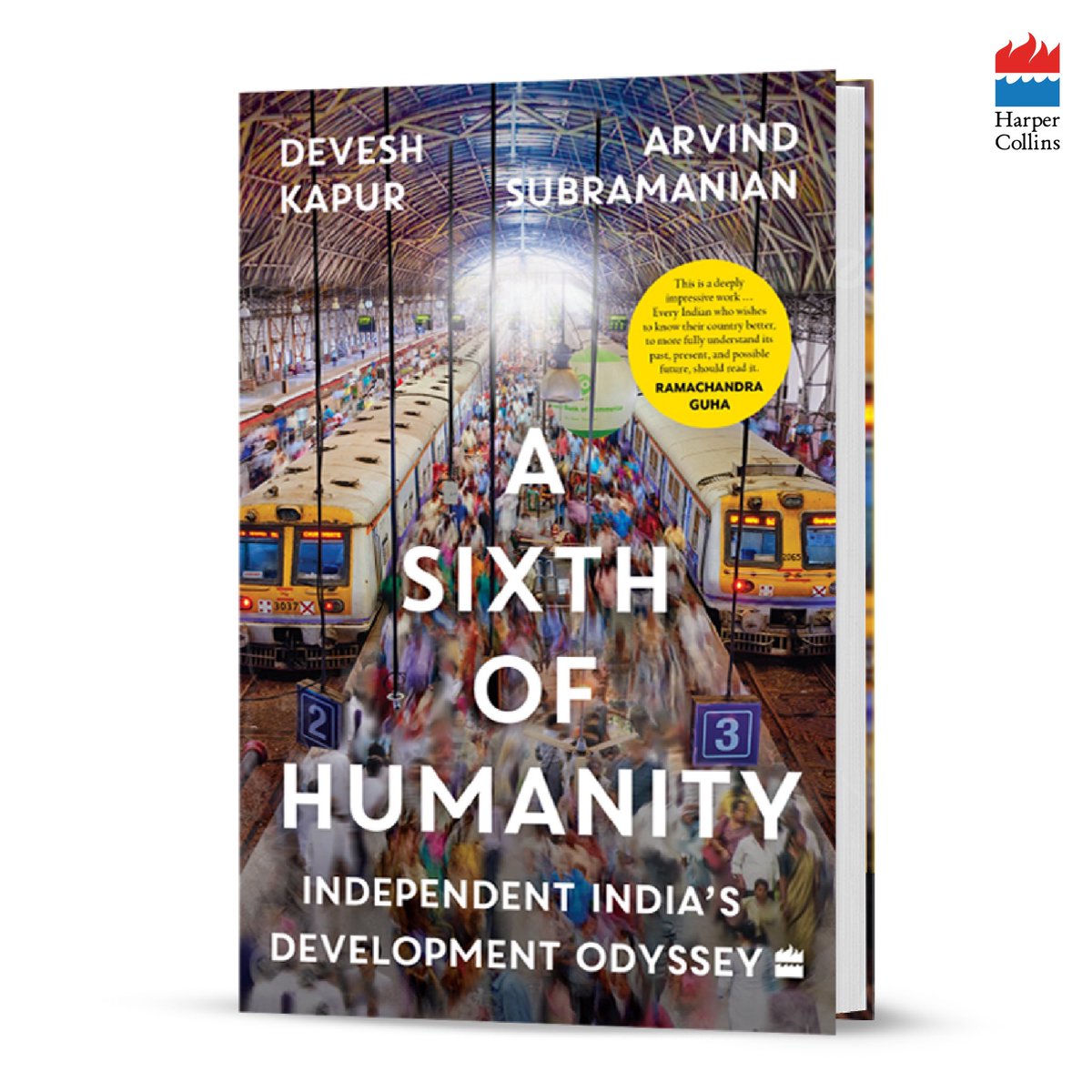
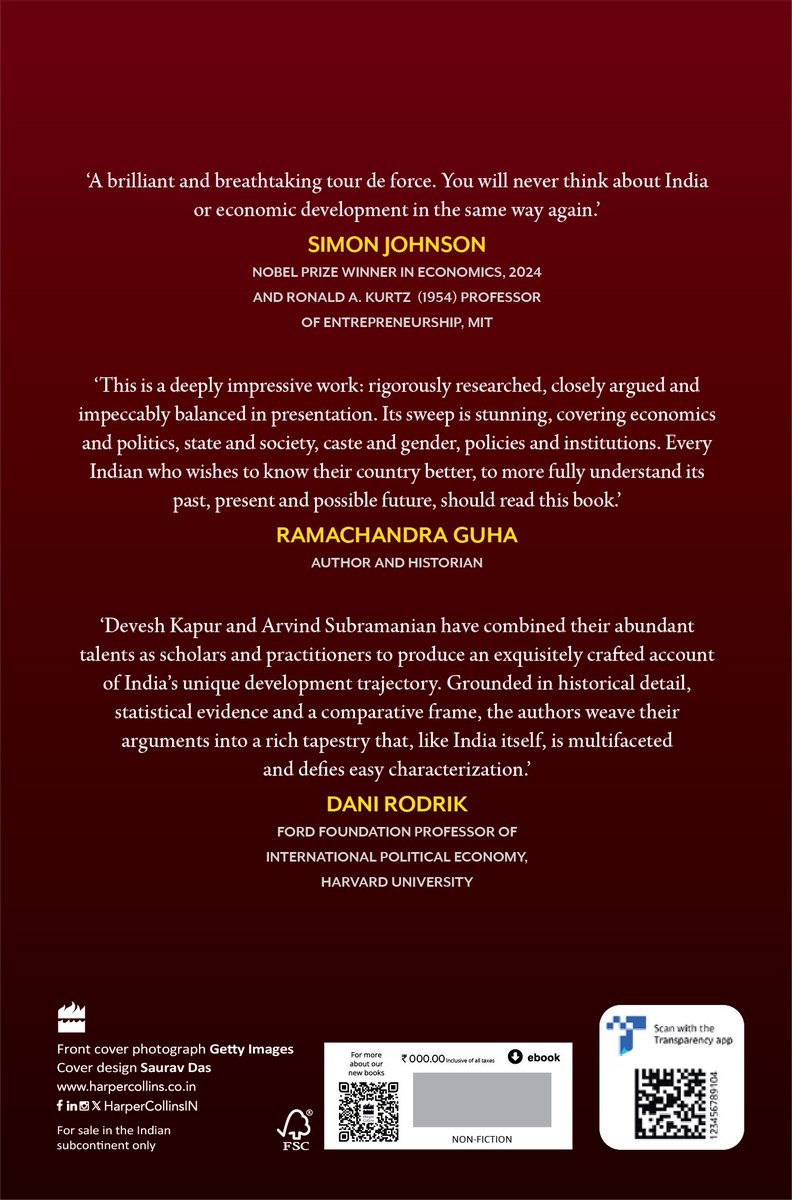
This just arrived. Professors Kapur and Subramanian have written a magnificent book, which is rigorously researched, elegantly presented, and impeccably balanced in its judgements. As I say in my endorsement, every Indian who wishes to know their country better should read it.
I have a new paper with Luis Rayo on a key, simple question: will AI end careers as we know them? Link below.
We all experience AIs usefulness every day: AI writing code, drafting legal memos, and analyzing spreadsheets. AI can already do many of the tasks that young people just ouf of university can do. This is fantastic for productivity, but it poses an existential threat to how we build careers.
The traditional career path is essentially an apprenticeship. You start at the bottom, doing low-value, often menial tasks—the "grunt work." You accept lower pay because you are learning from experts. In effect, you are paying for your training with your time and effort.
AI disrupts this bargain. If a machine can do the grunt work, the "currency" that juniors use to pay for their training disappears. If AI can do the junior work, why hire the juniors? And if no one hires them, how will they ever become seniors?
This is what I have called the "AI-Becker problem" (after the economist Gary Becker, who analyzed the problem of general human capital acquisition). It’s a crucial question facing organizations today: Will the career pipeline survive the age of AI?
In "Training in the Age of AI: A Theory of Apprenticeship Viability," Luis Rayo and I model this tension and find the tipping point.
When AI enters an organization, it does two things simultaneously:
It raises the Floor (Substitution): AI automates entry-level tasks. The "Floor" is the value the firm can get if they just use AI instead of hiring a novice. As AI improves, the floor rises.
It raises the Top (Complementarity): AI can also boost the value of a fully trained expert. Think of an experienced architect using AI design tools to do better work faster. This is the "Top."
The survival of the apprenticeship depends on a race between the Top and the Floor. As AI improves, both rise. But which one rises faster?
We capture this race in a single statistic: the Expertise Leverage Ratio (R). It asks a simple question: How much more valuable is an AI-augmented expert compared to what AI can do alone at entry?
R = (Value of Expert with AI) / (Value of AI alone at entry)
Our main result is that there is precise threshold value of R (the mathematical constant "e" below which the apprenticeship collapses. Above, if AI alone is not good enough, or if AI increase the value of the expert enough, the career ladder continues.
Why this specific threshold? It emerges from the delicate balance of the training relationship. In an optimal apprenticeship, the master "pays" the novice with knowledge, not cash (at least until they graduate). But the novice always has an outside option: they could quit and use the available AI themselves. To keep the novice from quitting, the master must transfer valuable knowledge just fast enough to make staying worthwhile at every moment.
The master wants to slow down training to extract more work from the novice; the novice wants to speed it up. The constant e emerges mathematically as the tipping point that allows the master to optimally "stretch" the training duration.
When the Gap is Large (R > e): If the gap between the Top (expert value) and the Floor (AI value) is large, the master has a lot of unique knowledge to "sell." They can stretch the training over an optimal, fixed duration. This gives the master enough time to recoup the costs of onboarding and mentoring. The pipeline is stable.
When the Gap is Small (R <e): If the gap is small, the master runs out of saleable knowledge quickly—AI already knows too much. The AI floor gets in the way of the optimal training path. The master is forced to start the training right at the AI floor and must speed up the knowledge transfer. The training window compresses.
The Collapse: This compression is critical because hiring isn't free. When the training window becomes too short, the master simply cannot earn enough from the junior's work before they graduate to cover the fixed costs of hiring them. At that point, the pipeline collapses. The firm stops hiring juniors and relies solely on AI for entry work.
The future of careers depends not just on how much AI automates entry-level tasks (substitution), but crucially on how much it enhances the value of the experts doing the high-level work (complementarity).
Substitution at the bottom threatens training. But complementarity at the top can save it.
Remembering the irreplaceable Jane Goodall with her abiding reflection on the measure of wisdom and the deepest wellspring of hope for our future: https://t.co/4AmRKIQgFc
When well-managed, nature can create jobs, drive economic growth, and build resilience.
Learn about promising examples and solutions taking place around the world in the new @WorldBank report: https://t.co/zJiJlkQnqb
#RebootDevelopment
90% of people live with degraded land, unhealthy air, or water stress. In low-income countries, 8 in 10 face all three. Our new @WorldBank#RebootDevelopment report, launched today, shows we can grow economies & create jobs while protecting nature. 🌍
🔗 https://t.co/vElumAgcMH
Can prosperity exist on a planet under strain? 🌍
The World Bank’s new flagship report shows how protecting nature is key to health, jobs & resilience.
📢 Launch event at @OxfordMartin School:
📆 Tues 2 Sept, 4–6pm
📍 In person, Oxford
🔗 Register: https://t.co/sXKKznNXR1
Having had the pleasure of reading drafts of this book by @arvindsubraman & Devesh Kapur, I can say—with no exaggeration—it’s one of the most —important books published on India—and development more generally—in recent memory. You can pre-order here:
https://t.co/uST2eKPmYw
Excited to announce a new funding opportunity for research on "what works" in climate adaptation. We are specifically looking for strong causal designs that tell us what interventions work (or don't) to reduce impacts of a changing climate. Link in next post. Plz share!
Yes.
Writing is not a second thing that happens after thinking. The act of writing is an act of thinking. Writing *is* thinking.
Students, academics, and anyone else who outsources their writing to LLMs will find their screens full of words and their minds emptied of thought.
Never too late to read a magnificent article! Once one connects with a raga, its therav (or stillness) gently carries you back to where it first found you, regardless of how it’s rendered!
Thanks for this gem @arvindsubraman
A personal musical journey provoked by the excellent Amazon Prime series Bandish Bandits, and in particular the Raga Marwa sung by the great Hindustani classical khayal singer Ustad Amir Khan in @scroll_in: https://t.co/kDF8Lflkvy
The Economics of Bicycles for the Mind. With @joshgans and @professor_ajay. A bicycle amplifies human locomotion. Computers and AI amplify human intelligence. We model such cognitive tools, showing when they affect productivity, inequality, & teams. https://t.co/1khBKAmwJs
Forthcoming in the JEL: "Difference-in-Differences Designs: A Practitioner’s Guide" by Andrew Baker, Brantly Callaway, Scott Cunningham, Andrew Goodman-Bacon, and Pedro H. C. Sant'Anna. https://t.co/usGVoaPfkx






![NobelPrize's tweet photo. "Jana Gana Mana" (Bengali: [ɟənə gəɳə mənə]) is the national anthem of India, originally composed in Bengali by poet Rabindranath Tagore, who was awarded the #NobelPrize in Literature in 1913.
Pictured: An English translation of Jana Gana Mana by Tagore https://t.co/8HFwLDToKh](https://pbs.twimg.com/media/HHnP9vYWIAUirCp.jpg)