I like the resurgence of "old-school" NFs that is happening. Here to distill CNFs for free-energy estimation.
RL https://t.co/bVPe9Ta1WI
Diffusion models (NFDM)
https://t.co/V9B1T8e5AD
Latent SDEs (SDE Matching)
https://t.co/k8PNxYTYZP
#SDE#Diffusion#GenAI#ML#FlowMatching
Why work on medical AI?
It's one of the most impactful usecases of AI, it's as simple as that.
If you want to work on something meaningful instead of using AI to optimize for clicks/revenue/engagement/etc., consider working on medical AI!
We REALLY REALLY need a "Findings" for NeurIPS, ICLR, and ICML. 25,000 submissions at this year's NeurIPS represents extreme excess pressure. It takes valuable time away from legitimate new research.
One question is how to administer it. I suggest that Findings go through a lightweight round focused on improving clarity, reeling in overselling, etc. An AC can then "sign off". Authors can always decline the opportunity, if they want to try for the next conference.
The NeurIPS's proceedings are called "Advances in Neural Information Processing Systems". We could have "Findings in Neural Information Processing Systems", or to not trample on their brand, perhaps "Contributions to Neural Information Processing Systems".
ICLR could have "Letters on Learning Representations."
ICML could have "Machinations on Machine Learning."
If your learning algorithm is based on correlation rather than causation, it will struggle with overfitting. To understand something is to identify its minimal sufficient causal mechanisms. Parsimony isn't just elegance, it's generalization robustness.
Everything old is new again.
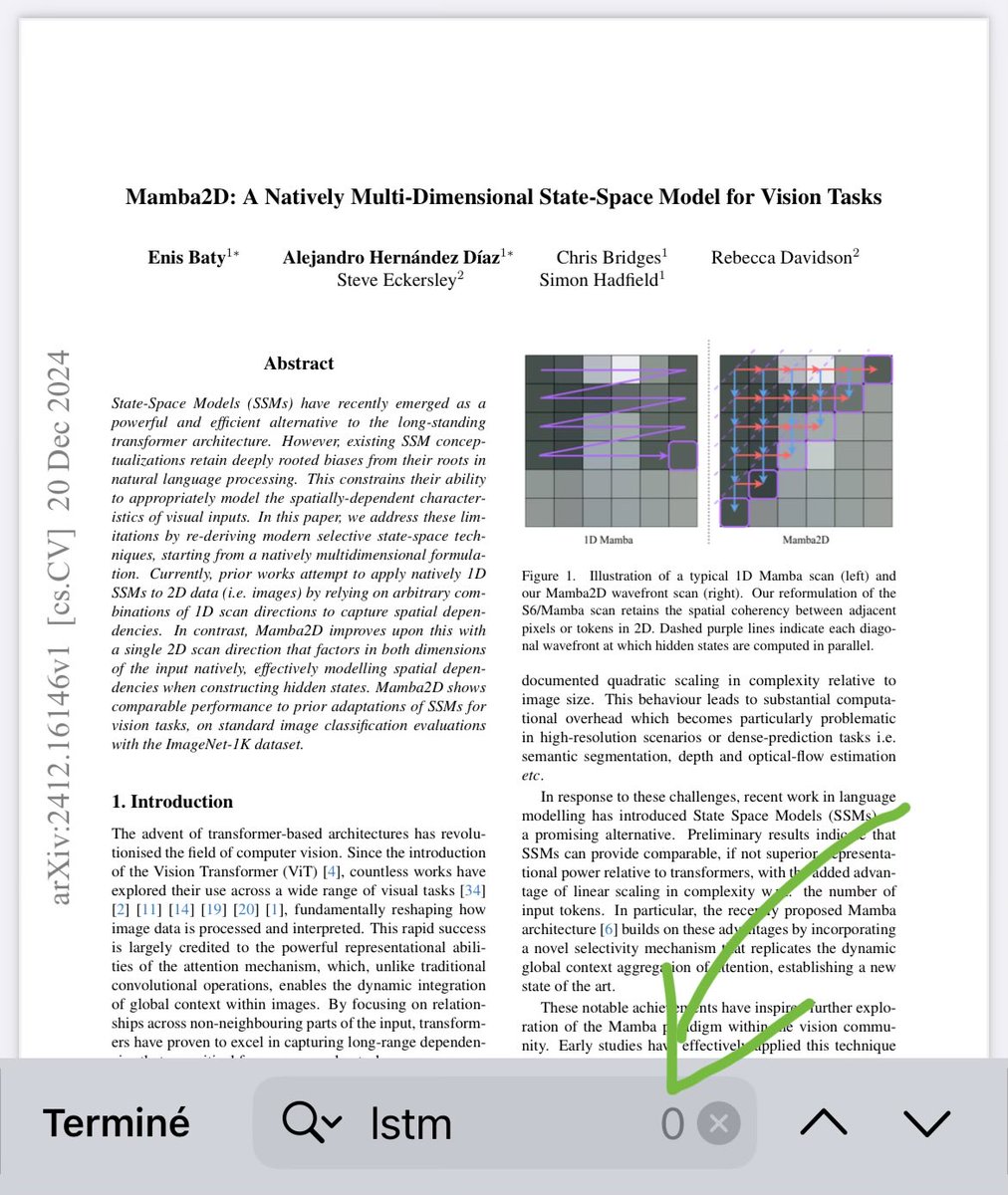
Mamba/ssm folks should really google their "new idea + lstm" please. About a decade ago, people have tried a shitton of things with lstms. Nothing wrong with retrying with modern tools, but ack the past.
This is not the first such case I see btw.
Why do NNs often learn similar representations? Existing identifiability results offer theoretical insights, but applying them in practice poses challenges.
We’ll present our new work exploring these challenges next week at @unireps#NeurIPS2024 🇨🇦🎉
https://t.co/lCKgRhh43m
1/
A common question nowadays: Which is better, diffusion or flow matching? 🤔
Our answer: They’re two sides of the same coin. We wrote a blog post to show how diffusion models and Gaussian flow matching are equivalent. That’s great: It means you can use them interchangeably.
I’m thrilled to announce that my paper has been accepted at #UNSURE2024 at #MICCAI2024! Check out the video below where I give a summary of my findings! Keep an eye out next week for a full-length post where I’ll dive deeper into the work and what’s next!
Grateful for the warm reception at the #CausalAI Conference ! Honoured to share how #CausalSystemDesign draws parallels between Aristotle’s 4 Causes, NASA TRLs & Pearls causal modelling to transform AI. #AIInnovation#AIforBusiness
📢 New preprint on finding good representations for Visual Question Answering!
We focus in particular on object-centric (OC) learning – since its role in downstream tasks is still partially underexplored – and on pretrained foundation models.
📄 https://t.co/1tgsCZ7oDX
🧵👇
Looking for PhD candidates interested in exploring multi-modal AI for healthcare! If you or someone you know is curious about this opportunity, feel free to reach out. More info about me and the team: https://t.co/lUwYusdqrE