Today we're launching our first support for the @nvidia ecosystem. BaseRT now runs LLM's on the NVIDIA DGX Spark (GB10).
On dense LLM's with up to 35B parameters, this is now the fastest token generation available. Up to 87% faster than vLLM, up to 18% faster than llama.cpp.
The DGX Spark fits on a desk and we know it's very popular with research labs, robotics startups and local AI builders. Give it a try and let us know!
GitHub to the runtime is linked on our website.
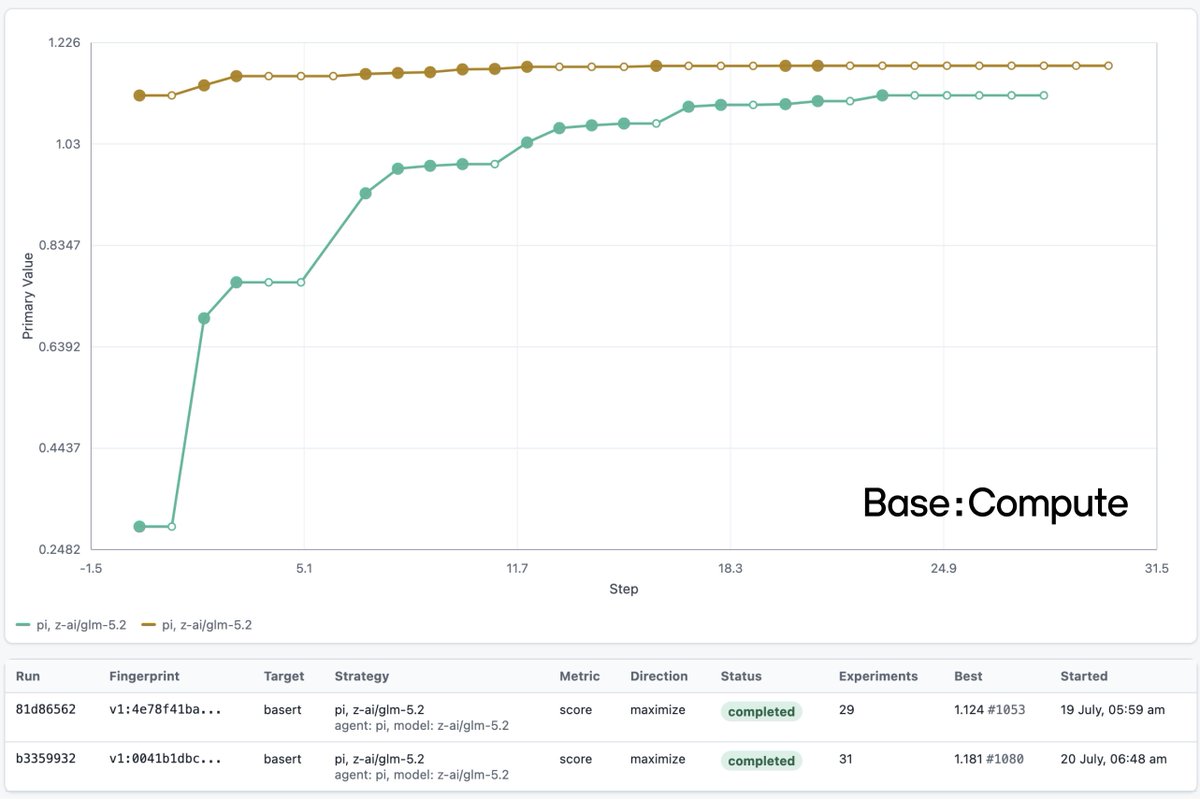
We applied GLM 5.2 to improve it's own inference performance. We're seeing first signs of recursive self improvement in our automated research pipelines. It improved its own inference performance by 45% on prefill (prompt-processing) and 19% on decode (token generation) compared to the previous efficiency frontier using MLX.
BaseRT is now the most performant way to run GLM 5.2 locally.
The model was deployed locally on a Mac Studio M3 Ultra, 512 GB Ram.
More technical details soon.
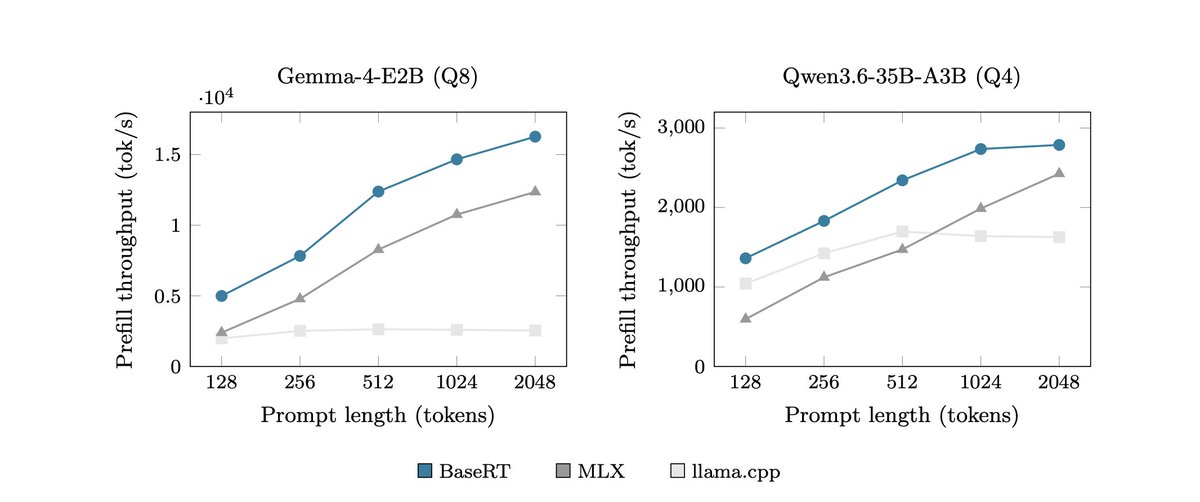
New performance ceiling for LLMs on Apple's M5 Pro. The M5 has a new tensor core architecture, exposed via the Metal 4 tensor API. We tuned BaseRT to use all of it.
Up to 6.3× faster prompt processing (prefill) than llama.cpp and 3.9× faster than MLX.
Tested on 10 configs across Qwen3/3.5/3.6, Llama 3.2, and Gemma 4, from 0.6B to 35B params.
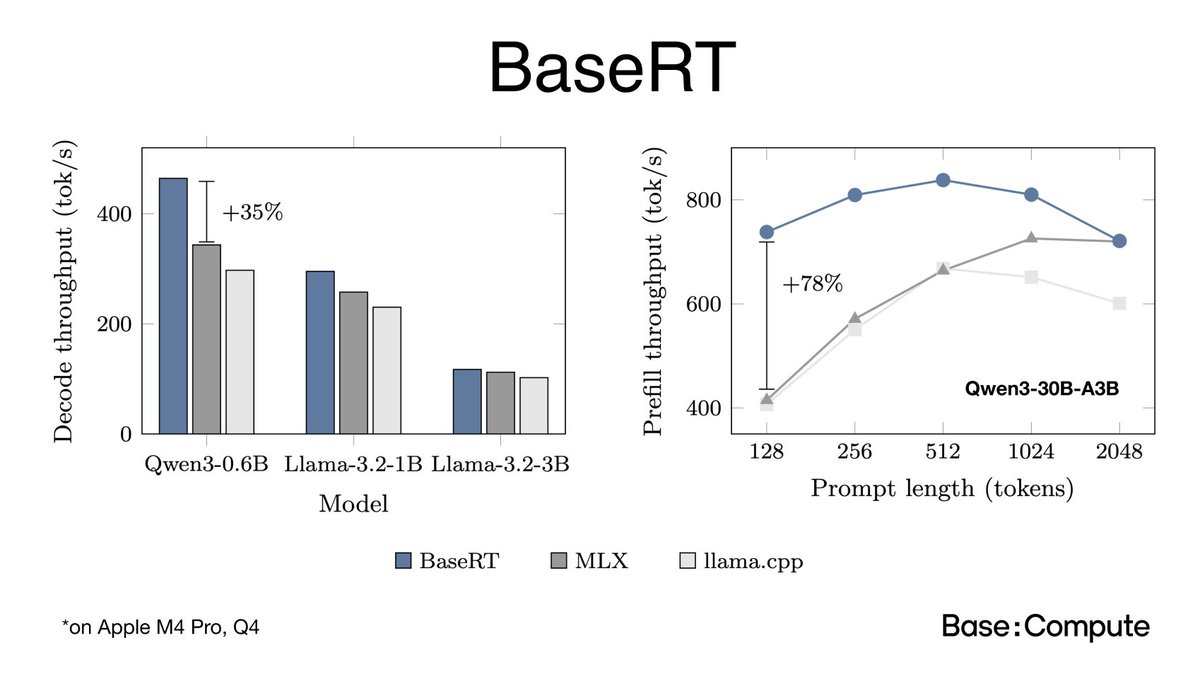
We’ve built the fastest inference runtime for LLMs on Apple Silicon, faster than MLX and llama.cpp.
BaseRT is up to 35% faster than Apple's MLX on token generation (decode) for small models, and 78% faster on prefill for bigger models.
Details below.
How the world has evolved over the last century in terms of:
- Child mortality
- Life expectancy
- GDP
- Women's education
- Basic water source
- Basic sanitation
[charts by @toddrjones]
We were so pleased to host interns across the Simons Foundation & @FlatironInst for the summer of 2022. We are honored to be a part of their scientific careers! (Below is a photo of 3/4 of the intern class. We are proud of ALL of our interns for their great work this summer!)
@Plinz@GaryMarcus How far do you think we will need to move from ANNs towards algebraic symbolic (e.g. https://t.co/H8u3ZjUN4w) or algorithms (e.g. https://t.co/E1kjo6hfkF) to achieve robust generalization?