This Sam Altman story is chilling.
He says the current AI moment feels like the final night before the world realized COVID would change everything.
A few people saw what was coming.
Everyone else kept partying.
That is exactly what AI feels like now.
We are not waiting for the disruption.
We are living in the last moments before everyone notices it.
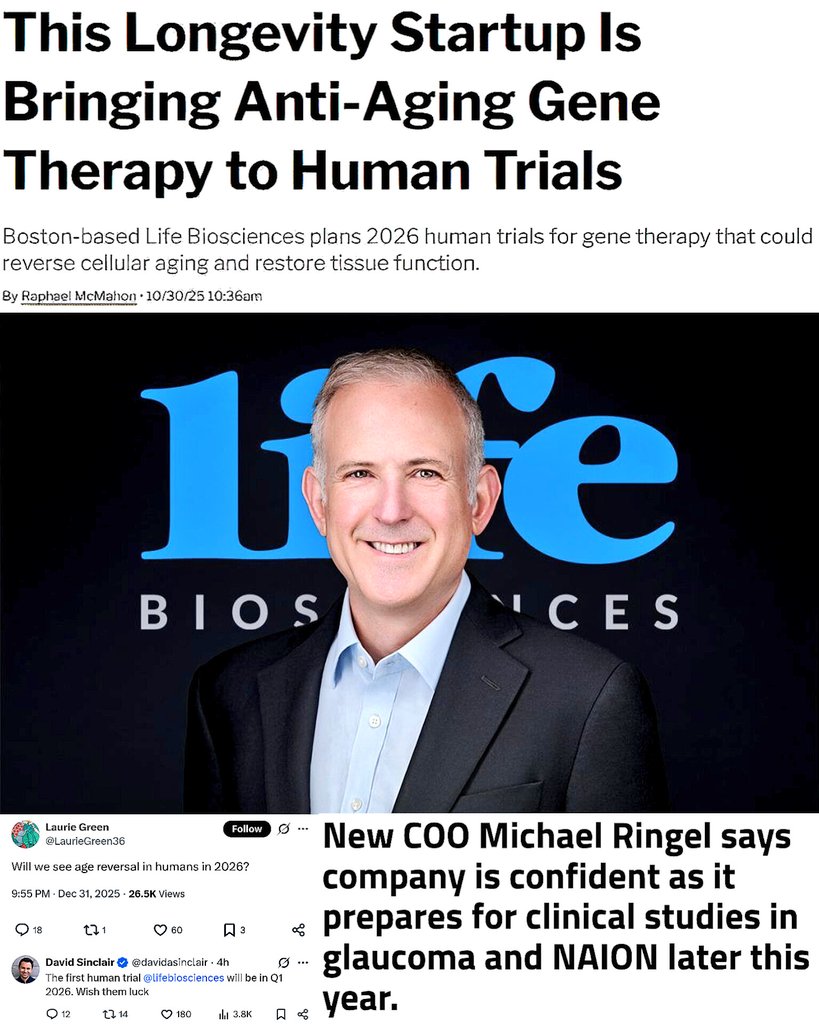
Life Biosciences plans to start the first human trials for reversing aging in Q1 2026.
> Life Biosciences, a Boston-based biotechnology company is poised to become the first to conduct human clinical trials for a therapy that targets aging by rejuvenating cells without altering their core function.
> They’ll use partial epigenetic reprogramming, a method to turn back a cell’s biological clock without changing its identity.
> The company is developing a cellular reprogramming treatment that, if successful, could address a wide range of age-related diseases, including Alzheimer’s, Type 2 diabetes and Parkinson’s.
> New COO Michael Ringel says company is confident as it prepares for clinical studies in glaucoma and NAION later this year.
> Longevity sector is rapidly scaling up.
Global longevity market was valued at $19.29 billion in 2023 and is projected to reach $63 billion by 2025, driven by growing investment in therapies that target aging at the cellular level rather than individual diseases.
> Major players are racing toward human trials.
Companies like Bezos-backed Altos Labs are working on cellular rejuvenation, Insilico Medicine is using AI to speed up discovery of age related drugs, and Retro Biosciences, funded by Sam Altman, aims to extend human lifespan by a decade, with plans to begin human trials for its Alzheimer’s pill.
Google just dropped its new AI image model, Gemini 2.5 Flash Image aka Nano Banana. So I tested it using a photo of my week-old banana from the fridge. Although the Korean text came out slightly blurred and distorted, the overall result was truly impressive!
It has been only one month since 2025 began, but there have already been many interesting news stories, such as the Stargate Project and DeepSeek-R1. We still have 11 months left, how many more exciting news stories are waiting for us in 2025?
I learned about the singularity from Ray Kurzweil, and I felt the singularity from Tim Urban. At the time in 2015, it was hard to believe, but now it is becoming more tangible within our sight.
10 years ago today, I published my big post on AI. It has aged quite well if I may say so myself. Of the many 2015 predictions I cited in the post about the rate of AI progress ahead, it seems that the most bullish are the ones who had it right.
Even before the year 2024 ends, it seems like AGI(Artificial General Intelligence) is already here, or at least very close. What an amazing year 2025 will be!
The Singularity is near, because we’re already seeing rapid, exponential progress in key areas like AI, computing power, and robotics. AGI is no longer a distant concept—it’s becoming a reality with breakthroughs happening faster than ever (o3). Once AGI emerges, it will trigger a chain reaction, accelerating innovation at a rate beyond human comprehension.
The pace of change is so fast now that the gap between where we are and the Singularity is shrinking by the day. We're approaching a tipping point. This is the most exciting, transformative period in human history, and we’re on the edge of something truly revolutionary.
Ray Kurzweil says we will soon be able to back up our brains to ensure our consciousness survives in the event of accidents and if you can hold on for another 5-10 years "it's going to be very hard to imagine how you could die"
The future expands the variance of human condition a lot more than it drags its mean. This is an empirical observation with interesting extrapolations.
The past is well-approximated as a population of farmers, living similar lives w.r.t. upbringing, knowledge, activities, ideals, aspirations, etc.
The future trends to include all of:
- the transhumanists who "ascend" with neuralinks etc., and the Amish living ~19th century life.
- those who "worship" ideals of religion, technology, knowledge, wealth, fitness, community, nature, art, ...
- those exploring externally into the stars, those exploring internally into minds (drugs++), or those who disappear into digital VR worlds
- those who date a different partner every day and those who are monogamous for life
- those who travel broadly and those who stay in one location their entire life
- those in megacities and those off-the-grid
For almost any question about a dimension of human condition, the answer trends not to any specific thing but to "all of the above". And to an extreme diversity of memetics. At least, this feels like the outcome in free societies that trend to abundance. I don't know what it feels like to live in such a society but it's interesting to think about.