The UK military is now using Starlink + Starshield at serious scale 🇬🇧
Britain’s Ministry of Defence currently has roughly:
• 500 Starlink terminals
• 1,000 Starshield terminals
• £16.5M spent on Starlink
• £13M spent on Starshield
The UK has used Starlink since 2022
In 2024, it started using Starshield airtime through existing Starlink terminals, before purchasing dedicated Starshield terminals in 2025
Britain is now the first country outside the U.S. to publicly acknowledge adopting Starshield
SpaceX connectivity is becoming part of the communications infrastructure of one of NATO’s major militaries
Starlink built the global connectivity network
Starshield is turning that scale into strategic defense infrastructure
There are no other cars that can truly compete with Tesla Cybercab right now, because what it is about to offer is on a completely different level in travel experience, convenience, and most importantly cost, with rides that could cost just 10–20% of today’s typical Uber fares
It is engineered from the ground up for full autonomy, it eliminates many of the traditional upfront costs built into conventional cars and fleets. By relying purely on a vision‑based system, Tesla doesn't need lot of expensive, redundant hardware like LiDAR, the system is vastly simpler and more scalable, and those savings are passed directly to riders through extremely cheaper rides
During Tesla Cybercab launch week in Austin, I took a total of 12 paid Cybercab rides and kept every receipt.
TOTAL:
• 12 rides
• 29.7 miles traveled
• $108.34 total spent
• $3.65 average cost per mile
• 2 hours and 19 minutes riding around Austin in a Cybercab
• Compared to Uber and Waymo, every Cybercab ride was still ~30-50% cheaper
EACH OF MY CYBERCAB RIDES:
1/ Sept 3 — 7:23 PM
3.9 miles · 16 min · $8.70
≈ $2.23/mile
2/ Sept 3 — 7:53 PM
0.5 miles · 6 min · $4.65
≈ $9.30/mile
3/ Sept 4 — 6:52 AM
2.5 miles · 12 min · $6.99
≈ $2.80/mile
4/ Sept. 4 — 7:13 AM
2.4 miles · 11 min · $6.84
≈ $2.85/mile
5/ Sept. 4 — 7:39 AM
1.8 miles · 11 min · $6.16
≈ $3.42/mile
6/ Sept. 4 — 8:03 AM
1.4 miles · 8 min · $5.69
≈ $4.06/mile
7/ Sept. 4 — 8:20 AM
3.3 miles · 15 min · $7.90
≈ $2.39/mile
8/ Sept. 4 — 10:58 AM
4.0 miles · 19 min · $8.78
≈ $2.20/mile
9/ Sept. 4 — 11:58 AM
2.6 miles · 8 min · $7.08
≈ $2.72/mile
10/ Sept. 4 — 2:17 PM
2.8 miles · 11 min · $13.71
≈ $4.90/mile
11/ Sept. 5 — 12:57 PM
2.4 miles · 10 min · $16.18
≈ $6.74/mile
12/ Sept. 5 — 1:36 PM
2.1 miles · 12 min · $15.66
≈ $7.46/mile
One of the biggest things I learned from actually using Cybercab is that you cannot judge the economics from just one ride.
Pricing is dynamic.
Some of my longer rides came in cheaper around $2.20–$2.40 per mile.
Some of the shorter or higher-demand rides were much more expensive.
Sometimes, the Cybercab was even more expensive than the Model Y (Unsupervised) bc the demand was so high.
Some of the rides also became more expensive as Cybercabs became bookable on September 4 to the general public.
However, it’s hard for me to look at these receipts and not wonder how Uber and Lyft can compete if Tesla can scale Cybercab the way it wants to.
Uber and Lyft were built around connecting riders with human drivers.
That means every ride has to support a much bigger cost stack... like
1/ A human has to be paid.
2/ That person needs a car.
3/ That car has to be financed or purchased.
4/ It needs insurance.
5/ Maintenance.
6/ Fuel or charging.
7/ And then Uber or Lyft still needs its cut.
Cybercab attacks the biggest cost in that entire system which is the driver... there is no driver waiting to be paid at the end of the ride.
And Tesla is supplying the software.
Tesla can build the car.
Build the battery.
Build the autonomy system.
Operate the network.
Control the app.
Control the charging.
And the team designed the Cybercab from Day 1 around being a Robotaxi instead of taking a normal consumer car and trying to make the economics work.
This is a big deal.
Bc if Tesla can manufacture these at huge scale, keep them on the road for most of the day, and keep bringing the cost per mile down, then Uber and Lyft are going to be competing with the company that built the vehicle, the driver, and the network ALL AT ONCE.
And this was during launch week... with just ~45 Cybercabs, before this vehicle is anywhere close to mature scale. If Tesla can push that cost down further as the fleet grows to thousands and millions, while Uber and Lyft still have to pay a human being to sit behind the wheel…
I really don't see how these companies can survive... I think the days of Uber and Lyft are limited.
Q1 2026 Shareholder Update
https://t.co/dOjSLhd10p
We continued to make meaningful progress on the build out of the infrastructure & AI software that underpins our Robotaxi & future robotics businesses in Q1.
That meant commencing the ramp of new factories across AI compute, battery & battery materials, as well as preparing lines for start of production of Megapack 3, Cybercab & Tesla Semi.
Demand for our vehicles continued to grow in APAC & South America markets, with a rebound of demand in EMEA markets & North America.
As trade and geopolitics become more uncertain, we're further regionalizing and vertically integrating critical supply chains to ensure access to key materials & componentry in each region across vehicle, energy & AI.
Automotive
– Optimizing our vehicle product portfolio with an emphasis on vehicles designed for a fully autonomous future
– More affordable trims of Model 3/Y & rollout of Model Y L in markets outside of China
– Began deliveries of Cybertruck in the UAE
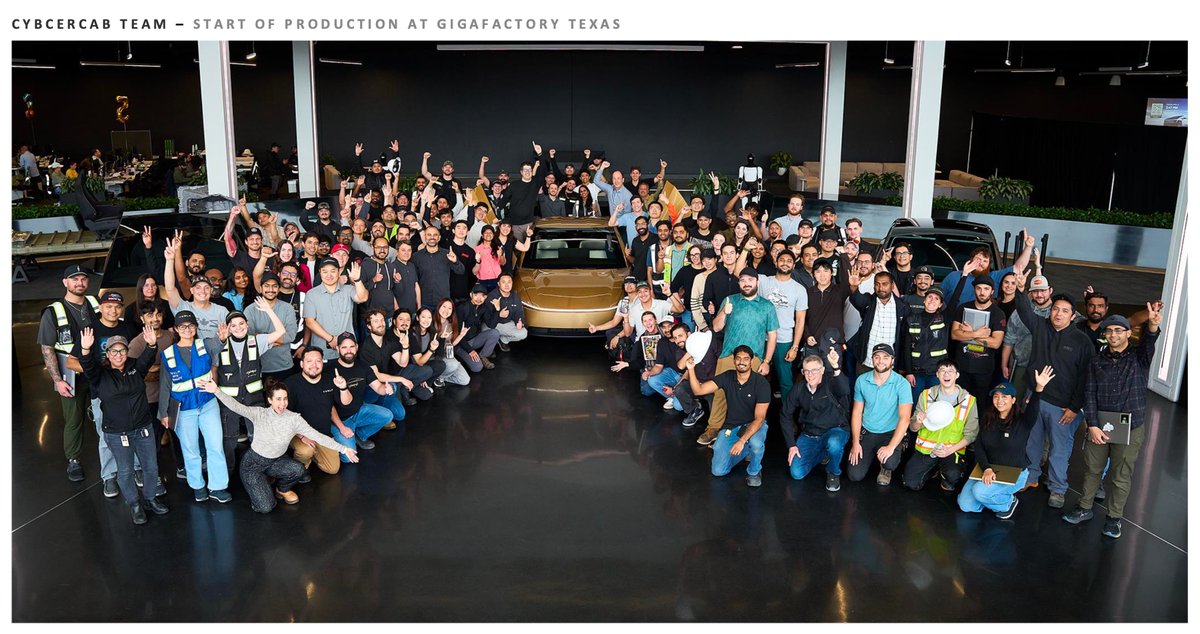
– Volume production of Cybercab & Tesla Semi this year
Energy Generation & Storage
– Good progress with new Megafactory outside Houston (will produce Megapack 3 for Megablock). Start of production on track for later this year
– We began meaningful customer deployments of Tesla’s first in-house designed solar panel produced at Giga New York
Robotics
– Preparations for our first large-scale Optimus factory will begin shortly in Q2.
First-gen line designed for 1M robots/year will replace Model S/X lines in Fremont Factory, second-gen line is being prepared at Giga Texas (long-term annual capacity of 10M robots/year)
AI Training Compute
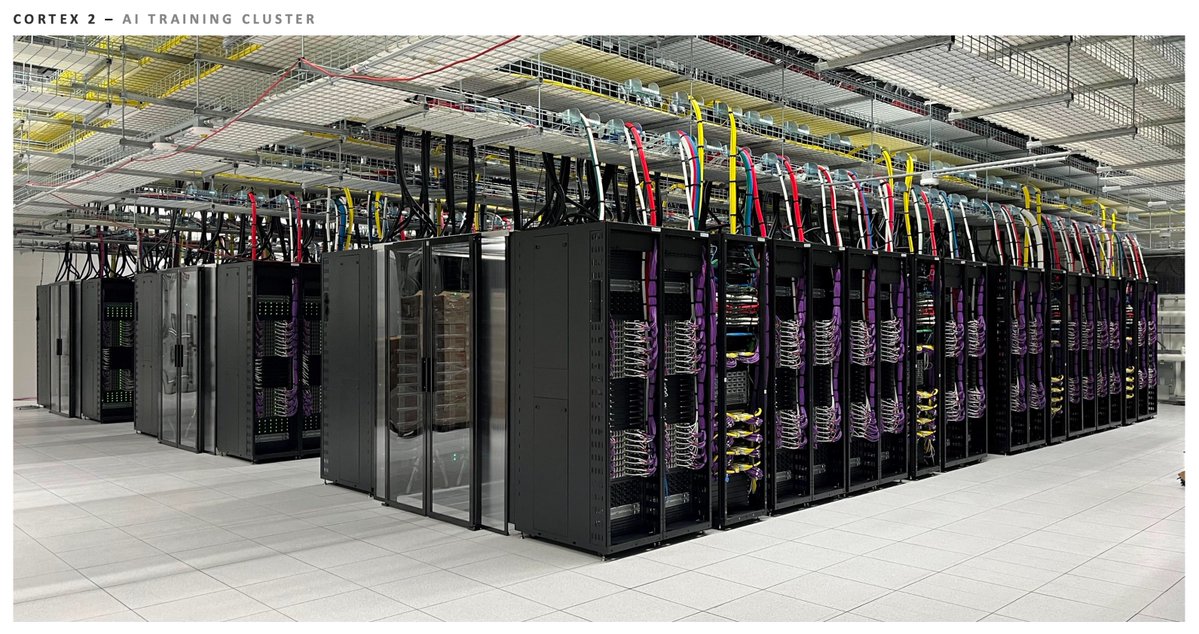
– Cortex 2 is now online & has started running training workloads
– Also ramping on-site training infrastructure to ensure sufficient compute resources for AI products & services
– Continuing with custom silicon development (Dojo 3) to reduce training cost over time
Battery
– Ramping new battery & material factories, including LFP cells in Nevada, cathode material & lithium refining in Texas
– Battery vendor cell availability continues to be a limiting factor on ramping vehicle production, so we're working on initiatives to de-bottleneck, including using 4680 cells at Giga Berlin
Other Supporting Infrastructure
– Giga New York is now producing V4 Supercharging cabinets (3x power density & 2x the number of stalls vs V3)
– Alongside the ramp of Tesla Semi, we're deploying public Megachargers, including our first one in SoCal
– Over 2,200 new Supercharger stalls, growing the network 19% YoY
AI Software
– FSD 14.3 launched in April
– Upgraded Reinforcement Learning (RL) stage to better handle long-tail edge cases, enhanced the neural network vision encoder for sharper perception in low-vis scenarios & rewrote the AI compiler to accelerate model iterations & cut inference latency by 20% (faster reaction time for FSD!)
This accelerates our efforts to eventually deploy unsupervised autonomy to both the Robotaxi fleet & customer owned vehicles
– Digital Optimus: our next evolution of AI development. We're working on automating digital workloads, building an intelligence layer that will complement real-world AI in vehicles & robots
AI Inference Compute
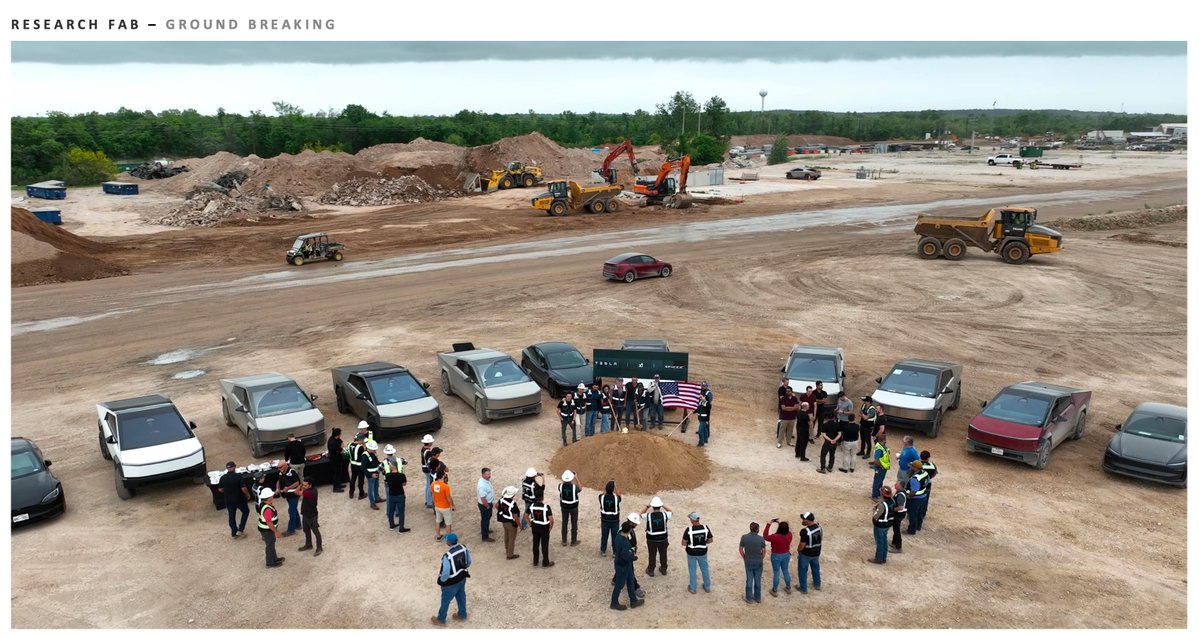
– Expanding our scope of manufacturing to include semiconductor fabrication (coinciding with Robotaxi & Optimus ramps) = step towards ensuring sufficient & resilient chip supply
– Partnership with SpaceX aims to build the largest chip fab ever, vertically integrating logic, memory & advanced packaging to allow for rapid iteration
– Completed final chip design of AI5 (our next-gen inference processor) in April
Automotive & Other Software
– Rolled out Spring Update which includes a new Self-Driving app with tutorials & stats, "Hey Grok" wake word w/ location-based reminders, accent lights for blind spot alerts, updated Pet Mode & more
Robotaxi
– Paid Robotaxi miles doubled sequentially in Q1
– Cybercab will begin replacing Model Y fleet once in production & be the largest volume vehicle in the fleet over time
– Continuing to lay the groundwork for expanding into new cities (testing, permitting), so we can launch quickly once ready. Safety remains top priority
– Expanded unsupervised ops in Austin & launched in Dallas & Houston in April
FSD Supervised
– Record net new FSD subscriptions in Q1
– Received approval to deploy FSD Supervised in the Netherlands in April, clearing the path for potential approval in other EU countries
– Continuing to make progress on approval in China
Automotive Services
– Safety Score v3.0 enables every mile driven with FSD Supervised engaged to receive a score of 100. Higher Safety Score over time = lower premiums for Tesla Insurance customers
One side says Tesla will kill Uber. The other says Uber owns the customer relationship and can just aggregate competing robotaxi fleets. I think both miss what changes when you remove the human driver.
Uber built an incredible business around a scarce resource: people willing to drive other people around. Recruiting those drivers, coordinating them, and connecting them with riders is difficult. Uber solved a real problem. But a robotaxi network changes that equation. Once you solve autonomous driving safely, you can grow supply by manufacturing vehicles. You don’t have to recruit another human for every additional car. That’s a completely different business.
Imagine a company putting enough robotaxis into a city to offer much shorter waits at half the price of Uber. How hard is it to convince someone to download another app at that point? People talk about Uber’s brand, payment relationships, and existing users as if those automatically carry over into a robotaxi world. They matter. But I think people underestimate how quickly a dramatically better service can create demand for its own network.
And this is where the “Uber will aggregate everyone else” argument gets difficult. If another company actually solves robotaxis and can deploy them at scale, why would it keep giving Uber a meaningful cut of every ride? Why wouldn’t it build its own network and pass those savings to customers? Uber might help it get started. That doesn’t mean Uber remains essential once it scales.
There’s an even bigger problem for the second and third robotaxi networks: they have to compete with whoever gets to scale first. I mean real scale. Enough vehicles, coverage, and availability that the service feels significantly better to the customer. A few impressive demos don’t establish that. Once a network reaches that point, the next competitor has to match its availability AND its price. That could require a lot of subsidies while building out a fleet.
This is why I think Tesla’s work on Cybercab manufacturing is such a big deal. A competitor needs great autonomous driving software. But it also needs a vehicle cost structure that lets it compete sustainably. Tesla is working on both sides of that equation. If Tesla gets the software right and scales a much cheaper vehicle, that combination becomes extremely difficult to compete against.
Does that mean Uber goes bankrupt overnight? I don’t think so. There are plenty of services where people want or need a human involved. Delivery, assistance, specialized transportation. Habits also change more slowly than people in the tech world sometimes assume. Uber has room to adapt. But I think a true robotaxi network becomes a different class of transportation: cheaper, more available, and useful for far more trips.
The big questions are when Tesla can reach the required safety and reliability, how quickly it can deploy, and who else can match the complete service at a competitive cost.
Why is Tesla Cybercab and Robotaxi so important to me?
And why is today such a huge deal?
(Tesla is announcing Cybercab later today in a small event in Austin).
It started in 1980 and 81 when two of my high school friends were killed in car wrecks. One was a girl who marched next to me in band.
I visited her home the morning after it happened and saw the pain on her dad's face.
I wish I could wave a magic wand and keep that pain from other fathers.
Unfortunately about 40,000 a year in USA and 1.2 million world wide meet the same fate every year.
If the airline industry killed that many we would never fly again and the airline industry would shut down.
Since then I've had a front-row seat on the auto industry's efforts to improve safety. Years of meeting with auto industry, doing interviews, writing books.
But it goes way beyond that now.
Uber was started, partially, in front of me in a Paris snowstorm. Four years later I visited South Africa and interviewed housewives in the slums there about how deeply Uber improved their lives.
This will improve them even more by reducing the cost of transportation. Both in money and lives.
Yeah, Zoox beat Tesla to the market with a vehicle that has no steering controls, but that's a bigger vehicle that's more expensive to run.
Yeah, Waymo beat Tesla to the street with a Robotaxi network. It's quite nice. I use it and have been interviewing every customer I can get to talk who gets out of one in San Francisco.
But in the technology game, it isn't who is first that matters. Just ask Nokia, Kodak, Borland, Blackberry, AltaVista, or many other companies that are gone now like Wordperfect.
I have talked with Waymo's founder, Sebastian Thrun, a few times and once we talked about what will matter in Robotaxis.
We ended up asking ourselves why, say, Starbucks is such a dominant brand?
We boiled it down to two things:
1. Ubiquity.
2. Consistency.
It is available almost everywhere (three in one mall in Yokohama, Japan, when I visited). Ubiquitous.
And it is consistent. You will get exactly the same latte in Japan as you will get at its headquarters in Seattle, or anywhere else you will find a Starbucks.
Tesla will be the most ubiquitous and consistent for a variety of reasons.
I once got insight into Waymo's own market research and Waymo found that the number one reason people switch ride sharing is price. Number two is experience.
Eventually Tesla and Waymo will get into a price war. That will be two to five years away, but it is coming and might even start later today as we learn Tesla's pricing strategy for Cybercab.
Tesla's entrance to the Robotaxi market will dramatically change transportation. And improve it. Make it safer that any human driven vehicle and it certainly is way smoother at driving than any human I've seen drive (and I've been in the car of NASCAR legend Brett Bodine and Audi taught me to race on both ice and concrete).
But it goes way deeper still for me. How many arguments have I had over the years about LiDAR vs. cameras?
So many, even in the AI industry, told me "you need LiDAR to have a safe autonomous car." Heck, I was told that again at NVIDIA's GTC.
It's hogwash. It always has been hogwash. But people get stuck on their opinions and can't change their minds that fast. So they argue. I've had this happen thousands of times in my career.
And they never apologize. Several told me on other social networks that they blocked me just because I took this stance. I won't be unblocked, I'm sure.
But today proves they all were wrong. Tesla is putting on the road an autonomous vehicle that is safer than they are. Think about that. It runs only with cameras. No expensive LiDARs.
Now let's talk about LiDARs one last time. Why are they bad for transportation?
Cost.
And you don't realize what the costs are until you meet with the people who actually build cars. Any added sensor needs more wires. More compute to handle. And disrupts air flow over the car, which makes it slightly more expensive (and noisier inside).
The expenses add up. The Cybercab should be about $30,000. We'll learn the actual price later. The Waymo vehicle is easily double that.
And uses more electricity to go a mile. And will have more maintainance costs.
Which is why Tesla will be able to always underprice Waymo. And deliver a better experience.
And give you the opportunity to own a Tesla that uses the same system to drive and put one in your garage. Something Waymo isn't setup to do.
I already trust my life every day to my Tesla. Today it went around a large garbage can that had fallen into the freeway. The way it looked several other people had hit it. Mine just drove around it at high rate of speed. Wish I had thought of making a video for you.
Is Robotaxi perfect? Not yet.
It needs to be far more flexible, and far more available, everywhere, to make that kind of claim and there are years of regulatory fights to bring Robotaxis into many communities, sadly. Their politicians are dooming their citizens to having a less efficient and less safe system operating in their communities to protect jobs, or to take advantage of AI hate to get reelected, so we have a long road to go before the job is done.
But I wanted to celebrate today. Years ago @IrenaCronin and I wrote "The Infinte Retina" where we had a whole chapter on Robaxis.
Today at 4 p.m. I'll open up an audio space here on X and read the chapter so you can see just how accurate/inaccurate we were years ago before anyone was thinking about Robotaxis.
It's a big day. First step in making vehicles safer is to get rid of the steering wheel. It's often what kills people in a high-speed wreck.
Not having a steering wheel means having a much bigger airbag, so it is safer for you in a wreck.
And Ford's head of safety told me that in a wreck humans only do the right thing about 15% of the time. The rest of the time they often don't even touch the brakes.
In crisis our brains go into vapor lock.
A computer doesn't have these problems. It can see a crash is unavoidable and still slam on the brakes to pull energy out of the vehicle before a wreck. Crashing at 60 mph is a lot more survivable than crashing at 80. So a little scrubbing of energy is a big deal.
But Tesla's cameras see the wreck coming and pre-tension your seat belts and even fire off airbags in a much better way than without such a system.
And usually it will avoid the wreck altogether in a way that humans can't.
When I met some of the team building it at the We, Robot event two years ago they told me they argued about grams added to the vehicle.
Many might say "it feels cheap" inside. That's because it is designed to be abused, barfed in, drinks spilled in it, among other things (you will get charged for damages, keep in mind, and there is a camera watching you. Do enough damage and you will never be picked up again. Something that you will soon regret, since all the other options will be more expensive.)
And back 14 years ago when I was arguing with Mercedes engineers about this I learned just how resistant the auto industry was to include any of this technology.
Heck, they even refused to put digital vents in their vehicles.
Why does that matter?
My wife and I had one long argument in our 24 year marriage: vents.
I like the air on my face. She doesn't. So every time I would get in her car I would change the vents. Then when she got in to drive she would complain that I changed her vents.
We never have that argument in a Tesla because our vent settings are saved in our account and if we get in a Robotaxi the vents are automatically set to where we each like them. I believe it still is the only Robotaxi that can do that. And everything is like that. You start listening to Skrillex on one ride and Skrillex will still be playing on your next ride. And seats automatically adjust to where you set them on previous rides.
I could go on for many hours, and have, on more than 1,000 Tesla spaces I've been a part of over the past few years. Tonight I'll be on more after my book reading and watching the news being shared by a group of people who have been covering FSD and Robotaxi in more depth than I have been here (I usually focus on AI and innovative new companies).
Anyway, Cybercab does something I've been waiting for the auto industry to do for decades: get rid of the steering wheel.
Human drivers aren't as safe as AI driven vehicles as you will soon learn. And Robotaxis will be cheaper than owning your own car for many people, particularly those who have to commute to a close city center where parking and time wasted add up to the costs.
Soon they will be available in more cities, you can sense that as Cybercabs are starting to fill up parking lots around the USA, sort of taunting us with a big release coming.
It's a big day for transportation.
You probably won't see another huge improvement like this in your lifetime.
The avg. cost of a Tesla Cybercab ride is $9
A iPhone Duo with 2TB of storage is $3,200
That's approx. 355 cybercab rides 🤯
Tesla Duo 🚖 > iPhone Duo 📱📱
Why would anyone choose an Uber or Waymo vs. THIS…?
Cheaper.
Safer.
Fully autonomous.
And it looks like it came straight out of the future.
That’s the Tesla Cybercab.
I really think it’s game over.
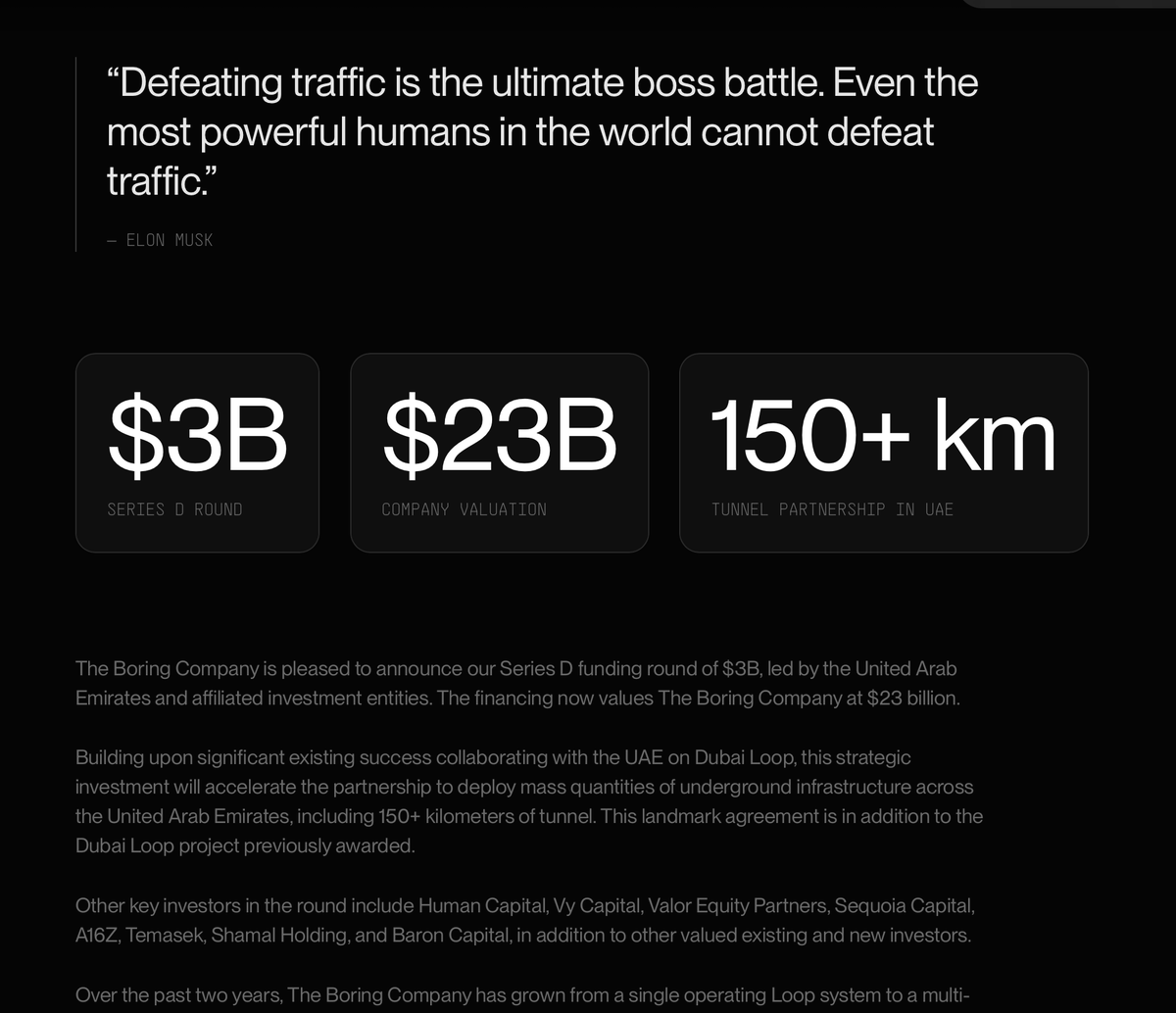
Elon Musk's The Boring Company has just announced that they have raised $3 billion at a $23 billion valuation.
"The Boring Company is pleased to announce our Series D funding round of $3B, led by the United Arab Emirates and affiliated investment entities.
Building upon significant existing success collaborating with the UAE on Dubai Loop, this strategic investment will accelerate the partnership to deploy mass quantities of underground infrastructure across the United Arab Emirates, including 150+ kilometers of tunnel. This landmark agreement is in addition to the Dubai Loop project previously awarded.
Other key investors in the round include Human Capital, Vy Capital, Valor Equity Partners, Sequoia Capital, A16Z, Temasek, Shamal Holding, and Baron Capital, in addition to other valued existing and new investors.
Over the past two years, The Boring Company has grown from a single operating Loop system to a multi-city tunneling program, pairing faster machine design with the first hard-rock project, the first international construction contract, and a substantial expansion of Vegas Loop.
The company’s mission:
• Solve Traffic: To solve the problem of soul-destroying traffic, roads must go 3D. Tunnels minimize usage of valuable surface land and do not conflict with existing transportation systems. A large network of tunnels can alleviate congestion in any city.
• Beautify Cities: In many major cities around the world, roads take up an extraordinary proportion of available real estate, often monopolizing an astounding 20% to 30% of space, and up to 60% if you include parking. By placing transportation systems underground, valuable surface land can be used for pedestrians, green spaces, and recreation.
• Enable Rapid Point-to-Point Transportation: Loop is an express public transportation system that resembles an underground highway more than a subway system. If a subway or traditional light rail line had 100 stops, a train would typically stop at each station, so the trip between Stop 1 and Stop 100 would be long. In contrast, Loop passengers travel directly to their destination, anywhere between Stop 1 to Stop 100, without stopping at the intermediate stations. In Las Vegas, for example, if a train stopped at every hotel on Las Vegas Blvd, a trip from the airport to the convention center would take over 25 minutes vs 5 minutes with TBC’s system. This transportation architecture can be applied intra-city (Loop) and, with increased boring speed, can be applied inter-city (Hyperloop).
The funds from the round will be used to significantly increase hiring across engineering, operations, and production, to build and scale Loop projects, including Vegas Loop, Music City Loop in Nashville, Dubai Loop, and others, in addition to accelerating the research and development of Prufrock and future products."
After launching on Aug. 30, @NASARoman is on its way to its final destination, where it will change how we view the universe.
You can adopt a pixel in one of Roman's first images, expected by early 2027. Sign up today to claim yours: https://t.co/Whku14dE7u
Today, we announced a new €13 billion commitment to Finland’s digital and clean energy infrastructure over the next two years — our largest single investment in Europe to date.
Building on 15+ years in Finland, this investment will expand our presence in Hamina and establish new infrastructure in Kajaani, Muhos, and Vaala. During construction, the project is projected to contribute an annual average of €3.6 billion to Finland’s GDP and support over 37,000 jobs nationwide.
𝕏 Chat is getting a major upgrade with Calls / 𝕏 Meetings soon coming.....basically its own Google Meet / Teams-style layer
New features now include:
• Pre-call lobby to check camera + mic
• Side chat for comments and links
• Audio device picker + noise reduction
• Grok Imagine-generated backgrounds
• Whiteboard tools
• Emoji reactions + search
• Meeting links and scheduling
But the biggest change is under the hood
𝕏 is rebuilding Meetings from the ground up on a new system
That same architecture could eventually power a much better version of Spaces and live broadcasts too
𝕏 is quietly rebuilding its entire real-time communication stack.....bringing messaging, calls, meetings, Spaces and live broadcasts together inside one app