BREAKING NEWS
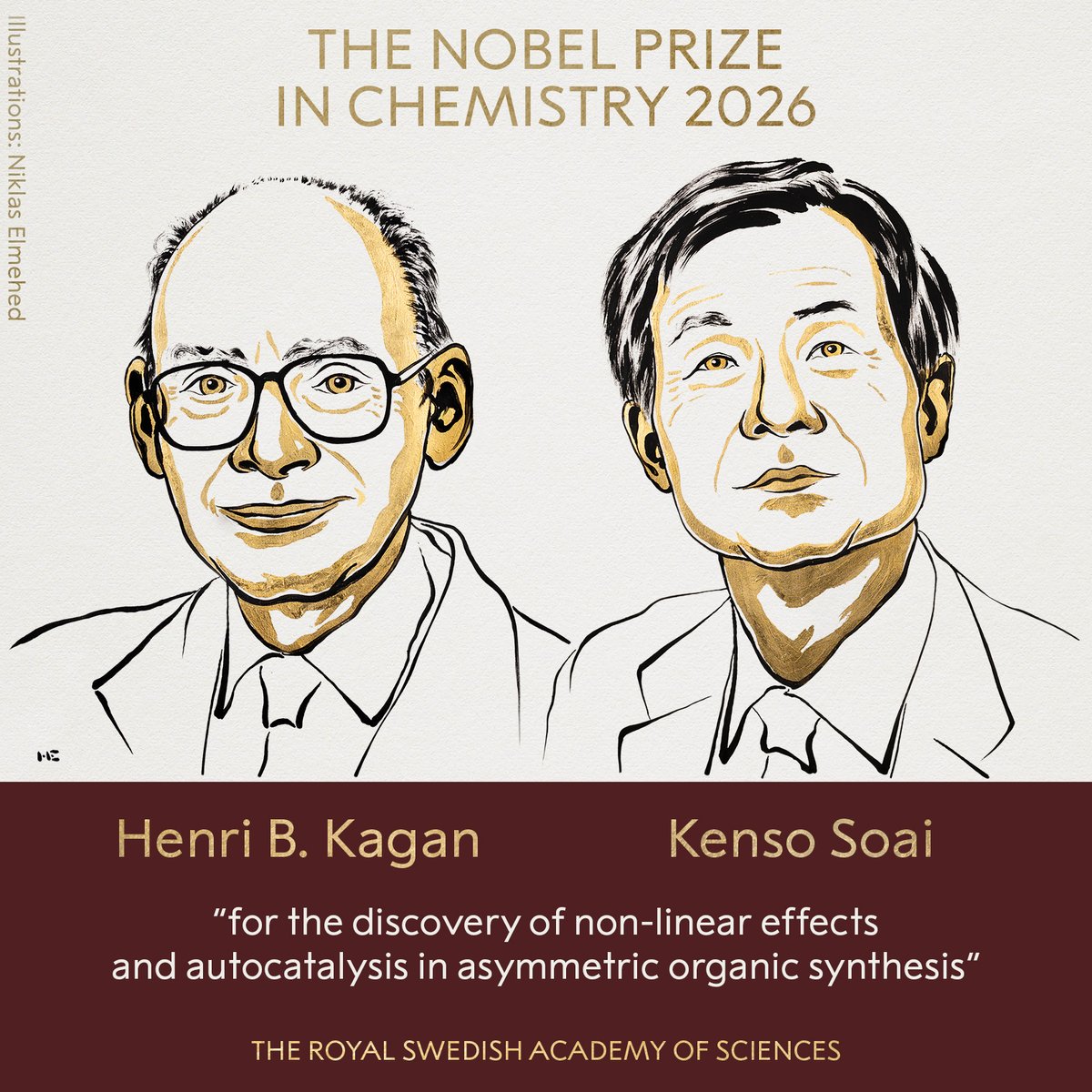
The Royal Swedish Academy of Sciences has decided to award the 2026 #NobelPrize in Chemistry to Henri B. Kagan and Kenso Soai “for the discovery of non-linear effects and autocatalysis in asymmetric organic synthesis.”
A Galton board drops balls through 12 rows of pegs, and at each peg a ball goes left or right with probability ½.
Bin k collects the balls that went right exactly k times, and C(12, k) of the 2¹² equally likely paths do that, so P(k) = C(12, k)/2¹². The middle bin gets 924/4096 ≈ 22.6 %: here 227 of 1000 balls, against 225.6 expected.
With mean np = 6 and spread √(npq) = √3, the stacks close on the normal curve as rows are added.
BREAKING NEWS
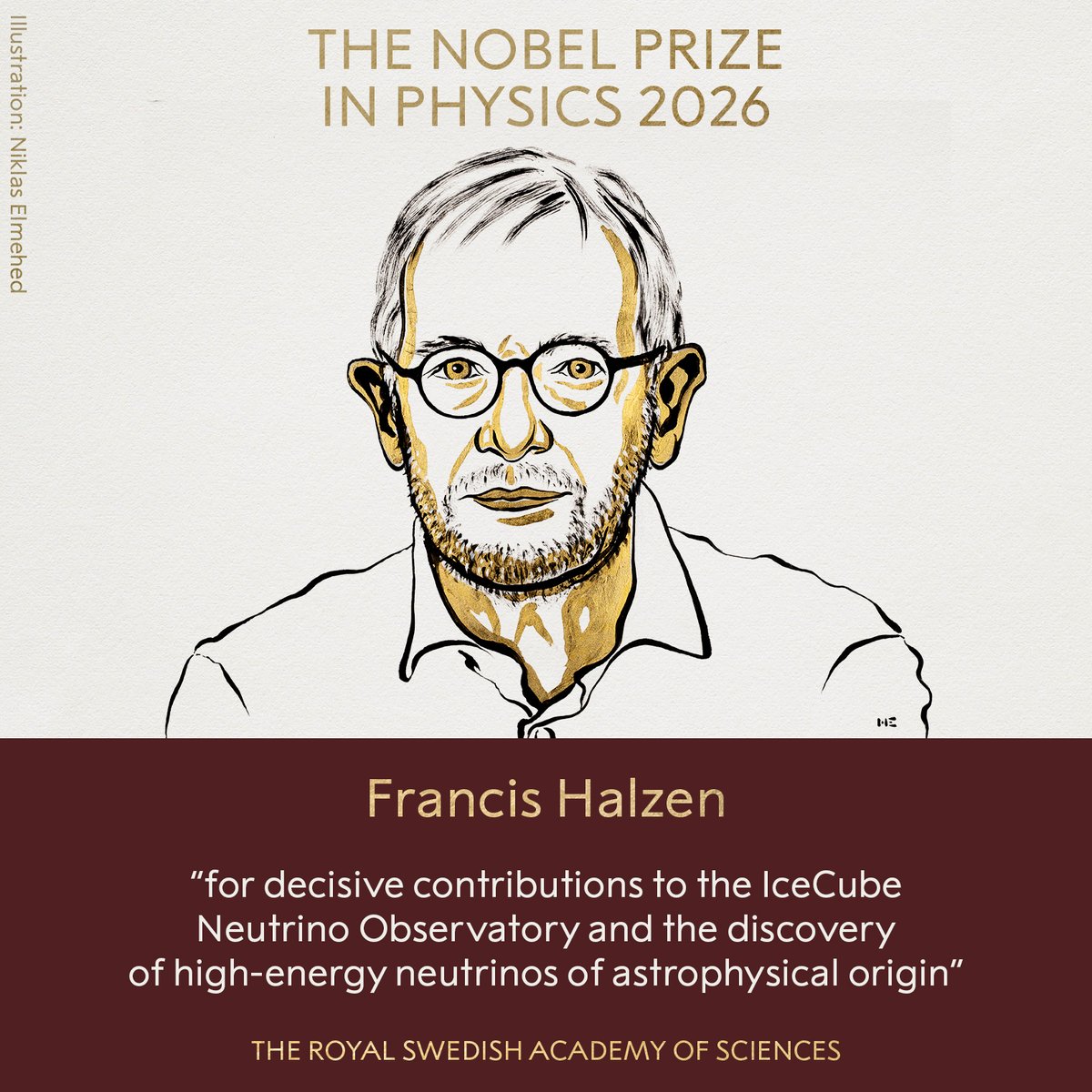
The Royal Swedish Academy of Sciences has decided to award the 2026 #NobelPrize in Physics to Francis Halzen “for decisive contributions to the IceCube Neutrino Observatory and the discovery of high-energy neutrinos of astrophysical origin.”
Pearson's r = ∑(x − x̄)(y − ȳ) / √(∑(x − x̄)² ∑(y − ȳ)²) adds one signed rectangle per point, spanned from the point to the mean centre (x̄, ȳ).
Points above right or below left of the centre add area; the other two quadrants subtract it. By Cauchy-Schwarz, −1 ≤ r ≤ 1. Here r climbs from −0.121 to 1.
On a line, y − ȳ = 0.75(x − x̄), every rectangle is positive and the ratio cancels to exactly 1.
Formation of conic sections ✍️
Circle: When the cutting plane is perpendicular to the axis of the cone, the cross-section is a circle.
Ellipse: When the plane is angled, but still cuts through only one cone (without being parallel to the side of the cone), the result is an ellipse.
Parabola: If the plane is parallel to the side (slant) of the cone, it creates a parabola.
Hyperbola: If the plane cuts both halves of the double cone, it forms a hyperbola - two separate curves.
La crisis de vivienda en España: lo que creo que puede funcionar para solucionarla... y lo que probablemente no sirva o sea directamente contraproducente. En siete minutos y medio.
Dentro video 👇
The curve y = ∛(x²) + 0.9 sin(kx)√(3 − x²) is a sine wave on |x| ≤ √3, carried by the cusp ∛(x²) and scaled by a semicircle.
Since |sin(kx)| ≤ 1, it never leaves the band between ∛(x²) − 0.9√(3 − x²) and ∛(x²) + 0.9√(3 − x²). Those two envelopes are the heart: lobes peaking at 2.27 near x = ±1.03, a point at −0.9√3 ≈ −1.56 on the axis.
Raising k only packs the wave tighter. At k = 100 it crosses the band about 110 times.
We often call Euler’s identity the most beautiful equation in mathematics. But sometimes we forget the beauty of the Gaussian integral.
It is absolutely gorgeous.
And if you don’t know this integral yet, can you really call yourself a math nerd? 😉
How do you make reading DNA faster, cheaper and scalable enough to transform medicine?
That question sits at the heart of the breakthrough behind the 2026 Wolf Prize in Chemistry, awarded to Pascal Mayer, Shankar Balasubramanian and David Klenerman.
Their work helped turn DNA sequencing into a massively parallel process, dramatically reducing the cost and time needed to read genetic information, and helping make large-scale genomics possible.
But what does that actually mean? How does next-generation sequencing work, and why was this such a major leap forward?
Watch the video to see the science behind the breakthrough and understand how three researchers helped change the way we read the human genome.
@Cambridge_Uni
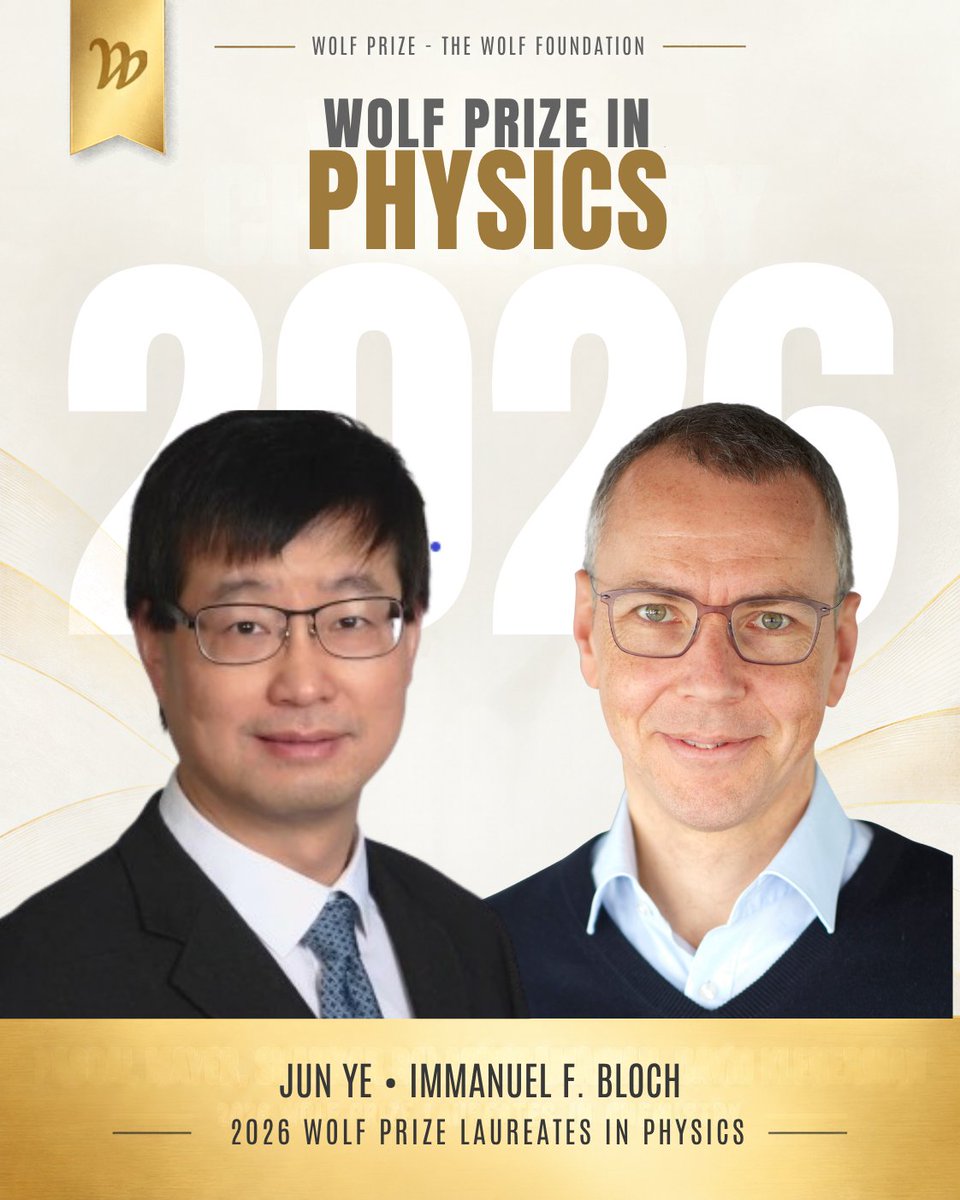
ANNOUNCING THE 2026 WOLF PRIZE LAUREATES IN PHYSICS
The 2026 Wolf Prize in Physics is awarded to Immanuel F. Bloch and Jun Ye “for transformative, widely applicable advances in the control of ultracold atomic systems.”
Their work has pushed experimental physics into realms that were once almost impossible to control.
Bloch established ultracold atoms trapped in optical lattices as a powerful platform for studying complex quantum systems. His work helped define the modern field of quantum simulation, revealing new insights into many-body quantum states and laying foundations for emerging quantum technologies.
Ye, meanwhile, led the development of the world’s most accurate and stable optical atomic clocks, achieving levels of precision that have reshaped how time and frequency can be measured. His work has also opened new ways to test fundamental physics, from relativity to searches for variations in nature’s fundamental constants.
From controlling quantum matter to measuring time with unprecedented precision, their discoveries have expanded what physicists can observe, test, and engineer.
Congratulations to Immanuel F. Bloch and Jun Ye, the 2026 Wolf Prize Laureates in Physics.
@NIST@maxplanckpress
ANNOUNCING THE 2026 WOLF PRIZE LAUREATES IN CHEMISTRY
The 2026 Wolf Prize in Chemistry is awarded to Pascal Mayer, Shankar Balasubramanian and David Klenerman for developing impactful, low-cost, next generation DNA sequencing methods for genomic medicine.
Their work helped transform DNA sequencing into a technology capable of operating at extraordinary speed and scale.
Balasubramanian and Klenerman pioneered a massively parallel sequencing approach that contributed to a million-fold improvement in sequencing speed and cost, helping make it possible to sequence a human genome for under $200.
Mayer played a pivotal role in turning those breakthroughs into a practical high-throughput sequencing system, integrating the chemistry, microfluidics, optics and computational components needed to make the technology work at scale.
Today, the sequencing platform that grew from this work forms the technological foundation for more than 90% of global sequencing data, powering major advances in genomics and precision medicine.
Congratulations to the 2026 Wolf Prize Laureates in Chemistry!
@Cambridge_Uni @universitedestrasbourg
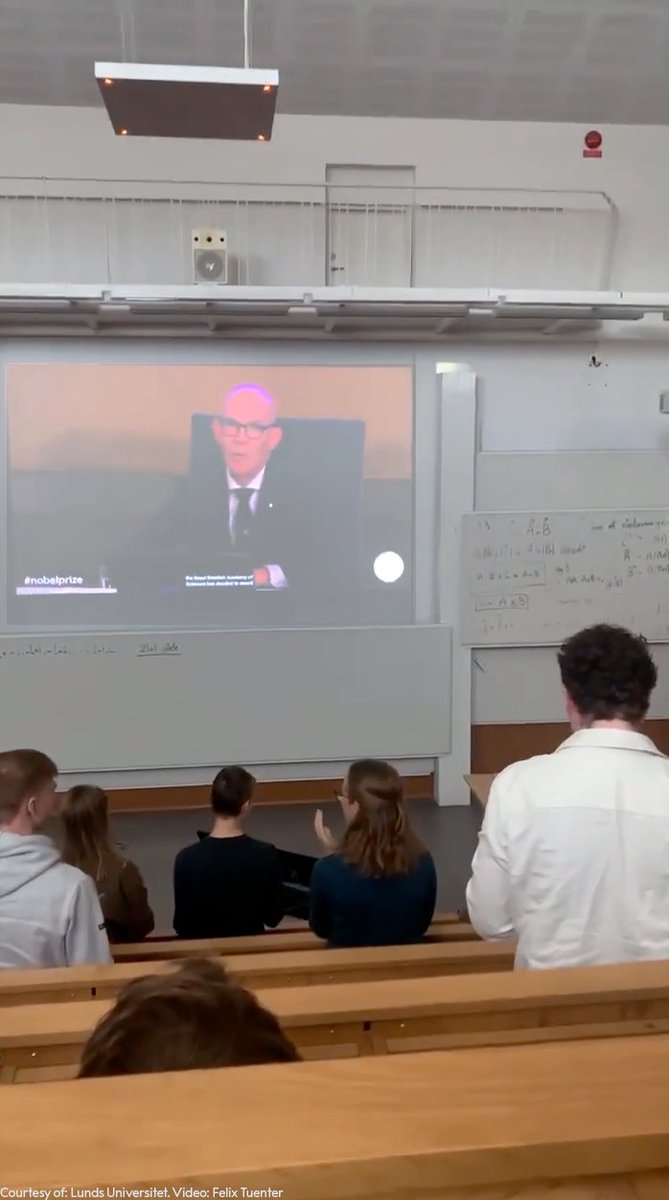
Annie L'Huillier was teaching the morning of the 2023 physics prize.
During a break, she got the news. Back in class, she told her students class would end early but gave no reason.
Suspicious, her students stayed to watch the announcement. They cheered when her name was said.
We'll be announcing the 2026 physics laureates on 6 October. Stay tuned to our channels to hear the news first.
"Unchained Melody" is one of the most recorded songs in music history, with over 1,500 versions performed in multiple languages by hundreds of artists, including Elvis Presley, Roy Orbison, and Gareth Gates.
Hay melodías capaces de detener el mundo. Ennio Morricone demostró que la perfección existe y se puede escuchar.
Ponte auriculares. Sube el volumen y cierra tus ojos. La belleza era esto. 🎻✨
#LaMision#Morricone