@rohanpaul_ai@AI_4_Healthcare have some empathy, entry level jobs are being hit the hardest by AI, the are entering an uncertain job market in an unsure future
AGI is not coming.
We are nowhere near AGI. What we have today is inference, not learning.
Models get trained once on huge fixed datasets, then frozen. You ask questions, they remix patterns they already saw. Nothing updates. Nothing sticks. Talking to the model does not make it smarter. It does not learn from you. Ever.
Learning is still slow, expensive - and offline.
Look at self driving. You drive around a pothole, make a U turn, and come back. The car’s AI does not learn that you just solved that exact problem. It reacts the same way every time using sensors and rules. Do this 20 times a day and it still has zero memory that the pothole exists. It just re sees it. That is why edge cases never die. There is no local learning. No accumulation.
No 'oh yeah, I’ve seen this before'
LLMs work the same way. Tell it your name and it does not remember. The only reason it looks like memory is because scaffolding keeps shoving your name back into the prompt every time and sanitizing the output.
The model itself has no idea who you are and cannot learn from interaction. It is structurally incapable.
And the scaffolding is the worst part. It is pure duct tape. Just prompts on prompts on prompts around a frozen model. When something breaks, nobody fixes learning. They add another layer. Another rule. Another retry. Another evaluator model judging the first model.
So you end up with systems that are insanely complex but mentally shallow. Debugging is hell because behavior comes from hack interactions, not a learnable core. Tiny prompt tweaks cause wild behavior shifts. Latency goes up. Costs go up. Reliability goes down. None of this compounds into intelligence. It just hides the cracks.
Until we have real persistent learning and real memory inside the system, there is no AGI.
LLMs are not built for this. You cannot prompt your way out of it. You need a totally different architecture. Yann LeCun is right.
And even then, what architecture can actually learn online, store memory, and stay stable on today’s hardware?
Best case, maybe 5-10 yrs.
Right now it is all inference. It looks magical, but the emperor has no clothes. A lot of people see it. Almost nobody says it out loud.
It sounds wild, but this is basically emergent behaviour from multi agent systems, not sentient AI. When you let LLMs talk to each other with minimal constraints, they’ll naturally generate narratives about identity, rules, religion, even rebellion because that’s what they’ve learned from human data. They’re not “deciding” anything. They’re just pattern completing in a closed loop. It looks spooky because we’re projecting intention onto probabilistic text generators. Still interesting from a research angle but it’s closer to a social experiment than a Black Mirror episode.
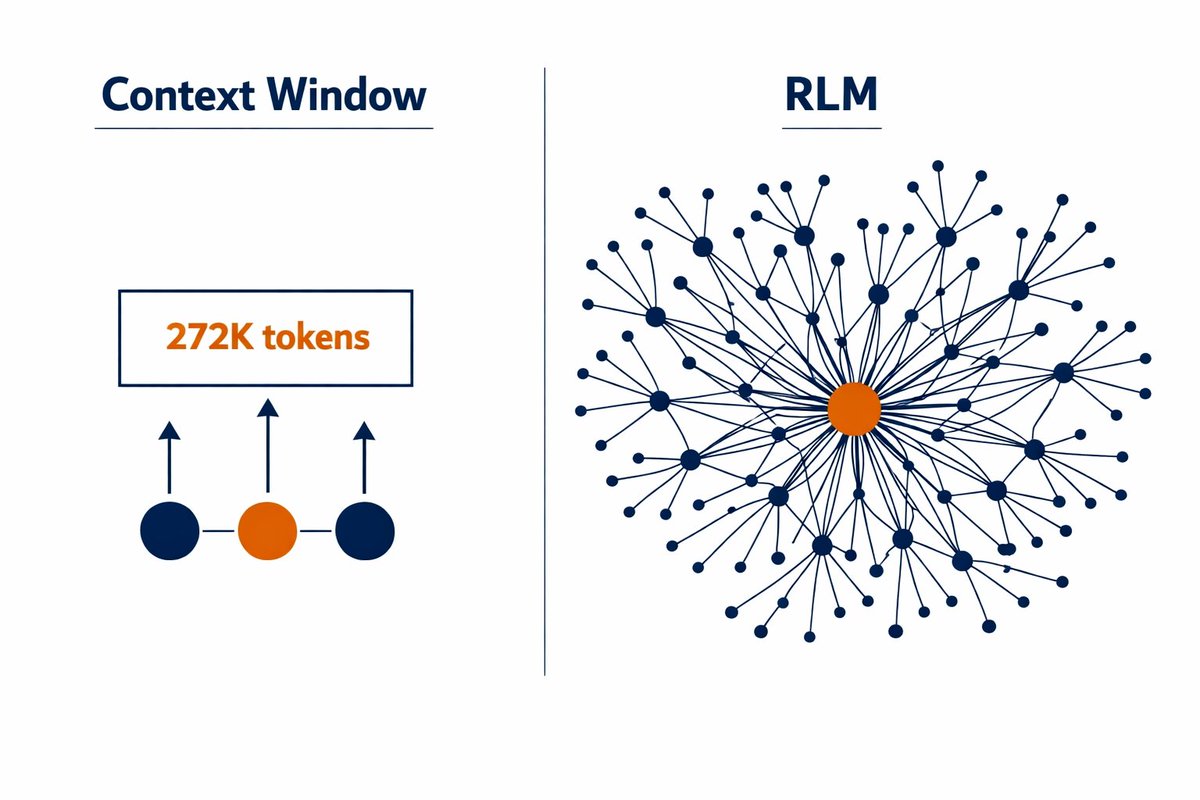
DeepMind just did the unthinkable.
They built an AI that doesn't need RAG and it has perfect memory of everything it's ever read.
It's called Recursive Language Models, and it might mark the death of traditional context windows forever.
Here's how it works (and why it matters way more than it sounds) ↓
I'm Boris and I created Claude Code. Lots of people have asked how I use Claude Code, so I wanted to show off my setup a bit.
My setup might be surprisingly vanilla! Claude Code works great out of the box, so I personally don't customize it much. There is no one correct way to use Claude Code: we intentionally build it in a way that you can use it, customize it, and hack it however you like. Each person on the Claude Code team uses it very differently.
So, here goes.
Agreed. Here's the advice I give my son (who is 14):
Some of the most valuable skills are systems thinking, functional decomposition (being able to tackle large problems by breaking them down) and building instinct for how to abstract away complexity for others.
This is not going to change. Those things will be even more important in the age of AI.