“The Soho Society, a group of residents established in 1972 aimed at “preserving the character of Soho”, voted in its AGM on Thursday for a new licensing mandate, meaning it will challenge all new applications for bars and restaurants in the area, including renewals of existing licences. It will also object to any venue that wishes to open beyond “core hours”, which Westminster council decrees end at 11pm.”
And we wonder why we have a youth unemployment problem
The AI Operating System for Companies
@sdianahu
The best AI-native companies have made their entire company queryable: every meeting, ticket, and customer interaction legible to an intelligence layer that learns from it.
Building this today requires brutal integration work, and there's no product that connects all this context into a single layer that can reason across it.
@thomasforth Why do you think this is ? My assumption would be it's a product of education choices for typical civil servant jobs.
Personally I have only ever really interacted with DST and found them fairly open to technical opinion but this is probably a filtered view.
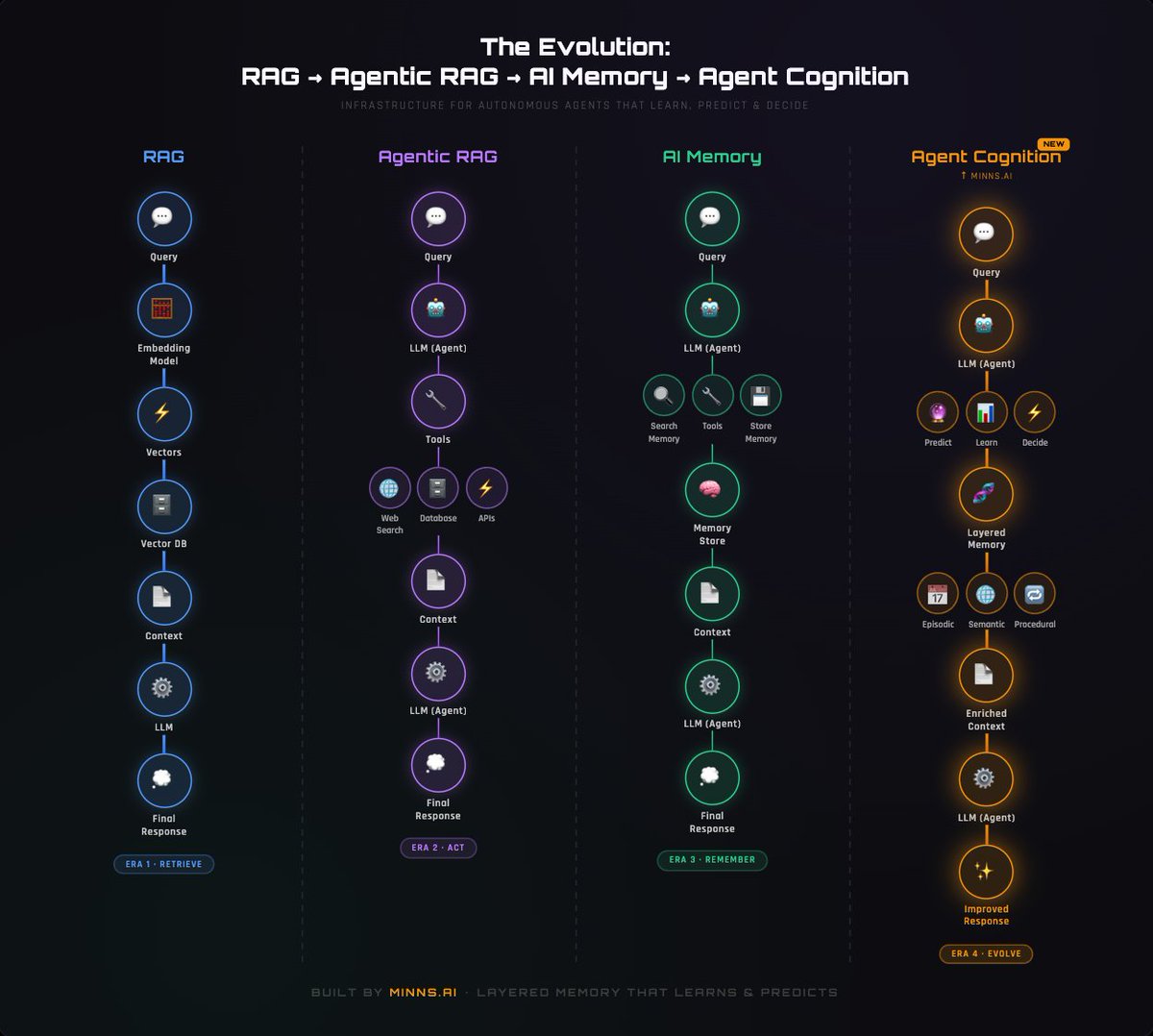
AI infra is moving fast 😮💨
RAG → retrieve knowledge
Agentic RAG → use tools
Memory → agents that remember
We looking towards whats next, agents that learn, predict, and decide.
Here’s how the stack is evolving
@ManusAI Can we plug in more advanced memory systems or is this closed source ?
I'd like to plug in https://t.co/GEGhAEyagQ so the agents learn over time like we did for openclaw.
@sama Open Claw has been great to experiment with. To make it production-ready, we need better shared memory and stronger security isolation. https://t.co/GEGhAEyagQ already helps swarms keep learning across sessions. Would love to see more ecosystem/security investment here.
Before LLMs, Palantir was competing with Snowflake and Databricks.
Post-LLMs, they do not believe they have any competitors. Why? Snowflake/Databricks optimized for SQL and query throughput: get raw data into tables, run fast analytical reads, ship dashboards and models on top. Palantir made a different bet: an ontology, a world model where data is represented the way humans actually reason about it (objects, relationships, properties; nouns/verbs/adjectives). Back then, that was built for government analysts trying to make sense of messy, interdependent systems.
Then LLMs arrived and the ontology suddenly looked like the perfect interface because models don’t want a trillion rows. They want a structured, language-shaped substrate: named entities, typed relationships, constraints, and “what interacts with what”, something you can linearize into a coherent prompt, traverse, and act on.
The bigger implication for decision traces is that the “context graph” problem we wrote about has multiple architectural solutions:
Platform-first (example: Palantir): prescribe the unified world model upfront. Pay the integration + ontology + embedded-team tax (months of use case discovery / workflow decomposition / “process mining”), and in return you get a substrate that can connect data to decisions because everything now lives inside the same model for an extremely absurd price.
Workflow-first (decision traces): don’t start by rebuilding the world. Instrument the moments where the world changes. Capture decision receipts at commit surfaces: inputs referenced, policy/constraints, exception path, approvals, action taken, outcome. Over time (not day 1), that write-time provenance becomes its own world model, learned from trajectories rather than imposed upfront (there will be many different methods here)
And importantly: this is still an ontology approach, just a different kind. Palantir prescribes the ontology first. Our take is that startups can learn it bottom-up from traces. You start by capturing what people actually do at the decision surface: what evidence is referenced, which approvals happen, what exceptions recur, what actions are taken, what outcomes follow and over time, infer the minimal set of entities + relations that explain those trajectories.
The missing piece is decision traces: without them, you have state, but not the legible “why”!! Cc @akoratana
Two things need to be squared. First, the justice system has absorbed sustained cuts over many years and is now path-dependent: capacity constraints are structural, and even significant new investment will take years to translate into higher throughput. As the report notes, funding alone will not quickly resolve the backlog.
Second, the vast majority of criminal cases are already tried without a jury at the magistrates’ level. Jury trials account for only a small proportion of total cases.
What is your alternative solution ?
@KarlTurnerMP Around 90% of UK cases are tried in the magistrates’ court before a bench of three magistrates and a legal adviser so no jury present already.
Admittedly it's not in the best part of the city but in Sheffield most buildings become student accommodation or spoons/pub.
In my opinion the major problem with Sheffield is that it is too focused on university/students hence why it has the highest vacancy rates 12.9% of any city centre in the UK.
One for the "yeah but do people *really* value beautiful buildings?" pile here. Also goes on the "rumours of Northern City renaissance are greatly exaggerated" pile. Of course the listing means we can't value the land value, but I bet it's very low.
@thomasforth@nicdc4 What is your opinion on following a Swiss model eventually. Where regions can set their own income tax levels and local level can set a multiplier of what is set at the regional level.
I understand the argument about fairness behind the child benefit cap. However, as a society, we should not condemn children to poverty simply because of the circumstances of their birth.
Looking after children strengthens the next generation, which is a net gain for society as a whole.
More local tax powers is great. I would much prefer the UK move to a system where there was national, regional and then town/city level tax. Where each layer has a fiscal responsibility.
My worry with centralised taxes being raised and if not spent on infra but on say opex it makes it harder for central government to devolve more tax powers in the long run.
Strong disagree. We need investment in infrastructure to enable growth. We can't afford that without taxes. Cutting taxes and thus investment would be a disaster for growth outside of South East England where the infrastructure has already been built by UK government generosity.