@michael_chomsky You make the assumption that people reacting to Richard's position on LLM consciousness read only the paywalled version.
I doubt they read even that much.
For those interested, here's the archived article in full:
https://t.co/SlmbMKAngo
New essay on the economics of structural change and the post-commodity future of work.
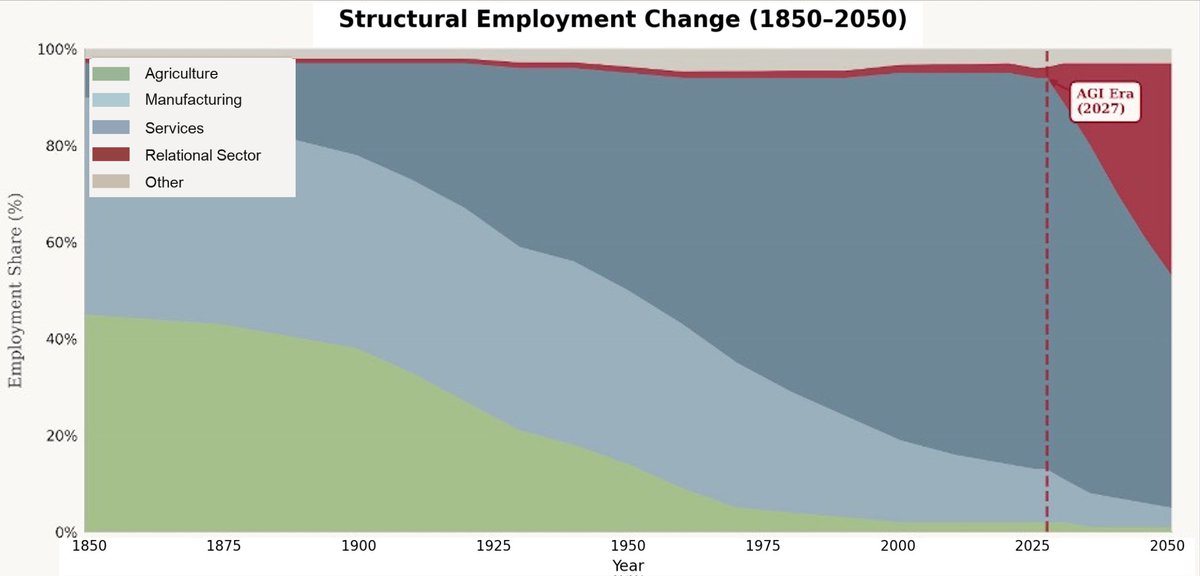
1. Almost any question about the impact of advanced AI on the economy needs to start at the same place: what is still scarce? Answer that, and the analysis becomes pretty straightforward. This essay explores what becomes scarce if AI really can replicate most of what humans do in production, and what this mean for the future of jobs.
2. My conjecture, working through the economics: labor reallocates across sectors, and the sector it reallocates to has properties that keep labor a meaningful share of the economy. Ultimately this is about the structure of demand itself. For this, we have to go back to Girard, Augustine and Rousseau: once people's base needs are met, their preferences shift to comparative motives (e.g., status, exclusivity, social desirability). This motive is inherently non-satiated.
4. The key paper is Comin, Lashkari, and Mestieri (Econometrica 2021). As people get richer, they don't buy proportionally more of everything. They shift spending toward sectors with higher income elasticity. They estimate income effects account for 75%+ of observed structural change.
5. The ironic consequence: the sector that gets automated becomes a smaller share of the economy, not a larger one. Agriculture got massively more productive and its share of employment collapsed. Manufacturing too. The "stagnant" sectors absorb the spending and the jobs.
6. So the question is: which sectors have high income elasticity in a post-AGI world? I argue it's what I call the relational sector. Categories where the human isn't just an input into production, it is part of the value.
7. Why does the relational sector have high income elasticity? Because human desire has a mimetic, relational dimension. We don't just want things for their intrinsic properties. We want what others want, and we want it more when others can't have it. Girard, Rousseau, Augustine, and Hobbes all saw this.
8. In work with Kristóf Madarász, we showed this experimentally: WTP roughly doubles when a random subset of others is excluded from the good. And in new work with Graelin Mandel, AI involvement kills the premium. Human-made art gains 44% from exclusivity; AI-made art only 21%.
9. This all comes together for the core argument. The sector that absorbs spending as AI makes commodity production cheap is one where human provenance is part of the value, and demand for it grows faster than income. Exactly the profile that keeps labor meaningful.
10. To be clear about the claim: I'm NOT saying aggregate labor share must rise. It may fall. The claim is about sectoral composition, i.e., where expenditure and employment go once commodities get cheap, and the fact that the sector that will absorb reallocated labor maps to a substantial component of human preferences and desire.
11. If you're interested in the formal model, a linked companion technical note works out all the economics.
Read the essay here: https://t.co/NcjVgn2o8g
I wish I could live a thousand lives so I could learn every single thing that is interesting to me, deeply, immerse myself within it. The world we live in is so beautiful, mundane things that you take for granted have great people, research and engineering behind it
Yesterday I did a thread on Argentina's regional personalities
A few Brazilians showed up in the comments like "you should do Brazil, we're WAY more diverse"
Fine. Challenge accepted
Let's talk about how Brazil is basically a mini world in and of itself 🇧🇷🧵
Yes. There's a difference between:
1. AI is human-level at everything we have great training data on and can easily verify success / failure on. [But can't learn in the real world, needs enormous data, can't generalize beyond training set, etc..]
&
2. AI can figure out novel problems like humans can, on as little data.
We have 1 or something fairly close to it. It's incredible. It's valuable. It's changing the world. We still haven't absorbed what we have. It's not AGI.
We don't yet have 2. That's AGI, or at least much closer to it.
A bespoke software revolution? I don't buy it.
It'll exist. It already exists. Small consultants and big consulting firms have made custom software for years. It almost always sucks. It’s bloated, confusing, and because the client pays, it’s built wrong in all the ways.
Who’s excited about bespoke software? Software makers! Of course they're excited about building bespoke software — that's what they do. X is full of them. Your feed is full of people who love making software talking about making software. Of course they’re excited about the revolution. Echo, echo, echo...
Most people don’t like computers. Nobody in tech wants to say that out loud. People tolerate computers. They use them because they have to. Given the choice, most would rather not think about them at all.
So when someone suggests that AI means everyone will build their own custom tools, ask who "everyone" is. The three-person accounting firm drowning in client paperwork? They want the paperwork gone, not a new system to maintain. The regional logistics company with 40 trucks? They want the routes optimized, not Joe spouting off about this new system he’s been messing around with. The law firm billing 70-hour weeks? They want leverage on their time, not a software project to design.
They don’t hate technology. But building and maintaining their own critical systems isn’t their wheelhouse, regardless of how much faster and easier it’s become. It's another job on top of the job.
Will these people use AI? Absolutely, for all sorts of things. Will some outliers go deep and build real custom systems? Sure, but they're almost always people who already had some pull toward software. The curiosity was already there. They were dabblers before.
Giving everyone access to software building tools doesn't mean everyone becomes a builder. A powerful excavator doesn't turn a homeowner into a contractor. Most people just want the hole dug by someone else. They don’t want the responsibility either.
eu nunca tinha ouvido o professor Clóvis contar essa história, mas acredito que se passou exatamente desse jeito por causa de uma experiência que eu tive.
TL DR: Continous learning, experimenting and building like a child will give you the clarity, joy and peace just like a child & an added bonus of competence that will make you a force to be reckoned with.
Not to mention it makes you develop highly valuable skills for life.
@yoemsri They built the machines, got briefly replaced by people writing glue code for 15 years, and now the machines are giving the field back to them.
Poetic justice.