Further proof that engagement at the other place is similar to here.
As of this morning, we have ~300 retweets at both platforms, with about 25% more 'likes' on the first tweet here, and about 25% more likes deeper in the thread there.
Also...that UI is a ~perfect clone, hah
Thrilled to share this: hand to hand with the amazing @F_Mikus and @HiralABShah , with incredible guidance from @CentrioleLab , @Dey_Gautam , and @dudin_o , we’ve unlocked the cytoskeletal secrets of 200 protists! 🦠 #protists#PlanExM#UExM 👇https://t.co/SjXKknJJwj
Here’s a cool study that found that direct PCR (putting cells directly into the PCR mix) can be used for DNA barcoding marine and freshwater microalgae from liquid culture, saving a lot of money and time compared to conventional DNA extractions.
⭐ A key step for some strains is to give the algal suspension a quick centrifuge and resuspension in sterile distilled water. This removes PCR inhibitors carried over from the growth media (e.g. salt for marine algae), and concentrates the algal cells, resulting in better success and significantly brighter amplicons.
⭐ Another important step was to sample the microalgae when they are actively growing during their daily growth cycles, with successful amplifications being achieved during the logarithmic phase to stationary phase.
The authors tested this approach on 8 different species of algae and found that all produced amplicons for 3 different barcoding gene regions (ITS, rbcL, and tufa).
It may seem like a small discovery, but this method by Fei et al. (2020) could make it much easier for researchers, students, or the scientifically curious, to investigate these amazing microscopic organisms for taxonomic, ecological and industrial purposes using PCR and sequencing.
And, given how many species of algae there are (around 50,000 described, and maybe up to 800,000 in total), and how important they are ecologically and to industry, the easier it is to amplify and sequence their DNA the better!
You can find the article here:
Fei et al. (2020). A quick method for obtaining high-quality DNA barcodes without DNA extraction in microalgae. Journal of applied phycology, 32, 1165-1175.
https://t.co/3bUHFdTscL
On the same theme, Fitriyah et al. (2021) suggested that a microalgae cell suspension could also be subjected to a cycle of heating and cooling in the thermocycler before centrifugation to break down cell walls, and used a PCR-inhibitor resistant PCR master mix (MyTaqTM MIX from Meridian Bioscience):
Fitriyah et al. (2021, December). Improved direct lysis PCR amplification method of microalgal culture for sequencing and species identification. In IOP Conference Series: Earth and Environmental Science (Vol. 948, No. 1, p. 012013). IOP Publishing.
https://t.co/xRWQ4fnz8J
And Kawamura et al. (2022) found that both direct PCR, and a simple crushing and heating/cooling method, worked well for PCR of the colony-forming freshwater microalga Botryococcus braunii using EmeraldAmp® Max PCR Master Mix (TaKaRa, Japan):
Kawamura et al.. (2022). BoCAPS: Rapid screening of chemical races in Botryococcus braunii with direct PCR-CAPS. Algal Research, 66, 102789.
https://t.co/dR5XyvfegF (subscription only, but also available here: https://t.co/bn0zf5QAbQ )
Image public domain, credit to University of Rhode Island/Stephanie Anderson. - NASA Earth Expeditions
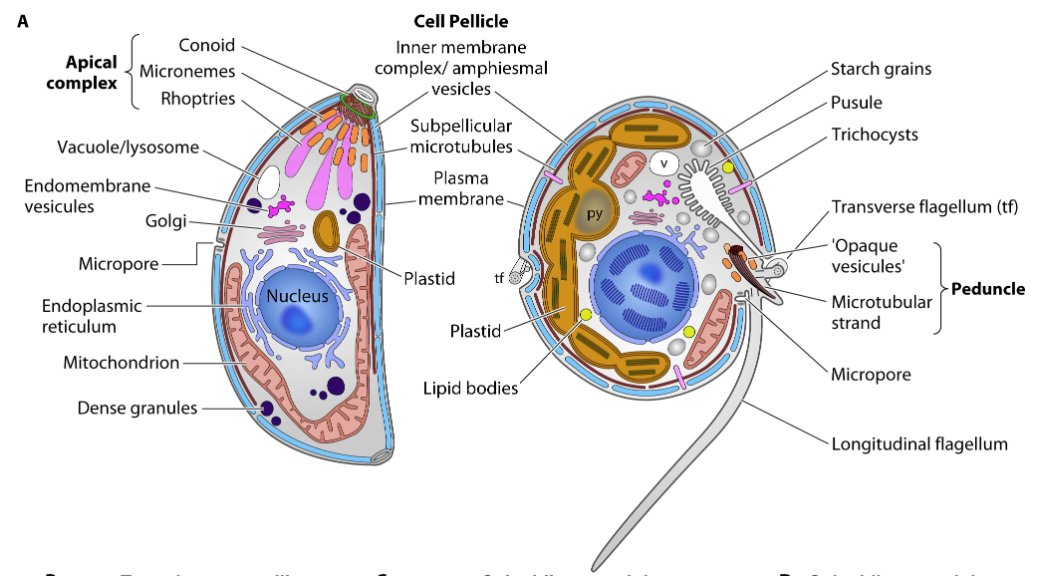
@VernCarruthers and I had a great time writing this review pondering the versatility of key adaptations common to #apicomplexans, #dinoflagellates and other myzozoans that have made this group so prolific and successful. (1/3)
https://t.co/RvIRPK1vDA
The first report on Hexamita nelsoni a Diplomonad trophozoite parasite in Blue mussels. By Anders Alfjorden and @fburki from @SystBio_UU
https://t.co/hp86QERvaK
🧬 New insights into microbial genomics! Comparing SAGs and MAGs reveals that Single Amplified Genomes (SAGs). although more costly, better reflect microbial abundance and diversity with less contamination, while Metagenome-Assembled Genomes (MAGs) excel at capturing rare microbes. Both methods have unique strengths in uncovering Earth's hidden diversity! 🌍🔬 #diversity #Genomics Congrats @chang_tianyi@stepanausk8197 & all authors!
👉https://t.co/aKWjp9JX54
Excited and proud to share our preprint!
A network of glycan sensing controls endosymbiosis in the protist, Paramecium bursaria 🦠 This includes an ancient eukaryote immune-like factor, and prokaryote proteins acquired via horizontal gene-transfer!
1/10
https://t.co/6RWrXZ7xkH
COMING SOON – New article submission platform! We’re switching to Research Exchange which will provide a simpler process for submitting your paper. No more copy/pasting abstracts, author lists – the platform will do it for you!