Es pot entrevistar Garzón sobre lawfare, aquell jutge que pels JJOO va perseguir i empresonar independentistes, que van ser torturats, i se’n va desentendre? O no tenen memòria o no tenen vergonya!
All Future of Mathematics Symposium talks are now available on Youtube, linked below.
Day 1 talks:
Leonardo de Moura, Amazon
Clark Barrett, Stanford
Michael Freedman, Harvard
Kevin Buzzard, Imperial
Andrea Bertozzi, UCLA
Adam Brown, DeepMind
Deirdre Haskell, Fields Institute
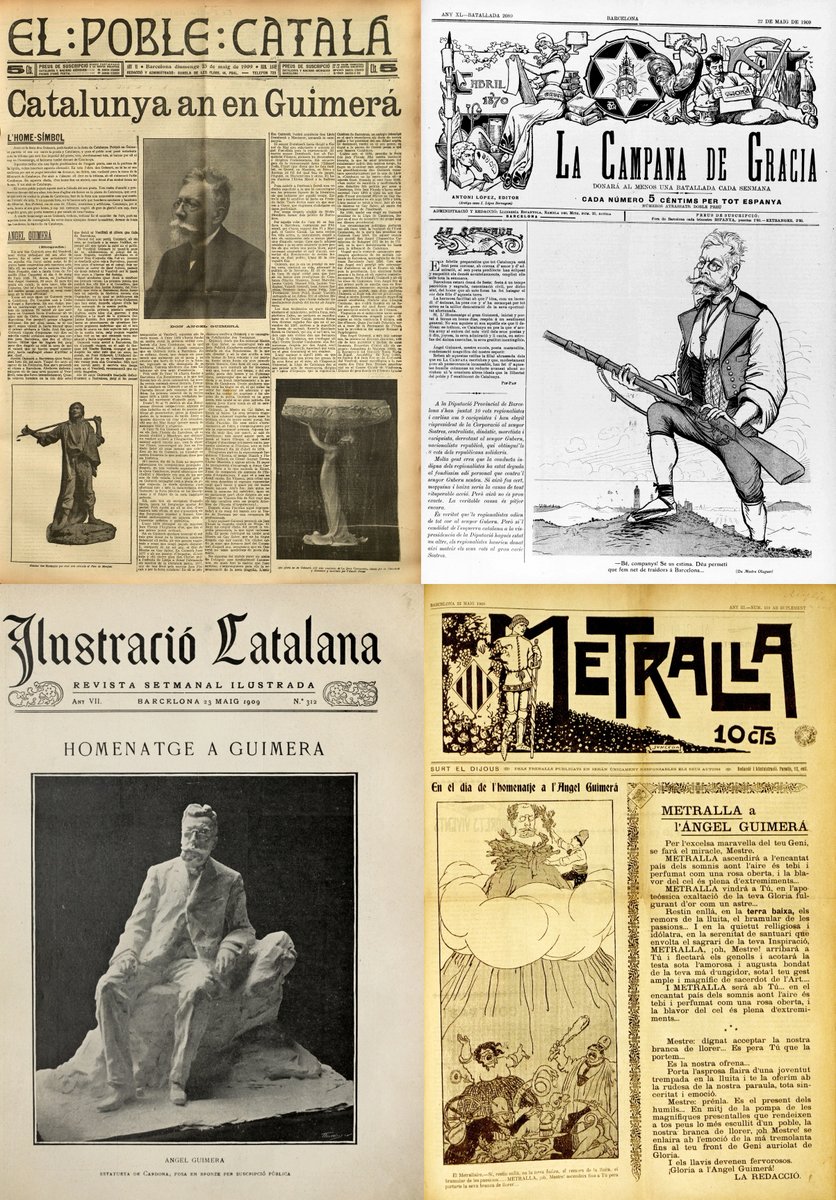
"—Bé, companys! Se us estima. Déu permeti que fem net de traidors á Barcelona."
#Taldiacomavui de 1845 va néixer un pioner de l'independentisme català, escriptor candidat al Nobel i amic de Gaudí: Àngel Guimerà, que el 1909 rebé un gran homenatge vist així per la premsa. Fil 🔥
A MIT professor gave a 1-hour lecture in 2019 that has 18 million views.
He died 5 months after recording it.
It was his final gift to the world.
Patrick Winston taught at MIT for 50 years.
The smartest engineers on earth sat in his classroom.
And he spent his last lecture teaching them the one skill their degrees never covered.
How to speak.
15 lessons that will change how you communicate forever:
Never open with a joke. Your audience is not ready to laugh yet. Open with a promise of what they will know by the end.
Your ideas are like your children. You are too close to them. What is obvious to you is invisible to everyone else. Explain the obvious.
The 5-minute rule: the first 5 minutes of any talk determine whether people will listen for the next 55. Spend more time on your opening than anything else.
Repeat your most important idea 3 times in 3 different ways. Once is never enough.
Build a fence around your idea. Tell people what it is NOT before you tell them what it IS.
Verbal punctuation. Pause. Let the idea land before moving to the next one.
Ask questions nobody will answer. Then wait 7 seconds. The silence is not awkward. It is processing.
Never read your slides. Your audience can read. They cannot listen and read simultaneously.
Use the board not the slides. Writing forces you to slow down. Slowing down forces clarity.
Inspire before you inform. Nobody learns from someone they are not inspired by.
End with a contribution not a summary. Tell them what you gave them. Not what you said.
Never say thank you at the end. It is weak. End with something that lands.
Stories make ideas stick. Data makes ideas understood. You need both. In that order.
The quality of your communication determines the quality of your ideas in the eyes of the world. Not the ideas themselves.
Practice is not preparation. Practice IS the skill.
Patrick Winston understood something most people spend their entire careers missing.
Your ideas are only as powerful as your ability to transfer them into someone else's mind.
You can be the smartest person in the room and be completely invisible.
Or you can master communication and make average ideas feel like breakthroughs.
He chose to spend his last lecture teaching this.
Watch it tonight.
Bookmark this first.
Follow @cyrilXBT for more lessons from the people who built the future.
In 1948, a 32-year-old at Bell Labs published a paper nobody fully understood.
Engineers found it too mathematical. Mathematicians found it too engineering-focused. One prominent mathematician reviewed it negatively.
That paper - "A Mathematical Theory of Communication", became the founding document of the digital age.
The man was Claude Shannon. Father of Information Theory.
At 21, he wrote the most important master's thesis of the 20th century.
Working at MIT on an early mechanical computer, Shannon noticed its relay switches had exactly two states - open or closed. He had just taken a philosophy course introducing Boolean algebra, which also operated on two values: true and false.
Nobody had ever connected these two things.
His 1937 thesis proved that Boolean algebra and electrical circuits are mathematically identical, and that any logical operation could be built from simple switches.
Howard Gardner called it "possibly the most important, and also the most famous, master's thesis of the century."
Every digital computer ever built traces back to this insight.
At 29, he proved that perfect encryption exists.
During WWII, Shannon worked on classified cryptography at Bell Labs. His work contributed to SIGSALY, the secure voice system used for confidential communications between Roosevelt and Churchill.
In a classified 1945 memorandum, he mathematically proved the one-time pad provides perfect secrecy, unbreakable not just computationally, but provably, permanently, against an adversary with infinite power.
When declassified in 1949, it transformed cryptography from an art into a science. It laid the foundations for DES, AES, and every modern encryption standard.
At 32, he defined what information is.
His 1948 paper introduced one equation:
H = −Σ p(x) log p(x)
Shannon entropy. The average uncertainty in a probability distribution. The minimum bits required to encode a message.
Three things followed:
> He defined the bit - the fundamental unit of all information. His colleague John Tukey coined the name.
> He proved the channel capacity theorem, every communication channel has a maximum rate of reliable transmission. You can approach it. You can never exceed it.
> He unified telegraph, telephone, and radio into a single mathematical framework for the first time.
Robert Lucky of Bell Labs called it the greatest work "in the annals of technological thought."
Where his equation lives in AI today:
Cross-entropy loss - the function training every classifier and language model, is derived directly from H. Decision tree splits use information gain, which is H applied to data. Perplexity, the standard LLM evaluation metric, is an exponentiation of cross-entropy.
Every time a neural network trains, Shannon's formula runs inside it.
He also built the first AI learning device.
In 1950, Shannon built Theseus, a mechanical mouse that navigated a maze through trial and error, learned the correct path, and repeated it perfectly. Mazin Gilbert of Bell Labs said: "Theseus inspired the whole field of AI."
That same year he published the first paper on programming a computer to play chess. He co-organized the 1956 Dartmouth Workshop, the founding event of AI as a field.
The man:
He rode a unicycle through Bell Labs hallways while juggling. He built a flame-throwing trumpet, a rocket-powered Frisbee, and Styrofoam shoes to walk on the lake behind his house.
He called his home Entropy House.
When asked what motivated him: "I was motivated by curiosity. Never by the desire for financial gain. I just wondered how things were put together."
In 1985, he appeared unexpectedly at a conference in Brighton. The crowd mobbed him for autographs. Persuaded to speak at the banquet, he talked briefly, then pulled three balls from his pockets and juggled instead.
One engineer said: "It was as if Newton had showed up at a physics conference."
He died in 2001 after a decade with Alzheimer's, the cruel irony of information slowly leaving the mind of the man who defined what information was.
Claude, the AI model, is named after Claude Shannon, the mathematician who laid the foundation for the digital world we rely on today.
Here are some of the top mathematicians’ accounts on X (formerly Twitter), based on prominence in the field, follower counts, activity, influence in math communication/research discussions, and mentions across sources like Reddit threads, AMS blogs, Quora, and science media roundups. “Top” here focuses on active or notable accounts from professional mathematicians (Fields Medalists, professors, authors, etc.), rather than purely historical figures or broad science popularizers.
Note that many leading mathematicians (e.g., Terence Tao) are more active on Mathstodon (the math-focused Mastodon instance) than on X, and some have reduced activity on X over time. X handles can change, and activity varies.
Highly Prominent/Research-Oriented Mathematicians
•@stevenstrogatz — Steven Strogatz (Cornell professor, author of popular math books like The Joy of x). Known for clear explanations of complex topics, nonlinear dynamics, and engaging threads. One of the most followed math accounts (~174k followers).28
•@littmath — Daniel Litt (University of Toronto, algebraic geometry/number theory). Frequently discusses math research, AI progress in math, and shares insights as a “tireless math ronin.” Highly regarded for clarity (~56k followers).29
•@wtgowers — Timothy Gowers (Fields Medalist, Collège de France/Trinity College Cambridge). Posts on combinatorics, math research, AI in mathematics, and broader issues. Influential in the community.53
•@JSEllenberg — Jordan Ellenberg (University of Wisconsin, author of How Not to Be Wrong and Shape). Shares number theory, geometry, and accessible math enthusiasm.66
•@edfrenkel — Edward Frenkel (UC Berkeley, author of Love and Math). Discusses math, its beauty, and intersections with culture/AI.9
•@JohnDCook — John D. Cook (applied math consultant). Shares daily math/stats/probability tips, facts, and practical insights via his personal account and specialized tip accounts. Praised in math communities for usefulness.97
Popularizers, Communicators, and Educators
These accounts often blend deep math knowledge with outreach, puzzles, memes, or applications:
•@standupmaths — Matt Parker (stand-up mathematician, YouTuber, author). Fun, humorous takes on math, puzzles, and “maths clown” energy. Strong following among enthusiasts.76
•@FryRsquared — Hannah Fry (UCL professor, broadcaster, author). Popular math/science communication, often on probability, data, and real-world applications. Very engaging style.106
•@Anthony_Bonato — Anthony Bonato (Toronto Metropolitan University). Math, graph theory, memes, and book-related posts.34
•@mathematicsprof — Former math professor sharing reflections and insights (higher follower count but more personal/retired vibe).30
Other Notable Mentions
•@nntaleb — Nassim Nicholas Taleb (probability, risk, applied math/philosophy). High-profile but often broader than pure math.8
•@IAmTimNguyen — Timothy Nguyen (mathematician/ML researcher at Google DeepMind, podcast host). Discusses math, physics, and critiques.90
•Accounts like @Quora or community lists sometimes highlight others (e.g., Evelyn Lamb @evelynjlamb for writing, or historical-focused ones), but the above are more consistently recommended.36
For pure research depth, follow Fields Medalists or specialists like those above. Many also cross-post or link to blogs/arXiv. If you’re interested in specific subfields (e.g., number theory, applied math, AI+math), let me know for more tailored suggestions—recommendations evolve with activity levels.
X isn’t the primary platform for all top mathematicians (Mastodon/Mathstodon is popular for rigorous discussions), but these accounts stand out for quality content. Search their names directly on X for the latest.
Ens ha deixat Blanca Serra, activista incombustible de l'esquerra independentista i afiliada a La Intersindical. El seu compromís ferm amb la defensa de la llengua catalana, la lluita per la independència i la memòria històrica, són un exemple de lluita i de dignitat. Descansi en pau.
https://t.co/j01CiNIp5j
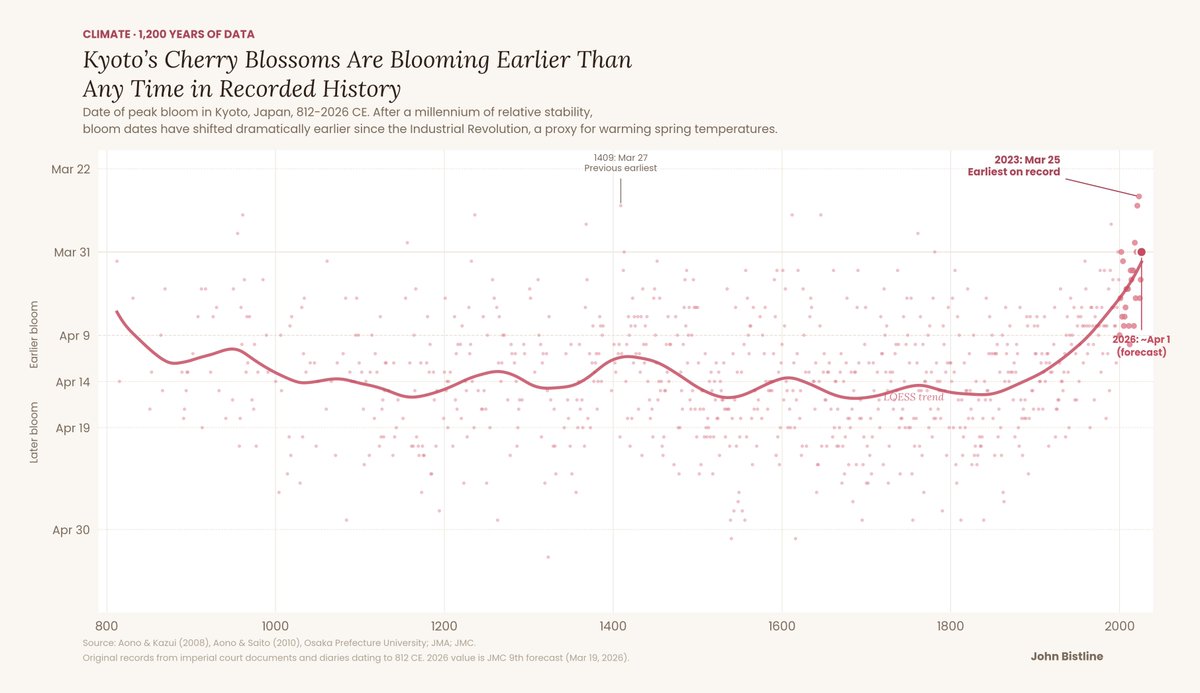
This is my favorite climate change chart. Japanese monks, aristocrats, and emperors kept meticulous records of cherry blossom festivals for 1,200 years and accidentally built the world's longest climate dataset.
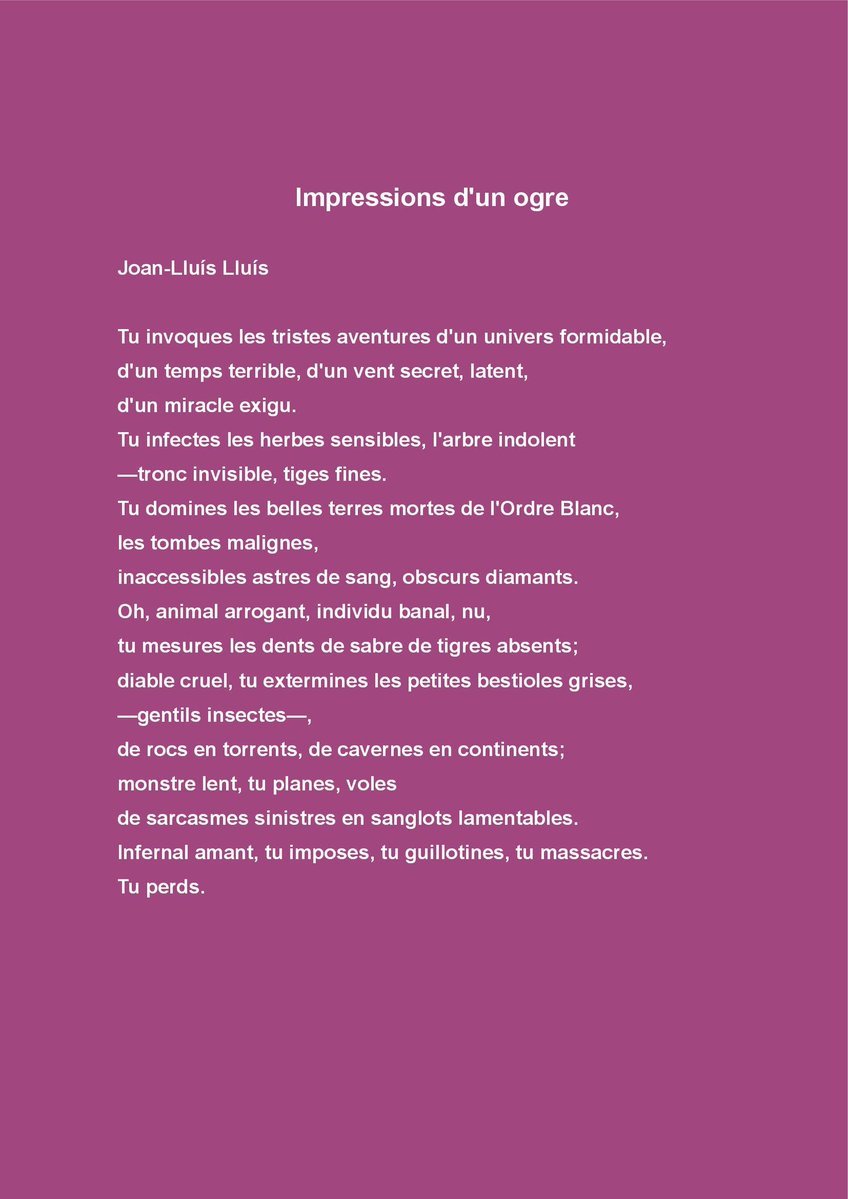
Els francesos fan les innocentades el 1r d'abril. Així doncs, a tall d'"homenatge" (ehem) i per primer cop en 35 anys he escrit un poema en francès: és en francès, sí, i alhora no ho és gens!
Més que un poema és un exercici d'estil (per això la qualitat literària és secundària).
Semblava impossible millorar l'estrena de POLS A L'ERA, però VIROLAI l'ha superat amb escreix! La catalana terra rebrota sempre i sobreviu als seus il·lusos enterradors.
OBESES - Virolai
https://t.co/J6bRlzcu1b
⚠️🐗 21 nous casos de pesta porcina africana. 216 en total, 1 a Sant Just Desvern.
L’anunci de la nova zonificació ha servit per deixar de declarar els positius fora del radi de 6km, que cada cop són més.
➡️ Radi 6km que deien tenir perimetrat, cosa que la nova zonificació no ho està. La malaltia avança i el departament es fa trampes al solitari mentre el que està en joc és un sector vital per Catalunya.
➡️ Mapa del Ministerio, el @govern no en publica.
La IA ha resuelto un problema en Teoría de Computación que Don Knuth no conseguía resolver.
Vencer a Don Knuth viene a ser como si alguien le hubiera ganado 10 partidos seguidos en tierra batida al prime Nadal.
"Creo que tengo que revisar mis opiniones sobre la IA..." 😱
En relació amb alguns titulars sobre la intervenció de Sir Tim Berners-Lee al #TalentArena d'ahir, em limito a deixar-vos aquestes dues fotos.
L'altre senyor és Vinton Cerf, premi internacional Catalunya de 2019.