@tiagotatamotors my Tiago EV connects to iRA EV app last three years. Suddenly not connecting.
Oshiwara Mumbai service centre has no idea.
They are saying “Log out and try”
“Uninstall app and try “.
eKYC to be done??
Please inform them on steps to be taken.
@tiagotatamotors gave Tiago EV for service at Oshiwara Mumbai. 27Aug. Car kept 2 days but…
Two injury and safety related repairs not carried out. Car going again tom 31Aug
Please ask service personnel to pay attention to repairs.
I studied in RSS-run Vidya Bharati schools from nursery to Class 8. My father sat in the Akhil Bharatiya Pratinidhi Sabha (the highest decision-making body of the RSS). Our house had the Ram Charit Manas, the Geeta, all four Vedas, and shelves of RSS literature. The school library had more.
In all those years I never once heard the word Manusmriti.
Not because it was defended. Because it was irrelevant.
Rahul Gandhi grew up on comics (Not Chach Chaudhary but the one imported from the UK). I would be surprised if he had read the Bible, growing up. So when someone read him selective shlokas from a Manusmriti over a depressing weekend, he thought he had cracked open the secret operating manual of a billion Hindus. He found a nothing burger.
Mark this post. Count how many times he says "Manusmriti" during the 2029 campaign. My prediction: zero. By then he will have worked out that it matters to no one. But by then it will be too late. The Left will have burned another cycle on a low IQ leader who cannot tell an exposé from a nothing burger.
So let me put it to the only people who would actually know.
If you went to a Vidya Bharati school: did you ever read Manusmriti? Was it assigned, mentioned, or on any shelf?
And if not, then how old were you when you first heard the name, and who brought it up? In what context?
Answer honestly, even if it cuts against my argument. Let's help a low IQ opposition because whether you like him or not, a democracy needs robust opposition.
Having grown up among Hindus, and having my closest friends(who are family), I have not had one single interaction in my life, where they have mentioned about Manusmriti or their homes had the book of Manusmriti on their book shelves or even in their Mandirs.
I don't know any conversation in my life till know, whether political, whether ideological, whether religious, where my Hindu friend, acquaintance or opponent, has brought up any verse from the Manusmriti.
In my online debates, with thousands, no Hindu has even remotely mentioned about the Manusmriti. My leftist Hindu friends have never brought it up, their strong difference with me continues to be our differing views on our Prime Minister,Mr Narendra Modi.
My right wing friends, have not in any debate mentioned the words Manusmriti. Even hardline right wing followers have never left a reply under my tweets, mentioning Manusmriti.
My everyday life in Pune since childhood is lived amongst a Hindu Majority and in all my experiences, there is no symbology I have seen in public spaces, where there is any imprint of verses from the Manusmriti.
My closest Hindu friend is an Atheist and co-incidentally, his name is Rahul too. My son is surprised that how come Rahul Chachu is an Atheist and still be a Hindu and not face any backlash from his community, rather it is treated as a matter of choice.
I told him, that is the beauty of the faith he is born to, he can be a Hindu, regardless of his views on his faith, a privilege which Abrahamic children of India will never have.
He can be a Hindu and be among those millions and millions of Hindus, who have never even heard about the Manusmriti and are reminded every now and then of it, by Leftist Hindus and now by the opposition leader of India, Mr Rahul Gandhi.
A believer like Narendra Modi is a Hindu and Rahul Gandhi who attacks the Manusmriti, he too, is seen as a Hindu by the 1 Billion Hindus of India.
Durante mi militancia en el marxismo asistí a muchísimas charlas. Y con el tiempo empecé a notar un patrón muy interesante:
Podíamos pasar diez horas hablando de cómo tomar el poder.
Diez horas hablando de revolución, de estrategia, de organización, de activismo, de cómo derrotar al enemigo de clase, de cómo transformar las relaciones de poder.
Pero había una pregunta que nunca aparecía:
¿Y después qué?
Es decir:
¿Cómo vamos a crear riqueza?
¿Cómo vamos a organizar los incentivos?
¿Cómo vamos a asignar recursos escasos?
Silencio.
Y fue ahí cuando lo entendí.
El marxismo tiene una obsesión patológica con conquistar el poder y una pobreza extraordinaria de respuestas sobre cómo utilizarlo para construir una sociedad funcional.
La revolución está perfectamente descrita.
La sociedad posterior, en absoluta oscuridad.
Porque decir que algún día llegará una sociedad sin explotación, sin clases y sin contradicciones es muy fácil.
Lo difícil es explicar cómo llegas hasta ahí sin destruir en el camino los mecanismos que permiten a una sociedad producir y prosperar.
Y cuanto más preguntaba, más evidente se volvía.
El marxista podía explicarte durante horas quién tenía la culpa.
Pero cuando preguntabas cómo funcionaría concretamente esa nueva sociedad, las respuestas se hacían más oscuras.
Y quizá por eso, cuando intentaba ahondar en estos temas, la conversación siempre volvía al mismo lugar: cómo tomar el poder. No pasaban de eso.
Por eso hoy, cuando escucho a alguien hablar durante horas sobre la explotación, destruir el sistema y construir una sociedad nueva, mi primera pregunta es:
¿Cómo vas a hacerla funcionar?
Nunca verás a un marxista responderte esto porque literalmente no puede, no sabe.
Entonces deduce que, al igual que como con cualquier otra estafa piramidal, cuando hagas preguntas directas y concretas al marxismo, este intentará evitar en todo momento darte respuestas claras.
Nunca lo olvides.
Vivek Raghavan Ji just made TIME100 AI 2026, the list of the 100 most influential people in AI on Earth.
Before Sarvam, this man spent 12 years building Aadhaar, the world's largest biometric ID system, serving 1.4B people.
Alongside co-founder and CEO Pratyush Ji - IIT Bombay, PhD from ETH Zurich, IBM Research, Microsoft Research, IIT Madras faculty, they built AI4Bhārat at IIT Madras first.
TIME did not put Vivek on a list with Sam Altman, Dario Amodei, and Fei-Fei Li because he ran a good PR cycle.
Building foundation models for 22 official languages and 100s of dialects, on a fraction of the compute and capital OpenAI / Google DeepMind have, is not "just wrapping GPT." :))
Congratulations, Vivek ji. Congratulations, Pratyush ji. Keep building.
Bharat is rising 🙏🙏
MANUSMRITI:
The real question is not whether the Manusmriti is good or bad. Right or wrong.
It is why, in 2026, anyone with enormous public influence feels compelled to defend a text that has virtually no authority over the life of any Indian today.
A book that nobody reads, nobody practices, and that has no meaningful place in the everyday lives of most Indians does not need to be rehabilitated.
You cannot change the cultural meaning of Manusmriti by repeatedly insisting that people have misunderstood it. Some battles are not lost because the argument is weak, they are lost because the historical baggage has become inseparable from the object itself.
We don’t spend our energy trying to restore the reputation of every ancient text, that history has left behind. We study them, understand them, debate them. And then decide what deserves a place in the present.
Perhaps the more intellectually confident position is this:
Read Manusmriti if you want to understand history. Critique it if you find it intellectually interesting. But why make its defence a cause in contemporary India?
The future does not need to inherit every idea from the past.
And defending an irrelevant past can sometimes make you look far more regressive than the past itself.
Can you guess what number is this? 228
Not the number of districts. Not a ranking. Not a budget figure.
That is the number of countries a village artisan can now ship a handmade product to straight from a post office counter.
Not through a private courier. Not through an export consultant charging fees no small business can afford.
Through the same post office your grandparents used to send a money order.
The scheme: Dak Ghar Niryat Kendra...
Launched only in December 2022, barely 3 years old, and almost nobody outside a handful of MSME circles has heard the name.
Here is the problem it quietly solved:
- For decades, if you were a small artisan / a home-based business / a rural manufacturer wanting to sell abroad, exporting was practically closed to you
- You needed customs brokers, freight forwarders, paperwork nobody had ever explained to you in a language you understood
- And costs that made a ₹2,000 handicraft order simply not worth the hassle. Exporting was something only big companies with dedicated logistics teams could realistically do.
What changed...
- 1,000+ Dak Ghar Niryat Kendras are now operational across the country reaching not just metros.
- Towns like Mangaluru, Dimapur in Nagaland, and villages across Odisha, turning the local post office into a genuine 1 stop export counter.
- Online customs documentation, IGST refunds, packaging, and shipment booking, all from a single counter a small business owner already knows and trusts.
And in Jan 2026, the govt extended actual export incentives: Duty Drawback, RoDTEP, and RoSCTL to shipments sent through the postal channel for the first time ever.
Before this, those benefits were mostly reserved for exports through ports, airports, or private couriers, meaning a small artisan shipping through a post office was, for years, quietly excluded from the same tax rebates a big exporter got automatically.
A small, real example of what this looks like on the ground...
In Mangaluru alone, in just the initial weeks of one division's rollout, small exporters were already shipping herbal products, cashew, and handmade goods abroad, businesses that had never exported anything in their lives before this counter existed a few kilometres from their home.
Why nobody talks about this loudly:
There's no ribbon-cutting for "a woman making handloom textiles in a small town just shipped her first order to Germany." It's not a rocket, not a chip, not a highway. It's a counter at a post office that used to only sell stamps, now quietly turning home-based Indian businesses into international sellers.
Bharat is rising. 🙏🙏
PS: A few might have a question that how come 228 countries? UN designates only 195...The answer is Postal services (including India Post) do not limit themselves to sovereign countries. Examples include: Hong Kong, Macau, Puerto Rico, Greenland, French Guiana, Guernsey, Jersey, Aruba, Curaçao, etc...
Every EV, every solar storage system, every phone battery on Earth runs on lithium and India has almost none of it domestically.....
Lithium, cobalt, nickel all imported, all subject to global price swings and geopolitical chokepoints, the exact same vulnerability with rare earth magnets.
Dr. Vilas Shelke and Dr. Manjusha Shelke, a husband-wife scientist duo, founded a company called Rechargion Energy in 2021. Rechargion is trying to make that dependency optional by building battery cells that need none of those three metals at all.
Dr. Manjusha Shelke is also a Chief Scientist at CSIR's National Chemical Laboratory, India's premier government chemistry research institute.
This is not a garage startup pivoting into hardware, it is an official spin-off from NCL, built directly on the work of Shelke's own research group, which is why the science checks out rather than being marketing.
Sodium-ion batteries using sodium instead of lithium as the ion that moves and stores charge....
The company has patented its own hard carbon anode material, proprietary electrode materials, and sodium compounds, and this is the elegant part.....
The sodium is derived from seawater and aluminium, 2 things India has in near-infinite domestic supply, unlike lithium.
Rechargion's cells have demonstrated a cycle life of 10,000 charge cycles translating into a potential battery life of 25+ years. A typical lithium-ion EV battery today lasts ~8-10 years before serious degradation.
This is claiming ~3x that, using metals that do not need to be imported at all.
Why it is credible, not just a claim....
- In August 2025, the Automotive Research Association of India ran an independent 2 month evaluation of Rechargion's cells at its Chakan testing centre covering vibration, mechanical shock, crushing, high-temperature endurance, short circuit, overcharge, and forced discharge, under the international IEC 62660 protocol.
- Rechargion became the 1st company in India to achieve IEC 62660 compliance for sodium-ion batteries, independent, govt body verified safety testing, not a startup's own lab claims.
Rechargion is almost entirely non-VC, which is itself telling, support has come from the Union Ministry of Heavy Industries, the Indo-US Science and Technology Forum, Tata Power-backed Social Alpha, ARAI, Venture Centre Pune, and Rice University, Houston.
This is patient, institutional, science-first capital, not hype-chasing venture money.
A pilot plant installed in 2024 is already producing 10 Ah capacity cells, and the company is now building a facility to scale to 500 cells per day, moving from lab research into actual commercial manufacturing with an initial focus on India's massive electric two and three-wheeler market.
Why this matters for Bharat...
India's entire EV ambition currently rests on a mineral India does not have. If sodium-ion chemistry proves out at scale, the country's electric mobility future stops depending on lithium mines in Australia and Chile and starts depending on seawater and aluminium resources India actually controls.
A husband-wife scientist team out of a Pune government lab, quietly building the battery chemistry that could make India's EV revolution genuinely self-reliant. 🙏🙏
If you’re a Mimiq user working on multiple Avids connected to a non-Nexis, then stay on 2025.12. More details on the Hedge blog.
And if you’re still on 2018.x (cos you hated the ‘new’ 2019 Avid) then you’re the wisest.
You've probably already seen the news: From Media Composer 2026.8, bin locking on third-party storage moves behind an Enterprise license, and Ultimate will need a NEXIS.
Paul wrote up the whole story on how this affects Mimiq users
👉 Read the blog - https://t.co/5QEYT7Oos2
@MTPHereToHelp THANKS for the wrong side driving action.
Rampant wrong side driving is exactly outside Andheri W RTO. Evening time, RTO signal hundreds of wrong side and signal jump. Just outside your own office.
Riders become angry and violent when stopped by citizens.
I worked on a docu where we shot at the computer reservation centre in New Delhi. That may have been 1988 or so. Nandan Kudyadi directed the film. Produced by Dept of Science and Tech (DST)
In the scorching summer of 1984, the Northern Railway reservation office at New Delhi station was a circle of hell.
100,000+ passengers descended on the station daily. Behind wooden counters sat clerks buried alive under 1000s of bound, leather-backed ledgers called Charting Sheets. To book a ticket, a clerk had to physically find the ledger, cross out a berth with a fountain pen, hand write a paper ticket, and file a duplicate slip.
If you wanted a return ticket from Madras to Delhi? You could not buy it in Delhi. You had to send a physical telegram to Madras, wait 48-72 hours for a manual reply, and pray the seat was not sold twice.
This is where CMC Limited (Computer Maintenance Corporation) slowly entes into the scene, a public sector company staffed by young, intense Indian systems engineers, working alongside a dedicated task force from Indian Railways.
The mandate was terrifying: Digitized reservation did not exist at this scale in the developing world. Foreign vendors wanted astronomical sums for custom software. The team had to build it from scratch, using bare metal hardware.
They chose VAX/VMS minicomputers and picked a language built for raw numerical calculation, not transaction processing: FORTRAN.
They named the software IMPRESS (Integrated Multi-train Passenger Reservation System).
On 15th Nov, 1985, a quiet pilot went live at New Delhi station for just 2 trains: the Tamil Nadu Express and the Grand Trunk Express.
There were no satellite beams / grand reveals. The software was bug riddled, the clerks were terrified of the green phosphor CRT monitors, and paper backups were kept open on the desks just in case the system crashed.
When the 1st green terminal screen printed a clean, automated ticket in < 60 secs without a clerk touching an ink pad, the engineers in the back room did not celebrate. They held their breath, waiting for the system memory to dump.
It did not......
By 1987, IMPRESS was expanded to Bombay, Calcuttta, and Madras. But there was a catch: They were island nodes.
Bombay had no idea what Calcuta was doing. A clerk in Delhi could still only sell tickets for trains originating out of Delhi.
To manage this growing digital beast, Indian Railways created CRIS (Centre for Railway Information Systems). CRIS inherited 5 massive regional databases: Delhi, Bambay, Calcutta, Madras, and Secunderabad.
Each region was an isolated digital kingdom running on different hardware iterations.
As travel exploded in the 1990s, the "Island Problem" became a crisis. Passengers did not travel in single regions.....
CRIS engineers were tasked with the ultimate computer science nightmare: How do you synchronize 5 massive, high throughput, realtime transaction databases across 4,000 KMs over unreliable copper telegraph lines and primitive telecom links?
If a user in Secunderabad tried to book a seat on a train running from Howrah to Bombay while a user in Ahmedabad tried to book the exact same berth at the exact same second, how do you prevent a deadlock without crashing the entire national network?
The CRIS team went to work on a master architecture: CONCERT (Country-wide Network for Computerized Enhanced Reservation and Ticketing).
They had to engineer custom distributed database protocols. They built networking software that could handle dropped packets, noisy BSNL landlines, and sudden power blackouts. Where landlines failed, they rigged up hybrid data pipes, combining microwave links, leased telecom lines, and early satellite VSATs for redundant failovers.
The system was rolled out region by region starting in 1994. The pressure on the CRIS software architects was unbearable, a single logic bug in memory locking could lock up 100s of 1000s of seats across the nation, halting the economy overnight.
Finally, in April 1999, the final switch was flipped....
For the 1st time in human history, a passenger walking up to a remote ticket window in Guwahati could instantly query, lock, and purchase a ticket for a train running between Trivandrum and Mumbai in < 2 secs.
It was a 15 year relentless siege by teams at CMC and CRIS, writing low level C and FORTRAN code, fighting hardware limitations, and building custom networking protocols long before modern cloud infrastructure existed.
When IRCTC was launched in 2002 to bring ticket booking to web browsers, it did not build the core reservation engine. It simply built a web frontend that plugged into the massive, bulletproof CONCERT backend built by CRIS.
Today, that same underlying architectural logic handles over 1.5M+ bookings a day, serving a population larger than entire continents.
Remember, this was done without any massive VC funding. Just pure, unyielding Indian engineering built line by line in the dark.
These are precisely the attitudes that allow toxic workplaces and newsrooms to survive. People stay silent, look the other way when complaints are made, or protect the institution because exposing what happened might politically benefit people they dislike.
What kind of ideological brainwashing makes someone willing to swallow workplace abuse, intimidation, trauma, heck, even sexual harassment or assault, because speaking up might give the “other side” ammunition to expose liberal-left hypocrisy? If your politics requires women to stay silent to protect your ideological tribe, that isn't feminism, solidarity or principle. It's tribalism at its most toxic. Sick.
Hey @TheKenWeb your employee needs mental health help!
My rather long stream of consciousness in response to Sanjay Hegde’s op ed on Tribune today re the Bombay HC judgment in Tejpal. I was, frankly disappointed by that piece. Why do men with otherwise progressive politics get gender politics so wrong? https://t.co/qmP6YoNPvc
For 75 years, India looked into a broken mirror and called it history.
Historian Dr. @vikramsampath ji explained, battle by battle, what got left out- the queens who won wars nobody teaches, the resistance that lasted 500 years before anyone tells you it started, and why a Prime Minister's calmest afternoon happened five hours before a military strike.
Here's the version they didn't put in the textbook. 🧵
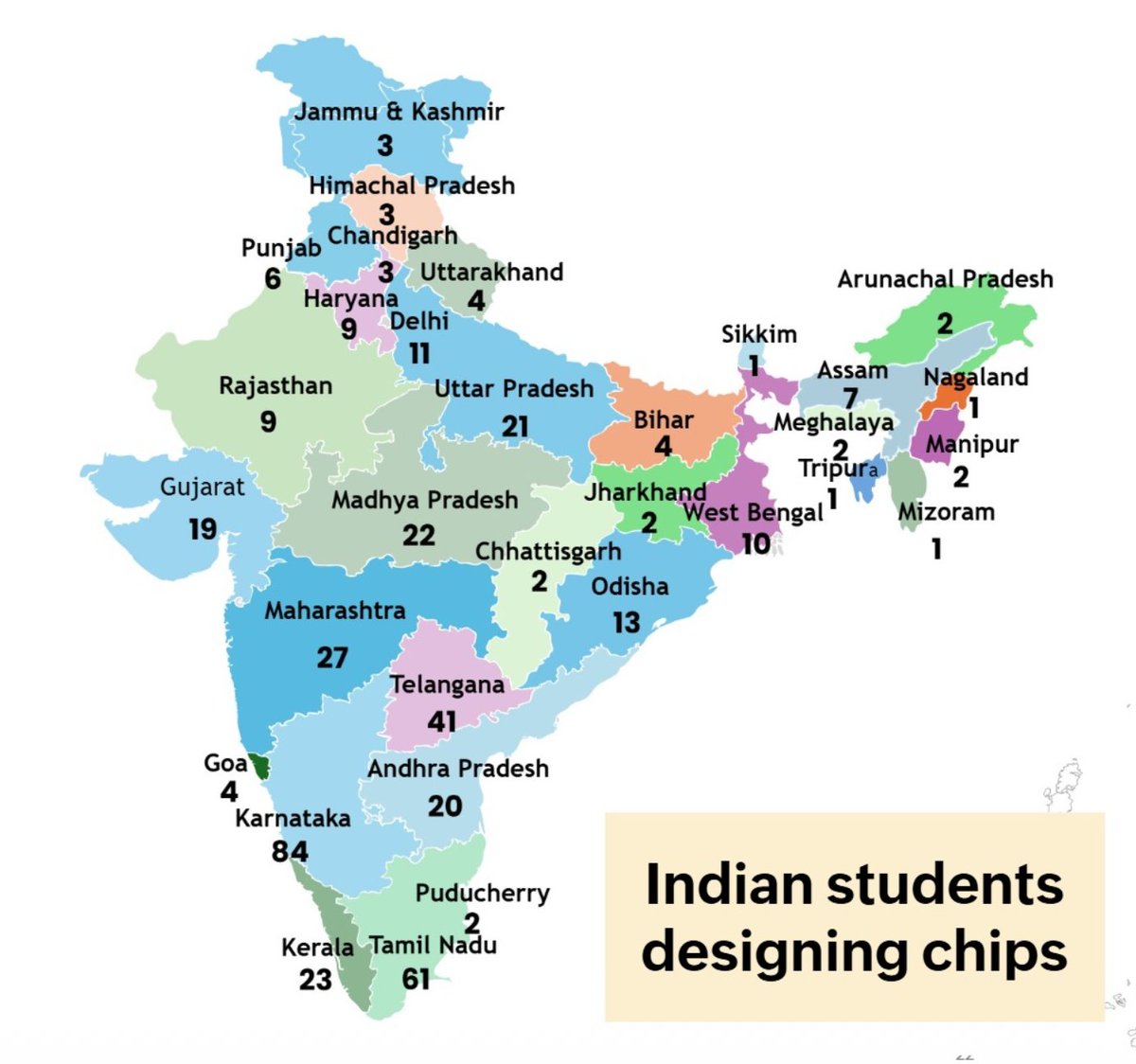
When people talk about microchip design by Indian students, ask yourself what picture pops into your head.
You probably think of hyper-elite institutions: the IITs / IISc / NITs. You tell yourself, “This is for the top 0.1%.”
Now, look at this map (attached). Look closely at those numbers.
Karnataka 84. Tamil Nadu 61. Telangana 41. Maharashtra 27. Madhya Pradesh 22. Uttar Pradesh 21. Andhra Pradesh 20. Gujarat 19. Odisha 13. Delhi 11.
And keep looking........
Look up at Jammu & Kashmir (3), Himachal (3), and Punjab (6). Look east to Assam (7), Bihar (4), and right to the edge of the country, Manipur (2), Arunachal Pradesh (2), Nagaland (1), Mizoram (1), Sikkim (1).
This is a map of a quiet, relentless national awakening.
Under the Chips to Startup (C2S) initiative, the govt plugged world-class, industrial-grade chip design software directly into computer rooms across 100s of colleges in tier-2, tier-3, and remote towns across India.
Think about what is happening right now, this very minute....
A student in a small college in Assam is not just memorizing formulas for an exam...she is drawing transistor layouts.
A hostel room in Bihar is not just discussing coding projects, a group of 20 yr olds is designing a custom AI accelerator chip.
A lab in Manipur is running design checks on micro-architectures that will eventually be etched onto real physical silicon.
For decades, foreign corporations treated India like an intellectual goldmine to be extracted. They took our best talent, paid them to build foreign patents, and sold the final chips back to us at exorbitant prices.
They thought chip design was an exclusive club. They thought Bharat would forever depend on foreign blueprints.
They did not realize we were quietly turning an entire nation into a giant, decentralized brain for global silicon.
Factories can be built with money. Foundries can be raised with concrete.
But an army of 10s of 1000s of young engineers, designing microchips from Srinagar to Imphal, from Jaipur to Tiruchirappalli?
That cannot be bought. That cannot be stopped.....
So let the doubters count nanometers in foreign blogs. Out here in our classrooms, from the metros to the farthest corners of Bharat, a new generation is writing the future of hardware.
The world thought we were only here to write their software. Bharat is now designing the silicon it runs on.
A very interesting thing happened at Jharkhand Students protest.
Dafli gang of AISA reached there and started chanting "halla bol", "azadi" and "Hum Dekhenge" shit.
A nationalist came and said this is not your Jantar Mantar, No one will be allowed to raise Azadi slogans here.
My request to all Jharkhand Students, this is how you should stand. Please keep AISA, AISF, SFI and CJP away from this protest. They will do all efforts to capture your protest and do backdoor setting with government.