Our initiative supports #women. We believe in a more feminine future and want things to #change. For equality, fairness in the workplace and female #leadership.
⬛️ AI Readiness Is Not Optional - It’s Digital Transformation
Intro
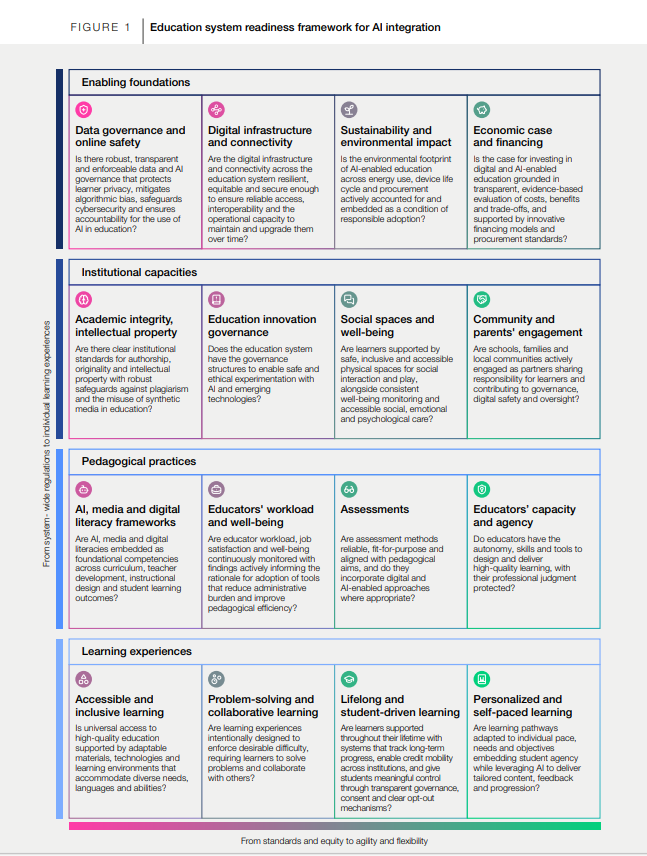
AI is no longer a future topic. It is already shaping how people learn, think, and work- faster than organizations can adapt. The real challenge is not adopting AI. It is aligning systems, structures, and behaviors around it. What the latest World Economic Forum report - "Shaping the Future of Learning: Education Readiness for the Age of AI | June 2026" - makes clear: The gap is no longer about technology; it is about the system’s ability to adapt.
7 Key Takeaways
1⃣ The real problem is not AI - but system readiness
The core challenge is misalignment between governance, organization, and human behavior - not the technology itself.
2⃣ AI readiness is the next stage of digital transformation. AI is not an add-on. It forces a shift toward true end-to-end transformation.
3⃣ Bottom-up adoption vs. top-down systems creates friction. AI spreads faster than institutions adapt - creating structural instability.
4⃣ AI scales efficiency- but can weaken capability
Without intentional design, AI leads to less thinking, less depth, and weaker judgment.
5⃣ AI amplifies existing structures- including silos
Fragmented organizations don’t improve with AI - they fragment faster.
6⃣ Trust and performance measurement are changing
If outputs can be generated instantly, they lose meaning as indicators of performance.
7⃣ Impact requires full-system orchestration
Real value emerges only when all layers evolve together: data, governance, organization, leadership, and behavior.
Conclusion
AI is not just another technology wave. It is a stress test for how well organizations truly understand transformation. It exposes whether systems are:
▪️ integrated or fragmented
▪️ governed or improvised
▪️ learning or merely optimizing
📢 And it makes one thing unmistakably clear: Digital Transformation does not fail because of technology. And AI will not save it. But it will ruthlessly reveal whether we understood it in the first place. ✨
#DigitalTransformation #AI #Leadership #AIReadiness #FutureOfWork #HowWeWork #SystemThinking #EndToEnd #People #Learning #Empowerment #Mindset
✨ @wef@Khulood_Almani@timo_vi@TamaraMcCleary@AkwyZ@MaryRich78@rwang0@drsharwood@DrHolzwarth@HelenBevan@phinifa@pierrecappelli@JimHarris@jenstirrup@GlenGilmore@subare@Ronald_vanLoon@enilev@Scobleizer@AndrewYNg@YuHelenYu@quepasachico ✨
📢 Download Report: https://t.co/X2DyyfvDRH | @wef 💡
⬛️ Technology Scales Processes. Culture Determines Whether Organizations Learn - Lessons from The Geek Way
My #Blog4Managers series combines strategic perspectives with practical organizational development. At its core are topics that are becoming increasingly mission-critical for modern enterprises: digital transformation, organizational effectiveness, holistic thinking and execution, cultural transformation, and contemporary leadership. The objective of the series is not to describe isolated methods or technologies, but to explore how organizations can remain adaptive, resilient, and capable of learning under conditions shaped by complexity, data-centricity, and AI.
📢 Andrew McAfee’s The Geek Way provides a particularly relevant reference framework for this discussion because it consistently shifts digital transformation from the technological to the cultural dimension. The central question is no longer which tools organizations deploy, but according to which normative principles they make decisions, learn, and create value.
McAfee describes four norms of what he calls a “New Culture”:
▪️ Science,
▪️ Ownership,
▪️ Speed, and
▪️ Openness.
🔹 Together, they form the cultural operating system of successful digital organizations. What is especially remarkable is not merely the description of specific management practices, but the underlying logic of organizational adaptability. The Geek Way implicitly describes the transition from technology-centered transformation toward evidence-based, human-centered learning systems. That is precisely what makes the book so relevant.
🔹 Many organizations today invest heavily in platforms, data architectures, and AI systems without simultaneously building the cultural conditions necessary for those technologies to generate meaningful organizational impact. Technology scales processes. Culture determines whether organizations learn. Within the context of data-based work, it becomes particularly clear why these norms are so powerful.
▪️ Science replaces opinions with evidence. Decisions are no longer legitimized primarily through hierarchy, experience, or intuition, but through data, experimentation, and testable hypotheses. This creates an organization that functions as a learning system. Co-creation, experimentation, iterative work, and continuous measurement become the foundation of governance and execution. Companies such as Amazon and Netflix have built their operational strength precisely on this principle: decisions are not scaled because experienced managers made them, but because they are empirically validated.For digital transformation, this represents a fundamental break from classical management logic. The perfect business case is no longer the central focus; instead, success depends on the ability to generate valid insights quickly and act on them decisively. The real innovation of digital organizations therefore lies not primarily in technology itself, but in their capability for collective learning adaptation. In an end-to-end system, Science becomes far more than analytical competence - it is the mechanism that overcomes local optimization in favor of systemic evidence. Data is not an end in itself, but part of an organizational knowledge system.
▪️ Ownership embeds accountability across the entire value chain. In many established organizations, accountability remains structurally fragmented: functions optimize isolated domains without considering the performance of the overall system. Sales optimizes revenue, Operations optimizes efficiency, IT optimizes stability - yet no one truly owns the outcome of the end-to-end system. Geek culture breaks with this logic. Ownership here means not only responsibility, but accountability for outcomes across the entire end-to-end process. In highly digital organizations (Maturity Levels 4–5), this becomes especially visible: teams are accountable not for isolated tasks, but for customer value, system performance, and the continuous improvement of an entire value stream.Combined with data-driven transparency, Ownership becomes visible, measurable, and manageable. Teams can immediately see the impact of their actions and adjust accordingly. Particularly in platform models and integrated value streams, this form of Ownership becomes the prerequisite for true scalability. Without it, organizations create highly digitized silos instead of adaptive systems. This is where a fundamental shift in modern organizational development becomes visible: away from functional control and technology dominance toward human-centered, collaborative value creation systems. Co-creation therefore evolves from a complementary method into a structural prerequisite for organizational learning capability.
▪️ For McAfee, Speed should not be understood merely as velocity, but as the structural capability to radically shorten learning cycles. Organizations that experiment quickly, integrate feedback rapidly, and adapt continuously develop a decisive competitive advantage. Speed does not primarily emerge from increased pressure or higher operating tempo, but from reducing friction within the system. In practice, this means small releases instead of large-scale programs, continuous iteration instead of episodic transformation, and rapid feedback loops instead of months-long governance cycles. Data provides the foundation by making progress visible and enabling rapid course corrections. This is why digital leaders are often not more successful because they have superior long-term plans, but because they learn faster than their competitors.
Many organizations digitize processes. Only a few digitize learning. In an end-to-end context, Speed therefore becomes an emergent system characteristic: only when information, decisions, and accountability can flow through the organization without structural friction does true adaptability emerge.
▪️ Openness ultimately ensures that the other three norms can function effectively at all. It describes the willingness to question assumptions, make mistakes visible, and accept new evidence - even when it contradicts existing beliefs, power structures, or established experience. For data-driven organizations, this is essential:
📢 Data only creates impact when it is culturally accepted.
Many companies fail not because of missing technology, but because of defensive organizational patterns in which evidence is ignored whenever it threatens established narratives. Openness creates the cultural space for critical discourse, interdisciplinary learning, and systemic thinking. In combination with AI, this norm becomes even more important. Algorithmic systems continuously generate new recommendations, patterns, and disruptions.
🔹 Organizations must therefore learn to constantly challenge decision-making logic instead of merely digitizing existing routines. AI thus amplifies not primarily technological capability, but cultural selection capability: organizations must learn which evidence they are willing to accept, which routines they are prepared to abandon, and which mental models they must evolve. Openness therefore becomes a prerequisite for organizational learning capability under conditions of growing complexity.
🔹 Taken together, the four norms address one of the central problems of many transformation initiatives: the gap between technological capability and organizational effectiveness. Many companies today possess data platforms, analytics tools, and modern digital architectures - yet they lack the cultural logic required to use them effectively. Technology scales processes. Culture determines whether organizations learn.
📢 Without Science, data work remains decorative. Without Ownership, accountability dissipates across functional silos. Without Speed, organizations stagnate in lengthy decision and escalation cycles. And without Openness, learning collapses under internal resistance.
🔹 This is precisely where the real challenge of modern organizational development lies. The future viability of digital organizations will not primarily depend on technological competence, but on their ability to place evidence above hierarchy, institutionalize learning systematically, and develop collective adaptability. Digital maturity emerges where technology, culture, and co-creation are no longer treated separately, but function together as an integrated learning and value creation system. For leaders, this creates a clear implication: digital transformation is fundamentally not a technology project, but a design challenge centered on organizational decision and learning systems.
📢 The goal is to build an organization that thinks in evidence-based ways (Science), embeds accountability consistently along value streams (Ownership), learns faster than its environment (Speed), and remains open to correction, disruption, and strategic realignment (Openness). Ultimately, this is the true competitive advantage of digital organizations.
⭐️ The Geek Way therefore provides a precise answer to why so many transformations fail to meet expectations despite massive investments. Technology itself is not the bottleneck. The real bottleneck is the cultural operating system into which technology is embedded. Or more directly: data alone does not create transformation.
📢 Only a culture that functions as a scientific, learning-oriented, end-to-end system can make digital capabilities effective at scale.
✨ @amcafee@Khulood_Almani@timo_vi@TamaraMcCleary@AkwyZ@MaryRich78@rwang0@drsharwood@DrHolzwarth@HelenBevan@phinifa@pierrecappelli@JimHarris@jenstirrup@GlenGilmore@subare@Ronald_vanLoon@enilev@Scobleizer@AndrewYNg@YuHelenYu@quepasachico ✨
#DigitalTransformation #OrganizationalDevelopment #Leadership #CultureChange #Data #AI #DigitalTransformation #SystemicThinking #Effectiveness #LearningOrganization #EndToEnd #ValueCreation #Science #Ownership #Speed #Openness #TheGeekWay 💡
#Blog4Managers by @thomas_dettling and Image created by @thomas_dettling | powered by GPT 5.5
⬛️ How People Are Actually Using AI at Work in 2026 | 28% of workplace AI usage is already about decision-making
▪️ According to the Microsoft Work Trend Index 2026 - https://t.co/M3rsgUc9k1 - decision-making accounts for 28% of workplace AI activity across more than 100,000 Microsoft 365 Copilot chats analyzed globally in February 2026.
▪️ The findings suggest workplace AI is evolving beyond simple productivity tasks. Instead of functioning mainly as an automation tool, AI is increasingly being used to analyze information, evaluate options, and support human judgment.
▪️ The first wave of workplace AI focused heavily on generating content such as emails, meeting summaries, and documents. Now, the technology is increasingly being used for something broader: helping people think through decisions.
📢 If these trends continue, the workplace of the future may rely less on AI to fully automate jobs and more on AI to enhance how people think, analyze, and make decisions every day. ✨
Read more:
@Microsoft Work Trend Index 2026
"The opportunity for human potential at work has never been greater. People are using AI and agents to expand what they can do and who gets to do it, and new research shows that’s only accelerating. Call it the new agency equation: as agents take on more of the execution, humans increasingly have more agency - more room to direct the work, make the calls, and own the outcomes. For every firm, the imperative now is to turn that agency into unprecedented value." -
https://t.co/M3rsgUc9k1
✨ @Khulood_Almani@timo_vi@TamaraMcCleary@AkwyZ@MaryRich78@rwang0@drsharwood@DrHolzwarth@HelenBevan@phinifa@pierrecappelli@JimHarris@jenstirrup@GlenGilmore@subare@Ronald_vanLoon@enilev@Scobleizer@AndrewYNg@YuHelenYu@quepasachico ✨
#AI #FutureOfWork #DigitalTransformation #People #HumanCentricAI #Leadership #Copilot #Productivity #DecisionMaking #WorkplaceAI 💡
Absolutely insightful analysis on the evolution toward Industry 5.0, @thomas_dettling!
By prioritizing human-centric design, resilience, and sustainable value creation, organizations can move beyond optimization to build truly adaptive and purposeful ecosystems powered by AI and intelligent systems.
#Industry50 #DigitalTransformation #HumanCentricAI #AI #Resilience #SustainableInnovation #FutureTech
⬛️ #Blog4Managers | Industry 5.0 – From Efficiency to Meaningful Value Creation
Industry 4.0 has fundamentally reshaped industrial value creation. It introduced connectivity, data, and digital infrastructure as the backbone of modern operations. Cyber-physical systems, IoT platforms, cloud architectures, and advanced analytics enabled organizations to automate, integrate, and scale processes at an unprecedented level. Many companies built extensive data lakes, sophisticated digital twins, and end-to-end process transparency. Where these elements were consistently implemented, they created what can truly be described as an operational nervous system: real-time data flows, interconnected assets, and increasingly autonomous decision-making loops.
🔹 And yet, Industry 4.0 revealed a profound structural limitation. It excelled at optimizing what already existed. It made processes faster, leaner, and more scalable - but often without questioning whether these processes were truly meaningful, resilient, or human-centric in the first place. Efficiency became an end in itself, sometimes at the expense of adaptability, purpose, and long-term value. At the same time, many organizations underestimated three critical prerequisites that now determine whether Industry 5.0 can succeed:
▪️ First, the ability to work truly data-driven. Not merely collecting data, but ensuring consistent data quality, shared definitions, and decision relevance across the organization. In many cases, data exists - but it does not create insight, alignment, or action.
▪️ Second, the shift toward end-to-end thinking. Most processes are still optimized locally - within functions, departments, or systems. What is missing is a holistic perspective that connects demand, engineering, supply chain, production, and service into a coherent system of value creation.
▪️ Third, the explicit focus on value creation. Industry 4.0 often optimized efficiency metrics - Overall Equipment Effectiveness [OEE], throughput, cost. Industry 5.0 requires a different question: how does this process contribute to real value - for customers, employees, and the business as a whole?
📢 Without these three capabilities - data maturity, end-to-end thinking, and value orientation - organizations risk digitizing fragmentation instead of transforming performance.
🔹 A realistic example that reflects the reality of many industrial players:
A global machinery manufacturer - representative of many industrial players - invested over 250 million € in a comprehensive Industry 4.0 program. Digital twins of production lines delivered impressive OEE improvements of 18%, predictive maintenance reduced unplanned downtime significantly, and supply-chain dashboards provided unprecedented transparency. Yet when a major geopolitical disruption combined with raw material shortages hit, the system faltered dramatically.
The highly optimized, just-in-time processes - perfectly tuned for stable conditions - created cascading failures. Data was abundant, but the organization lacked the human judgment frameworks and cross-functional resilience mechanisms to interpret signals early and reconfigure meaningfully. Production lines stood still for weeks, customer commitments were missed, and employee trust in the “smart factory” narrative eroded.
🔸 This case illustrates why Industry 5.0 is not a nice-to-have evolution - it is a necessary correction.
Industry 5.0 does not replace 4.0. It builds on its foundation - and fundamentally reframes its purpose.
At its core, Industry 5.0 introduces three interdependent dimensions that shift the paradigm from pure optimization to purposeful value creation:
1. Human-centricity
The focal point moves from technology to people — employees, customers, and society. The decisive question is no longer “What can we automate?” but “What should we automate - and how do we keep human judgment, creativity, empathy, and ethical responsibility at the center?” AI and cobots become true augmenters: they take over repetitive and dangerous tasks, while humans retain sovereignty over complex decisions, innovation, and relationship-driven value. This requires systems that are intuitive, explainable, and empowering rather than alienating.
2. Resilience
Industry 4.0 optimized for efficiency in predictable environments. Industry 5.0 optimizes for adaptability and antifragility under uncertainty. In the machinery example, the company responded by establishing interdisciplinary “Resilience Labs” - teams of operators, data scientists, engineers, and strategists who use 4.0 data not merely for prediction, but for stress-testing scenarios, dynamic reconfiguration, and rapid learning loops. Resilience here means designing systems that become stronger through shocks - far beyond traditional risk management.
3. Sustainability
While Industry 4.0 enabled transparency, Industry 5.0 demands accountability and regenerative impact. Value is no longer measured solely in productivity metrics, but in the triple bottom line: environmental, social, and economic outcomes. Digital technologies now enable circular economy models, emissions tracking [eg Scope 3 | GHG protocol], and regenerative supply chains. The critical shift lies in intention: optimizing not just for output, but for sustainable outcomes.
🔹 This evolution exposes a critical dependency:
Industry 5.0 can only deliver its promise where Industry 4.0 has been meaningfully implemented.
▪️ Without reliable, high-quality data, there can be no informed decision-making.
▪️ Without robust digital infrastructure, there is no scalability of resilience.
▪️ Without integrated systems, there is no sustainability at scale.
In many organizations, however, the Industry 4.0 journey remains fragmented - islands of excellence surrounded by legacy systems. In such environments, Industry 5.0 risks becoming a strategy on paper rather than operational reality. This is where most transformations fail - not because of data or technology, but because of fragmentation.
The fundamental insight for leaders today:
Industry 5.0 is not primarily a technology program. It is a maturity test for the entire organization. It requires a conscious shift from:
▪️ data collection → deep problem clarity
▪️ automation → meaningful human augmentation
▪️ efficiency → systemic and sustainable value creation
This is why Design Thinking, systems thinking, and adaptive leadership move from “nice-to-have” to mission-critical. They provide the cognitive and organizational foundation to decide what should be built before scaling how it is built.
Looking ahead, emerging signals around Industry 6.0 point toward autonomous, self-designing systems and deeply integrated human–AI collectives that blur the boundaries between creator and creation.
📢 If Industry 4.0 connected machines and Industry 5.0 re-centered humans, Industry 6.0 may redefine the relationship between both.
In such a landscape, competitive advantage will no longer come from technology adoption alone, but from an organization’s ability to continuously redefine what value means, which problems truly matter, and how humans and intelligent systems collaborate.
Industry 5.0 is therefore not the next step in industrial evolution. It is the correction of a fundamental mistake: Optimizing systems before understanding what they are for.
✨ @timo_vi@Khulood_Almani@AkwyZ@MaryRich78@rwang0@drsharwood@DrHolzwarth@HelenBevan@phinifa@pierrecappelli@JimHarris@jenstirrup@GlenGilmore@subare@Ronald_vanLoon@enilev@quepasachico@Scobleizer@AndrewYNg@YuHelenYu@SDGS4GOOD@EU_Commission ✨
#Industry50 #Industry40 #Industry60 #Innovation #DigitalTransformation #Leadership #AI #Engineering #DesignThinking #SystemsThinking #Resilience #Sustainability 🌱 #HumanCentric #People #HDC #ValueCreation #DataDriven #EndToEnd #Competitiveness
Infographic by @thomas_dettling | GPT 5.5
Orgs don’t need to wait for 100% completion to see #DigitalTransformation impact.
When #infrastructure, #AI, & #data foundations begin reducing friction and improving decision-making, transformation shifts from roadmap to operational reality. 🗺️📍
Spot on, @thomas_dettling! 🎯
⬛️ #Blog4Managers | Chief Economists' Outlook: May 2026
While AI adoption continues to accelerate globally, chief economists are becoming more cautious about when productivity gains will actually materialize.
This raises a central question for me when reading the latest World Economic Forum Chief Economists' Outlook:
📢 Can Digital Transformation and AI truly strengthen companies in an increasingly fragmented world?
▪️The findings of the Chief Economists’ Outlook - https://t.co/EkRHgiCKuH - published by the World Economic Forum paint a remarkably nuanced picture of the role that digital transformation and artificial intelligence play in the global economy. At first glance, the report reinforces a familiar narrative: despite geopolitical tensions, rising volatility, and increasingly fragmented markets, AI remains one of the few structural growth drivers with broad-based potential. More than 90% of surveyed chief economists expect AI adoption to continue accelerating over the next twelve months (World Economic Forum, 2026).
▪️At the same time, however, a significant shift is emerging in how AI’s economic impact is assessed. Expectations for near-term productivity gains are becoming more measured. This development is strategically important. It signals a transition from a phase of technological enthusiasm to one of operational reality. While early applications have delivered tangible benefits in digitally intensive sectors such as information technology and communications, expectations for productivity improvements across most other industries have been pushed further into the future. Productivity gains do not arise automatically from technology adoption; they emerge when technology is effectively integrated into processes, organizational structures, and decision-making frameworks.
▪️This observation aligns closely with research on General Purpose Technologies (GPTs). Historically, the economic benefits of transformative technologies have materialized only after complementary investments were made in organizational design, workforce capabilities, management practices, and process innovation (Brynjolfsson, Rock & Syverson, 2021; Bresnahan & Trajtenberg, 1995). This is precisely where digital transformation evolves from a technology initiative into a question of organizational maturity.
▪️The Outlook highlights that the greatest economic value is created not where AI is merely deployed, but where organizations redesign workflows, decision processes, and operating models around its capabilities. Numerous studies have shown that the returns generated by digital technologies depend far more on management quality, organizational adaptability, and execution capabilities than on the technology itself (McKinsey Global Institute, 2023; MIT Sloan Management Review, 2024). At the same time, the Outlook reveals a second and often underestimated dynamic:
AI’s impact is highly asymmetric. Benefits are likely to accrue first to large enterprises, knowledge-intensive industries, and regions with strong digital infrastructure. Data availability, energy capacity, regulatory clarity, and organizational capabilities remain critical constraints on adoption and value creation.
▪️The result is an accelerating divergence among companies, regions, and business models. Both the OECD and the International Monetary Fund have warned that AI may initially widen productivity gaps between leading and lagging organizations before broader economic gains become visible across the economy (OECD, 2024; IMF, 2024). For business leaders, the implication is clear: competitive advantage no longer stems primarily from access to technology, but from the ability to translate technology into meaningful value creation.
▪️AI amplifies existing structures - it makes strong systems more effective while exposing organizational weaknesses more quickly. Research on generative AI demonstrates that the largest productivity gains are realized in environments characterized by clear processes, high-quality data, and effective management practices (Noy & Zhang, 2023; Stanford HAI, 2025). This helps explain why chief economists expect AI’s macroeconomic impact to unfold gradually. A broad-based productivity surge is unlikely until organizations adapt their structures, capabilities, and management systems to fully leverage the technology. Equally noteworthy is the fact that AI is advancing within an increasingly fragile economic environment. Rising inflation, geopolitically driven supply chain disruptions, and heightened market volatility are not slowing digital transformation.
If anything, they are increasing the urgency for organizations to become more efficient, adaptive, and resilient. As a result, digital transformation is becoming less of an option and more of a strategic necessity. Taken together, the findings point to a clear conclusion:
✨ AI is evolving from a short-term efficiency promise into a long-term transformation driver. The primary constraint is no longer the technology itself, but the ability of organizations to define problems effectively, redesign systems, and integrate human and technological capabilities in ways that create sustainable value. ✨
📢 Ultimately, the Outlook reinforces a central lesson of modern transformation: the economic value of AI does not stem from its existence, but from the quality of the decisions, processes, and organizational systems into which it is embedded. The winners of the AI era will not necessarily be those with the best technology. They will be those that redesign their organizations fastest.
Sources:
World Economic Forum (2026). Chief Economists’ Outlook, May 2026.
Brynjolfsson, E., Rock, D., & Syverson, C. (2021). The Productivity J-Curve: How Intangibles Complement General Purpose Technologies.
Bresnahan, T., & Trajtenberg, M. (1995). General Purpose Technologies: Engines of Growth?
McKinsey Global Institute (2023). The Economic Potential of Generative AI.
MIT Sloan Management Review (2024). How Organizations Capture Value from AI.
OECD (2024). Artificial Intelligence, Productivity and the Future of Work.
International Monetary Fund (2024). Gen-AI: Artificial Intelligence and the Future of Work.
Noy, S., & Zhang, W. (2023). Experimental Evidence on the Productivity Effects of Generative Artificial Intelligence.
Stanford Institute for Human-Centered Artificial Intelligence (2025). AI Index Report.
✨ @wef@Khulood_Almani@timo_vi@TamaraMcCleary@AkwyZ@MaryRich78@rwang0@drsharwood@DrHolzwarth@HelenBevan@phinifa@pierrecappelli@JimHarris@jenstirrup@GlenGilmore@subare@Ronald_vanLoon@enilev@Scobleizer@AndrewYNg@YuHelenYu@quepasachico ✨
Infographic by @thomas_dettling | GPT 5.5
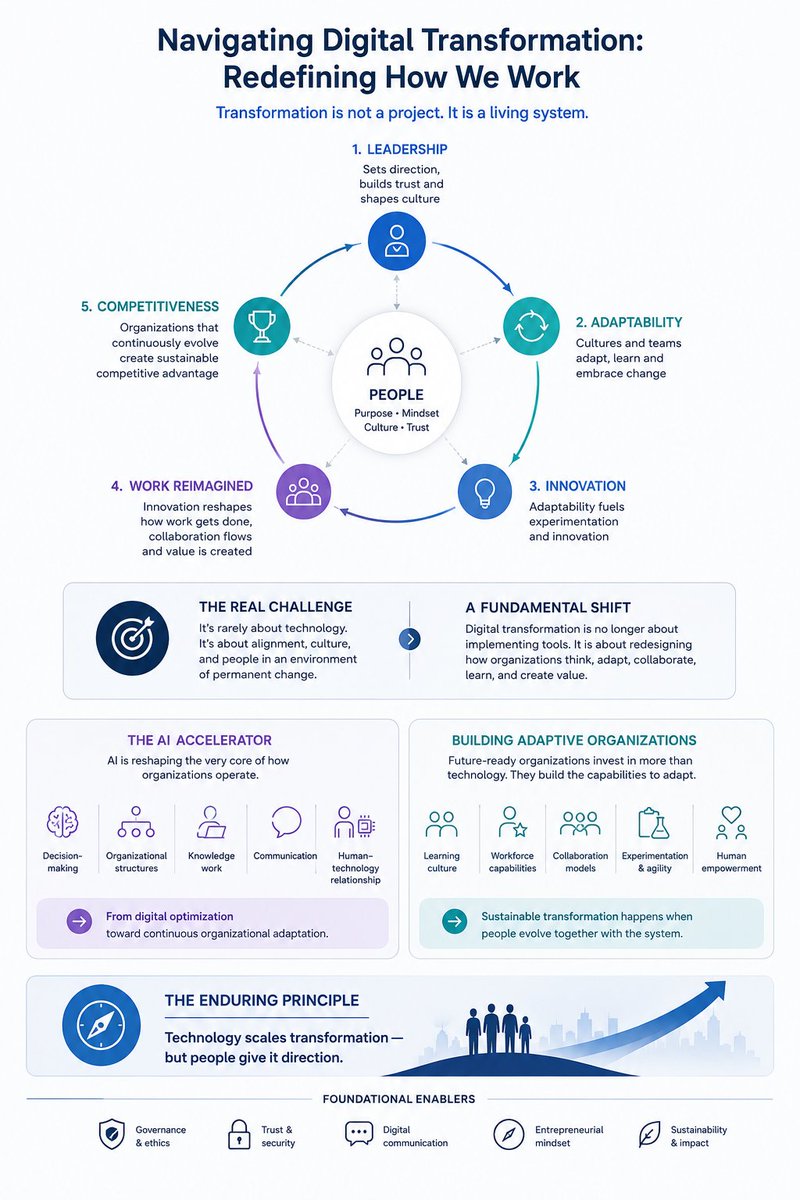
⬛️ #Blog4Managers | Reimagining Work: Putting People at the Centre of Digital Transformation
Most organizations still approach digital transformation as a technology initiative -
even though transformation ultimately depends on people.
Transformation does not behave like a software rollout.
▪️ It behaves like a living system.
Leadership influences culture.
▪️ Culture shapes adaptability.
▪️ Adaptability drives innovation.
▪️ Innovation reshapes work.
And work itself increasingly defines competitiveness.
This is why so many transformation initiatives struggle despite massive investments in technology.
The challenge is rarely technological.
The real challenge is organizational alignment in an environment of permanent change.
🔷 You cannot change a system without understanding its details. Transformation begins with learning how complexity actually works. What emerges is a fundamental shift in perspective:
Digital transformation is no longer about implementing tools. It is about redesigning how organizations think, adapt, collaborate, learn, and create value.
➡️ The future of transformation will not be defined by who adopts the most technology. It will be defined by who builds the most adaptive organizations.
That requires something many companies still underestimate:the human dimension of transformation.
Because while technology evolves exponentially, organizations often evolve culturally at a much slower pace. Employees are expected to adapt continuously to new systems, workflows, and AI-driven environments - often without enough orientation, clarity, or involvement in the process itself. As complexity increases, leadership becomes more important, not less.
Not as command-and-control management, but as the ability to create:
▪️ direction during uncertainty,
▪️ trust during acceleration, and
▪️ alignment across interconnected systems.
🔷 Artificial intelligence accelerates this tension even further.
AI is no longer simply automating tasks. It is reshaping:
decision-making, organizational structures, knowledge work, communication, and the relationship between humans and technology itself. This means organizations are entering a new phase of transformation: from digital optimization toward continuous organizational adaptation. And adaptive organizations are built differently.
They invest not only in platforms and infrastructure - but equally in learning culture, workforce capabilities, collaboration models, experimentation, and human empowerment. Because sustainable transformation happens when people are able to evolve together with the system around them.
➡️ Transformation is no longer linear. It is systemic, interconnected, and permanently evolving. At the center, however, one principle remains unchanged: Technology scales transformation - but people give it direction.
✨ @timo_vi@Khulood_Almani@AkwyZ@MaryRich78@rwang0@drsharwood@DrHolzwarth@HelenBevan@phinifa@pierrecappelli@JimHarris@jenstirrup@GlenGilmore@subare@Ronald_vanLoon@enilev@quepasachico@Scobleizer@AndrewYNg@YuHelenYu ✨
#FutureOfWork #People #SystemThinking #Adaptability #Innovation #Competitiveness #Leadership #Culture #DigitalTransformation
Infographic by @thomas_dettling | GPT 5.5
White Paper by World Economic Forum | @wef
⬛️ #Blog4Managers | Design Thinking in the Age of AI
Why Mindset Matters More Than Method
Design Thinking is still misunderstood in many organizations. As a creativity method. As a workshop format. As a colorful break from “real work.” In the age of Artificial Intelligence, this misunderstanding is not just unfortunate - it is risky. Because Design Thinking is less a method than a mindset. And that mindset ultimately determines whether AI becomes a true driver of productivity and innovation - or just another technological disappointment.
When Machines Become Faster Than We
🔹 Artificial Intelligence is now capable of writing texts, generating designs, developing software, and preparing decisions. What AI cannot do, however, is understand why something actually matters. AI optimizes what has been clearly formulated. It accelerates what is already structured. It scales what has already been thought through. And this is exactly where many organizations face a problem. We apply AI to processes that evolved historically. To problems that were never seriously questioned. To trade-offs that remain implicit. The result is not intelligent value creation, but automated inefficiency. Many AI initiatives therefore fail not because of the technology itself, but because organizations lack clarity about which problem should actually be solved.
Design Thinking as a Counterweight to
Pure Optimization Logic
🔹 Design Thinking starts from a fundamentally different place than traditional management and engineering logic. Not with the solution. Not with efficiency. But with the question: Do we truly understand the problem - from the perspective of the people who work with it, live with it, or are affected by it? At its core, Design Thinking means deliberately shifting perspectives, making assumptions explicit, structuring complexity without reducing it prematurely, and developing solutions iteratively in real-world contexts. This is not a “soft” discipline. It is hard organizational work under uncertainty.
Why This Mindset Becomes Critical in the Age of AI
🔹 AI fundamentally changes how value is created. In the past, what mattered was who mastered the methods, knew the tools, or could calculate faster. Today, what matters is who asks the right questions. Who recognizes which problem should be solved - and which should not. And who can design systems in ways that allow machines to support human work meaningfully. Design Thinking develops exactly these capabilities. Not as creativity training, but as a discipline of intentional design. It creates the ability to pause before optimizing, to question assumptions before scaling, and to make implicit trade-offs explicit. Start by questioning one AI use case before optimizing it. In the age of AI, competitive advantage no longer comes primarily from access to information. It comes from superior problem recognition.
Design Thinking and Engineering
🔹 Not a Contradiction. In technically driven organizations, Design Thinking is often perceived as the opposite of engineering. That is a misunderstanding. Engineering stands for precision, reliability, and reproducibility. Design Thinking complements this with user focus, systems understanding, and clarity about purpose and meaning. Together, they create something essential: Engineering that is not only correct, but relevant. And this is exactly where AI unfolds its real value. AI requires clear problem definitions, clean interfaces, and deliberate decisions. Design Thinking provides the foundation for all three.
Leadership in the Age of AI
🔹 For leaders, this means a shift in role. Less making detailed decisions, prescribing solutions, and exercising control. More designing conditions, providing orientation instead of answers, and creating learning environments instead of demanding perfection. Design Thinking does not provide leadership recipes. But it fosters a way of thinking that keeps leadership effective under uncertainty. Because AI does not remove the responsibility for good problem-solving. It makes visible how capable organizations truly are at it.
🔹 Design Thinking as a Prerequisite for Meaningful AI Adoption. Artificial Intelligence amplifies what already exists. It makes good systems better - and bad systems visible faster. Design Thinking ensures that organizations work on the right problems, that technology serves people rather than the other way around, and that learning, adaptation, and continuous evolution become part of the system itself. That is precisely why Design Thinking is no longer optional in the age of AI. It is a foundational mindset for modern leadership and organizational development.
Artificial Intelligence provides computational power. Design Thinking provides orientation.
🔹 Without clear problem understanding, organizations use AI primarily to automate their own weaknesses. In the age of AI, success will not be determined by the intelligence of systems, but by the mindset of the people designing them. 💫
✨ @TamaraMcCleary@timo_vi@Khulood_Almani@AkwyZ@MaryRich78@rwang0@drsharwood@DrHolzwarth@HelenBevan@phinifa@pierrecappelli@JimHarris@jenstirrup@GlenGilmore@subare@Ronald_vanLoon@enilev@Scobleizer@AndrewYNg@YuHelenYu@gleonhard@quepasachico
#DesignThinking #AI #Mindset #Engineering #Data #DigitalTransformation #Capabilities #People #Mindset #Creativity #Collaboration
Image by @thomas_dettling | Grok 4.3
⬛️ #Blog4Managers | India Becomes the Third-Largest Economy – Why This Is More Than Just a Number
While the U.S. and China may maintain a comfortable lead over their peers, India is rapidly emerging as the next major economic powerhouse - and this shift carries strategic implications far beyond GDP rankings.
🔹 According to IMF forecasts, the world’s most populous country is expected to grow its GDP by roughly 63.5% by 2031, making it the fastest-growing major economy globally. India is projected to surpass Japan and the United Kingdom as early as 2028, crossing the $5 trillion threshold for the first time. By 2031, it is forecast to overtake Germany, reaching a GDP of approximately $6.8 trillion.
🔹 At first glance, this may appear to be another milestone in global economic statistics. In reality, it signals a structural shift in the balance of global economic power - one that will reshape where growth, talent, and competitive advantage originate over the next decade.
For decades, economic influence, innovation, and capital were heavily concentrated in the West. The next decade may look very different.
🔹 India’s rise above several long-industrialized economies is not simply the result of catch-up growth. It reflects a deeper transformation driven by demographics, digital infrastructure, and a new form of economic dynamism.
🔹 With a population of more than 1.4 billion people, India combines scale with an increasingly connected and digitally enabled workforce. Initiatives such as Aadhaar, UPI, and large-scale mobile payment ecosystems are accelerating economic participation at a pace many established economies struggle to match.
🔹 Today, global companies are already shifting critical capabilities - from software engineering to AI development - toward India, not only for cost reasons, but for access to talent at scale.
What makes this especially important for business leaders is not only that India is growing - but how it is growing.
🔹 Unlike traditional industrial growth models, India is leapfrogging in areas such as digital services, IT, fintech, and innovation ecosystems. This creates new forms of competition: faster, more networked, and often less constrained by legacy systems. Indian companies are becoming globally competitive not only on cost, but increasingly on capability, adaptability, and speed.
🔹 For many leaders, this shift will not appear as a single clear strategic signal - but as growing pressure: faster competitors, changing talent dynamics, and increasing uncertainty about where future growth will come from.
🔹 At the same time, this development is part of a broader rebalancing of economic power toward Asia. Value creation, talent pools, and innovation hubs are expanding beyond their traditional centers.
For European organizations, this raises a critical strategic question:
How do you remain competitive in a world where growth, innovation velocity, and digital talent are increasingly concentrated elsewhere - while operating in environments with slower growth, higher costs, and more rigid structures?
🔹 Significant challenges remain - including infrastructure gaps, inequality, regulatory complexity, and labor market disparities - but the long-term trajectory is difficult to ignore.
What does this mean for managers?
1⃣ Global strategy must become truly global again.
India is no longer just a peripheral market or sourcing destination. It is increasingly becoming a core arena for growth, innovation, partnerships, and talent.
2⃣ Leadership must adapt to asymmetrical competition.
Organizations are no longer competing only with similar peers operating under similar conditions. They are increasingly competing with companies shaped by entirely different cost structures, technological ecosystems, and execution speeds.
3⃣ Transformation is becoming a prerequisite for relevance.
Economies and organizations that successfully combine scale, digital infrastructure, human capital, and adaptability will define the next decade of competitive advantage.
Or, put more simply:
The future of the global economy will not be decided where it has historically been strongest - but where innovation, talent, and growth are scaling fastest today.
IMF: https://t.co/mPq45Y4Ws1
#DigitalTransformation #Leadership #India #GlobalEconomy #Strategy #Innovation #AI #Collaboration #Responsibility #ValueCreation
✨ @timo_vi@Khulood_Almani@AkwyZ@MaryRich78@rwang0@drsharwood@DrHolzwarth@HelenBevan@phinifa@pierrecappelli@JimHarris@jenstirrup@GlenGilmore@subare@Ronald_vanLoon@enilev@Scobleizer@AndrewYNg@YuHelenYu@quepasachico@IMFNews ✨
⬛️ #Blog4Managers | Why the First 50% Become the Turning Point of Transformation
Digital transformation is still treated in many organizations like a traditional rollout or implementation program. The prevailing assumption is that real value only emerges once everything is fully integrated, automated, and rolled out across the enterprise - in other words, at 100%. Only then is transformation considered “successful.”
🔹 But this mindset often causes companies to overlook the most important moment in the entire transformation journey: the point where transformation begins changing organizational behavior.
🔹 Because transformation does not start at the end of the journey. It starts much earlier. Not when everything is perfect, but when enough new capabilities are in place to fundamentally improve how people work. That is why the first 50% of a transformation should not be interpreted as “half finished.” Instead, it marks the moment when a critical threshold is reached. Information becomes more accessible. Processes become more efficient. Decision-making improves. Collaboration changes. Transparency increases. Organizations become less operationally reactive and more orchestrated in how they work.
📢 This is the real tipping point.
🔹 Many companies underestimate this phase because they evaluate transformation primarily through completeness. Yet momentum rarely emerges from perfection. It emerges from usability. People do not change behavior because an architecture is theoretically complete. They change behavior once they experience meaningful improvement in their daily work. This becomes especially visible in project management environments.
🔹 Even partially integrated data models, early automation of reporting processes, or AI-supported risk indicators can fundamentally change operational reality. Project teams spend less time consolidating information. Risks become visible earlier. Alignment becomes more focused. Decisions are made faster and on a more reliable data foundation. Of course, this does not mean transformation is complete. Not every system is integrated. Not every process is automated. Not every decision is data-driven. But the organization is already working differently.
📢 That is what matters.
🔹 Because the moment people experience faster access to information, clearer decisions, and less friction in daily operations, something fundamental begins to shift: expectations change. Leaders start asking different questions. Teams proactively identify improvement opportunities. Discussions become more forward-looking because less energy is wasted reconstructing the present. At that point, transformation stops being a 'program'. It becomes operational reality. The remaining 50% still matter enormously. That is where scale, resilience, governance, integration depth, and long-term optimization emerge.
🔹 But the second half builds on something that already exists: trust in the new way of working. And this is precisely why the first 50% are strategically more important than many organizations realize. They create the momentum that makes transformation sustainable. They generate acceptance not through presentations or vision statements, but through visible operational improvement.
📢 The key question changes from: “Do we really need this?” to: “What becomes possible if we continue?” That is the moment transformation starts reinforcing itself.
🔹 So perhaps the most important insight is not that 50% is enough. It is that transformation starts creating real impact long before 100% is reached. Not because the journey is complete - but because the organization has already begun thinking, deciding, and working differently - that is where real transformation begins.
✨ @Khulood_Almani@timo_vi@TamaraMcCleary@AkwyZ@MaryRich78@rwang0@drsharwood@DrHolzwarth@HelenBevan@phinifa@pierrecappelli@JimHarris@jenstirrup@GlenGilmore@subare@Ronald_vanLoon@enilev@Scobleizer@AndrewYNg@YuHelenYu@quepasachico
#DigitalTransformation #TransformationLeadership #BusinessTransformation #AI #OperationalExcellence #ChangeManagement #FutureOfWork #Innovation #DigitalStrategy #ProjectManagement #Leadership
Infographic by @thomas_Dettling | GPT 5.5
⬛️ #Blog4Managers: Transformation Starts with the Ability to Learn — It Happens When Systems Improve Together
🔹The False Separation
Many organizations still treat Continuous Improvement and Digital Transformation as separate worlds: one focused on operational excellence, the other on strategic renewal. But this distinction is increasingly misleading. Sustainable transformation does not emerge from technology alone. It emerges from a system in which learning, improving, and co-creating are deeply interconnected.
Transformation and improvement are not opposites - they are a reinforcing cycle.
🔹Improvement Creates Learning Capability
Continuous Improvement and Lean Thinking create the foundation. They simplify processes, reduce complexity, and focus attention on value creation. But their greatest contribution is not efficiency. It is learning capability. Organizations that truly understand how work happens can improve processes, adapt faster, and apply technology meaningfully. Without this capability, companies simply digitize existing inefficiencies. With it, Digital Transformation becomes targeted, scalable, and sustainable.
At the same time, transformation strengthens improvement:
▪️data expands visibility,
▪️AI increases predictive capability,
▪️digital technologies accelerate learning cycles.
Transformation accelerates improvement - and improvement stabilizes transformation.
🔹Culture Enables Transformation
This cycle only works under one decisive condition:
culture. A learning organization is not defined by training programs, but by behaviors embedded in daily work. At the center lies a critical principle:
People First - and with it, psychological safety.
Without psychological safety:
▪️problems stay hidden,
▪️mistakes are not discussed,
▪️learning stops.
Without learning:
▪️improvement becomes superficial,
▪️transformation turns into activity without impact.
🔹Leadership Creates the Environment
Leadership is therefore not about providing answers.
It is about creating environments:
▪️where thinking is encouraged,
▪️where dissent is possible,
▪️where learning becomes part of how work happens.
Leadership enables organizational learning.
🔹Why Co-Creation Matters
Transformation cannot be imposed - it must be developed collaboratively. Co-creation is not a participation format or a cultural add-on. In complex organizations, it is a strategic necessity. Why?
Because knowledge is distributed. No single leader, back office, or transformation department fully understands how value is created across the system. Operational realities, customer interactions, technical constraints, inefficiencies, and improvement opportunities exist across teams and functions.
This is why Continuous Improvement and Lean Thinking matter so deeply:
▪️They surface knowledge.
▪️They make work visible, expose friction, and create learning loops close to operational reality.
▪️The more complex the system becomes, the more dependent organizations are on collective intelligence.
Without co-creation:
▪️strategy disconnects from operations,
▪️solutions are designed in isolation,
▪️adoption remains superficial,
▪️improvement stays localized.
Organizations may implement technology -
but they fail to create ownership, learning, and systemic capability.
🔹From Local Learning to Systemic Transformation
Co-creation changes this dynamic fundamentally. It connects perspectives, challenges assumptions, and links operational experience with strategic intent.
This is where improvement and transformation converge:
▪️Continuous Improvement creates learning loops
▪️Co-creation connects and scales them
▪️Digital Transformation amplifies their impact
What begins as local improvement can evolve into systemic transformation. Especially in the age of AI and growing complexity, this becomes decisive.
The future will not belong to organizations with the most technology.
It will belong to organizations that best integrate distributed knowledge, collective learning, and collaborative problem-solving into how transformation itself is designed. Co-creation is therefore not participation for the sake of inclusion. It is the organizational capability to transform distributed intelligence into sustainable transformation.
🔹The Integrated System
Co-creation becomes the integrative element between:
🔸Strategic Thinking
🔸System Development
🔸Continuous Improvement
🔸Digital Transformation
Within such a system:
▪️Lean Thinking creates clarity
▪️Continuous Improvement establishes learning cycles
▪️Co-creation drives ownership
▪️Leadership shapes culture
▪️Psychological Safety enables openness
▪️Digital Transformation scales value creation
▪️Strategic Thinking aligns long-term direction
▪️System Development integrates everything into a coherent whole
🔹The Real Question
The critical question is not:
Do we start with transformation or with improvement?
The real question is:
How do we design a system in which both continuously reinforce each other?
Because transformation without improvement remains superficial. And improvement without transformation remains limited.
🔹Where Transformation Really Starts
The future belongs to organizations that understand:
Continuous Improvement is the discipline that makes transformation sustainable — and Digital Transformation is the force that makes improvement exponential.
And both start in the same place: Not with technology. But with people who are willing — and enabled — to think and act differently, together.
✨ @Khulood_Almani@timo_vi@TamaraMcCleary@AkwyZ@MaryRich78@rwang0@drsharwood@DrHolzwarth@HelenBevan@phinifa@pierrecappelli@JimHarris@jenstirrup@GlenGilmore@subare@Ronald_vanLoon@enilev@Scobleizer@AndrewYNg@YuHelenYu@quepasachico
#Leadership #Transformation #LeanThinking #ContinuousImprovement #DigitalTransformation #SystemsThinking #CoCreation #PsychologicalSafety #OperationalExcellence #AI #LearningOrganization #LeadershipDevelopment #DesignThinking #Strategy #Innovation #PeopleFirst ✨
Infographic by @Thomas_dettling | GPT 5.5
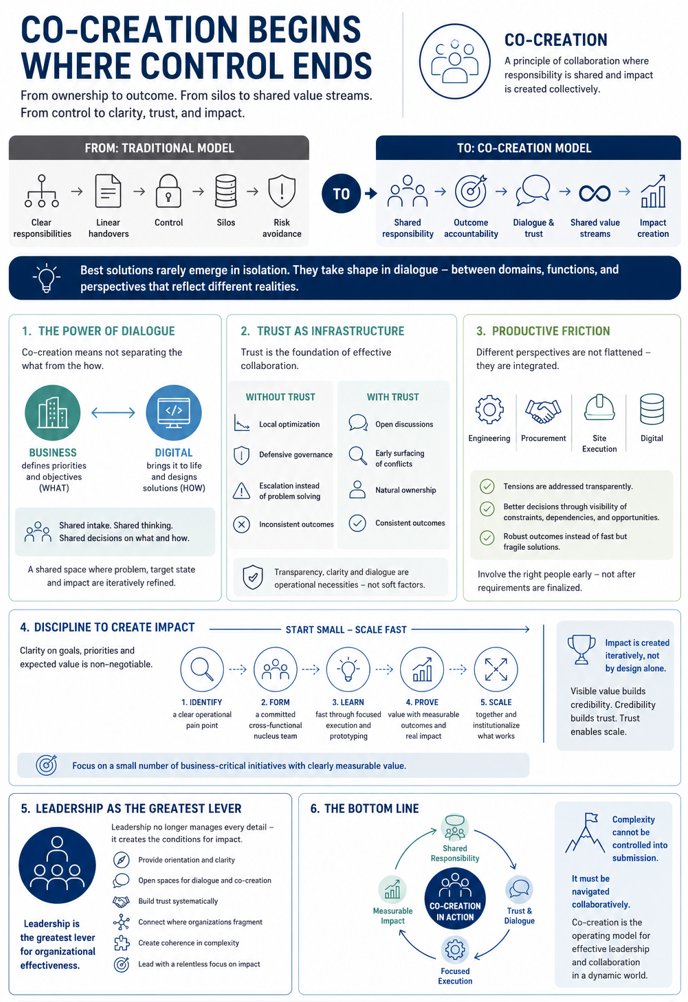
⬛️ #Blog4Managers | Co-Creation begins where control ends
Co-creation is not a tool. It is a principle. And it fundamentally changes the logic of collaboration. While traditional organizational models rely on clear responsibilities, linear handovers, and control, co-creation emerges where responsibility is deliberately shared and impact is created collectively.
🔹 It shifts the focus: from ownership to outcome accountability, from silos to shared value streams. In practice, one insight stands out: the best solutions rarely emerge in isolation. They take shape in dialogue – between domains, functions, and perspectives that reflect different realities. Co-creation means not separating the what from the how. Business does not merely define requirements, and digital teams do not rush to deliver solutions. Instead, a shared space of thinking emerges, where the problem, the target state, and the intended impact are iteratively refined. Only within this shared understanding does activity turn into real value creation.
🔹 Yet co-creation does not work without trust. Trust is not a soft dimension – it is the true infrastructure of effective collaboration. Without trust, alignment becomes tactical, decisions become political, and outcomes remain inconsistent. Organizations then optimize not for impact, but for risk avoidance. With trust, however, the dynamics shift: discussions become more open, conflicts surface earlier, and ownership is taken more naturally – especially under conditions of uncertainty. Trust-based collaboration does not mean harmony. On the contrary, it creates the space for productive friction.
🔹 Different perspectives are not flattened, but deliberately integrated. It is precisely within the tension between conflicting demands that quality emerges. Decisions do not become easier, but more robust. Speed is not driven by less alignment, but by better alignment – through clarity, reliability, and a shared understanding of priorities. Co-creation therefore requires a high degree of discipline. Clarity about goals, priorities, and expected value is not a “nice-to-have,” but a prerequisite. Small, focused initiatives are often more effective than large-scale programs, as they enable learning and make complexity manageable.
🔹 Start small – scale fast is not a slogan, but a structural principle: impact is created iteratively, not by design alone. What matters is to generate visible value early, validate hypotheses, and scale solutions together. Leadership fundamentally changes in this context. It no longer primarily defines content, but shapes the conditions under which good content can emerge. Leadership means providing orientation, opening spaces, and systematically building trust. It connects where organizations fragment and creates coherence where complexity increases - not through control, but through clarity, dialogue, and a consistent focus on impact.
📢 Co-creation is not an additional process step. It is the way organizations remain effective in complex and dynamic environments. Wherever solutions can no longer be planned but must be developed, co-creation becomes the central logic of leadership and collaboration.
Infographic by @thomas_dettling | GPT 5.5
✨ @TamaraMcCleary@timo_vi@Khulood_Almani@AkwyZ@MaryRich78@rwang0@drsharwood@DrHolzwarth@HelenBevan@phinifa@pierrecappelli@JimHarris@jenstirrup@GlenGilmore@subare@Ronald_vanLoon@enilev@Scobleizer@AndrewYNg@YuHelenYu@quepasachico ✨
#CoCreation #Leadership #Trust #Collaboration #Mindset #DigitalTransformation #HolisticThinking #People #System #ValueCreation #Impact
⬛️ #Blog4Managers | What does an organization have to do with an 🦑 octopus?
Long as a tentacle —
but worth the read.
🔶 If we are honest, many companies are still managed like machines: efficient, controllable, predictable. Processes interlock neatly, responsibilities are clearly assigned, and decisions follow well-defined hierarchies. This organizational model worked extremely well for decades - in a world that was relatively stable. But this is precisely where today’s problem begins. The reality in which organizations now operate is no longer stable. It is complex, dynamic, and unpredictable. Markets change faster than strategy papers can be written. Customer needs emerge and disappear in real time. Technologies evolve exponentially. Competition suddenly arises from completely new directions. And in the middle of all this are organizations still trying to respond to a living reality with a machine model.
🔶The Harvard Business Review article “Become an Octopus Organization” (Dec. 2025) describes exactly this rupture - and offers a powerful counterimage: the octopus 🦑
The Invisible Boundary:
Complicated vs. Complex
The most important shift in thinking lies in the distinction between complicated and complex:
◾️ Complicated systems can be analyzed, decomposed, and optimized. Cause and effect are understandable. This is exactly what traditional organizations were designed for: control, efficiency, scalability.
◾️ Complex systems behave fundamentally differently. They are shaped by interactions, dynamics, and uncertainty. Small impulses can have large effects. Solutions often emerge only through action. Learning becomes more important than planning. Adaptation more important than control.
This is where many organizations become overwhelmed: they continue to try to manage complexity with the tools of complication. But complexity cannot be “worked through.” It can only be navigated. And that changes everything: leadership, collaboration, decision-making, and responsibility.
The Octopus:
A Different Organizational Model 🦑
🔶 The octopus offers a fascinating metaphor for a different way of thinking about organizations. Its nervous system is not centralized. A large part of its “intelligence” resides in its arms. These can act independently while remaining coordinated and adapting to the situation. The octopus does not wait for central approval - it learns continuously from its environment. That is the essence of the metaphor. Translated into organizational terms, this means: a future-ready organization distributes its intelligence. It does not merely delegate tasks, but decisions. It shifts responsibility to where knowledge is created. It relies less on control and more on clarity, trust, and context. The result is not chaos. Quite the opposite. A highly adaptive system emerges - one that learns faster, responds faster, and operates closer to customers, markets, and real problems.
🦑 The key question therefore is no longer: “How do we improve control?” But rather: “How do we create conditions in which good decisions can emerge everywhere in the system?”
🔶 What Changes in Practice
The difference between a traditional organization and an “octopus organization” does not first appear in strategy documents or org charts, but in everyday behavior.
Take meetings, for example: In many traditional structures, meetings are primarily about information transfer: tons of slides, control (🟢or🔴) clearly assigned speaking roles -top down. Communication is controlled and sequential. But real insight rarely emerges from slides.
🦑 In an octopus logic, meetings become spaces for shared thinking. Different perspectives collide. Ideas evolve. Assumptions are challenged. Leadership becomes facilitation - not instruction. Or consider how customer problems are handled.
In many organizations, an issue travels up and down several hierarchy levels before someone is allowed to decide. Speed is lost. Responsibility diffuses. Proximity to the customer disappears.
Adaptive organizations work differently. Decisions are made closer to the problem - and therefore closer to the customer. Employees take ownership, respond situationally, and learn from every interaction. Something crucial emerges from this: innovation is not delegated. It emerges from daily work.
🔶 The Three Invisible Brakes
Why does this shift remain so difficult? Not because of a lack of methods, but because of deeply embedded organizational patterns. The HBR article describes three recurring antipatterns:
1. Unclear Direction
Many organizations believe their goals are clear. In reality, interpretation gaps, information loss, and silo thinking emerge. Teams optimize locally, but not collectively. People make decisions without shared context. Paradoxically, this increases the need for alignment, control, and escalation.
2. Lack of Ownership
Many companies talk about accountability while building systems that punish it. Employees are controlled, safeguarded, and embedded in reporting logic. Decisions must be justified rather than enabled. Ownership is demanded rhetorically - but structurally prevented. As a result, people learn to avoid risk instead of taking responsibility.
3. Suppressed Curiosity
Organizations constantly talk about innovation. What they usually reward, however, is predictability. Curiosity becomes the exception, not the norm. In the age of AI, this becomes a strategic problem. Machines take over routines. Humans create value through creativity, learning, and contextual understanding. Yet many organizations create precisely the conditions under which these capabilities wither.
🔶 Rethinking Leadership
Designing systems instead of dictating resultsrole of leadership itself. In the traditional model, leaders are decision-makers, problem-solvers, and control points. They are expected to provide answers, minimize risks, and manage as many variables as possible. In complex environments, this leadership model increasingly fails. No one can centrally comprehend complexity. In the octopus model, the focus shifts radically. Leadership now means: Designing systems instead of dictating results
Providing context instead of issuing instructions Creating orientation instead of maximizing control
Asking questions instead of rushing to answers. The leader’s task is no longer to find the best solution personally, but to create the conditions under which good solutions can emerge throughout the system.
🔶 For many leaders, this is the hardest part: no longer having to be the smartest point in the system. Because the real challenge is rarely structural. It is psychological. It involves loss of control, trust, uncertainty, and the willingness to redistribute power. That requires humility - and at the same time, considerable courage.
Change Starts Small
🔶 One point is often underestimated: An octopus organization does not emerge through a large transformation program. It emerges through many small changes in everyday work:
◾️ a meeting that is well prepared and facilitated differently
◾️ a decision that is deliberately decentralized
◾️ a team that receives more context instead of more control
◾️ a process that is removed rather than expanded
◾️ a leader who listens first instead of responding immediately
🦑 The real leverage often lies not in “more,” but in “less”: Less rules. Less escalation. Less safeguarding. Less control. In return: more clarity, more trust, more responsibility, and more learning.
🔶 The Future Is Alive
So what does an organization have to do with an octopus? More than we might initially think:
In a complex world, rigid structures are no longer sufficient. Organizations must learn to adapt, to move, and to learn continuously. They must become alive. The octopus stands for exactly that: distributed intelligence, adaptability, and the interplay of autonomy and connection. Or put differently:
🦑 The organization of the future is not a perfectly engineered system. It is a learning organism. And perhaps that is the most important management question of our time: Where in my organization am I still blocking learning, adaptation, and emergence?
@TamaraMcCleary@timo_vi@Khulood_Almani@AkwyZ@MaryRich78@rwang0@drsharwood@DrHolzwarth@HelenBevan@phinifa@pierrecappelli@JimHarris@jenstirrup@GlenGilmore@subare@Ronald_vanLoon@enilev@Scobleizer@AndrewYNg@YuHelenYu@gleonhard@quepasachico
#Leadership #Complexity #AdaptiveOrganizations #OrganizationalDesign #FutureOfWork #People #Trust #SystemsThinking #Agility #Mindset #DigitalTransformation #Innovation #Ownership #Innovation #HBReview #Octopus 🦑
Image by @thomas_dettling | GPT 5.5
@Khulood_Almani we mention design thinking in previous posting with AI especially in healthcare now @thomas_dettling have arrive at a design thinking chart for AI
⬛️ Organizational Transformation in the Age of AI
🔷 Artificial intelligence has moved beyond curiosity and early experimentation. Across industries, organizations can point to measurable gains from adoption and are beginning to integrate AI into core enterprise workflows.
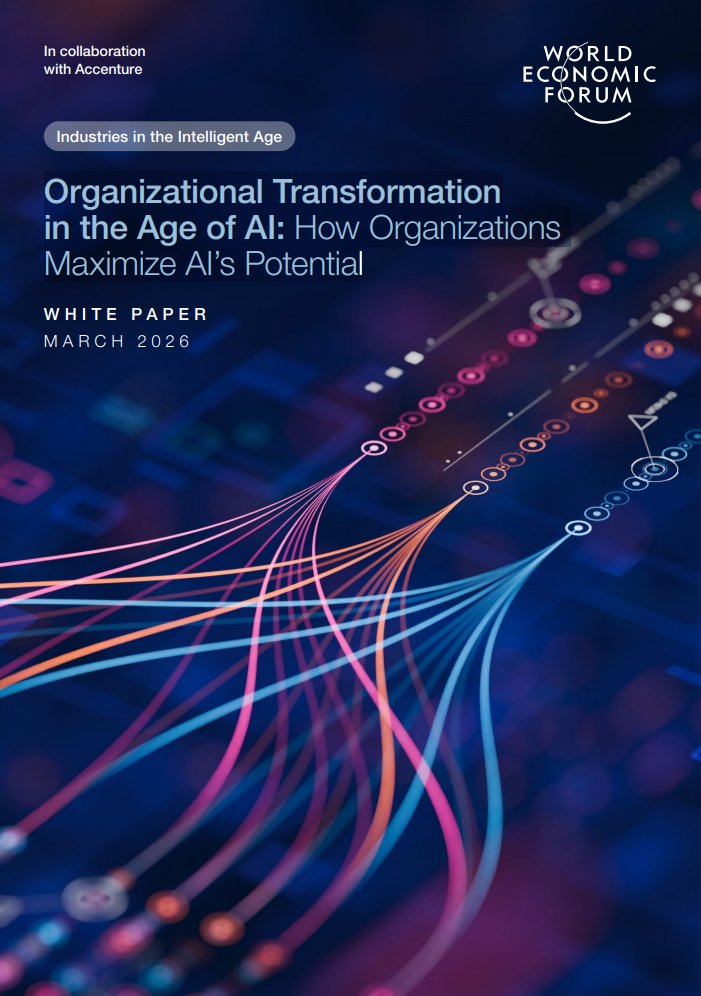
🔷 Organizational Transformation in the Age of AI: How Organizations Maximize AI's Potential examines how leading organizations are embedding AI across customer experience, operations, R&D, strategic planning and talent.
🔷 Drawing on insights from more than 450 executives in the World Economic Forum’s AI Transformation of Industries community, it highlights a shift from isolated use cases to connected systems, from episodic initiatives to continuous processes and from task automation to human value creation.
🔷 Five principles enable adoption at scale:
1⃣ Human accountability
2⃣ End-to-End operating model (redesign)
3⃣ Scalable talent systems
4⃣ Transparency-driven trust
5⃣ Disciplined experimentation
➡️ Together, they support sustained productivity, resilience and growth - provided organizations treat AI transformation not as a technology rollout, but as a fundamental shift in culture, leadership, and learning.✨
🦋 @Khulood_Almani@AkwyZ@TamaraMcCleary@MaryRich78@rwang0@timo_vi@drsharwood@DrHolzwarth@HelenBevan@pierrecappelli@JimHarris@jenstirrup@GlenGilmore@subare@Ronald_vanLoon@enilev@Scobleizer@AndrewYNg@YuHelenYu
#DigitalTransformation #AI #OrganisationalChange #Culture #People #Experimentation #Trust #DatadrivenWork #Industry #FutureOfWork
➡️ Download: https://t.co/DNVdgwP8fS | @wef
⬛️ The Essence of a Culture of Excellence in the Age of Digital Transformation
“Excellence is not an aspiration. Excellence is the next five minutes.”
— Tom Peters
🔷 A Culture of Excellence is far more than the pursuit of peak performance, operational efficiency, or the achievement of OKRs. Its true essence lies in a deeply shared inner mindset: a persistent, passionate commitment to creating meaningful impact for customers, society, and the organization itself - consistently, reflectively, and profoundly human-centered. Excellence is neither a fixed end state to be reached nor a time-bound program or initiative that can simply be “implemented.” It is a living, everyday culture, expressed in every meeting, every decision, and every interaction - in how people think, prioritize, decide, and act.
🔷 At its core, a Culture of Excellence integrates three central, deeply interwoven dimensions: radical ambition, continuous learning, and deep psychological safety. It challenges rather than pacifies or settles for compromise. It systematically transforms mistakes and setbacks into valuable learning opportunities instead of hiding or punishing them. And it creates an environment in which people have the courage and freedom to take real responsibility, ask uncomfortable questions, openly voice doubts, critically challenge ideas, and boldly explore new and unfamiliar paths - even when the outcome is uncertain.
🔷 Especially in the age of Digital Transformation, such a culture becomes a decisive strategic necessity. Digital technologies, artificial intelligence, automation, and data-driven systems not only increase technical complexity dramatically - they also accelerate decision-making to unprecedented speeds, drastically shorten development and innovation cycles, and make permanent uncertainty, volatility, and ambiguity the new normal. In such highly dynamic environments, true excellence can no longer be enforced through traditional control mechanisms, detailed master plans, or rigid hierarchies. Instead, it emerges from the intelligent use of collective intelligence, from open and trust-based dialogue across all levels, from deliberate and courageous experimentation, and from an organizational capability to learn from errors and failures faster and more systematically than competitors.
🔷 A Culture of Excellence therefore fundamentally shifts the organization’s focus: away from mere operational efficiency toward sustainable, tangible impact for all stakeholders; away from the sole emphasis on individual expertise toward the development of collective learning and adaptive capacity; and away from traditional hierarchical structures toward a culture shaped by mutual trust, clear accountability, and genuine psychological safety.
🔷 Leaders play a particularly decisive role in this transformation. They do not create excellence through top-down instructions, detailed specifications, or motivational PowerPoint presentations, but above all through authentic role modeling. This means listening deeply and actively, setting clear and ambitious expectations, openly acknowledging their own mistakes, and dealing with them constructively -through an honest “I was wrong here; let’s learn from this together,” or a sincere “What do you really think?” in critical moments. Such seemingly small gestures often have a stronger cultural impact than any formal initiative.
🔷 Ultimately, Digital Transformation is far less a purely technological challenge than a profoundly cultural one. Without a strong, living Culture of Excellence, even the most advanced technologies, algorithms, and tools remain mere instruments without sustainable impact - often expensive, yet ineffective. With such a culture, however, they become powerful, multiplicative levers for genuine and sustainable innovation, for significantly higher engagement and commitment, and for long-term, resilient success in an increasingly complex market environment.
🔷 Excellence, therefore, is not the result of successful digital transformation. It is its indispensable prerequisite—and its most powerful driver. Why? Digital transformation does not create excellence. Only in a culture of excellence can it truly succeed.
🦋 @tom_peters@Khulood_Almani@AkwyZ@TamaraMcCleary@MaryRich78@rwang0@timo_vi@drsharwood@DrHolzwarth@HelenBevan@pierrecappelli@JimHarris@jenstirrup@GlenGilmore@subare@Ronald_vanLoon@enilev@Scobleizer@AndrewYNg@YuHelenYu
#CultureChange #FutureOfWork #People #Learning #Leadership #PsychologicalSafety #Behavior #Excellence #Innovation #DigitalTransformation
Infographic by the great @tnvora ✨







![thomas_dettling's tweet photo. ⬛️ #Blog4Managers | Industry 5.0 – From Efficiency to Meaningful Value Creation
Industry 4.0 has fundamentally reshaped industrial value creation. It introduced connectivity, data, and digital infrastructure as the backbone of modern operations. Cyber-physical systems, IoT platforms, cloud architectures, and advanced analytics enabled organizations to automate, integrate, and scale processes at an unprecedented level. Many companies built extensive data lakes, sophisticated digital twins, and end-to-end process transparency. Where these elements were consistently implemented, they created what can truly be described as an operational nervous system: real-time data flows, interconnected assets, and increasingly autonomous decision-making loops.
🔹 And yet, Industry 4.0 revealed a profound structural limitation. It excelled at optimizing what already existed. It made processes faster, leaner, and more scalable - but often without questioning whether these processes were truly meaningful, resilient, or human-centric in the first place. Efficiency became an end in itself, sometimes at the expense of adaptability, purpose, and long-term value. At the same time, many organizations underestimated three critical prerequisites that now determine whether Industry 5.0 can succeed:
▪️ First, the ability to work truly data-driven. Not merely collecting data, but ensuring consistent data quality, shared definitions, and decision relevance across the organization. In many cases, data exists - but it does not create insight, alignment, or action.
▪️ Second, the shift toward end-to-end thinking. Most processes are still optimized locally - within functions, departments, or systems. What is missing is a holistic perspective that connects demand, engineering, supply chain, production, and service into a coherent system of value creation.
▪️ Third, the explicit focus on value creation. Industry 4.0 often optimized efficiency metrics - Overall Equipment Effectiveness [OEE], throughput, cost. Industry 5.0 requires a different question: how does this process contribute to real value - for customers, employees, and the business as a whole?
📢 Without these three capabilities - data maturity, end-to-end thinking, and value orientation - organizations risk digitizing fragmentation instead of transforming performance.
🔹 A realistic example that reflects the reality of many industrial players:
A global machinery manufacturer - representative of many industrial players - invested over 250 million € in a comprehensive Industry 4.0 program. Digital twins of production lines delivered impressive OEE improvements of 18%, predictive maintenance reduced unplanned downtime significantly, and supply-chain dashboards provided unprecedented transparency. Yet when a major geopolitical disruption combined with raw material shortages hit, the system faltered dramatically.
The highly optimized, just-in-time processes - perfectly tuned for stable conditions - created cascading failures. Data was abundant, but the organization lacked the human judgment frameworks and cross-functional resilience mechanisms to interpret signals early and reconfigure meaningfully. Production lines stood still for weeks, customer commitments were missed, and employee trust in the “smart factory” narrative eroded.
🔸 This case illustrates why Industry 5.0 is not a nice-to-have evolution - it is a necessary correction.
Industry 5.0 does not replace 4.0. It builds on its foundation - and fundamentally reframes its purpose.
At its core, Industry 5.0 introduces three interdependent dimensions that shift the paradigm from pure optimization to purposeful value creation:
1. Human-centricity
The focal point moves from technology to people — employees, customers, and society. The decisive question is no longer “What can we automate?” but “What should we automate - and how do we keep human judgment, creativity, empathy, and ethical responsibility at the center?” AI and cobots become true augmenters: they take over repetitive and dangerous tasks, while humans retain sovereignty over complex decisions, innovation, and relationship-driven value. This requires systems that are intuitive, explainable, and empowering rather than alienating.
2. Resilience
Industry 4.0 optimized for efficiency in predictable environments. Industry 5.0 optimizes for adaptability and antifragility under uncertainty. In the machinery example, the company responded by establishing interdisciplinary “Resilience Labs” - teams of operators, data scientists, engineers, and strategists who use 4.0 data not merely for prediction, but for stress-testing scenarios, dynamic reconfiguration, and rapid learning loops. Resilience here means designing systems that become stronger through shocks - far beyond traditional risk management.
3. Sustainability
While Industry 4.0 enabled transparency, Industry 5.0 demands accountability and regenerative impact. Value is no longer measured solely in productivity metrics, but in the triple bottom line: environmental, social, and economic outcomes. Digital technologies now enable circular economy models, emissions tracking [eg Scope 3 | GHG protocol], and regenerative supply chains. The critical shift lies in intention: optimizing not just for output, but for sustainable outcomes.
🔹 This evolution exposes a critical dependency:
Industry 5.0 can only deliver its promise where Industry 4.0 has been meaningfully implemented.
▪️ Without reliable, high-quality data, there can be no informed decision-making.
▪️ Without robust digital infrastructure, there is no scalability of resilience.
▪️ Without integrated systems, there is no sustainability at scale.
In many organizations, however, the Industry 4.0 journey remains fragmented - islands of excellence surrounded by legacy systems. In such environments, Industry 5.0 risks becoming a strategy on paper rather than operational reality. This is where most transformations fail - not because of data or technology, but because of fragmentation.
The fundamental insight for leaders today:
Industry 5.0 is not primarily a technology program. It is a maturity test for the entire organization. It requires a conscious shift from:
▪️ data collection → deep problem clarity
▪️ automation → meaningful human augmentation
▪️ efficiency → systemic and sustainable value creation
This is why Design Thinking, systems thinking, and adaptive leadership move from “nice-to-have” to mission-critical. They provide the cognitive and organizational foundation to decide what should be built before scaling how it is built.
Looking ahead, emerging signals around Industry 6.0 point toward autonomous, self-designing systems and deeply integrated human–AI collectives that blur the boundaries between creator and creation.
📢 If Industry 4.0 connected machines and Industry 5.0 re-centered humans, Industry 6.0 may redefine the relationship between both.
In such a landscape, competitive advantage will no longer come from technology adoption alone, but from an organization’s ability to continuously redefine what value means, which problems truly matter, and how humans and intelligent systems collaborate.
Industry 5.0 is therefore not the next step in industrial evolution. It is the correction of a fundamental mistake: Optimizing systems before understanding what they are for.
✨ @timo_vi @Khulood_Almani @AkwyZ @MaryRich78 @rwang0 @drsharwood @DrHolzwarth @HelenBevan @phinifa @pierrecappelli @JimHarris @jenstirrup @GlenGilmore @subare @Ronald_vanLoon @enilev @quepasachico @Scobleizer @AndrewYNg @YuHelenYu @SDGS4GOOD @EU_Commission ✨
#Industry50 #Industry40 #Industry60 #Innovation #DigitalTransformation #Leadership #AI #Engineering #DesignThinking #SystemsThinking #Resilience #Sustainability 🌱 #HumanCentric #People #HDC #ValueCreation #DataDriven #EndToEnd #Competitiveness
Infographic by @thomas_dettling | GPT 5.5](https://pbs.twimg.com/media/HJWibJlWkAIWC5i.jpg)