Good post from @balajis on the "verification gap".
You could see it as there being two modes in creation. Borrowing GAN terminology:
1) generation and
2) discrimination.
e.g. painting - you make a brush stroke (1) and then you look for a while to see if you improved the painting (2). these two stages are interspersed in pretty much all creative work.
Second point. Discrimination can be computationally very hard.
- images are by far the easiest. e.g. image generator teams can create giant grids of results to decide if one image is better than the other. thank you to the giant GPU in your brain built for processing images very fast.
- text is much harder. it is skimmable, but you have to read, it is semantic, discrete and precise so you also have to reason (esp in e.g. code).
- audio is maybe even harder still imo, because it force a time axis so it's not even skimmable. you're forced to spend serial compute and can't parallelize it at all.
You could say that in coding LLMs have collapsed (1) to ~instant, but have done very little to address (2). A person still has to stare at the results and discriminate if they are good. This is my major criticism of LLM coding in that they casually spit out *way* too much code per query at arbitrary complexity, pretending there is no stage 2. Getting that much code is bad and scary. Instead, the LLM has to actively work with you to break down problems into little incremental steps, each more easily verifiable. It has to anticipate the computational work of (2) and reduce it as much as possible. It has to really care.
This leads me to probably the biggest misunderstanding non-coders have about coding. They think that coding is about writing the code (1). It's not. It's about staring at the code (2). Loading it all into your working memory. Pacing back and forth. Thinking through all the edge cases. If you catch me at a random point while I'm "programming", I'm probably just staring at the screen and, if interrupted, really mad because it is so computationally strenuous. If we only get much faster 1, but we don't also reduce 2 (which is most of the time!), then clearly the overall speed of coding won't improve (see Amdahl's law).
A million seconds ago was May 23rd
A billion seconds ago was 1993
A trillion seconds ago was 30,000 B.C.
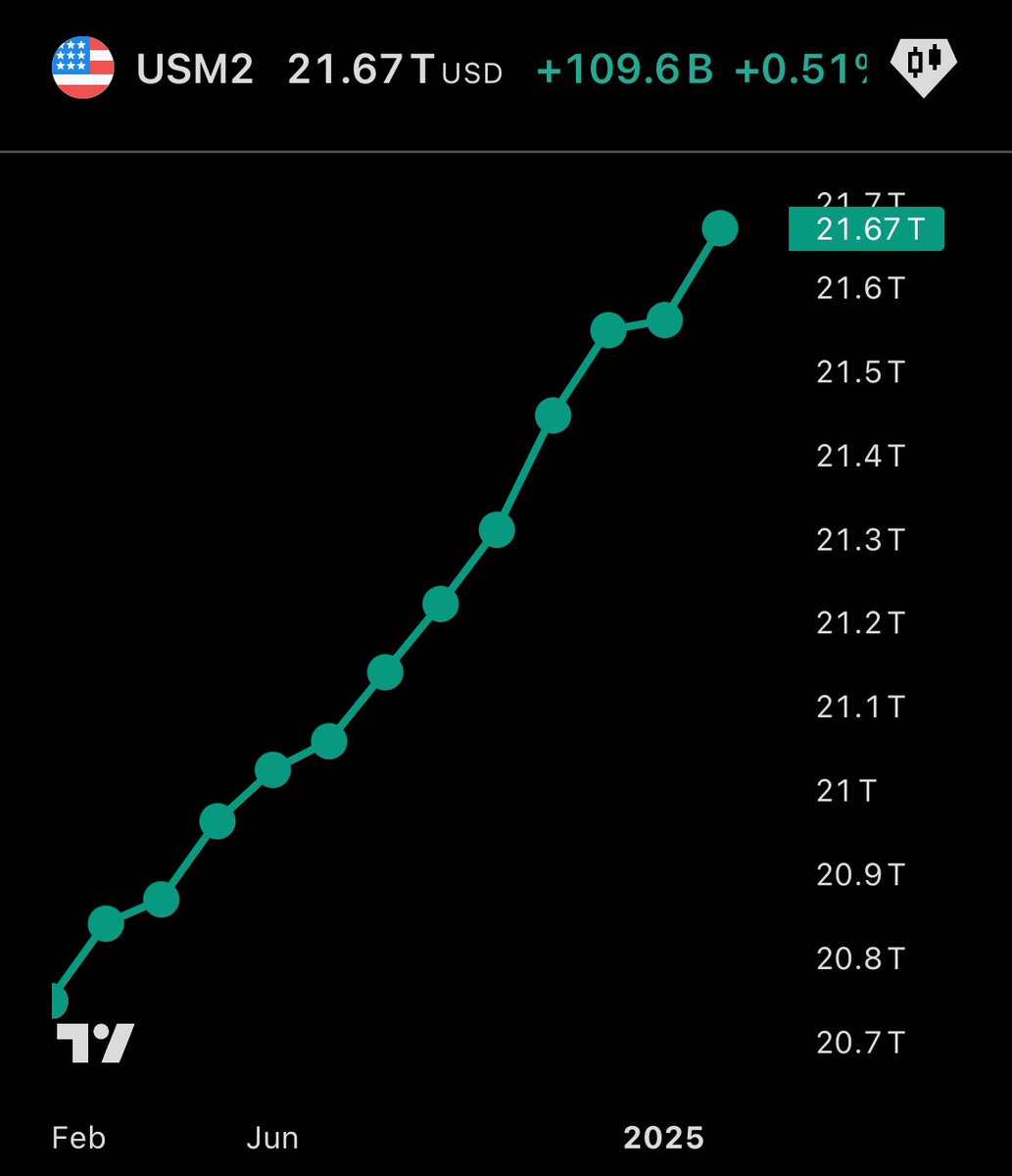
The US national debt is now rising by $1 Trillion every 180 days.
Cutting your nose off to spite your face...
The bond market understands what has transpired and it doesn't like it. Rates are rising, and may now move rapidly.
Many of the same journos, politicians and media who thought they "won" by trying to sideline DOGE will now face an uncomfortable new reality in their personal financial lives and those of their constituents as rates rise.
They will then realize, but never admit, that what they did was reckless.
Re the U.S. debt downgrade, you should know that credit ratings understate credit risks because they only rate the risk of the government not paying its debt. They don't include the greater risk that the countries in debt will print money to pay their debts thus causing holders of the bonds to suffer losses from the decreased value of the money they're getting (rather than from the decreased quantity of money they're getting). Said differently, for those who care about the value of their money, the risks for U.S. government debt are greater than the rating agencies are conveying.
#principles #howcountriesgobroke #debt
Good to see the Senate finally voting on stablecoin legislation. It’s a first round to the negotiation, and I expect there will be another vote early next week after more debate.
Frankly, the bill still needs some work (like fixing the prohibition on yield and interest which makes no sense). But this is all part of the process.
Once all members have had time to review the text, and a few changes are made, I suspect the GENIUS Act will be one step closer to the President’s desk with a strong bipartisan vote.
The 52m American voters who hold crypto are watching closely!
This famous image by István Orosz features a scene from the classic novel The Mysterious Island.
When a mirrored cylinder is placed on the Moon, it reveals by anamorphosis a portrait of the writer, Jules Verne.
"Chatting" with LLM feels like using an 80s computer terminal. The GUI hasn't been invented, yet but imo some properties of it can start to be predicted.
1 it will be visual (like GUIs of the past) because vision (pictures, charts, animations, not so much reading) is the 10-lane highway into brain. It's the highest input information bandwidth and ~1/3 of brain compute is dedicated to it.
2 it will be generative an input-conditional, i.e. the GUI is generated on-demand, specifically for your prompt, and everything is present and reconfigured with the immediate purpose in mind.
3 a little bit more of an open question - the degree of procedural. On one end of the axis you can imagine one big diffusion model dreaming up the entire output canvas. On the other, a page filled with (procedural) React components or so (think: images, charts, animations, diagrams, ...). I'd guess a mix, with the latter as the primary skeleton.
But I'm placing my bets now that some fluid, magical, ephemeral, interactive 2D canvas (GUI) written from scratch and just for you is the limit as capability goes to \infty. And I think it has already slowly started (e.g. think: code blocks / highlighting, latex blocks, markdown e.g. bold, italic, lists, tables, even emoji, and maybe more ambitiously the Artifacts tab, with Mermaid charts or fuller apps), though it's all kind of very early and primitive.
Shoutout to Iron Man in particular (and to some extent Start Trek / Minority Report) as popular science AI/UI portrayals barking up this tree.
Kurt Gödel astonished the world by proving that in any sufficiently rich axiomatic system, there are true statements that cannot be proved within the system—a result so subtle it took decades for its full impact on mathematics and philosophy to be grasped.
📷Courtesy of the IAS Archive
we crossed the turing test & no one gave a shit. no parades. no front page headlines. just… a casual shrug. like “oh yeah, the machines are smart enough to fool us now. anyway, what’s for lunch?”
that silence tells you everything about the pace we’re moving at.
back in my cs classes, the turing test was treated like the final boss. now every break through is another god damn tuesday.