Nice detail here: the Fermat’s Last Theorem news was revealed to the world by a coffee shop on instagram, an hour or so before the official announcement
Of course you don't understand. It takes an OOM higher IQ (in the real projective IQ line) than a mathematician to understand any post on lesswrong dot com. To get started, first read Harry Potter and the Methods of Rationality by E. Yudkowsky. This ain't algebraic geometry.
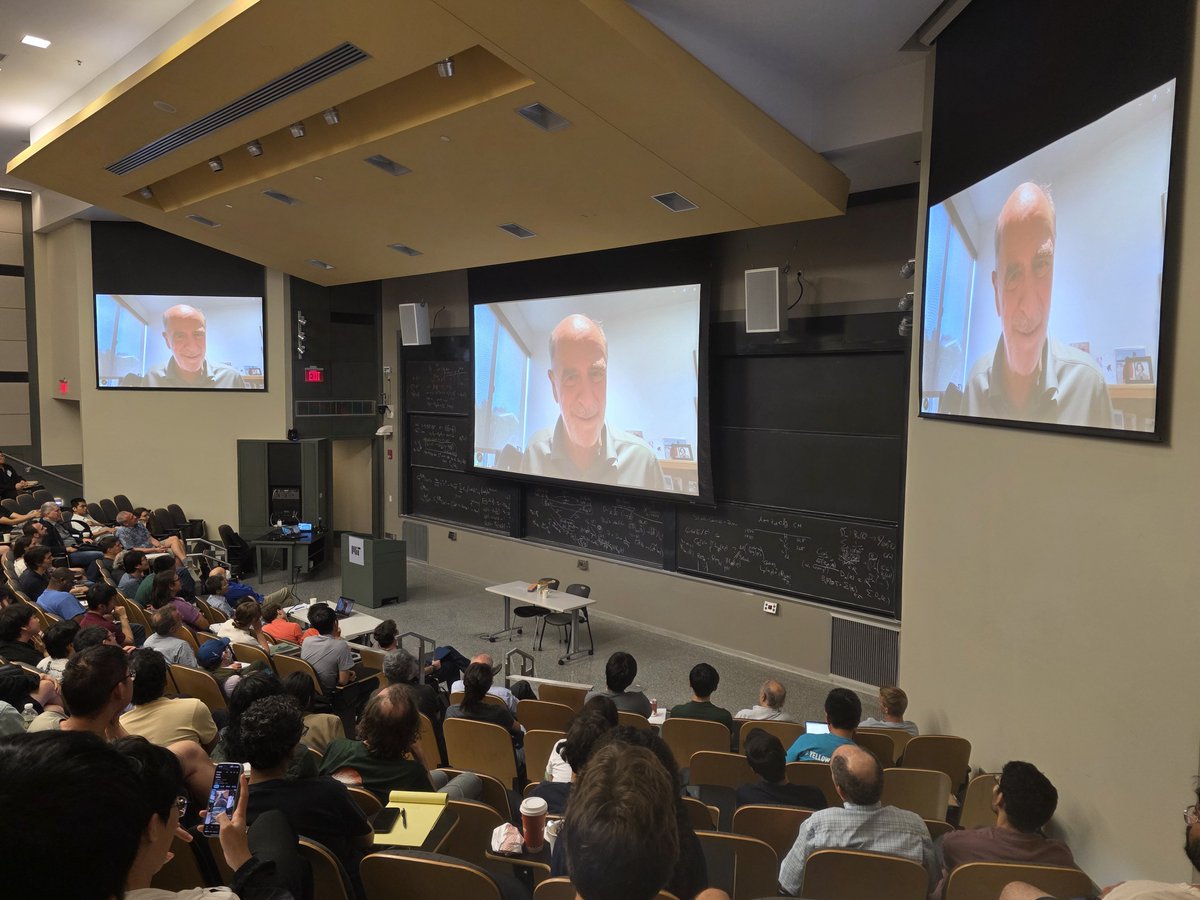
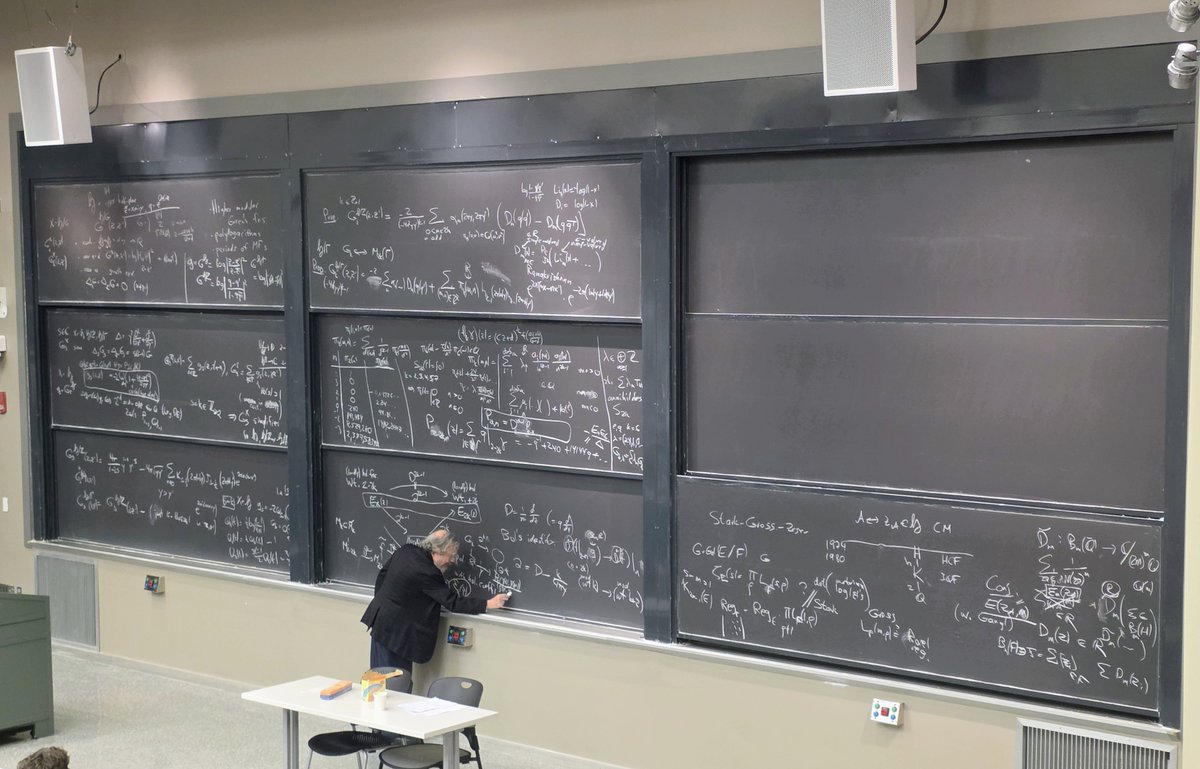
In a very emotional moment, after Zagier's talk during the "Gross-Zagier conference, 40 years later", the organizers played a video that Dick Gross recorded before his recent passing.
When we do math, we devote our life to it, we do it with our entire soul.
Anyone who thinks they can stop a mathematician from doing math doesn't get it. fuck a job.
It's deeply spiritual, I will BCI with AI to keep doing it.
Bury my body with a copy of Munkres. dust to dust.
This is a real worry of mine (for both RH and other problems) - one can imagine the rush of headlines crowing "AI superintelligence solves hardest problem", and not recognising that the AI was putting the final polish on a massive programme built by decades of human work.
Oh ffs why are so many cs profs making these pronouncements? You don’t know the depth of mathematics. It has not been reached by any model. I believe that day is coming and my community must prepare for it but it’s grossly inaccurate to declare it has already happened.
Only certain traditional routes to ego gratification through mathematics are being slaughtered. If you find mathematics beautiful, you can go check in your mind right now and find that it's still there.
I don't think I had a full appreciation until recently of the degree to which the study of mathematics is functionally equivalent a religious order for so many mathematicians. The old gods are being slaughtered by the new machine god, and it must be like watching heaven being plundered.
I've seen this sentiment from several mathematicians, and it is understandable, but I feel it is also dangerously wrong. I say this because I think mathematicians need to adapt hard and fast, instead of wishing that the disruption from AI will somehow go away.
There is a science to large language models and it predicts that with the linear scaling rate we are seeing now, capabilities will increase over the next 5 years at a similar rate as the last 5 years. To get a sense of what that means, one of the main benchmarks 5 years ago was GSM8K, whose questions you can see for yourself at https://t.co/fNyx6xUVse.
There also seems to be a misconception that frontier labs are emphasizing math right now, and spending a lot on solving open math problems, in order to advertise the intelligence of their models. There was some truth to this 7-10 months ago, but that time has passed and most labs are now focused on coding agents. The continued improvements in math are largely a side effect.
In the past, the path to a math Ph.D. cultivated resilience, resourcefulness, critical thinking, and a healthy skepticism. These qualities are still needed today, perhaps more than ever, but suddenly you can produce a passable Ph.D. thesis with the push of a button. This signals that the field needs to completely overhaul itself, starting now.
My recommendation is that the future role of humans in mathematics, and similar theoretical fields, should be preserving and disseminating knowledge in oral and social forms; written papers will be the domain of AI. Over the coming months I will be involved in workshops that aim to produce more concrete proposals. But people need to come to terms ASAP with the fact that drastic change and compromise are needed to prevent the disenfranchisement of humanity from knowledge work.
I might just be too naive or stupid to take on the noble task of suffering through identifying with my mathematical work, but I always saw math as a beautiful, vast world outside of myself, and I was always just grateful whenever I could see a bit more of it for myself.
There is AI despair in young mathematicians, similar to that artists have been facing. See this recently circling article (next tweet). I was once serious about trying to become a mathematician (even if I drifted into becoming a computational scientist instead) so a lot of this resonates.
Basing self worth on being the first to discover or prove something may not be viable for young mathematicians and scientists. It's like John Henry versus the Steam Engine. Or maybe Lee Sedol versus AlphaGo. At some point the machine will be more powerful at search (As an aside, this still isn't sentience for the same reason chess bots aren't sentient. We now have math/programming bots is all). I still think the spiritual value of mathematics or research persists. There is value in understanding and explaining difficult things. But admittedly economics will shift. The more effective machine search becomes the more "industrial grade" research will shift that way.
What do we base self worth on then as mathematicians or scientists? My two cents is all the classical spiritual and philosophical guides are still relevant. We just need to break free of defining our worth as our work. I think scientific culture will shift but it will be a slow painful thing.
Sometimes the fastest way to do something is slow.
I don't think the human mind is actually, in a réal sense, built for deeply understanding math by wireheading mathematics.
I think the human mind is built to sleep on hard ideas for a bit with a moment of epiphany on a walk.
If you think you don’t have metaphysical beliefs, it almost always means your beliefs are so unexamined and dogmatic that you don’t even realise you have them.
This is especially true of secular, humanist materialists who tend towards thinking their secular, humanist materialist views are somehow the default rather than being articles of deep, often unexamined faith.
Gerd Faltings' colleges and “partners in crime” tricked him into a “meeting”. Watch the reaction when mathematician Gerd Faltings realizes that he will be awarded the #AbelPrize in Oslo in May.
Being a scientist is still the best job in the world. The constant frustrations, all the crap that goes with trying to keep the lab alive and move things forward - it all resets and washes away in those occasional moments when we catch a glimpse of nature revealing something remarkable and not seen before. This has been a good week - I saw a few completely amazing, wild new things; it will be a total slog to get them polished and out, but it doesn't matter because they've been seen and a new piece of the roadmap is revealed. Just feeling immensely grateful for the opportunity, and mentally sending a message back in time to childhood me (and anyone else who dreams of this now).
“Grothendieck was working on the foundations of algebraic geometry seven days a week, twelve hours a day, for ten years”. - David Ruelle
https://t.co/aeFQEeEaFT