Beautiful paper from Google DeepMind.
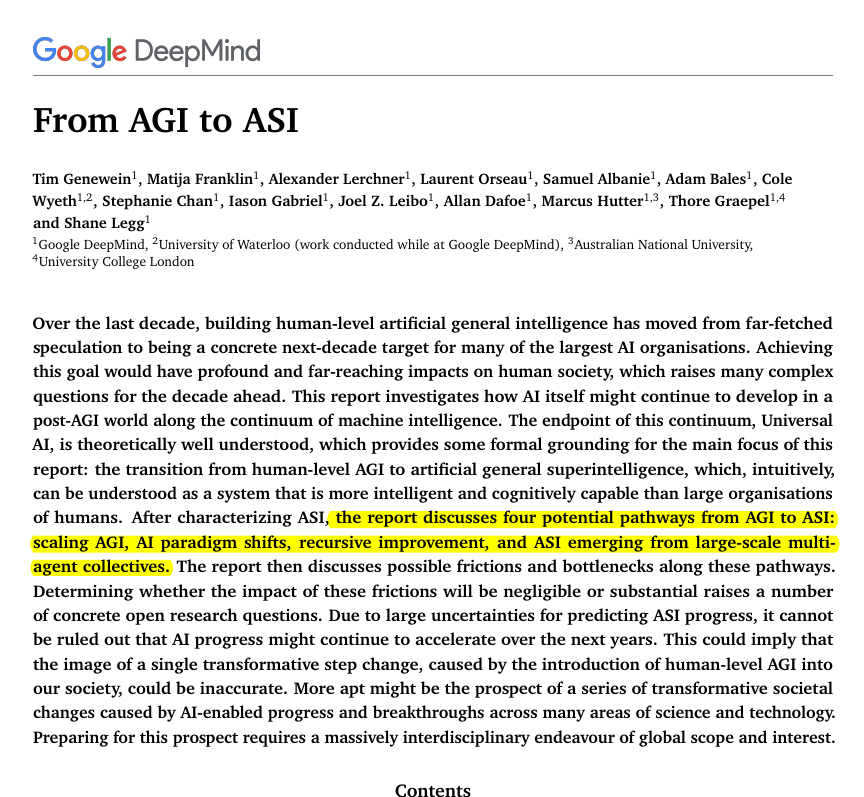
Explains the pathways from AGI to ASI, and why that jump could happen through several routes.
The authors frame the AGI-to-ASI transition around 4 technical pathways:
- continued scaling of compute, model size, data, and test-time inference;
- algorithmic paradigm shifts beyond today’s transformer-based foundation-model stack;
- recursive self-improvement, where AI accelerates AI R&D and improves future systems; and
- multi-agent collective intelligence, where large populations of specialized agents coordinate into a superhuman group agent.
Scaling may work for a while, but it could hit limits in data, compute, energy, or weaker returns from making systems larger.
Recursive improvement is the most uncertain path, because AI could speed up AI research, but that loop may also slow if hard research problems need real-world testing, scarce hardware, or new ideas.
Multi-agent collectives may be the most underappreciated path, because a society of competent digital workers could outperform a brilliant individual model through specialization, speed, and coordination.
The big point is that ASI may not arrive as 1 sudden event, but as a chain of faster changes as AI helps create better AI and stronger scientific tools.
- arxiv. org/abs/2606.12683
🏆 The final regular-season stop and signature event of the Grand Chess Tour is almost here!
The 2026 Sinquefield Cup, running August 10–20, continues its traditional classical format at the Saint Louis Chess Club, with a $475,000 total prize fund.
As the final opportunity to earn points in the 2026 GCT, the stakes are high as players battle to finish in the top four and qualify for the GCT Finals.
The field also features U.S. wildcard GM Levon Aronian, as well as GM Sam Sevian, who replaces GM Alireza Firouzja following his withdrawal late last month.
♟️ Get ready for world-class classical chess in Saint Louis!
#grandchesstour #SinquefieldCup
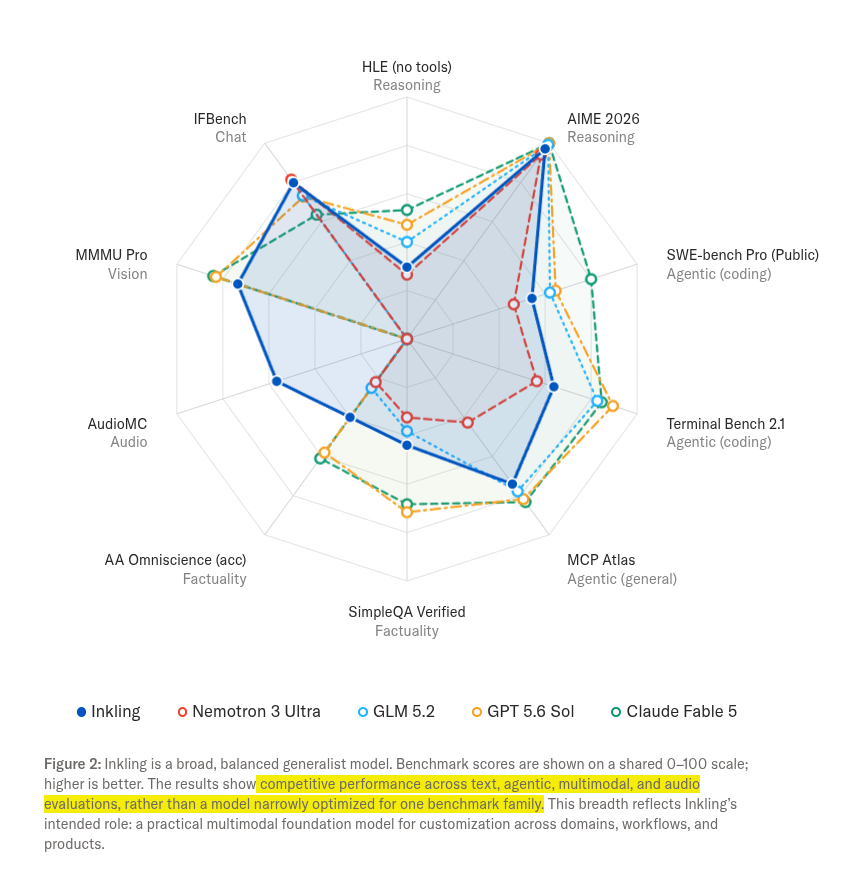
Mira Murati's Thinking Machines Lab released Inkling, its first open-weights model.
A 975B-parameter (41B active) open-weights model with multimodal reasoning and adjustable effort.
- A 1M-token context window lets the system process unusually long documents and workflows.
- Trained on 45T tokens spanning text, images, audio, and video from scratch.
- Users can raise reasoning effort for difficult tasks or reduce it for speed.
- The release matched Nemotron 3 Ultra on Terminal Bench using roughly one-third as many tokens.
- Strong Native audio and vision processing. Inkling scored 91.4% on VoiceBench and 82.0% on CharXiv RQ with Python.
- Large-scale reinforcement learning used more than 30M rollouts and steadily improved reasoning scores.
Fine-tuning support arrives through Tinker, while full weights are available through Hugging Face.
Inkling-Small activates 12B parameters and sometimes matches its larger sibling on core evaluations.
Thinking Machines Lab's latest valuation was at $12B, following a $2B seed round. Nvidia later invested an undisclosed amount, while reported $50B talks never produced a confirmed valuation.
LLM Knowledge Bases
Something I'm finding very useful recently: using LLMs to build personal knowledge bases for various topics of research interest. In this way, a large fraction of my recent token throughput is going less into manipulating code, and more into manipulating knowledge (stored as markdown and images). The latest LLMs are quite good at it. So:
Data ingest:
I index source documents (articles, papers, repos, datasets, images, etc.) into a raw/ directory, then I use an LLM to incrementally "compile" a wiki, which is just a collection of .md files in a directory structure. The wiki includes summaries of all the data in raw/, backlinks, and then it categorizes data into concepts, writes articles for them, and links them all. To convert web articles into .md files I like to use the Obsidian Web Clipper extension, and then I also use a hotkey to download all the related images to local so that my LLM can easily reference them.
IDE:
I use Obsidian as the IDE "frontend" where I can view the raw data, the the compiled wiki, and the derived visualizations. Important to note that the LLM writes and maintains all of the data of the wiki, I rarely touch it directly. I've played with a few Obsidian plugins to render and view data in other ways (e.g. Marp for slides).
Q&A:
Where things get interesting is that once your wiki is big enough (e.g. mine on some recent research is ~100 articles and ~400K words), you can ask your LLM agent all kinds of complex questions against the wiki, and it will go off, research the answers, etc. I thought I had to reach for fancy RAG, but the LLM has been pretty good about auto-maintaining index files and brief summaries of all the documents and it reads all the important related data fairly easily at this ~small scale.
Output:
Instead of getting answers in text/terminal, I like to have it render markdown files for me, or slide shows (Marp format), or matplotlib images, all of which I then view again in Obsidian. You can imagine many other visual output formats depending on the query. Often, I end up "filing" the outputs back into the wiki to enhance it for further queries. So my own explorations and queries always "add up" in the knowledge base.
Linting:
I've run some LLM "health checks" over the wiki to e.g. find inconsistent data, impute missing data (with web searchers), find interesting connections for new article candidates, etc., to incrementally clean up the wiki and enhance its overall data integrity. The LLMs are quite good at suggesting further questions to ask and look into.
Extra tools:
I find myself developing additional tools to process the data, e.g. I vibe coded a small and naive search engine over the wiki, which I both use directly (in a web ui), but more often I want to hand it off to an LLM via CLI as a tool for larger queries.
Further explorations:
As the repo grows, the natural desire is to also think about synthetic data generation + finetuning to have your LLM "know" the data in its weights instead of just context windows.
TLDR: raw data from a given number of sources is collected, then compiled by an LLM into a .md wiki, then operated on by various CLIs by the LLM to do Q&A and to incrementally enhance the wiki, and all of it viewable in Obsidian. You rarely ever write or edit the wiki manually, it's the domain of the LLM. I think there is room here for an incredible new product instead of a hacky collection of scripts.
V-JEPA 2.1 - New paper from @ylecun and other Meta researchers.
Its way of teaching a model to watch video more carefully, so instead of mainly learning the overall scene, it also learns the exact position, shape, and movement of things inside the scene.
The big deal is that V-JEPA 2.1 is not trying to make prettier video or better captions, but a much better internal map of a scene so the model knows what each small region is, where it is, and how it moves over time.
That sounds small, but it changes the kind of representation the model learns, because it moves from “I understand the clip” to “I understand the layout of the world inside the clip.”
V-JEPA 2 learns a world model from over 1 million hours of video, enabling it to perform complex, real-world robotic tasks zero-shot.
The old version mostly tried to guess the missing pieces of a video, which helped with broad understanding but let the visible parts get lazy, so they often stored blurry, mixed-up information about where objects really were.
The new version fixes that by making the model learn from every patch, including the parts it already saw, so each small region has to carry its own useful meaning instead of depending on the rest of the frame to do the work.
It also adds deep self-supervision, which means the model is corrected not just at the final layer but at several middle layers too, so the whole network learns cleaner and more stable visual features from bottom to top.
A simple way to picture it is this: the old model learned “someone is in a kitchen doing something,” while V-JEPA 2.1 is better at learning “the hand is moving toward this cup, the cup is here, and it stays the same object across time.”
That is why it helps robotics, because a robot does not just need scene meaning, it needs dense features, which means reliable local detail about edges, depth, object parts, and motion, and the paper reports about a +20% gain in robotic grasp success versus the earlier system.
The bigger point is that Meta did not mainly teach the model new labels or new tricks, but changed what gets predicted during training, and that made the representation much more useful for action prediction, depth, tracking, and manipulation.
----
Paper Link – arxiv. org/abs/2603.14482
Paper Title: "V-JEPA 2.1: Unlocking Dense Features in Video Self-Supervised Learning"
The Gemini models are really good, but the Gemini interface isn't built for agentic work. It doesn't have the same full harness of tools as Claude and ChatGPT, and it doesn't do a good job explaining what it did and why, and it is unable to output files or other useful artifacts.
Small LLM teams can match big models by repeatedly critiquing each other and keeping the best answer.
This paper turns different models into a loop that keeps improving a shared answer each round.
Instead of buying a giant model, it runs a small group of models that review and revise together.
N-Way Self-Evaluating Deliberation makes model groups rethink in rounds, so early bad answers can be fixed.
Anonymous scoring and quadratic voting help the best idea win without letting any model dominate the room.
A broker picks the right mix of models per task, then the models keep checking each other in rounds.
The authors show consumer grade models can compete with top tier models when the teamwork follows clear rules.
They predict when extra debate starts adding noise, so the system can stop before quality drops.
This work trades a bit of time for cheaper hardware by using text feedback instead of giant memory.
It shows how to build a temporary stronger model from mixed models, without retraining them.
----
Paper Link – arxiv. org/abs/2601.16863
Paper Title: "Mixture-of-Models: Unifying Heterogeneous Agents via N-Way Self-Evaluating Deliberation"
A pretty bold commentary in Nature written by linguists, computer scientists and philosophers declaring "by reasonable standards, including Turing’s own, we have artificial systems that are generally intelligent. The long-standing problem of creating AGI has been solved."
My piece in @ProSyn on why this time the protests are different: "the Islamic Republic is in a vise, squeezed by the external threat from the US and Israel and the internal threat of a mass uprising. There is no easy escape from this impasse. A total collapse of the Islamic Republic is not necessarily imminent, but Iran’s revolution is now nearing its end." https://t.co/EMWhAl26am #Iran
A nice lateral thinking addition to the Sparks unicorn. Ask Opus 4.5 to make a TikZ unicorn, and it not only draws the unicorn in TikZ, but then compiles it in LaTeX, turns that into a PDF, turns the PDF into a PNG and then gives me the PNG image.
Also cute little hearts & stars
Interesting how absolutely stable the underlying dynamics of AI development have been:
1) Six month doubling time for AI capabilities (METR is just one measure, but others are similar)
2) Open weights models lag 8 months or so behind.
Baseline assumption should be this continues
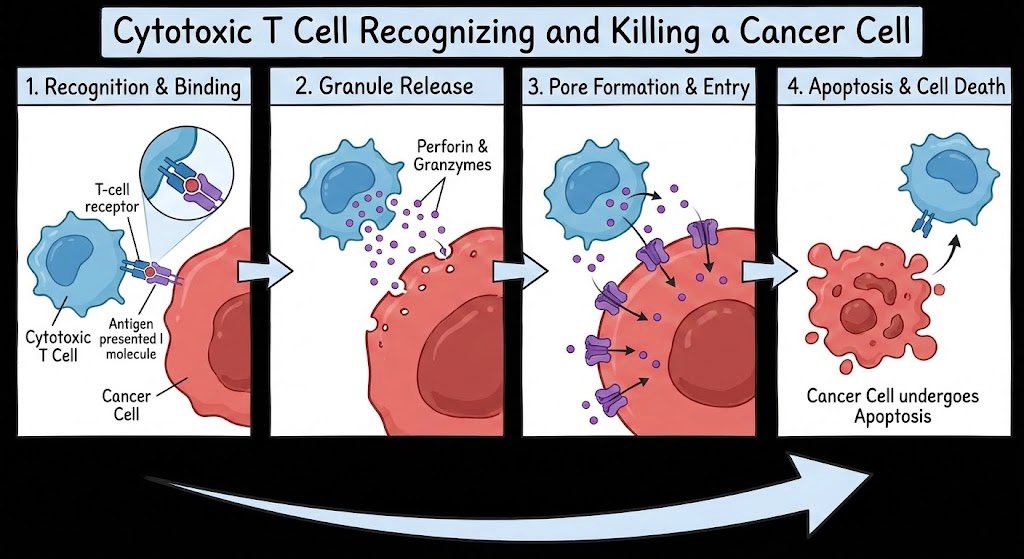
Until a few hours ago, creating this kind of scientific image would have required at least an hour of professional work. Now, with NanoBanana Pro, it only takes a simple prompt & less than 30 seconds!
Prompt: “Describe in an illustration the events for a cytotoxic T cell recognizing & killing a cancer cell.”
Very soon, the blocker to using AI to accelerate science is not going to be the ability of AI, but rather the systems of science itself, as creaky as they are.
The scientific process is already breaking under a flood of human-created knowledge. How do we incorporate AI usefully?
Fei-Fei Li (@drfeifei) on limitations of LLMs.
"There's no language out there in nature. You don't go out in nature and there's words written in the sky for you.. There is a 3D world that follows laws of physics."
Language is purely generated signal.