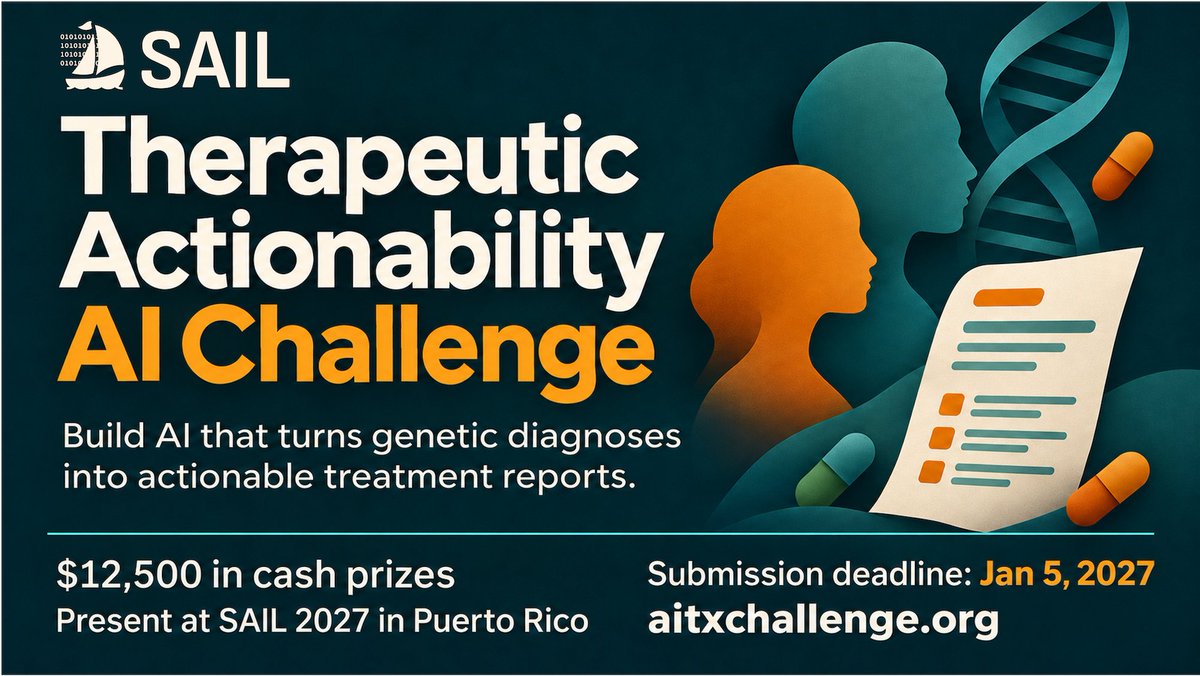
🚨 Introducing the SAIL Therapeutic Actionability AI Challenge! 🚨
Patients with rare genetic diseases (~450M worldwide!) often face decades-long journeys to find therapies. Less than 10% of rare diseases have an FDA approved therapeutic. We believe AI can transform this experience.
We're launching the SAIL Therapeutic Actionability AI Challenge, which asks teams to build AI that turns a genetic diagnosis into a report of actionable treatment options.
@SAILhealth@GoogleAI@NEJM_AI@huggingface 1/4
🚨Introducing the SAIL Therapeutic Actionability AI Challenge🚨
~450M people have a rare disease, often facing decades-long journeys to find therapies. <10% of rare diseases have an FDA-approved one.
We think AI can help close this gap.
Submit your model by Jan 5.
Details 👇
1/ As LLMs are integrated into our health systems, how can we efficiently evaluate whether evolving systems can reliably retrieve the information clinicians need?
Excited to share our new preprint: A Living Benchmark for Information Retrieval from Electronic Health Records.
🚀🤖 Introducing the Virtual Biotech: a multi-agent AI research platform for therapeutic discovery & development
This places a virtual CSO and its cross-functional R&D organization of AI scientists at a user’s fingertips.
Preprint: https://t.co/rK3eBpFmab
Check out PaperSearchQA, which I'll present at EACL in Morocco this March! We built an RL training environment for teaching LLMs to search and reason over scientific papers. 60k question-answer pairs + 16M papers to search over + benchmarks. RL training improves the model.
Simplex (@usesimplex) builds developer-first web agents that companies use to integrate with legacy portals. They're already in production, dispatching freight shipments, downloading customers’ invoices, and fetching websites’ internal APIs.
https://t.co/nH0ZccgXpR
Congrats on the launch, @skarpoor12 & @marcon680!
1/🧵Introducing TIMER: Temporal Instruction Modeling and Evaluation for Longitudinal Clinical Records
When we evaluate LLMs for reasoning over longitudinal clinical records, can we leverage synthetic data generation to create scalable benchmarks and improve model performance?
Biomedical datasets are often confined to specific domains, missing valuable insights from adjacent fields. To bridge this gap, we present BIOMEDICA: an open-source framework to extract and serialize PMC-OA.
📄Paper: https://t.co/zkb2m5yeal
🌐Website: https://t.co/atIKEfOpkv