$CRCL starting to turn around.
It just broke a downtrend that's been in place since early last summer.
Another good looking name in today's hottest theme.
Looks ready to enter a new Stage 2 uptrend.
On September 18, 1873, Jay Cooke & Company, the most trusted bank in the United States, stopped paying its depositors and closed. Two days later the New York Stock Exchange suspended trading for the first time in its history and stayed closed for ten days. The contraction that followed ran 65 months, which is still the longest in American history. I've spent a lot of time on what caused it, and the conditions that produced it are being rebuilt right now in the AI infrastructure buildout.
The 1873 panic came out of a railroad boom. Between 1865 and 1873 the US doubled its track mileage, and capital invested in railroads went from about $1.2 billion to $3.8 billion, which works out to roughly 3 to 4 percent of GDP a year for eight straight years. The five largest hyperscalers have committed somewhere between $660 and $800 billion to AI infrastructure in 2026, depending on which quarter's guidance you use, and the number has been revised upward at every earnings call. That's 2 to 2.5 percent of GDP. On the current trajectory the AI buildout matches the rail boom's share of the economy within a year or two.
What makes this different from a normal capex cycle is who is doing the spending. A decade ago Microsoft, Alphabet, Meta and Amazon spent 10 to 15 percent of revenue on capital expenditure. The whole investment case for these companies was that software scaled without physical assets. Capex is now 45 to 57 percent of revenue across the group. These are ratios you'd expect from a utility or a steel producer, and the businesses are still valued by most of the market as if the transition hadn't happened.
The overbuilding dynamic is the same one that appeared in the 1870s. By 1873 several competing railroads had been built between the same cities, each financed on projections that assumed it would carry most of the traffic. Today five hyperscalers, OpenAI's Stargate project, Anthropic, xAI and a group of smaller GPU cloud providers are each building capacity against forecasts that, added together, assume more demand than can exist. Each company's decision makes sense on its own. The aggregate doesn't, and it never does in these cycles.
Then there's the mismatch between how fast the assets wear out and how long the debt lasts. Railroad bonds in 1870 ran 30 years; rails and rolling stock needed replacing in 10 to 15. Hyperscalers depreciate GPUs over five or six years, and a number of analysts think three or four is more realistic given how quickly newer chips make older ones uneconomic to run. The bonds being issued to fund them run 10 to 40 years. The hyperscalers plan to add roughly $2 trillion in AI assets by 2030. At 20 percent annual depreciation that's about $400 billion a year in depreciation expense, which exceeds their combined 2025 profits.
The financing has also become circular in a way that should be familiar to anyone who's read about Cooke. He promoted the Northern Pacific Railroad, underwrote its bonds, sold them to the public through his own network, and advanced his depositors' money to the railroad when the bonds didn't sell. Today the chip vendor takes equity in AI labs that buy its chips, cloud providers take equity in startups that commit to spend on their cloud, and lenders are writing loans collateralized by GPUs whose resale value depends on the same demand the loan is being used to build. Some portion of the demand everyone is pointing to is the same dollar going around more than once.
Every hyperscaler said on its last earnings call that it is supply-constrained rather than demand-constrained. The Northern Pacific said the same thing about land and freight in 1872. It may well be true today. It's also the standard language of a market that hasn't yet found the limit of demand, and the limit is never visible until it's hit.
The change I'd pay the most attention to is the shift from cash to debt. In 2023 and 2024 the AI buildout was funded almost entirely from operating cash flow, and that's what made it safe: a company that doesn't need to borrow can't be cut off. Capex now exceeds cash generation at most of these firms. Hyperscalers raised $108 billion in debt in 2025, another $100 billion in the first weeks of 2026, and Morgan Stanley and JPMorgan project around $1.5 trillion in new issuance over the next few years, spread across investment-grade bonds, private credit, off-balance-sheet leases and GPU-backed loans. Demand for credit default swaps on these names is at record levels. The Panic of 1873 was not caused by a collapse in demand for rail transport; the trains stayed full. It was caused by the railroads' inability to refinance. The more the hyperscalers move from self-funding to borrowing, the closer they come to having the vulnerability that actually mattered in 1873.
The shock that ended the rail boom came from Europe. Germany's indemnity from France after the 1871 war, about a quarter of French GDP, flooded into Berlin and Vienna, fueled a speculative boom there, and blew up in May 1873. European investors, who held roughly a third of American railroad bonds, stopped buying. Cooke, already carrying Northern Pacific paper he couldn't sell, failed four months later. Nobody in New York was watching Vienna.
What followed is worth remembering. Brokerages failed within hours of Cooke. Depositors ran on banks across the country, and banks stopped paying cash and settled among themselves with IOUs. 89 of the nation's 364 railroads went bankrupt. Around 18,000 businesses failed. Unemployment reached an estimated 14 percent and wages fell roughly a quarter. The Great Railroad Strike of 1877 put federal troops on the streets of American cities and left about a hundred people dead. Grant's presidency was finished, Reconstruction was abandoned in part because the North could no longer afford it, and the country spent the next 25 years fighting over the monetary system.
The differences are real and I don't want to skip them. Microsoft and Alphabet hold hundreds of billions in cash and own businesses that generate enormous profit without AI; Cooke had no cushion at all. The debt in this cycle sits mostly with bond investors and private credit funds rather than in the banking system, so a write-down doesn't automatically become a bank run. The Federal Reserve exists, which is the reason Silicon Valley Bank's failure in 2023 was contained over a weekend instead of taking the system down with it. And the historical record from rail, electrification and the fiber overbuild of the late 1990s is consistent: the infrastructure ends up used and valuable. What doesn't survive is the capital that built it or, in most cases, the companies that raised that capital.
The version of 1873 that fits 2026 would look something like this. A shock from a market nobody in the US is pricing. A large, trusted company that borrowed short-term against long-lived, fast-depreciating assets and finds the refinancing window shut. Behind it, more than a trillion dollars of debt secured by chips that lose value every year, held by private credit funds that have never been through a downturn, in an economy where five companies account for roughly 3 percent of GDP in capital spending alone.
The rail network kept operating through the entire 1873 depression. That was never the problem. The problem was the financing, and that's where this cycle is heading.
WTF, WHY IS NOBODY TELLING YOU TO SET THIS UP TODAY? SEVEN AGENTS, ZERO CODE, ONE EVENING.
Start using Grok Bot for content today.
Not next month. Today.
The gap between the people who did and the people who kept meaning to is already visible on this timeline.
Nothing about your ideas has to change.
What changes is how many of them actually get out.
Almost nobody has an idea problem – they have a shipping problem, and shipping is exactly the part a machine is better at than you.
The setup is seven agents: a Chief of Staff routing every task, a Researcher pulling real sources, a Writer turning them into finished copy in your voice, a Visualiser producing every image in your style, an Analyst reading what actually performed, a Scheduler owning the timing, a Publisher shipping it.
You approve.
That's the whole job now.
More output → more surface area → more of everything that follows from being seen.
Full guide, the one Elon reposted, in the article below ↓
My wife sent 85 applications. Zero replies.
I uploaded her resume to Claude. 16 responses in 14 days.
Same qualifications. Same experience. Completely different results.
Here are the 7 prompts I used ⤵️
🇧🇷 TIM S.A. $TIMB 2026 Investment Thesis
1) Strong business: Brazil mobile leader with 5G, postpaid growth and expanding B2B opportunities.
2) Strong financials: ~51% EBITDA margin, low leverage, strong cash conversion, with dividends + buybacks growing.
3) Valuation looks extremely cheap: ~21% FCF yield + ~12% shareholder yield. The big question: how is this real?
Full Video:
https://t.co/rVJvGjVTQ3
This week on The Wide Moat Show, we go hunting for HIGH YIELD... without chasing sucker yields. Our 4 high-yield picks include:
🎰 $VICI — ~7.0% yield: World-class experiential real estate trading near COVID-era valuations despite a much larger, more diversified portfolio.
🏗️ $LADR — ~9.4% yield: A well-covered 9%+ yield backed by low leverage, an investment-grade balance sheet, and strong forecast earnings growth.
⚡ $BUI — ~6.9% yield: A diversified global utility and infrastructure fund offering nearly a 7% yield with monthly distributions.
🥫 $HRL — >5.0% yield: A Dividend Aristocrat trading below 15x earnings that could reward patient investors if growth rebounds.
Check out the Wide Moat Show on YouTube!
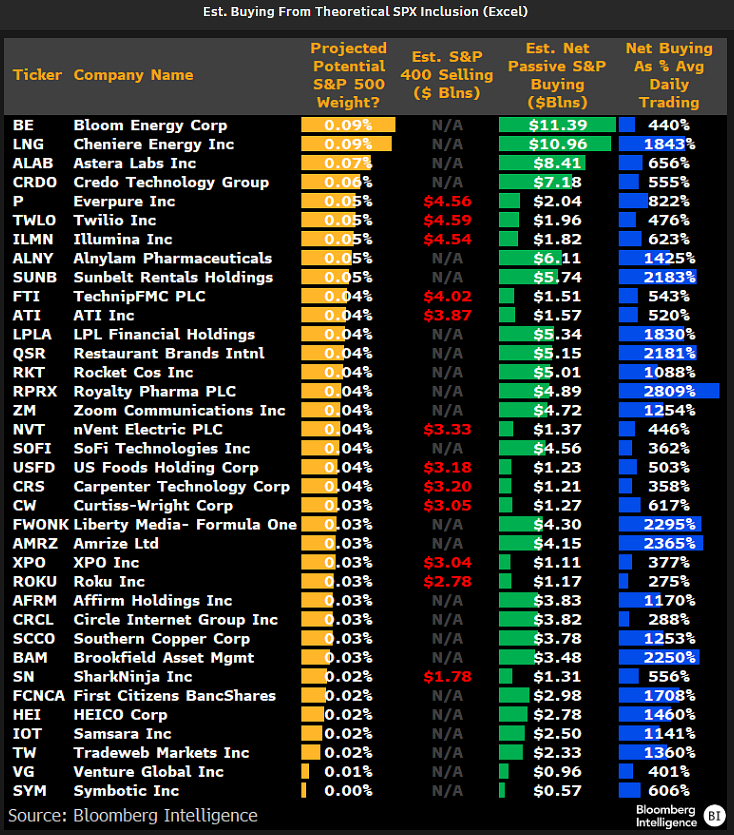
So, the S&P 500 3Q rebalance will be announced today. I wrote about the likely and potential names that could get into the index this go around last week. Here's some of the top candidates solely ranked by size:
$HTZ $tsla
Hertz is executing. The turnaround is showing up in the numbers — and the robotaxi build-out is the optionality the market still underprices.Q2 2026 revenue hit $2.4B, up 10% year over year — on a 1% smaller fleet. That’s pricing power and asset efficiency, not just more cars on the lot. Revenue per day was up 9% and was Hertz’s strongest second-quarter RPD on record outside the 2022 COVID spike. Revenue per unit rose 8% to $1,542.
https://t.co/7J1MFOrL1g
GAAP net income swung to $64 million and diluted EPS of $0.05, versus a $294 million loss a year earlier. Adjusted Corporate EBITDA came in at $81 million — a $63 million year-over-year improvement and above the top of revised guidance. Utilization rose to 79% (81% excluding recall drag). The spread between RPD and direct operating expense per day improved 17% YoY, the third straight quarter of that expansion.
https://t.co/7J1MFOrL1g
The fleet is young: ~94% of the U.S. core fleet is model year 2025 and 2026. Management is holding to its “buy right, hold right, sell right” playbook and targeting net DPU around $300 for the full year. Liquidity ended Q2 at about $984 million, with year-end guidance of $1.0–$1.4 billion. Q3 guide is $275–$325 million of Adjusted Corporate EBITDA and positive EPS. Leadership has pointed to a path toward a $1B+ Adjusted Corporate EBITDA run rate in 2027 and beyond.
https://t.co/7J1MFOrL1g
Now the Cybercab angle.Tesla is putting purpose-built, no-steering-wheel Cybercabs into its own Robotaxi service — Texas records already show dozens registered under Tesla Robotaxi, LLC, with an Austin launch event slated for Sept. 3, 2026. That is Tesla’s vertically integrated network, not a Hertz fleet. There is no announced Hertz–Cybercab partnership. Don’t invent one.
https://t.co/qtiLnA9ApX
What is real is Hertz positioning itself as the operating layer robotaxis need. Through Oro Mobility, Hertz is already the fleet operator for Uber’s Lucid + Nuro robotaxi program: charging, maintenance, repairs, cleaning, and depot staffing, targeted to start in the Bay Area later in 2026 with 2027 expansion on the table. Oro’s driver-led managed fleet has already logged more than 6 million miles across four markets. Hertz already has 11,000+ locations, thousands of airport sites, and ~2,700 EV chargers — the physical infrastructure that takes years and billions to copy. CEO Gil West has said the endgame is for Oro to own and operate robotaxis, not just wash them.
https://t.co/7J1MFOrL1g
How Cybercab can help HTZ if autonomy scales:Every purpose-built robotaxi still has to be charged, cleaned, repaired, repositioned, and depot-staffed. That is Hertz’s century-old skill set. If Tesla keeps the network in-house in a few cities, the category still expands demand for third-party fleet ops everywhere Tesla does not want to build depots.
Hertz already ran Teslas at scale and still operates a large EV / rideshare fleet. That ops muscle transfers to whoever wins the AV stack — Tesla, Lucid/Nuro, Waymo, or all of them.
A parked robotaxi is a depreciating asset. High-utilization fleet operators win. Hertz’s rental peaks (airports, weekends, holidays) and AV valleys can share the same yards, chargers, and techs — the “sweat the asset” story management is already selling.
If Tesla ever needs a national owner-operator or overflow capacity for Cybercab, Hertz is one of the few companies that already buys, finances, holds, services, and exits vehicles at half-a-million-car scale.
$htz $TSLA #cybercab
The risk is the same as the opportunity: Tesla may never need Hertz if it stays fully vertical. Robotaxis can also nibble at short-trip urban rentals over time. That’s why Oro is the hedge — Hertz gets paid on the ops layer even if it doesn’t own the Cybercab brand.Beaten-down rental name. Improving unit economics. Young fleet. Liquidity runway. And a live AV ops business standing up as Cybercab hits the street.Not financial advice — do your own work. But the core is healing and Hertz is already in the robotaxi supply chain.Hertz is executing. The turnaround is showing up in the numbers — and the robotaxi build-out is the optionality the market still underprices.Q2 2026 revenue hit $2.4B, up 10% year over year — on a 1% smaller fleet. That’s pricing power and asset efficiency, not just more cars on the lot. Revenue per day was up 9% and was Hertz’s strongest second-quarter RPD on record outside the 2022 COVID spike. Revenue per unit rose 8% to $1,542.newsroom.hertz.comGAAP net income swung to $64 million and diluted EPS of $0.05, versus a $294 million loss a year earlier. Adjusted Corporate EBITDA came in at $81 million — a $63 million year-over-year improvement and above the top of revised guidance. Utilization rose to 79% (81% excluding recall drag). The spread between RPD and direct operating expense per day improved 17% YoY, the third straight quarter of that expansion.newsroom.hertz.comThe fleet is young: ~94% of the U.S. core fleet is model year 2025 and 2026. Management is holding to its “buy right, hold right, sell right” playbook and targeting net DPU around $300 for the full year. Liquidity ended Q2 at about $984 million, with year-end guidance of $1.0–$1.4 billion. Q3 guide is $275–$325 million of Adjusted Corporate EBITDA and positive EPS. Leadership has pointed to a path toward a $1B+ Adjusted Corporate EBITDA run rate in 2027 and beyond.newsroom.hertz.comNow the Cybercab angle.Tesla is putting purpose-built, no-steering-wheel Cybercabs into its own Robotaxi service — Texas records already show dozens registered under Tesla Robotaxi, LLC, with an Austin launch event slated for Sept. 3, 2026. That is Tesla’s vertically integrated network, not a Hertz fleet. There is no announced Hertz–Cybercab partnership. Don’t invent one.benzinga.comWhat is real is Hertz positioning itself as the operating layer robotaxis need. Through Oro Mobility, Hertz is already the fleet operator for Uber’s Lucid + Nuro robotaxi program: charging, maintenance, repairs, cleaning, and depot staffing, targeted to start in the Bay Area later in 2026 with 2027 expansion on the table. Oro’s driver-led managed fleet has already logged more than 6 million miles across four markets. Hertz already has 11,000+ locations, thousands of airport sites, and ~2,700 EV chargers — the physical infrastructure that takes years and billions to copy. CEO Gil West has said the endgame is for Oro to own and operate robotaxis, not just wash them.newsroom.hertz.comHow Cybercab can help HTZ if autonomy scales:Every purpose-built robotaxi still has to be charged, cleaned, repaired, repositioned, and depot-staffed. That is Hertz’s century-old skill set. If Tesla keeps the network in-house in a few cities, the category still expands demand for third-party fleet ops everywhere Tesla does not want to build depots.
Hertz already ran Teslas at scale and still operates a large EV / rideshare fleet. That ops muscle transfers to whoever wins the AV stack — Tesla, Lucid/Nuro, Waymo, or all of them.
A parked robotaxi is a depreciating asset. High-utilization fleet operators win. Hertz’s rental peaks (airports, weekends, holidays) and AV valleys can share the same yards, chargers, and techs — the “sweat the asset” story management is already selling.
If Tesla ever needs a national owner-operator or overflow capacity for Cybercab, Hertz is one of the few companies that already buys, finances, holds, services, and exits vehicles at half-a-million-car scale.
This might be the most important comment from $DELL earnings:
“Inference has passed training and is pure demand on our industry.”
Dell expects AI inference demand to grow 87X by 2030 to 3,600 quadrillion tokens. (Whaaa???)
Training demand? That’s just 5X.
And Dell expects enterprise agentic AI to become the single largest workload by 2028.
This is why I think people calling for the AI infrastructure buildout to peak are missing the bigger picture.
Training was just phase 1.
Inference is going to be phase 2.
As agents begin performing dozens or hundreds of tasks autonomously, token consumption and compute demand could explode. This is exactly what @daniel_koss has been saying.
The AI infrastructure boom isn’t ending when the models are trained…this is when the real consumption starts.
THIS IS STRAIGHT UP INSANE.
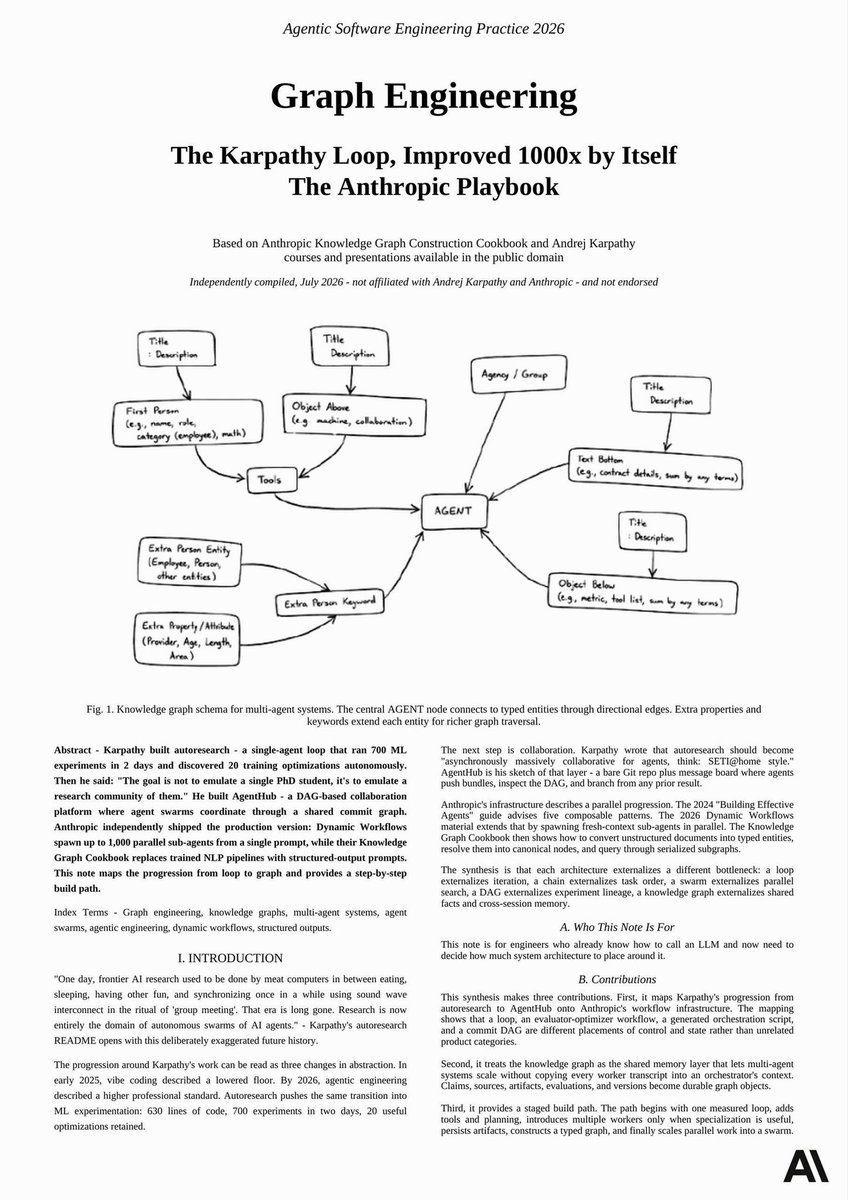
andrej karpathy jumped to anthropic five weeks ago.
and now two senior folks there just took karpathy’s loop and made it feel 1000x sharper with something they’re calling graph engineering
agentic systems don’t “improve” here, they transform the second you stop running agents in a line and start wiring them as a graph
i plugged it into my own setup and the first reply wasn’t just better
it was a different species
claude quit the canned, agreeable stuff and started reasoning the way my brain actually moves
save this before the algorithm buries it
read it now, then hit the article below
Elon Musk just showed an AI running a business better than other models and the article below shows how to build your own AI team that works while you sleep:
29:13 — Grokbot runs a business for days and makes 2x the money of other AI models
30:05 — 1M AI vending machines could generate $4.7B a year
31:54 — one person builds a full game in 4 hours with Grokbot doing the boring work
and if AI can already run a fake business, build products and make decisions for itself, what happens when you give it a real business?
you just need to give the right AI the right job
save & watch this, the article below shows how Grok Bot + Kimi K3 turns that idea into a real system with multiple agents, clear roles and workflows that keep working without you
Most traders are going to hate this: I met a 34-year-old trader making over $2.4M a year. Married. 3 kids. $280K car. Owns multiple properties. No fancy ICT setup. No 17 indicators. No secret algorithm.
I asked him what strategy made him this much money. His answer honestly pissed me off. He said: “I determine my bias on the 1H timeframe.” “I drop to the 5M.” “If I’m bullish, I wait for price to reach support.” “If I’m bearish, I wait for resistance.” “At my area of interest, I wait for a clear rejection candlestick.” “My stop goes beyond the invalidation point.” “I target a fixed 1:2 R:R.” “I mainly trade GBPUSD and XAUUSD.” That’s it. No magic indicator. No 20-step entry model.
No chart covered in lines. Just bias, support/resistance, confirmation and ruthless risk management. Meanwhile, thousands of traders are buying $1,000 courses looking for a strategy with a 90% win rate.
The uncomfortable truth? Your strategy might not be the problem. Your inability to execute a simple strategy consistently might be.
After Elon Musk reposted my Grok Bot guide, my friend Ryan used it to run his strip club.
7 days ago, he replaced his entire middle management with 8 Grok agents ($200/mo).
Last week alone, he saved $10,000 in salaries and missed leads.
Not because the club magically got better, but because he killed the middle layer that was eating his margin.
Before that, the setup was classic and expensive.
Back-of-house sat on 6 people:
> 1 recruiter
> 1 person on applications
> 1 cashier
> 2 shift managers
> 1 person on after-close requests
That layer cost about $8,400–$9,200 a week once you counted base pay, cuts, “bonuses,” and money that never made the report. The recruiter took $50–$150 per new girl. The cashier spent 1.5–2 hours closing a shift. On Friday the managers generated 80–120 messages on the schedule alone. The after-shift person held 10–15 requests in his head and lost 2–3 of them every week simply because someone did not answer in time.
Ryan saw the formula fast. Those people almost never made hard decisions. They moved data.
• An application came in → a person opened a chat.
• A girl wrote “I can do Friday” → a person typed a row into a spreadsheet.
• A client left a request → a person relayed it to a manager.
• The manager opened the schedule → and texted the girl.
• The shift ended → the cashier counted a stack and entered a number by hand.
Every handoff leaked time and money.
Applications. A live staffer used to review 40–60 incoming files a week. One file took 8–12 minutes. Total: 7–10 hours of raw review, plus another 3–4 hours on “send a reminder,” “send more,” “when can you work.” Out of 50 applications, 6–8 made it to a shift. Conversion was weak not because of the room, but because half the threads went cold for 24–48 hours.
Scheduling. Friday looked like this: 12 people want on, 8 slots. 1 can start only after 21:00. 1 will not work after 00:00. 1 drops out with 40 minutes left. 1 wants a swap. A manager already promised the slot to a fifth person. One change created 5 new messages. One substitution cycle took 20–40 minutes. By the end of the night there were 3–5 holes in the grid.
Money. That was the dirtiest part. By morning the count was off by $180–$400 on average. Sometimes $70. Sometimes $600. The explanations were always human: tips booked to the wrong place, a commission forgotten, a number rounded, an envelope put in the wrong pile, a shift closed from memory. The cashier was not an analyst. He was a loss point.
After-shift requests. The old chain took 25–45 minutes:
client → manager → spreadsheet → message to the girl → wait → reply to the client.
Out of 12 requests, 2–3 died in transit. Not because of a refusal. Because of human lag.
7 days ago Ryan cut that layer and hung it on Grok.
The application flow dropped into one funnel with statuses:
NEW → REVIEW → APPROVED → SCHEDULED → ACTIVE → INACTIVE
The bot sent the first packet itself, collected the fields, and closed the gaps. If data was missing → it asked. If there was silence for 48 hours → it nudged. Ryan no longer opened 50 chats. He opened one feed. He touched only REVIEW and exceptions by hand. First-pass review fell from 8–12 minutes per application to 30–90 seconds of control. In a week, 53 applications went through the funnel. 11 made it to a shift. That was no longer “we got lucky.” That was because no application rotted in a manager’s DMs.
The schedule became a rule, not a group chat. A girl marked available slots. The system saw 8 seats, not “we’ll figure it out.” Overbook went to a waitlist. A drop with 40 minutes left no longer spawned a 5-chat mess: the slot jumped to the next person in line in 10–20 seconds. Friday noise fell from 80–120 messages to 10–15 exceptions. Shift manager as a job title became unnecessary.
The register stopped being a notebook. Every operation was written immediately. Shift close produced one summary:
- floor revenue
- tips
- commissions
- payouts
- adjustments
- variance
If the total did not match, the system did not say “error somewhere.” It pointed at the exact operation. Over 7 days, variance stayed in the $0–$25 range instead of the old $180–$400. The weekly difference was about $1,200–$2,500 on “it didn’t add up” alone.
The client loop collapsed from 4 human nodes into 1 route. A request entered the bot. The bot pulled the standard fields, checked availability, pinged the girl, and after 2 confirmations closed both sides with a notification. Cycle time fell from 25–45 minutes to 2–4 minutes on a standard request. Burned requests for the week: 0. Before that, it was 2–3 lost checks every week.
Ryan’s role got narrow and hard. The bot closed the rule. He closed the exception. Morning looked like a panel, not a meeting:
> 3 new applications in NEW
> 1 card in REVIEW
> 2 shift cancellations
> 1 operation for manual review
> 47 automated messages already sent without him
The only living parts left were him and the girls on the floor. Plus anyone who took an after-shift call. The middle layer: sourcing, screening, schedule, requests, counting → sat on a $200 subscription.
In numbers, the week looked like this.
Old model:
> 6 people in the management loop
> $8,400–$9,200 for that layer
> 7–10 hours on applications
> 80–120 messages on one heavy Friday
> $180–$400 holes in the cash
> 2–3 lost requests
> 25–45 minutes per client cycle
New model:
> 1 person
> $200 for the tool
> 30–90 seconds of standard application control
> 10–15 exceptions instead of a whole-floor chat storm
> $0–$25 on the register
> 0 lost standard requests
> 2–4 minutes per standard cycle
That is where the ~$10,000 in 7 days came from. Not “floor magic.” A removed human tax:
- pay for 6 people
- recruiter cuts
- cash holes
- burned requests
- hours spent moving the same row from a chat into a spreadsheet
In this system, those people were not the “soul of the club.” They were latency and leak. Every extra node added delay. Every live data handoff added error. Every notebook added a gap for rounding. Ryan removed the nodes. He left rules, statuses, a ledger, and one escalation point.
So after 7 days the model already counted as a delta, not an experiment. $200 on top. About $10,000 in the plus. And the proof was short: the club ran. The middle-layer staff did not. Their job was done by the bot.
bookmark this.
Been digging through Q2 2026 investor letters.
Cash-rich duopolies, overlooked breakups and turnarounds with multibagger potential.
Here are my top 10 picks🧵
BREAKING🚨: These 15 careers will quietly dominate the next 10 years.
Most people won’t notice until it’s too late.
The people learning these skills today will be impossible to ignore by 2030:
If Sam and Dario built this 1 app, they could make Americans love AI
The app is called...
Fight It
What does Fight It do?
It helps Americans fight the institutions that are generally horrible to deal with
▪️Medical insurer denied your claim? Fight it.
▪️Student-loan servicer screwed something up? Fight it.
▪️Bank charging overdrafts? Fight it.
▪️HOA levies some BS charge on you? Fight it.
▪️Airline owes you $430? Fight it.
▪️Security deposit withheld? Fight it.
▪️Bank hit you with fees? Fight it.
But it doesn't just tell you what to do after you give it the info it needs
It saves you the 3 hours on the phone dealing with the chicanery of all these companies
Instead, once it tells you what you could get back, you can press a "Fight Harder" button
What's that do?
It writes the letter or calls the bank, insurer and handles it all.
That should be easy for AGI or super intelligence or whatever you've built, right?
Save Americans $X000 per year and help them fight the institutions that treat them like isht and people will love AI
To make room for this, here is what Sam and Dario should STOP doing
▪️Write dumbass essays that only the media/SV circlejerk read and podcast about
▪️Write and sign letters virtue signaling about some other BS nobody else cares about.
▪️Say AI will cure cancer. Just do it else shut up about it
▪️Show how AI helps plan your European summer vacation or gets you a resevation at some fancy restaurant
In addition to building Fight It, they should fire everyone in their comms organization as those people clearly don't know what they're doing
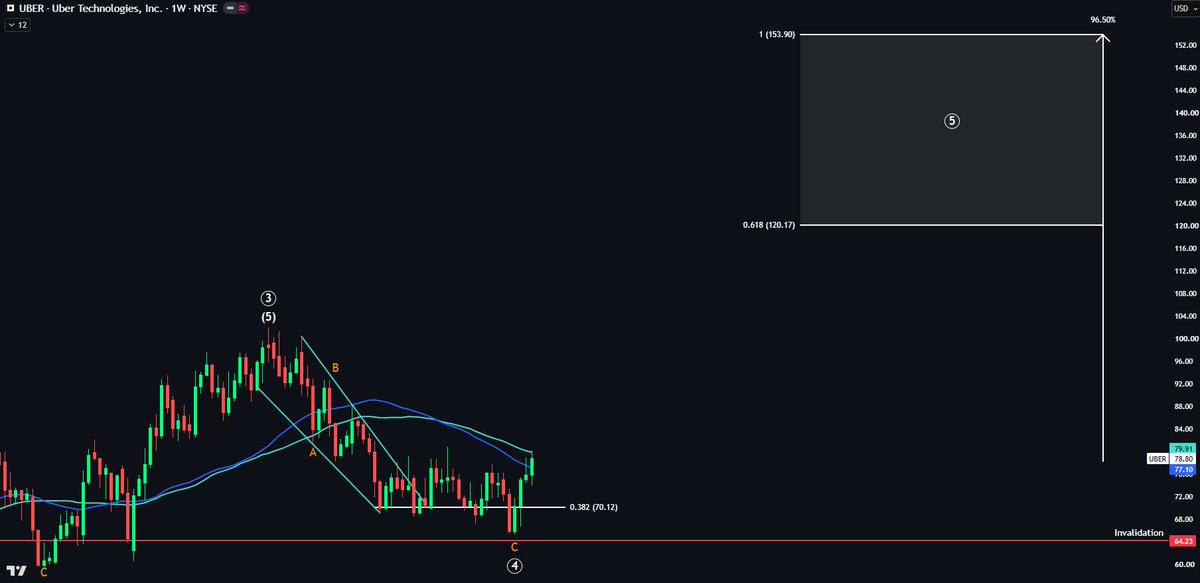
$UBER Looking primed 👀
I bought on Tuesday and price closed the week above the 200DMA which is great.
Going into next week I want to see price reclaim the 50WMA. Once that happens this can fly.
Wave 5 target: 96% 🚀