Astronomers have recently discovered an enormous structure in space called the "Big Ring," a vast formation of galaxies spanning roughly 1.3 billion light-years.
This discovery, along with a previously identified structure known as the "Giant Arc," challenges the Cosmological Principle, the assumption that, on large scales, matter is evenly distributed throughout the universe. The existence of such massive structures defies current models, as they exceed the theoretical size limit for cosmic formations, which is thought to be around 1.2 billion light-years.
The Big Ring and the Giant Arc were discovered in the same region of the sky and at a similar distance from Earth, which raises questions about the formation of such large, organized structures.
Theories to explain these structures, such as Baryonic Acoustic Oscillations (BAOs) or cosmic string remnants, have been considered but do not fully align with the observed characteristics of the Big Ring. These findings suggest the possibility that our current understanding of the universe might need significant adjustments, potentially requiring new theories or modifications to existing cosmological models to account for these anomalies.
👉 https://t.co/nJYUHImjsL
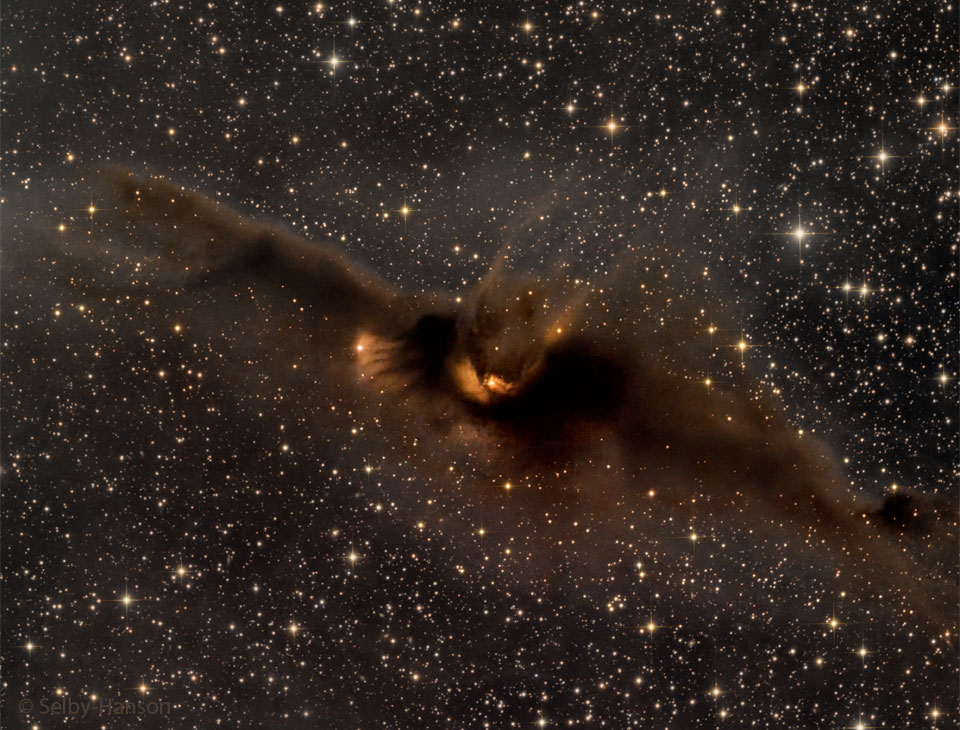
What is the most spook-tacular nebula in the galaxy? One contender is LDN 43, which bears an astonishing resemblance to a vast cosmic bat flying amongst the stars on a dark Halloween night. Located about 1400 light years away in the constellation Ophiuchus, this molecular cloud is dense enough to block light not only from background stars, but from wisps of gas lit up by the nearby reflection nebula LBN 7. Far from being a harbinger of death, this 12-light year-long filament of gas and dust is actually a stellar nursery. Glowing with eerie light, the bat is lit up from inside by dense gaseous knots that have just formed young stars.
Credit & Copyright: Mark Hanson and Mike Selby; Text: Michelle Thaller (NASA's GSFC)
I like all the sounds that upset people, they’re too complacent, and some of those sounds really shake ‘em. They need to wake up ‘cause it’s a very bad world and maybe they could do something about it.
(Sun Ra)
Hawaii Public Radio aired featuring Molly Hagan, Curatorial Assistant who spoke more about the recent Yosegaki Hinomaru transfer on board USS Missouri and Thursday's Mo-Joe event. It's worth the 8 minutes! https://t.co/awtDICS0RX
@AutismCapital The income divide has only grown larger in the last 50 years. Middle income families barely exist at all, I still work two jobs and own a business. The 1% has no idea what happens in my life-this artificial inflation is created by the 1% for increasing profits only. Selfish..
True freedom gives each of us the right to make decisions about our own life – how we worship, who we marry, what our family looks like. And we believe that freedom requires us to recognize that other people have the freedom to make different choices.
That’s what @KamalaHarris and @Tim_Walz believe.
#Cardano Founder Charles Hoskinson says "we want to be effective, efficient, and have integrity. $ADA is like Bitcoin, it's sound money. You can't inflate it. There's only a finite supply. We care about irreversibility, immutability, transparency, inclusive accountability."
🔔‘The people here are talking about human rights...about how do we build something for everybody? This is what keeps me young...I'm here because you keep me young...These conversations give me hope.’ - @IOHK_Charles
Charles Hoskinson’s keynote, "Blockchain and Argentina: Past and Present," is now available for you to watch.👇
Digel Cloud 2S imaged by Webb’s NIRCam and MIRI Infrared imagers. We can see a star cluster containing young, low metallicity newly formed stars. Webb’s data reveal that there are multiple jets shooting out in different directions:
https://t.co/A81KKHchmT
@ThatNAME7777777@NASAScienceAA@Pats1269 This is a personal statement, please respect my disagreement with your beliefs. I understand things differently, like many others. Ending war & peacefully living with each other is paramount to our future. Never kill anything… live & let live.
How did life form on Earth? Can it exist elsewhere? How can humans thrive in space? 🌍✨
These are the core questions behind our #NASAScience missions — questions that inspired our 2025 calendar. This year's theme — "Life" — explores how NASA studies habitability across the cosmos. 🌱🔬
From molecules to galaxies, discover the interconnectedness of it all: https://t.co/goWQKWGpUZ