Foresight Analytics is a leading provider of evidenced based investment consulting, data analytics, research and diligence solutions to global investors.
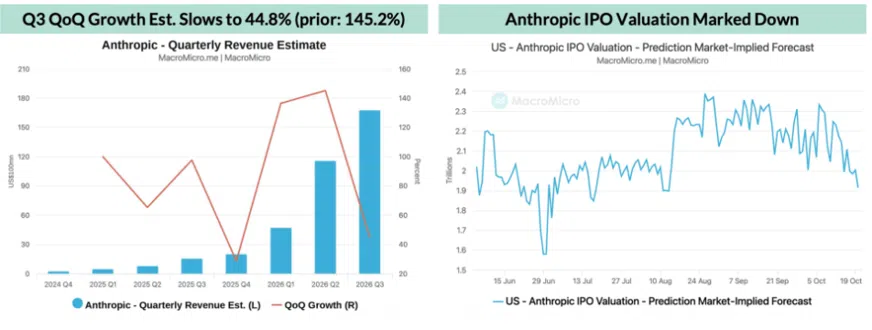
Chart of the week: Anthropic IPO Nears as Q3 Revenue Growth Slows
Anthropic is reportedly moving closer to an IPO after a strong but slowing third quarter. Q3 revenue reached a record $16.8 billion, while the company posted a second consecutive profitable quarter and positive operating cash flow. Enterprise net revenue retention reportedly reached 900%, alongside an adjusted gross margin of 85%. Despite these strong metrics, investors were unsettled by the sharp slowdown in quarterly growth, prompting a lower valuation assessment. Anthropic is now targeting a potential IPO around Thanksgiving, possibly as early as the week of November 9, making growth durability the key issue for prospective investors.
Read more - https://t.co/JlDiigvdrL
#Anthropic #IPO #ArtificialIntelligence #AI #TechIPO #AIInvesting #VentureCapital #TechStocks #StartupValuation #RevenueGrowth #EnterpriseAI #Profitability #FinancialMarkets #InvestmentOutlook #GenerativeAI
Weekly Overview of the ETF Markets
Inverse Strategies and Energy Lead as Tech and Crypto Tumble
The week ending 16 October 2026 saw inverse strategies, energy and defensive themes lead, while technology, semiconductors and crypto came under heavy pressure. Global X Ultra Short Nasdaq 100 Complex ETF (SNAS) led all ETFs at +14.0%, with Betashares Crude Oil Index ETF (OOO) up 8.9% and iShares Global Consumer Staples ETF (IXI) advancing 5.3%. Betashares India Quality ETF (IIND) rose 5.2% and Montaka Global Extension (MKAX) gained 4.8%, while Betashares US Equities Strong Bear HF (BBUS) added 4.7%. Global X India Nifty 50 ETF (NDIA) and Betashares FTSE 100 ETF (F100) each climbed 4.3%, with Magellan Infrastructure Fund (MICH) and Betashares Global Energy Companies ETF (FUEL) rounding out the leaders at +4.1% and +4.0% respectively.
Read more details here - https://t.co/TvMc1jasLR
#ETFs #ETFFlows #AustralianETFs #USETFs #StockMarket #SemiconductorStocks #TechnologyStocks #EnergyInvesting #Crypto #InverseETFs #FixedIncome #GlobalMarkets #InvestmentStrategy
Overview of the US Treasuries Market
The U.S. 10-year Treasury yield fell below 5% for the first time in a month as renewed political and fiscal turmoil in France triggered a global flight to safety.
French government bonds sold off sharply amid concerns over the country’s large budget deficit and the risk that higher oil prices could weaken consumption and economic growth. France’s 10-year yield rose as high as 5.142%, its highest level since 2002, while investors shifted toward perceived safe havens including German Bunds and U.S. Treasurys.
The move in U.S. bonds was particularly notable because it occurred despite elevated inflation and higher oil prices. The 10-year Treasury yield fell 19.3 basis points to 4.952%, its largest one-day decline since March 2023. The two-year yield dropped 18.8 basis points to 4.635%, while the 30-year yield fell 15.1 basis points to 5.286%.
Read more: https://t.co/ZDvfhiwTrF
#USTreasuries #USBondMarket #BondYields #FlightToSafety #FixedIncome #FrenchBonds #EuropeanMarkets #FiscalPolicy #GlobalEconomy #CreditMarkets #HighYieldBonds #FederalReserve #InterestRates #MarketVolatility #InvestmentStrategy
Overview of the Australian Government Bond Market
Australian fixed interest markets settled into a quiet pattern in the week ending 23 October 2026, with yields broadly steady to marginally lower across the curve following the sharp pullback seen the previous week. Rather than extending that decline, most tenors held close to their recent lows, suggesting the market is pausing to consolidate after offshore bonds drove a significant re-pricing the week before.
The 3-year bond yield was little changed, slipping 1 basis point to close at 4.84%, trading in a tight 4.84% to 4.90% range. With the cash rate steady at 4.60%, the front end’s gap to policy remains modest, consistent with a market still undecided on the need for further tightening. The 10-year yield eased 4 basis points to 5.20%, within a 5.20% to 5.27% range, while the 30-year was nearly unchanged, down 1 basis point to close at 5.67%, spanning 5.67% to 5.71%. As the Australian yield chart shows, the 3-to-10-year spread has held roughly steady this week, with the curve’s overall upward slope remaining intact after last week’s narrowing.
Short-term funding markets firmed further, with 3-month BBSW rising 6 basis points to 4.84%, within a wider 4.76% to 4.84% range, continuing to drift higher even as bond yields have stabilized.
Read more: https://t.co/FTgOR7Mwhk
#AustralianBonds #FixedIncome #BondYields #AustralianEconomy #RBA #InterestRates #BBSW #USTreasuries #USBondMarket #YieldCurve #BondMarket #AUD #CurrencyMarkets #FixedInterest #FinancialMarkets
Overview of the Australian Equities Market
Australian equities finished the week strongly, overcoming a sharp mid-week sell-off to record a third consecutive weekly gain. The S&P/ASX 200 rose 1.0% on Friday to 8,806.7, while the All Ordinaries gained 1.13% to 8,940.4.
Friday’s recovery was led by dip-buying in technology and mining stocks, following earlier concerns over stretched artificial-intelligence valuations and the debt-funded expansion of AI infrastructure. Mining heavyweights provided significant support, with BHP jumping 3.5% to $60.03, while gold producers benefited as bullion climbed to around US$4,175 an ounce.
Lower long-term US bond yields also helped risk sentiment. However, the sustainability of the bond rally remains uncertain given stronger-than-expected US producer and consumer inflation, which could reinforce expectations that interest rates remain elevated.
Read more - https://t.co/NSh8RapZR6
#ASX200 #AustralianEquities #ASX #StockMarket #EquityMarkets #MarketUpdate #MiningStocks #GoldPrices #TechnologyStocks #AustralianDollar #BondYields #Inflation #InterestRates #GlobalMarkets
Overview of U.S. Equities Market
U.S. equities ended the week under pressure as investors grew increasingly concerned that returns from the artificial intelligence build-out may not arrive quickly enough to service the sector’s rising debt burden.
The Nasdaq Composite fell 2.1% on Friday and around 4.5% for the week, its worst weekly decline since late June. The S&P 500 lost 1.1%, while the Dow slipped 0.3%. Small caps also weakened, with the Russell 2000 moving deeper into correction territory.
At the centre of the selloff was CoreWeave, whose shares fell another 12% and are now more than 50% below their highs earlier this year. The company has borrowed at least US$35 billion to fund data-centre expansion, making it a focal point for concerns over highly leveraged AI infrastructure companies. Nvidia fell 1.4%, while Dell Technologies dropped 4.6% and lost more than 22% over the week.
Read more - https://t.co/a9qlyy4ilI
#USMarkets #WallStreet #Nasdaq #SP500 #ArtificialIntelligence #AIInfrastructure #CoreWeave #Nvidia #TechStocks #TreasuryYields #InterestRates #OilPrices #GlobalMarkets #MarketVolatility
Australian interest rate market pricing eased again in the week to 16 October 2026, extending the retracement that has been building since the RBA’s late-September hike to 4.60% was confirmed. Far from reigniting the earlier climb in implied rates, the 16-Oct curve now sits below both the 9-Oct and 2-Oct readings across almost the whole forecast horizon, reinforcing the sense that markets are increasingly comfortable viewing the current cash rate as at, or very near, the top of this cycle.
At the front end, implied rates for the November and December 2026 meetings stay closely anchored to the 4.60% cash rate, with the three curves barely distinguishable at these nearer-dated tenors further evidence that the September decision is now fully priced and no longer a source of near-term uncertainty.
Read more: https://t.co/2bjVbZyOfX
#AustralianInterestRates #RBA #CashRate #InterestRateOutlook #MonetaryPolicy #InterestRateMarkets #MarketPricing #RateHikes #AustralianEconomy #BondMarkets #FixedIncome #CentralBankPolicy #FinancialMarkets #EconomicOutlook #RateCycle
Weekly Term Deposits Update
Over the past week, ending October 16, 2026, the strongest opportunity across the deposit curve remains concentrated around 6 months to 1 year. The standout tenor is 1 year, with an average rate of 4.96%, median 5.20%, and top rates of 5.50% from Bank First and Bank Australia. Defence Bank has lifted its 1-year rate to 5.30% from 5.20%. The quartile spread holds at 0.37%, indicating sustained tight clustering at this tenor.
For shorter terms, value remains uneven. 1–2-month deposits show stable clustering with quartile spreads at 0.85% and 0.50%, and medians unchanged at 1.40% and 1.65%. Great Southern Bank and in1bank lead at 3.50%–4.00%, but most institutions are materially lower. These terms suit liquidity parking only.
The 3–5-month range is mixed. The 3-month average edges up to 4.36% (up 0.02%), with the median holding at 4.50% and top rates at 5.25% from RACQ Bank. Bankwest has lifted its 3-month rate to 5.00% from 4.80%. At 4 months, the average is 4.23% and the median 4.30%, with top rates at 5.25% from Police Bank. At 5 months, the median holds at 3.75%, Bankwest has improved to 5.15% from 5.00%, and the quartile spread remains at 0.93%.
Read more - https://t.co/9eIeeXdiBZ
#TermDeposits #AustralianBanking #InterestRates #FixedDeposits #DepositRates #Banking #PersonalFinance #CashManagement #YieldCurve #RateComparison #RACQBank #BankFirst #BankAustralia
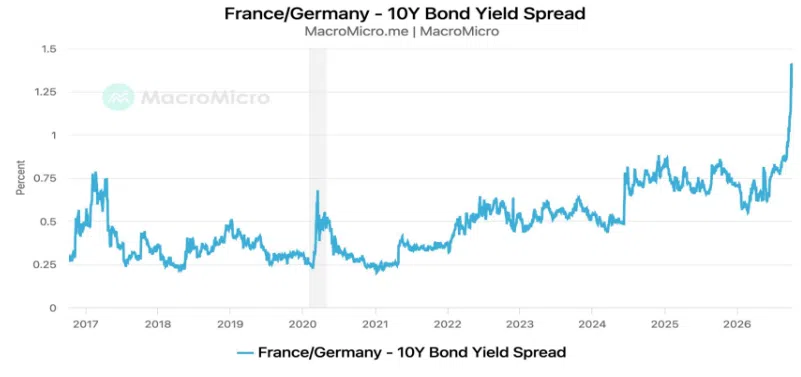
Chart of the week: France Drives Euro-Area Sovereign Bond Spread Widening
France led the widening in euro-area sovereign spreads during the global bond sell-off, with the 10-year OAT yield approaching 5%, its highest since 2002, and the spread over German Bunds reaching 159–160 basis points. Political and fiscal uncertainty is likely to keep French risk premiums elevated. The key near-term catalyst is the budget process, where use of Article 49.3 to pass legislation without a parliamentary vote could trigger no-confidence motions. Moody’s October 23 rating review adds further risk, while Fitch has warned that failure to pass the budget could increase downward pressure on France’s sovereign rating.
Read more - https://t.co/JlDiiguFCd
#France #Eurozone #SovereignBonds #BondYields #OAT #GermanBunds #CreditSpreads #FiscalPolicy #PoliticalRisk #SovereignRisk #Moody #FitchRatings #EuropeanMarkets #BondMarket #Macroeconomics
Weekly Overview of the ETF Markets
Cybersecurity Leads Again as Crypto and Miners Slide
The week ending 9 October 2026 saw cybersecurity, cloud computing and global equities lead, while crypto, miners and uranium came under pressure. Global X Cybersecurity ETF (BUGG) led all ETFs at +6.6%, with Betashares Global Cybersecurity ETF (HACK) up 4.9% and Lakehouse Global Growth Fund Active ETF (LHGG) advancing 4.6%. Betashares Cloud Computing ETF (CLDD) rose 4.4% and GCQ Global Equities Complex ETF (GCQF) gained 4.3%, while Betashares Global Energy Companies ETF (FUEL) added 3.8%. Property exposures also featured, with SPDR S&P/ASX 200 Listed Property Fund (SLF) and Vanguard Australian Property Securities Index ETF (VAP) up 3.7% and 3.6%, alongside Aoris International Fund Active ETF (DAOR) at +3.7%.
Read more details here - https://t.co/TvMc1jasLR
#ETF #Cybersecurity #CloudComputing #GlobalEquities #Cryptocurrency #Bitcoin #Ethereum #Semiconductors #RareEarths #Uranium #ETFFlows #AustralianETFs #USMarkets #EuropeanETFs #FixedIncome #TreasuryBonds
Overview of the US Treasuries Market
U.S. Treasury yields ended the week lower as recent bond-market turbulence eased, even as inflation expectations remained elevated and investors continued to debate whether the Federal Reserve is finished tightening.
The 30-year Treasury yield fell 16.2 basis points over the week to 5.436%, its largest weekly decline since April 2025. The 10-year yield dropped 14.6 basis points to 5.097%, while the two-year yield declined 5.5 basis points to 4.734%. The move reflected some relief after a sharp rise in yields earlier this month, with markets increasingly expecting the Fed to hold rates steady at its October meeting.
Inflation remains the key risk. One-year inflation expectations derived from derivatives markets rose to 2.64%, the highest since June and further above the Fed’s 2% target. Oil prices also climbed 3.5%, reinforcing concerns that energy could keep headline inflation sticky.
Read more: https://t.co/ZDvfhiwTrF
#USTreasuries #BondYields #FixedIncome #TreasuryMarket #FederalReserve #InterestRates #Inflation #BondMarkets #YieldCurve #CreditMarkets #InvestmentStrategy #GlobalMarkets #SafeHavenAssets
Overview of the Australian Government Bond Market
Australian fixed interest markets pulled back notably in the week ending 16 October 2026, with yields falling across the curve as a sharp rally in offshore bonds spilled over into domestic pricing. The move marked a clear reversal from the consolidation seen the previous week, with the long end leading the decline both locally and in the US.
The 3-year bond yield eased 4 basis points to close at 4.86%, trading within a 4.83% to 4.91% range a modest move at the front end compared to the sharper falls further out the curve. With the cash rate steady at 4.60%, the front end’s gap to policy has narrowed slightly, though it remains consistent with a market still undecided on the need for further tightening. The 10-year yield dropped 11 basis points to 5.25%, within a 5.21% to 5.34% range, while the 30-year also fell 11 basis points to close at 5.69%, spanning 5.41% to 5.69%. As the Australian yield chart shows, the 3-to-10-year spread has narrowed as the belly and long end outpaced the front end’s decline, though the curve’s overall upward slope remains intact.
Read more: https://t.co/wEgLB0TTfV
#AustralianBonds #FixedIncome #BondYields #AustralianEconomy #RBA #InterestRates #USTreasuries #TreasuryYields #YieldCurve #BBSW #BondMarkets #AUD #CurrencyMarkets #GlobalMarkets #MarketOutlook
Weekly Overview of the ETF Markets
Cybersecurity and Tech Lead as Miners and Precious Metals Retreat
The week ending 2 October 2026 saw cyber-security, crypto and growth technology lead, while silver, lithium miners and precious metals came under pressure. Global X Cybersecurity ETF (BUGG) led all ETFs at +5.8%, with Betashares Global Cybersecurity ETF (HACK) up 4.7% and Betashares S&P/ASX Australian Technology ETF (ATEC) advancing 4.2%. Global X 21Shares Bitcoin ETF (EBTC) and DigitalX Bitcoin ETF (BTXX) each gained 3.8%, while Vaneck Global Semiconductor ETF (SMHG) rose 3.7% and Global X Morningstar Global Technology ETF (TECH) added 3.6%. Monochrome Bitcoin ETF (IBTC), Global X Semiconductor ETF (SEMI) and Monochrome Ethereum ETF (IETH) rounded out the leaders at +3.5%, +3.4% and +3.3% respectively.
On the downside, the pullback was concentrated in precious metals, miners and China tech. Global X China Tech ETF (DRGN) and Global X Physical Silver (ETPMAG) each fell 5.4%, while Vaneck Rare Earth and Strategic Metals ex China ETC (RESM) shed 5.3% and Betashares Crypto Innovators ETF (CRYP) lost 5.2%. Betashares Global Gold Miners ETF (MNRS) declined 5.1%, with Global X Silver Miners ETF (SLVM), VanEck Gold Miners ETF (GDX) and ETFS Global Lithium Miners ETF (VOLT) each off around 4.7%. Global X Physical Palladium (ETPMPD) and Betashares Global Uranium ETF (URNM) also softened, falling 4.4% and 4.0%.
Read more details here - https://t.co/TvMc1jasLR
#ETFs #AustralianETFs #USMarkets #ETFFlows #Cybersecurity #TechnologyStocks #Semiconductors #BitcoinETF #PreciousMetals #LithiumMining #FixedIncome #EquityMarkets #InvestmentTrends
Overview of U.S. Equities Market
US equities advanced as expectations for another strong earnings season outweighed concerns over rising bond yields, elevated oil prices and geopolitical uncertainty. The S&P 500 gained 0.6%, the Nasdaq 100 rose 0.5%, and the Dow climbed 0.8%.
Corporate earnings remain a key market driver, with analysts expecting third-quarter profits to grow around 25% year-on-year. Wall Street banks and AI-related infrastructure businesses are also benefiting from strong trading activity and continued investment in data centres.
However, risks remain. The 10-year US Treasury yield reached 5.25%, Brent crude hovered near US$105 a barrel, and consumer sentiment weakened amid higher fuel prices and borrowing costs. Meanwhile, concerns over technology valuations and concentrated market leadership persist.
What’s next? Corporate earnings and upcoming US inflation data will be critical. Strong profits could sustain market momentum, but persistent inflation and elevated yields leave equities vulnerable to disappointment and renewed expectations of Federal Reserve tightening.
Read more - https://t.co/a9qlyy3Kwa
#USMarkets #WallStreet #SP500 #Nasdaq #CorporateEarnings #FederalReserve #Inflation #BondYields #ArtificialIntelligence #InvestmentOutlook #GlobalMarkets #YieldReport
Overview of the Australian Equities Market
The ASX 200 rose 0.64% on Friday to 8,716.6, while the All Ordinaries gained 0.62%. Despite recent gains, the benchmark remains more than 6% below its August record high.
Consumer, real estate and technology stocks led Friday’s recovery, while miners benefited from softer US bond yields and renewed strength in gold and copper. Energy stocks also outperformed for the week as Brent crude remained above US$102 a barrel.
However, elevated bond yields, persistent energy costs and inflation concerns continue to weigh on investor confidence. Financial stocks remain under pressure amid softer housing conditions, while the cancellation of Firmus’s planned float highlights caution around corporate valuations. What’s next for investors? Bond yields, oil prices, inflation and interest-rate expectations remain the key factors likely to shape the ASX’s next move.
Read more - https://t.co/NSh8RapZR6
#ASX #AustralianEquities #ASX200 #AustralianMarkets #InvestmentResearch #MarketOutlook #Inflation #InterestRates #BondYields #Gold #Copper #OilPrices #YieldReport
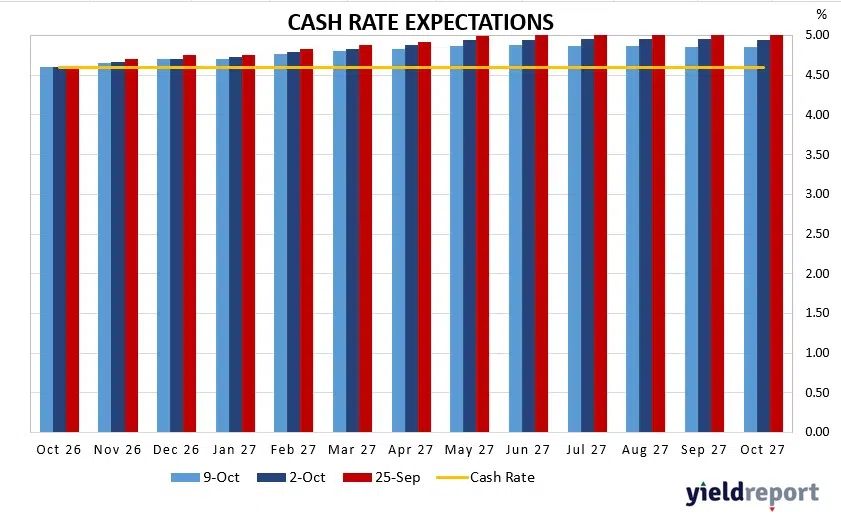
Australian interest rate market pricing softened further in the week to 9 October 2026, continuing the pullback that set in once the RBA’s late-September hike to 4.60% was confirmed. Rather than reviving the steady run-up in implied rates seen through September, the 9-Oct curve now sits beneath both the 2-Oct and 25-Sep readings across nearly the entire forecast horizon, pointing to a market growing more at ease with the idea that the current cash rate marks, or is close to, the top of this cycle.
At the front end, implied rates for the November and December 2026 meetings stay tightly anchored around the 4.60% cash rate, with minimal separation between the three curves at these nearer-dated tenors a sign that the latest hike has been fully digested and no longer drives near-term pricing uncertainty.
Read more: https://t.co/2bjVbZygqp
#AustralianInterestRates #RBA #ReserveBankOfAustralia #InterestRateOutlook #MonetaryPolicy #AustralianEconomy #FixedIncome #BondMarkets #InterestRateMarkets #CashRate #RateHike #MarketExpectations #FinancialMarkets #EconomicData
Weekly Term Deposits Update
Over the past week, ending October 9, 2026, the strongest opportunity across the deposit curve remains concentrated around 6 months to 1 year. The standout tenor is 1 year, with an average rate of 4.96%, median 5.20%, and top rates of 5.50% from Bank First and Bank Australia. The quartile spread remains at the exceptional 0.37%, representing sustained tight clustering. Notably, Bankwest has improved to 5.30% at 1-year, adding competitive depth.
For shorter terms, value remains uneven. 1–2-month deposits show stable clustering with quartile spreads at 0.85% and 0.50%, signaling mid-market consistency. Great Southern Bank and in1bank lead at 3.50%–4.00%.
Read more - https://t.co/9eIeeXdiBZ
#AustralianDeposits #TermDeposits #InterestRates #FixedIncome #CashManagement #DepositRates #YieldCurve #InvestmentStrategy #Banking #WealthManagement #PortfolioStrategy #RateCompetition
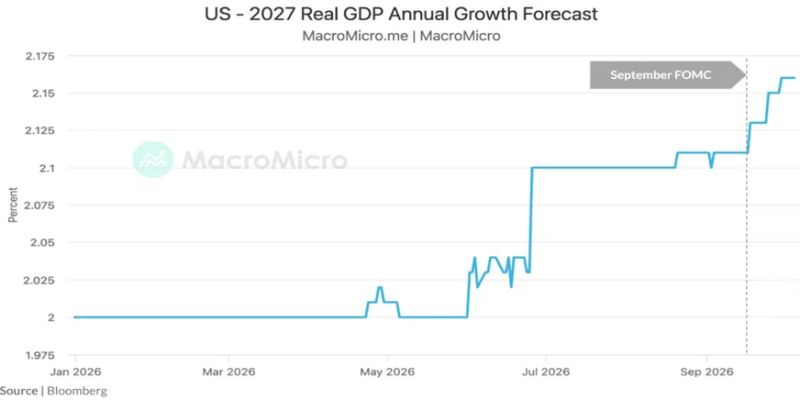
Chart of the week: US Economic Growth Forecasts Revised Up
The Federal Reserve has materially upgraded its interest-rate outlook, responding to stronger growth and persistent inflation. Following its September rate increase, the Fed’s updated dot plot now signals two 25-basis-point hikes in 2026, compared with no increases projected in June. Inflation forecasts face renewed upside pressure after core PCE rose 0.25% month-on-month, exceeding the Fed’s perceived 0.2% comfort threshold. Economic growth estimates have also strengthened, with second-quarter GDP revised sharply higher to 2.2% annualised from 1.5%, supported by robust consumption. Consequently, Treasury yields have repriced higher, with 10- and 30-year yields reaching levels last seen in the 2000s.
Read more - https://t.co/JlDiiguFCd
#FederalReserve #USInflation #InterestRates #MonetaryPolicy #TreasuryYields #BondMarkets #USEconomy #InflationOutlook #FixedIncome #FederalReservePolicy #GDPGrowth #YieldCurve
Weekly Overview of the ETF Markets
Cybersecurity and Tech Lead as Miners and Precious Metals Retreat
The week ending 2 October 2026 saw cyber-security, crypto and growth technology lead, while silver, lithium miners and precious metals came under pressure. Global X Cybersecurity ETF (BUGG) led all ETFs at +5.8%, with Betashares Global Cybersecurity ETF (HACK) up 4.7% and Betashares S&P/ASX Australian Technology ETF (ATEC) advancing 4.2%. Global X 21Shares Bitcoin ETF (EBTC) and DigitalX Bitcoin ETF (BTXX) each gained 3.8%, while Vaneck Global Semiconductor ETF (SMHG) rose 3.7% and Global X Morningstar Global Technology ETF (TECH) added 3.6%. Monochrome Bitcoin ETF (IBTC), Global X Semiconductor ETF (SEMI) and Monochrome Ethereum ETF (IETH) rounded out the leaders at +3.5%, +3.4% and +3.3% respectively.
On the downside, the pullback was concentrated in precious metals, miners and China tech. Global X China Tech ETF (DRGN) and Global X Physical Silver (ETPMAG) each fell 5.4%, while Vaneck Rare Earth and Strategic Metals ex China ETC (RESM) shed 5.3% and Betashares Crypto Innovators ETF (CRYP) lost 5.2%. Betashares Global Gold Miners ETF (MNRS) declined 5.1%, with Global X Silver Miners ETF (SLVM), VanEck Gold Miners ETF (GDX) and ETFS Global Lithium Miners ETF (VOLT) each off around 4.7%. Global X Physical Palladium (ETPMPD) and Betashares Global Uranium ETF (URNM) also softened, falling 4.4% and 4.0%.
Read more details here - https://t.co/TvMc1jb0Bp
#ETFs #AustralianETFs #USMarkets #ETFFlows #Cybersecurity #TechnologyStocks #Semiconductors #BitcoinETF #PreciousMetals #LithiumMining #FixedIncome #EquityMarkets #InvestmentTrends #GlobalMarkets #PortfolioStrategy
Weekly Overview of the ETF Markets
Semiconductors and Crypto Lead as Lithium and Palladium Slide
The week ending 25 September 2026 saw semiconductors, crypto and growth technology lead, while lithium miners, palladium and inverse strategies came under pressure. Monochrome Bitcoin ETF (IBTC) led all ETFs at +9.6%, with Monochrome Ethereum ETF (IETH) up 8.9% and Global X Ultra Long Nasdaq 100 Complex ETF (LNAS) advancing 7.6%. Vaneck Global Semiconductor ETF (SMHG) rose 7.3% and Betashares Wealth Builder Nasdaq 100 Geared (GNDQ) gained 6.6%, while Global X Semiconductor ETF (SEMI) added 6.5% and Global X 21Shares Ethereum ETF (EETH) climbed 5.9%. Vaneck MSCI International Growth ETF (GWTH), ETFS Magnificent 7+ ETF (HUGE) and iShares MSCI South Korea Capped ETF (IKO) rounded out the leaders at +5.5%, +5.3% and +5.2% respectively.
On the downside, the pullback was concentrated in inverse strategies, lithium miners and precious metals. Global X Ultra Short Nasdaq 100 Complex ETF (SNAS) fell 8.2%, while ETFS Global Lithium Miners ETF (VOLT) and Betashares Geared Long U.S. Treasury Bond Fund (GGFD) each shed around 4.1%. Betashares Crude Oil Index ETF (OOO) lost 3.7%, with Global X Physical Palladium (ETPMPD) off 3.5% and Betashares Strong Australian Dollar Hedge Fund (AUDS) down 3.0%. Betashares Global Gold Miners ETF (MNRS) and First Sentier Geared Australian Share Fund Complex ETF (LEVR) each fell 2.8%, while Magellan Infrastructure Fund (MICH) and GCQ Global Equities Hedged Complex ETF (HGCQ) softened 2.7% and 2.6%.
Read more details here - https://t.co/TvMc1jb0Bp
#ETFMarket #ETFs #AustralianETFs #USETFs #ETFFlows #Semiconductors #Crypto #Bitcoin #Ethereum #Lithium #PreciousMetals #GlobalMarkets #TechnologyStocks #FixedIncome #InvestmentTrends