Checkout our new paper, describing a simple method to analyze low amounts of flow sorted cells by @mrwaas and team
Droplet-based proteomics reveals CD36 as a marker for progenitors in mammary basal epithelium: Cell Reports Methods https://t.co/FXHzafuH6g
We are so proud of Foram Vyas who received an OICR Rising Stars in Cancer Research Network poster award last week at the OICR Translational Research Conference. Congratulations @fpvyas @OICRRisingStars @oicr @MBPatUofT @PMResearch_UHN
Introducing NEST, our deep-learning solution for detecting cell-cell communication on #SpatialTrascriptomics data at single-spot or #SingleCell precision!
Pre-print: https://t.co/ECFK3Lnr51
NEST: https://t.co/LtY0fBfHT8
NEST-Interactive: https://t.co/SWspm5uNJR
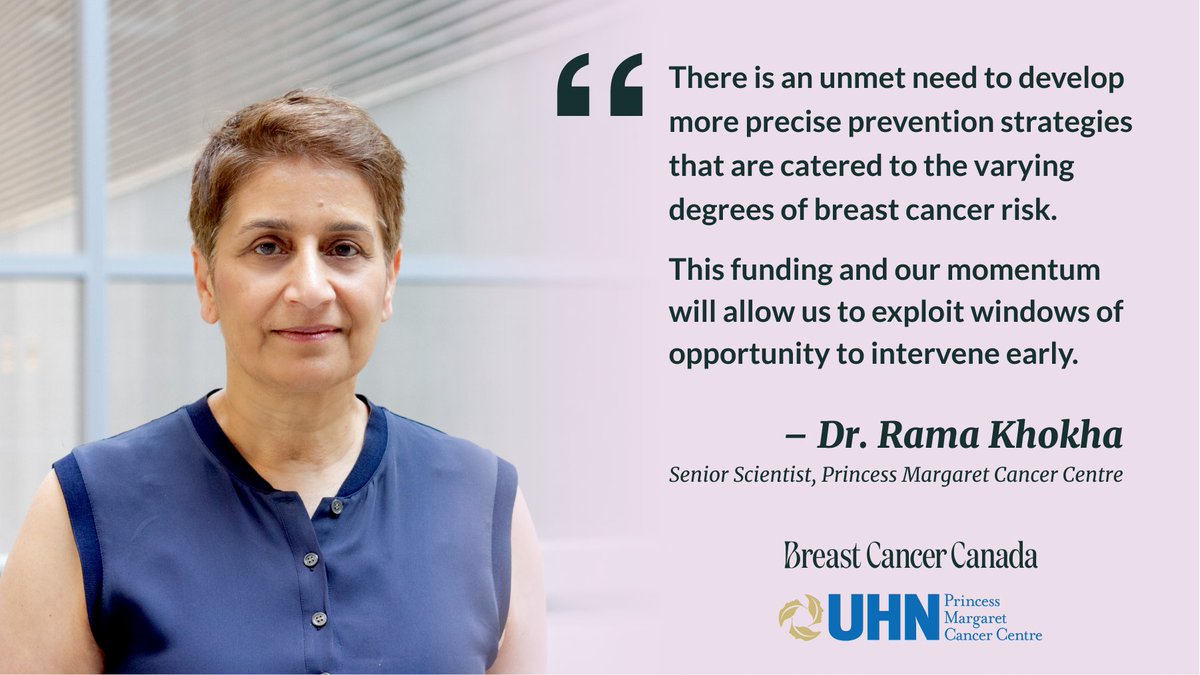
Meet Breast Cancer Canada Researcher, Dr. Rama Khokha.
Scientist Dr. Rama Khokha at @pmcancercentre has devoted her research to molecular cancer prevention.
Last year, Breast Cancer Canada witnessed the power of her innovation first-hand. In June, Breast Cancer Canada announced $3 million funding for the 3P Precision Prevention Progress Project, led by Dr. Khokha.
Her research focuses on identifying new risk factors and developing screening methods to detect cancer at an earlier stage, and will lead to future prevention strategies for breast cancer patients everywhere.
To Know More about Dr. Khokha’s story, please visit https://t.co/hnX7tcHdVi
@rmkhokha
#KnowMoreStories #MeettheResearcher #breastcancercanada #researchmatters
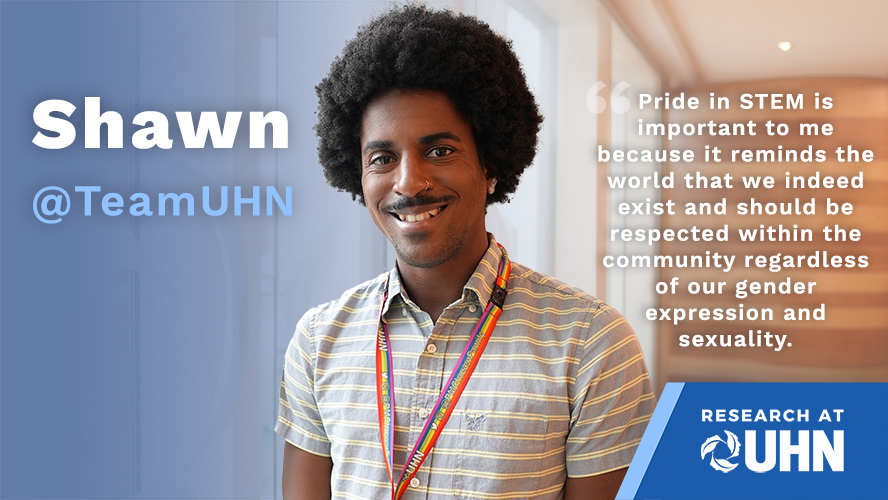
@UHN (2/4) Meet @ShawnHercules, a postdoctoral researcher in the lab of Dr. Rama Khokha (@rmkhokha) @UHN’s @PMResearch_UHN. Learn about Shawn’s research on breast cancer risk and prevention and why #PrideInSTEM is so important for challenging stereotypes. >> https://t.co/meMtA1TBJw
Excited to share our discovery of an epithelial progenitor population in the human breast! FABP7+ ductal luminal progenitors have distinct and targetable metabolism, and are the projected root of aberrant differentiation in the BRCA1 breast. @rmkhokha 1/9
https://t.co/Ve1AHbwrsB
Excited to share our work “Insulin Receptor Loss Impairs Mammary Tumorigenesis in Mice“. Led by @LaurenMPodmore and @KatPlz, our study reveals a major function of INSR in breast/mammary tumour initiation, likely independent of its kinase activity.https://t.co/ErPwZ79ip2
🧬 Our new study on how "Spatial tumor immune heterogeneity facilitates subtype co-existence and therapy response via AP1 dichotomy" is out now on @biorxivpreprint 🎉! Collaborative work of @ShivKSingh6 and @BarbaraGrnwald labs 🧪 Let's dive into the key findings! 🧵
🎉 An exciting new study led by T-CAIREM members @bhaibeka and @BoWang87 and UofT student researchers successfully reproduced and applied a new #ArtificialIntelligence (#AI) method. The research was supported by the @UofTDSI.
👀 Read more: https://t.co/hx6mQ6g0bV
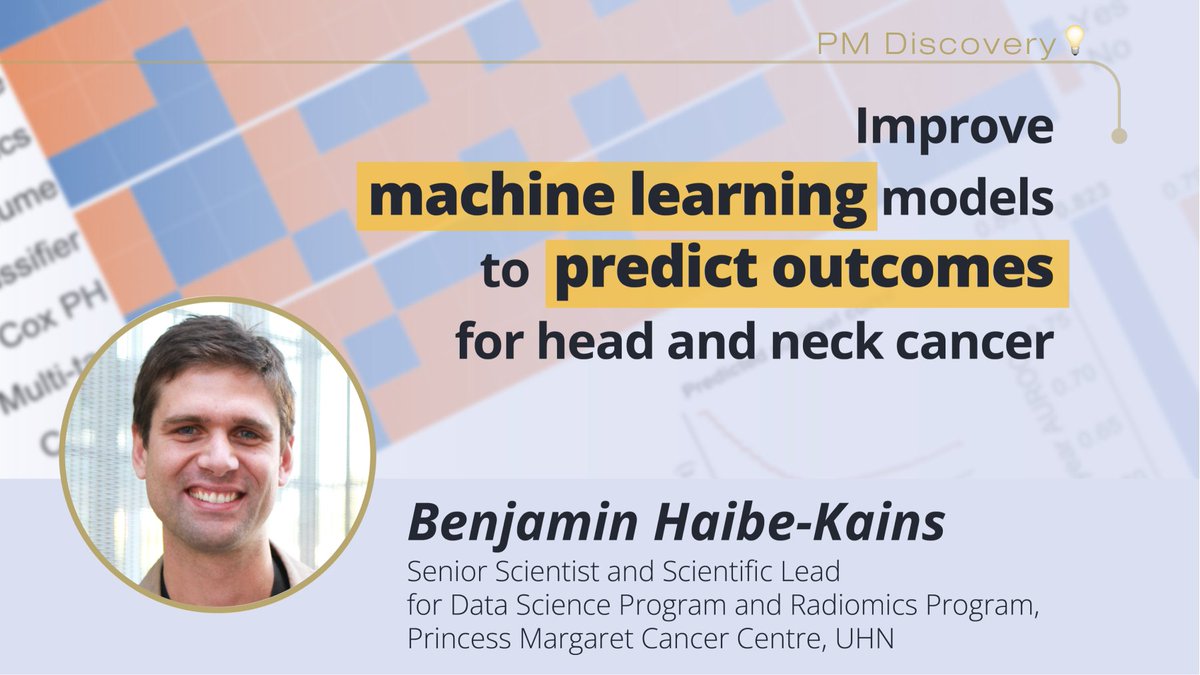
A team led by @bhaibeka@UHN compared 12 different machine learning models for predicting outcomes of head and neck cancer patients.
Using data from over 2,500 patients, the best model had a high accuracy in predicting 2-year and lifetime survival. #AI >> https://t.co/LAh7CSMW57
🎉Presented @ASCO, Dr. Rama Khokha @UHN has received a $3 million from Breast Cancer Canada to advance research on precision-based prevention of #breastcancer. #ASCO23 Read more > https://t.co/Ha4jcT22R5
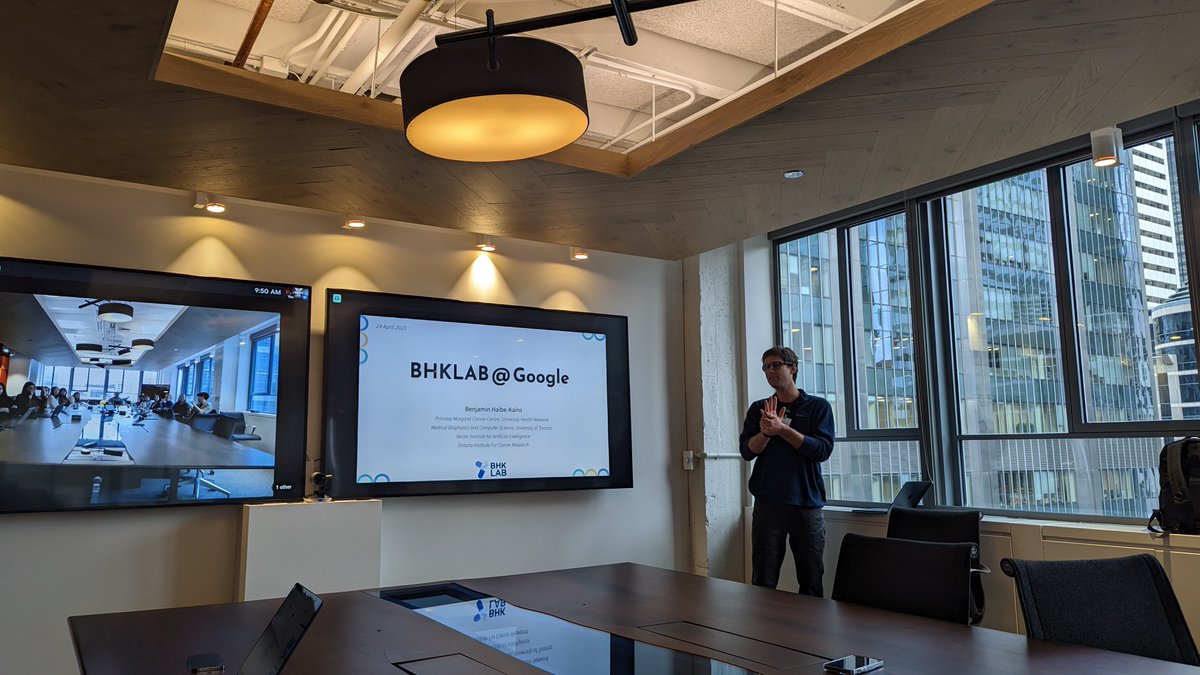
Today, we had a fun field trip to the Google office in downtown Toronto. It was very exciting to hear about several of Google Cloud's efforts and initiatives, especially in healthcare.
Preprint!📢Got a TMA and need help mining your data? Introducing Hourglass, a computational toolkit for non-coders and coders in the digital pathology space 🔬🔧🔨
In #PDAC, Hourglass pinpointed sex-disparities in the IL6-associated T cell response
🩺🏥
https://t.co/78NWiK6k1Q
Best quote from the GRC so far: "No one believes in a model except the person who makes it, and everyone believes in an experiment except the person who performs it"😆