After 3 years building @gizatechxyz from scratch, I’m stepping down from my full-time role as co-founder & CTO. I’ll stay close through a short transition and keep cheering the team on and supporting where my input is needed.
We started at the frontier of ZKML (Zero-Knowledge Machine Learning), making model outputs provable. The market was early, protocols weren’t ready to embed models in their smart contracts. So we focused where we could help most, DeFi AI agents that automate the manual work and improve crypto UX.
That’s how Arma was born: an autonomous yield-optimization agent for stablecoins. It continuously scans venues, prices risk, and reallocates within explicit guardrails (liquidity, tvl, protocol risk etc.). Decisions are transparent, actions auditable, and the system is built to self-recover.
Along the way, we were privileged enough to be backed by top tier investors like @coinfund and @cbventures. We grew a hands-on engineering team to 13, set a high delivery/quality bar, and shipped the best foundational infrastructure for agentic finance that is in production today.
Today, Arma manages $30M+ in assets with 5k+ daily active users. None of this happens without the people who built it, thank you to every teammate who shipped through the many long nights.
Now Giza enters a new chapter. I’m biased but I’m very confident in the team behind it and I’ll be around to help where useful.
To our investors, partners, and the community that believed from day zero: thank you for the ride.
New Anthropic research: progress on provable inference for large language models.
Here, we introduce FlashProve. Building on established cryptographic techniques, FlashProve allows developers to verify whether a given response came from a given AI model. It’s substantially more efficient than prior open-source methods for doing so.
These proofs have a range of applications. They can, for instance, make it harder for attackers to hijack a chat, or enable safety evaluators to verify that the model they’re testing is the same one being served to customers.
For our full write-up, see here: https://t.co/OIZWPb6QZa
Further progress in provable inference will likely be an important part of improving trust in AI deployment. To that end, we're open-sourcing FlashProve’s code, here: https://t.co/7ky3Ir8V06
We’re grateful to our collaborators: Alessandro Chiesa, @GiacomoFenzi, @gwberg95, @miranda__christ, Rahul Dalal (https://t.co/pjWKLHWXyz) and Ben Mayer (@transmissions11).
How do always-on, proactive agents like @Bot work?
Watch my lecture at Stanford CS146S:
2:35 How we got here
6:13 What changed in the models
10:06 Inside an always-on agent
18:07 The harness
27:26 Context engineering
34:26 Where this is going
implemented this in our internal rag and got a solid 12% perf boost in our evals by just using jev as the reranker. also quite solid in terms of costs!
Jev for RAG
in almost all cases you trust the semantic matching capability of Jev more than dot product similarity
very useful as the direct similarity metric in small data cases
and a great reranker with big data
Training tiny models for special purpose use cases works so incredibly well if you have a great self improving recursive flywheel. Shopify ML team is on fire.
finetuned 0.8b model beats GPT 5.6-sol xhigh in this very specialized task.
The future of FDE work seems closely related with all work around evals/posttraining/RL envs.
FDEs are effectively responsible for the following:
1. Define the business problem.
2. Codify the business problem into an eval rubric and environment.
3. Hillclimb the environment and output an agent/agentic workflow that solves the business problem.
Right now the process of (3) is quite manual - historically FDEs spend hundreds of hours creating bespoke software/workflows that solve the problem.
But assuming intelligence is abundant, they can effectively offload (3) to some automated optimization process. This includes RL on the model layer, and using Claude Code/Codex to optimize the harness/workflow.
Then the FDE responsibility shifts from implementing the task to defining the right goals and outcomes. In other words, they have access to /goal, and their job is more around making sure the goal, environment, and evals are correct vs. the tactical implementation details.
@jerryjliu0 fully agree. also production data on these agentic systems tend to drift over time. the fde skills on evals, rl and posttrainging become critical for the actual success of the use use case.
in the end it’s a data mining problem if you think about it.
using it well really makes a difference, specially in engineering teams. most people just follow inertia and use the base harness and little to none skills or neither create new ones over time.
it’s really worth it to sit and think on common patterns, best practices and standardize the work across teams when using ai. if not, slop and low quality code will be the norm.
Ryan Dahl just launched celld: self-hosted, distributed Durable Objects.
One SQLite database per cell. S3-compatible storage. No separate database cluster or control plane.
I looked at the architecture, tradeoffs, and where I’d use it:
https://t.co/3uOcurnaIz
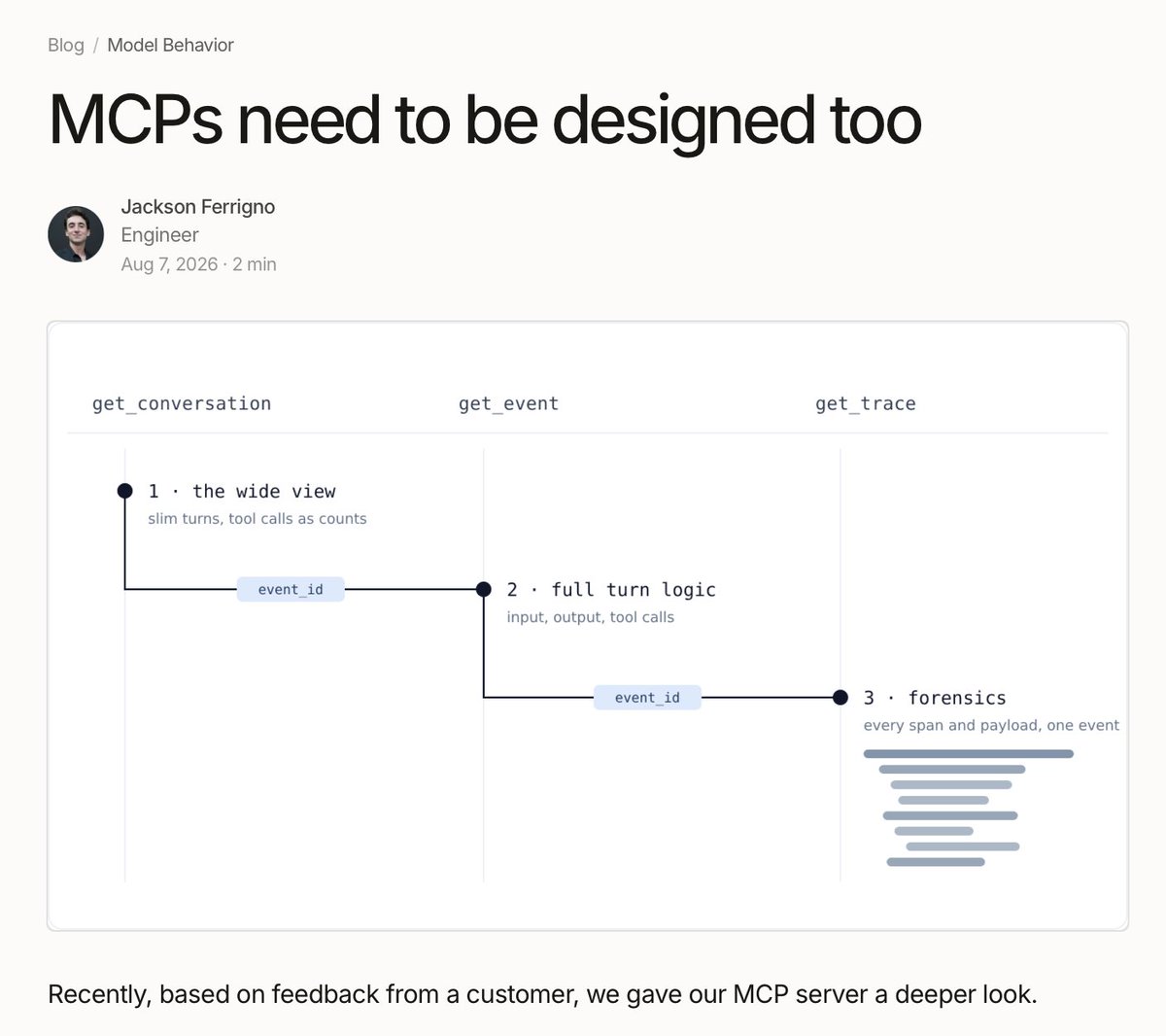
engineer on our team wrote a short piece about the AX of mcps.
turns out, there are problems with just throwing a bunch of tools into a bucket.
https://t.co/ZUlpYzQTDC
working at @HappyRobot means building agents that survive contact with real operations.
we study production traces, find where the agent or workflow broke, turn those cases into evals, improve the prompts, tools and control flow, then run the regression suite before shipping again.
that loop matters more than making a model look clever in a demo.
a production agent is the whole system around the model: context, tools, permissions, latency, fallbacks, observability and end-state verification.
we own all of it, then use what happens in production to make the next version better.
very excited to share the journey working along with pablo and the team on this.
We just raised a $150M Series C at a $1.2B valuation led by Prysm Capital and co-led by @eurazeo. 🦄
Two years ago we deployed one voice agent in a US freight broker. Today, we’ve deployed a full platform in over 150 enterprises globally across supply chain, energy and utilities, telecom, insurance and airlines. 5x growth since our Series B.
Some of those incredible customers include @DHLGlobal , @Kuehne_Nagel, @Naturgy, @Repsol, and @Uber.
We’re building Enterprise Superintelligence: the state where an organization's collective intelligence compounds as agents and humans learn from one another.
And it starts by deploying your first agent. Much like that first agent we deployed two years ago.
Thank you Prysm and Eurazeo. And to @a16z, @Base10Partners, and @ycombinator for doubling down.
Thank you to the 200 @HappyRobot folks who worked so hard to make this happen. If you need us, we’ll be heads down, building a world where things just work. ▶️
& Thank you to our strategic investors including including @DisruptiveKoch, @orange, https://t.co/lDMJ8JUKIo (@deutschetelekom), @Bankinter, @endeavor_global, @Kfundvc and Wave-X.
@arthaud_@JudgmentLabs yes, very similar to that. there is a lot of struggle on how to improve agents once they are in production and how measure their performance accurately.
recommended reading. in a few systems i built over the past 2 years i ended up with this flow for a given task:
- start with full inference for all steps, observe behaviour, judge correctness
- find inference steps that can be replaced with deterministic steps
eventually, most inference goes away, leading to more stable yet capable systems that can do much more than deterministic systems alone.
this is incredibly important for anyone building production agents, specially in the enterprise.
data drifts quite quickly, edge cases appear. agents need to be self evolving with a well designed feedback loop to create roi over time.
The creator of Pydantic explained how to make live agents smarter after they ship in 1 hour 21 minutes - better than $2500 agent evals bootcamps.
collect traces from your live agent -> score them with an eval -> run GEPA to auto-optimize the prompt -> deploy the winner -> repeat forever.
That loop is how Pydantic AI agents self-improve while running in production.
Pydantic AI + Logfire tracing + GEPA prompt optimizer + evals + feedback loops - that's the stack.
Watch and save it, then wire GEPA into your live agent this week.
@vasuman this is how to properly get enterprise adoption for ai. but it also needs to be done properly and fdes really need to standardize and productize their work as much as possible for it to scale and avoid one off deployments.
great read. i don’t feel confident enough to give loops enough autonomy to ship production code yet. nevertheless, it’s a tooling problem and it will be solved in the coming months.