There is a popular Apple Pie Position, which goes:
“If you don’t measure it, you cannot improve it”
This belief is often harmful on early-stage teams.
This is more accurate:
“If you don’t measure it, you cannot prove to some people that you improved it”
Impact vs. Optics
Implications:
1) You need leaders who have good taste. Without good taste, everything becomes an exercise to “prove it conclusively”, which slows teams down
2) As an org grows, it becomes increasingly hard to hire / retain enough people with good taste. Plus, because optics are now more important in such orgs, people end up having to do all sorts of useless work to prove the unprovable
3) Such orgs can maintain (and hopefully grow) existing mature products (because mature products lend themselves well to management by extensive measurement). But these orgs struggle to produce new products and make them successful. These orgs tend to be uninspiring and, for some people, boring
4) When you go from such an org to a smaller team or company, you must adjust your approach. If you yourself don’t have good taste, you must first build awareness of that and hire / listen to people who do have good taste
5) In all cases, understand that there is a difference between *evaluating* how something is going and *measuring* how it is going. In some cases, you can simply evaluate without performing crazy contortions to measure. Of course, such evaluation requires good taste and judgment
6) If you find yourself feeling upset by any of these words, consider perhaps that you might have tied too much of your identity to a certain way of operating and want to remain convinced that yours is the only right way
7) If, after considering this, you still don’t feel any differently, that’s okay. Not everything will resonate with everyone at all times. Maybe come back to this idea in a few years and see how it feels then
P.S.
Some people proudly repeat the “if you can’t measure it, you can’t manage it” quote, not realizing that they are actually mis-quoting Deming, who actually said the exact opposite:
“It is wrong to suppose that if you can’t measure it, you can’t manage it – a costly myth.”
🙂
"We're not as smart as we think we are!"
In his research into "How to Invent Everything," @RyanQNorth uncovered a number of inventions that humanity could have invented centuries or even millennia before we actually did, from compasses to hot air balloons to buttons.
1. Founders and CEOs don’t have a good way to think about competitors. Some ignore them, others obsess over them. Neither is optimal.
IMO, the right way to evaluate competitors is through a customer lens.
The passage that hit me hardest:
"I have already told some of my friends: When I see you in heaven, there’s only one thing I’m going to ask—Were you good to my son and my wife? Were you there for them? Does my son know you?"
(continued)
This Japanese technique to fold shirts in 2 seconds seems to find a secret topology hidden inside clothes
[full video, HD, DaveHax: https://t.co/0oeSpfouET]
So for most of us, things are ... more tense now between founders and VCs.
In the Boom Times:
* VCs were reluctant to be critical
* Founders viewed capital as a commodity
Now things are tenser
A few ideas of how to work better with your VCs in 2023: 🔽🔽🔽🔽🔽
A strategy for thinking clearly:
Rather than trying to be right, assume you are wrong and try to be less wrong.
Trying to be right has a tendency to devolve into protecting your beliefs.
Trying to be less wrong has a tendency to prompt more questions and intellectual humility.
Back-to-back meetings drain our brains. We need downtime in between to recover.
New research: even 10-minute breaks between meetings are enough to reduce stress, improve focus, and boost engagement.
Instead of defaulting to 30/60min meetings, we should schedule 20/50min blocks.
I asked 49,214 people what traits a great startup employee has.
27 people responded.
The other 49,187 people were stuck in traffic.
Here are 15 of the best responses (in no order):
How to create a mesmerizing (and scary) well in your living room table using the infinity mirror principle.
[what's an infinity mirror: https://t.co/CkuflyCjHa]
[source: https://t.co/IJVbi7lhPP]
Matt Mochary has coached @naval, the founders of Reddit, Coinbase, Notion, OpenAI, and leaders at Sequoia, Y Combinator, Benchmark, and many others.
Here are his 5 mental models that will help you become a strong leader:
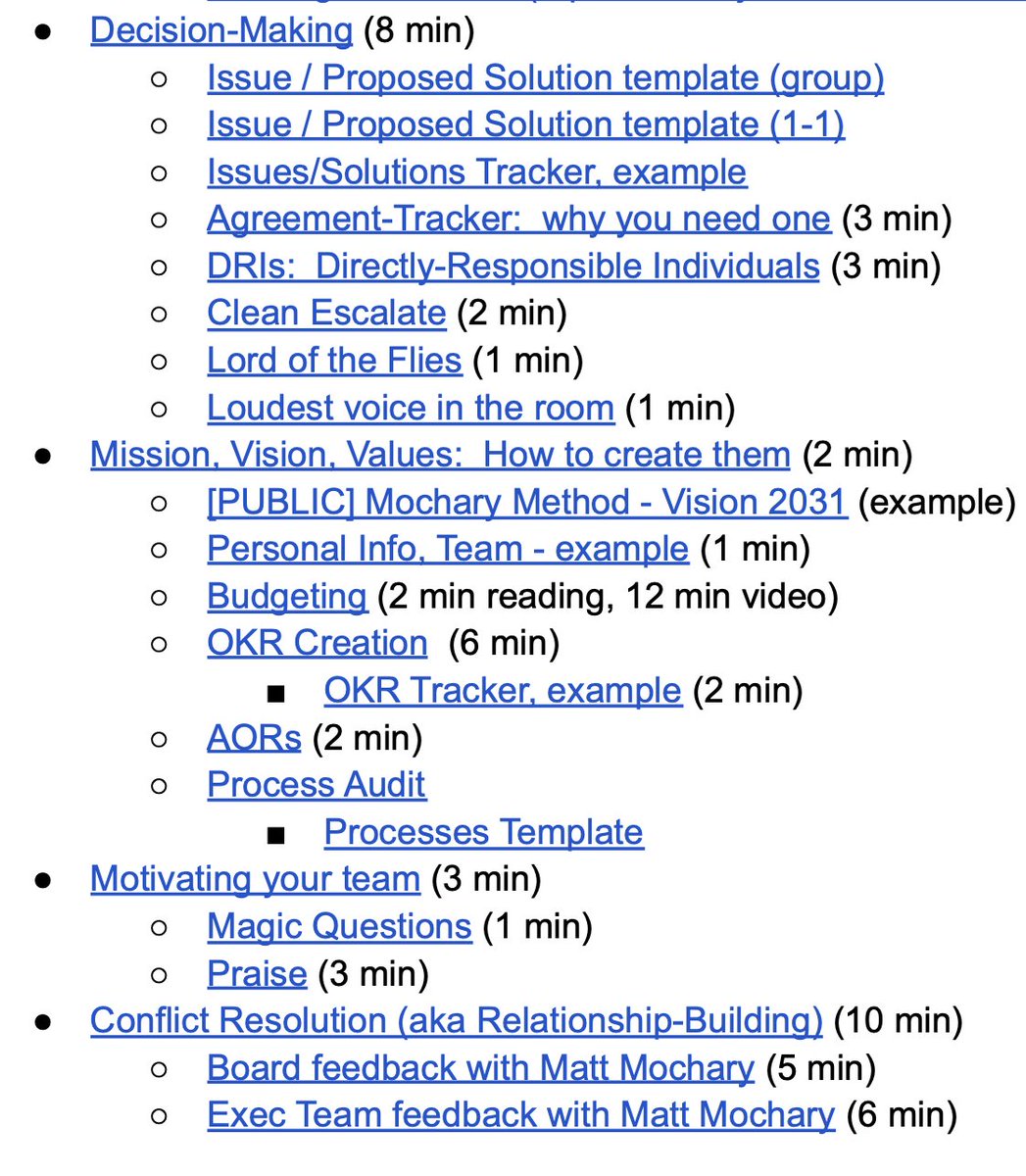
Matt Mochary has been CEO coach to @naval, the founders of OpenAI, Notion, Rippling, Robinhood, Coinbase, Reddit, Plaid, Flexport, Opendoor, partners at Sequoia, YC, Benchmark, and many others.
He also open-sourced his entire curriculum, templates and all. Here's a link 👇
@niblettc89@stevegraham@chamath@theallinpod Happy to help!
Top improvements:
- Get a large light with a soft box
- Set the camera (ideally an SLR) slightly under eye level and put it at least 3-4 feet from you
- Get a good mic
- Shoot a second light down at the back of your head