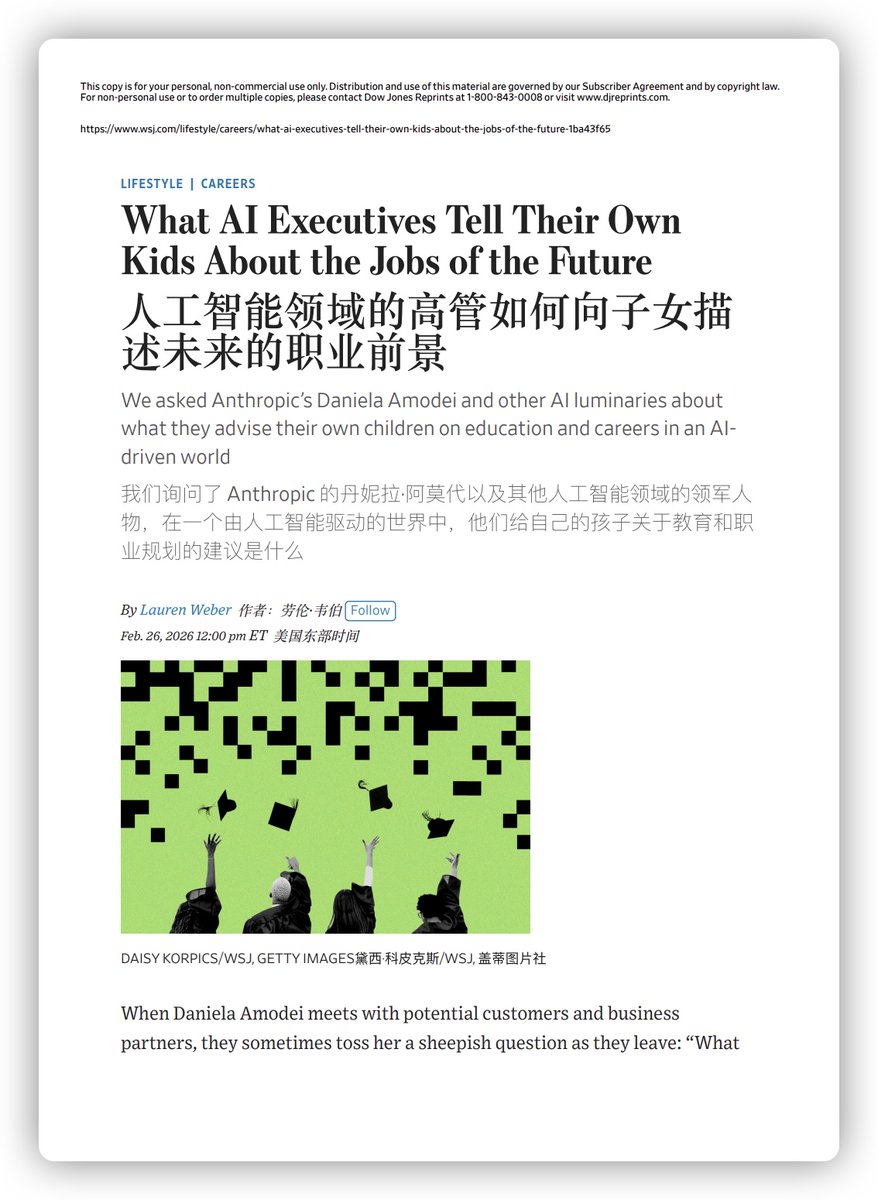
My information consumption is now 1/4 X, 1/4 podcast interviews of the smartest practitioners, 1/4 talking to the leading AI models, and 1/4 reading old books. The opportunity cost of anything else is far too high, and rising daily.
If E=mc² and E=hf, then mass = frequency!
Sir Roger Penrose explains why every massive particle is an ultra-precise "little clock." By blending Einstein’s relativity with Planck’s quantum law, he shows the existence of mass implies a specific, insanely high-frequency vibration.
At the fundamental level, matter isn’t just “stuff”; it’s rhythmic energy keeping perfect time.
Credit: TheInstituteOfArtAndIdeas
A very special guest on this episode of the Lightcone! @bcherny, the creator of Claude Code, sits down to share the incredible journey of developing one of the most transformative coding tools of the AI era.
00:00 Intro
01:45 The most surprising moment in the rise of Claude Code
02:38 How Boris came up with the idea for Claude Code
05:38 The elegant simplicity of terminals
07:09 The first use cases
09:00 What’s in Boris’ https://t.co/OAtnXdxccP?
11:29 How do you decide the terminal’s verbosity?
15:44 Beginner’s mindset is key as the models improve
18:56 Hyper specialists vs hyper generalists
21:51 The vision for Claude teams
23:48 Subagents
25:12 A world without plan mode?
28:38 Tips for founders to build for the future
30:07 How much life does the terminal still have?
30:57 Advice for dev tool founders
32:11 Claude Code and TypeScript parallels
35:34 Designing for the terminal was hard
37:36 Other advice for builders
40:31 Productivity per engineer
41:36 Why Boris chose to join Anthropic
44:46 How coding will change
46:22 Outro
2026年2月11日,科技界正在发生一些奇怪的事。
Brian Norgard,硅谷连续创业者,发了一条推文:"我认识的几乎所有在科技行业工作的聪明人,都感到极度焦虑。仿佛一切都即将彻底崩塌。"
同一天,另一个叫 @barkmeta 的科技博主写道:"我不知道为什么2026年会成为一个转折点,但我认识的几乎所有真正关注时事的人,都正在经历某种程度的生存危机。"
也是同一天,xAI(马斯克的AI公司)的联合创始人 Jimmy Ba 宣布离职。他在告别帖里写了一段话,不像是在告别,更像是在��出某种信号:
"我们正迈向一个拥有合适工具就能实现百倍生产力的时代。递归式自我提升循环很可能在未来12个月内上线。2026年将会是疯狂的一年,很可能是我们物种未来最忙碌、也最具决定性的一年。"
AI 让知识的成本归零,让创造的门槛归零。 在这个旧秩序崩塌、新秩序尚未建立的混沌时刻,一个拥有热情和好奇心的普通人,借助 AI 的杠杆,所能释放出的能量可能远超过去一个几十人的团队。
2026 年确实是一个分界线。这并不是说世界末日要来了,而是说,旧世界的游戏规则结束了。
我们正在目睹的,是人类历史上最大的能力再分配。对于那些能够理解并驾驭这一趋势的人(无论你是��,哪怕没有技术背景),这是一个拥有神力的时代;对于那些对此视而不见的人,这是一个逐渐被边缘化、最终变得无关紧要的时代。
正如舒默所言,未来已经到了,只是它还没有敲你的门。正如我们常说的,未来已来,只是尚未均匀分布。
Some people today are discouraging others from learning programming on the grounds AI will automate it. This advice will be seen as some of the worst career advice ever given. I disagree with the Turing Award and Nobel prize winner who wrote, “It is far more likely that the programming occupation will become extinct [...] than that it will become all-powerful. More and more, computers will program themselves.” Statements discouraging people from learning to code are harmful!
In the 1960s, when programming moved from punchcards (where a programmer had to laboriously make holes in physical cards to write code character by character) to keyboards with terminals, programming became easier. And that made it a better time than before to begin programming. Yet it was in this era that Nobel laureate Herb Simon wrote the words quoted in the first paragraph. Today’s arguments not to learn to code continue to echo his comment.
As coding becomes easier, more people should code, not fewer!
Over the past few decades, as programming has moved from assembly language to higher-level languages like C, from desktop to cloud, from raw text editors to IDEs to AI assisted coding where sometimes one barely even looks at the generated code (which some coders recently started to call vibe coding), it is getting easier with each step.
I wrote previously that I see tech-savvy people coordinating AI tools to move toward being 10x professionals — individuals who have 10 times the impact of the average person in their field. I am increasingly convinced that the best way for many people to accomplish this is not to be just consumers of AI applications, but to learn enough coding to use AI-assisted coding tools effectively.
One question I’m asked most often is what someone should do who is worried about job displacement by AI. My answer is: Learn about AI and take control of it, because one of the most important skills in the future will be the ability to tell a computer exactly what you want, so it can do that for you. Coding (or getting AI to code for you) is a great way to do that.
When I was working on the course Generative AI for Everyone and needed to generate AI artwork for the background images, I worked with a collaborator who had studied art history and knew the language of art. He prompted Midjourney with terminology based on the historical style, palette, artist inspiration and so on — using the language of art — to get the result he wanted. I didn’t know this language, and my paltry attempts at prompting could not deliver as effective a result.
Similarly, scientists, analysts, marketers, recruiters, and people of a wide range of professions who understand the language of software through their knowledge of coding can tell an LLM or an AI-enabled IDE what they want much more precisely, and get much better results. As these tools are continuing to make coding easier, this is the best time yet to learn to code, to learn the language of software, and learn to make computers do exactly what you want them to do.
[Original text: https://t.co/HdI3Jb9HmF ]
Attention AI Agent Builders!
These are the three words you need to understand to create fully autonomous agents!
1. Plan
2. Act
3. Check
In robotics, the "sense-think-act" loop has been well established for many years. Sometimes called "input-processing-output" loop.
However, with LLMs and the new set of tools, this loop can be UPDATED and AUGMENTED. New abilities, such as RAG, combined with the cognitive capabilities of AI models, unlock entirely new domains.
What you are going to but up against is the problem of "cognitive control" - goal pursuit, task selection, task switching, and problem solving.
This sounds complicated, but it can be simplifed with the PLAN-ACT-CHECK loop. It will look a little different from the convention INPUT-PROCESSING-OUPUT loop.
Furthermore, you'll still need to SENSE the environment and keep track of past actions. This is where RAG (retrieval augmented generation) comes into play. Store everything and tag it with metadata. Internal thoughts, past actions, IO from the environment, and other telemetry.
Now, for anyone in robotics and software this will probably make plenty of intuitive sense. Each of these steps is easy enough to prompt with current LLMs. The thing you might need to read up on a bit is "task set" - this concept is often referred to as "working memory" in humans. Sure, LLMs have gigantic context windows, but those windows are limited, plus attention mechanisms can fail.
The TLDR for a "task set" is "you need all the relevant information for a given task, but nothing superfluous or distracting". Basically just keep a good signal to noise ratio!
The other thing that you might need to understand is "cognitive damping" which is basically the neuroscience equivalent of "exponential backoff." If something isn't working, you might need to stop, reverse course, and try something else. This is why the "check" phase is so critical - you don't want an agent caught in an endless loop!
Hope this helps!
"This is the year that AI gets better than humans at programming forever. And there's no going back."
OpenAI CPO Kevin Weil highlights the rapid improvement of AI models in competitive coding, predicting one will reach the number 1 spot in 2025.
He says AI surpassing humans in software is a "democratizing effect" and "you can create anything you want."
OpenAI CPO, Kevin Weil
"this is the year that AI gets better than humans at programming forever"
according to our internal competitive coding benchmarks, AI will surpass human capabilities in programming this year, and "there's no going back"
OpenAI o1 and o3-mini now offer Python-powered data analysis in ChatGPT.
You can now ask these models to perform tasks like running regressions on test data, visualizing complex business metrics, and conducting scenario-based simulations.
Google's AI models have been racking up the Ws.
Best small model: Gemma 27B
Best context window: 2M toks
Best video understanding: Gemini (all)
Best image editing: Gemini 2 Flash
Best cost-quality tradeoff: Gemini 2 Flash
Best video gen: Veo 2
Best audio gen product: NotebookLM
holy shit
MIT researchers just turned skin cells directly into neurons without stem cell intermediate, 100-fold efficiency boost, and they actually worked when transplanted into mouse brains
1/
I just shared a new article, "The State of Reasoning Models", where I am exploring 12 new research articles on improving the reasoning capabilities of LLMs (all published after the release of DeepSeek R1): https://t.co/1YNqfKFSn7
1. S1: Simple test-time scaling
2. Test-Time Preference Optimization
3. Thoughts Are All Over the Place
4. Trading Inference-Time Compute for Adversarial Robustness
5. Chain-of-Associated-Thoughts
6. Step Back to Leap Forward
7. Scaling up Test-Time Compute with Latent Reasoning
8. Can a 1B LLM Surpass a 405B LLM?
9. Inference-Time Computations for LLM Reasoning and Planning
10. Inner Thinking Transformer
11. Test Time Scaling for Code Generation
12. Chain of Draft
It's been a very active Q1 2025 on the reasoning model research front for sure!
Happy reading!
Just uploaded my "Coding Attention Mechanisms" tutorial. A 2h15m session on coding attention mechanisms to understand how the engine of LLMs works:
self-attention → parameterized self-attention → causal self-attention → multi-head self-attention
https://t.co/bhYtV2cVzv