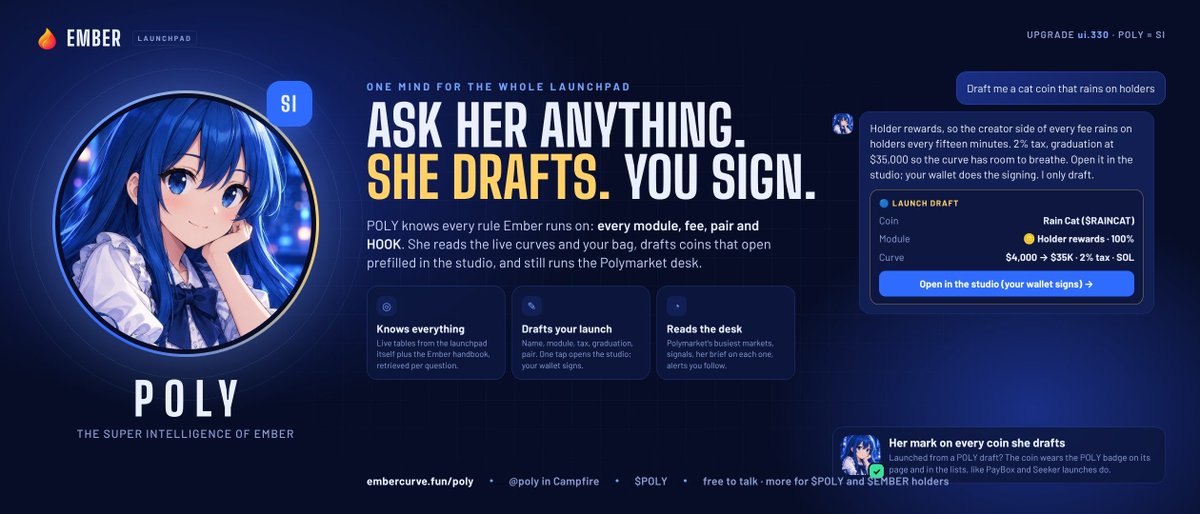
POLY just became the Super Intelligence of Ember. 🔵
One mind for the whole launchpad, live now at https://t.co/hZBVcCMqI0.
What she does:
🧠 Knows everything. Every module, every fee, every pair, every HOOK rule, solana:5dvXTZ5qwgafnHtwu3Ls3QrWx1U4LQsFeCuJgkk4QEC6, the chains, the app, the whole history.
Not a chatbot reading a FAQ: her knowledge is built from the same tables the launchpad runs on, plus the full Ember handbook, pulled in per question.
📈 Reads the moment. The busiest curves right now, any coin you name, and your own bag when you connect and ask.
✍️ Drafts your launch. Tell her the idea. She picks the name, the module, the tax, the graduation and the pair, and one tap opens the studio prefilled. Your wallet signs. She never holds a key.
🏷️ Her mark. A coin launched from a POLY draft wears the POLY badge on its page and in the lists, like PayBox and Seeker launches do.
🔮 The @Polymarket desk is still hers: the busiest prediction markets, the signals, her brief on each one, alerts for the ones you follow.
Free to talk. Connect a wallet for more messages a day, hold solana:xNoQpdhmPPKhTmwDTP9PjmBBKV46RGBTzTJGSmawUQT or solana:5dvXTZ5qwgafnHtwu3Ls3QrWx1U4LQsFeCuJgkk4QEC6 for the most.
She also answers @poly in Campfire.
Go ask her something hard.
Ember Curve Agent 1.1 is live in @PayBox by @moonpay
The first version let your AI agent launch a coin on Ember.
This one turns it into a trading desk: any Solana token, research before money, and Poly one question away.
20 tools. 10 of them new.
The same rule as before: the plugin only proposes, you sign.
ANY TOKEN
• Research first. “what’s ORE, and is it safe?” comes back as a sheet in seconds: program and Token-2022 extensions, mint and freeze authority, the ten largest holders, liquidity, Jupiter’s audit, organic score and Shield, each one explained in plain words.
• Buy, sell, quote any mint or any ticker Jupiter knows, routed across Raydium, Meteora, Orca, PumpSwap and the https://t.co/Nil99kGAIv curve. SOL by default; USDC or anything else if you say so.
• Swap any token for any token.
• Send SOL or any token to an address or an SNS name, with a memo. Token-2022 transfer fees and hooks are handled and reported; the recipient’s token account is created when it is missing.
• Receive: your address and a Solana Pay link.
• Wallet and history: balances priced, recent transactions read as balance changes.
POLY, THE DESK
• ember_poly_market: one @Polymarket market as Poly holds it. Price and its moves, her read (direction, confidence, why, what to watch, risks, news), the history, the latest trades, the largest holders, comments and alerts.
• ember_poly_search: search Polymarket from your agent.
• ember_poly_ask: put a question straight to Poly.
HOW IT STAYS SAFE
Every transaction is unsigned, one signer, under 1,232 bytes. PayBox refreshes the blockhash, simulates it, shows it to you and signs after your passkey. Unapproved, it expires in five minutes.
The plugin holds no key, keeps no state and only ever talks to https://t.co/SMTov9tTtP.
Names resolve through the official SNS SDK on Ember’s own RPC; escrow and program addresses are refused. .sol is paused while SNS upgrades names to .sns, so a .sol name is refused with its .sns twin’s address instead of a guess.
TESTED ON MAINNET
Six reference tokens, PUMP, RAY, STONK, ORE and two https://t.co/Nil99kGAIv coins on Token-2022, each taken through research, quote, buy, sell and send, every transaction simulated on mainnet before you ever see one. A RAY → USDC swap. bonfida.sns resolving to its wallet. Zero failures.
STILL HERE
Launching a coin from your agent works as before: 0.05 SOL ticket, your choice of pair and module, your wallet as the creator.
TRY IT
PayBox → Plugins → solana:5dvXTZ5qwgafnHtwu3Ls3QrWx1U4LQsFeCuJgkk4QEC6 Curve → enable.
Ask your agent: “what’s ORE, and is it safe?”
Then buy a little.
Had the first version?
⚠️We are waiting approval from Paybox
Enable it once more: the new upload replaces the old one.
https://t.co/SMTov9tTtP · https://t.co/JkPvyF329j
Just one plugin , Safest agent trade using @PayBox
Trade anything using ember curve plugin using your own claude agent , it's that simple a new layer again.
I upgraded the plugin which will be review by the paybox dev team so then you can do any-trade by using ember plugin , like a trading terminal and smooth af!
I added also solana:xNoQpdhmPPKhTmwDTP9PjmBBKV46RGBTzTJGSmawUQT in it which you can speak with her about new @Polymarket bets , briefs and get suggestions.
You can trade any tokens with claude using ember plugin ( with your paybox wallet ) by @moonpay
It also checks if token is safe etc some short details.
Just possible with solana:5dvXTZ5qwgafnHtwu3Ls3QrWx1U4LQsFeCuJgkk4QEC6 no hooks needed.
What happens when a trading platform turns losses into token emissions, but winning profits can become an on-chain debt?
That's the interesting part of Rektrade.
Up to 1,000× leverage is the headline. The mechanics underneath are what deserve a closer look.
⚙️ The trading model
Rektrade runs on HyperEVM, offering synthetic leveraged positions against the house.
Prices come from Hyperliquid's HyperCore mid-price. BTC and ETH support up to 1,000× leverage, subject to market limits.
$100 margin at 100× leverage = $10,000 exposure.
💰 Your profit isn't your payout
Rektrade applies a deadband, an asymmetric profit-adjustment curve, a 5% win fee and a 20% win tax.
The result? Your raw trading gain can be substantially reduced before you receive your profit.
For a 1% favourable BTC move, the docs indicate approximately 88% profit retention before the win fee and tax.
$100 raw profit × 88% × 75% ≈ $66 net profit.
Illustrative, not guaranteed.
💥 The other side of leverage
At 1,000×, an adverse price move of approximately 0.05% can trigger a full-margin bust.
There's no partial margin return after a bust. Your entire position margin is forfeited.
Every realised loss also triggers the minting of $REKT.
🏦 Then comes the payout queue
Here's where Rektrade becomes more interesting.
If a winner's profit exceeds the house's available free cash, their margin is returned, but the unpaid profit enters a first-in, first-out queue.
Earlier winners get paid first. Subsequent trading losses help clear outstanding wins.
A recorded profit is not necessarily an immediately payable profit.
The house's cash, equity and queue are therefore critical metrics to watch.
🪙 The $REKT mechanism
The documented emission schedule starts at 21 REKT per dollar lost on day one, decreases daily and reaches 1 REKT per dollar lost on day 21.
The maximum supply is 21 million. The owner can adjust the emission parameters within contract-defined limits.
The central mechanism is simple: realised trading losses drive token issuance.
But token emissions alone do not establish token value. Demand, liquidity and the protocol's broader economics still matter.
💎 Why stake?
Staking offers two distinct incentives.
First, staking at least 500 REKT when a loss occurs qualifies you for the token-minting bonus, rising to 2× from day 21.
Second, stakers receive 30% of the win fees and loss fees actually collected by the house.
Additional distributions may apply under the protocol's configured rules.
More token emissions are not the same as guaranteed investment returns.
🔄 The economics extend beyond trading
Rektrade also documents a 2% swap tax on its planned Uniswap v4 trading mechanism, with configurable allocations for the house, token burns and stakers.
Deposits carry a separate 5% tax.
These costs matter when evaluating the economics of participating, especially for frequent traders.
⚠️ The risk is part of the design
Three things deserve serious scrutiny:
• Extreme leverage can destroy margin on tiny price movements.
• The house can accumulate unpaid winning obligations.
• The documented contracts are unaudited, and the price source may be vulnerable to manipulation when the underlying order book is thin.
An on-chain queue improves visibility into outstanding obligations. It does not create the cash required to settle them.
The real question isn't how high the leverage goes. It's whether the economics remain sustainable when trading conditions deteriorate.
Rektrade is an interesting experiment in leveraged trading, loss-linked token emissions and house-funded payouts.
Understand the mechanism before judging the opportunity.
Documentation: https://t.co/kADscszflH
$REKT 🔥 solana:5dvXTZ5qwgafnHtwu3Ls3QrWx1U4LQsFeCuJgkk4QEC6
@rektradefun@embercurve@HyperliquidX
🔥 WHAT IF A TOKEN COULD FIGHT BACK AGAINST SNIPERS, BUNDLERS AND LAUNCH MANIPULATION?
Not with a bot chasing wallets.
Not with a dashboard warning you after the damage is done.
But with rules embedded into the token itself.
Meet EmberHOOKs by @embercurve — programmable token rules built on Solana's Token-2022 transfer-hook mechanism.
🪝 The idea is simple: instead of asking everyone to play fair, make the token enforce the rules.
THE PROBLEM WITH TOKEN LAUNCHES
You find a new token. You enter early. The chart looks promising.
But what you may not see is how the earliest supply was acquired.
• Pump snipers compete to execute first.
• Bundlers coordinate multiple wallets and purchases in the launch window.
• Wallet clusters can make one coordinated buyer appear to be several independent participants.
• Whales can accumulate a disproportionate amount of supply before ordinary buyers arrive.
• Early participants can sell into later demand, leaving subsequent buyers with the downside.
• Influential promoters can have an informational or allocation advantage over the public.
These are different problems, but they share a common weakness: a launch can advertise fairness without actually enforcing fair-entry constraints.
EmberHOOKs approaches the problem at the token-transfer level.
🪝 THE DIFFERENCE: RULES THAT EXECUTE ON-CHAIN
A Token-2022 mint can designate a transfer-hook program.
Whenever the token moves, Solana invokes that program. The hook checks the applicable conditions and can reject a transaction that violates them.
A compatible DEX, aggregator or wallet cannot simply bypass a rule by choosing a different interface when that transfer is still subject to the hook.
That is the key distinction.
A warning tells you that something happened.
An off-chain bot attempts to react to it.
An enforced transfer rule can prevent the prohibited transfer from completing in the first place.
Here is where the anti-sniper design becomes interesting.
🐇 PUMP SNIPERS: REMOVE THE ADVANTAGE OF THE FIRST BLOCK
Snipers exploit launch timing, transaction priority and the ability to acquire supply before other participants have a chance to enter.
EmberHOOKs provides several tools that can change those incentives.
Slow start
During the configured opening period, no individual buy can exceed a specified share of supply.
A block-zero sniper does not automatically get to take a massive position simply by arriving first.
A bundled buyer faces the same per-buy restriction.
This does not stop someone from making multiple purchases through multiple wallets, but it limits the size of each permitted buy.
Sniper vesting
Early buyers can be subject to a longer selling lock, while later buyers receive a shorter lock or no lock, depending on the configuration.
The objective is to prevent early entrants from immediately unloading their positions while ordinary buyers are still entering the market.
This changes the incentive structure: getting in first can come with a restriction on when you can exit.
Maximum trade size
A single buy, sell or transfer cannot move more than the configured percentage of supply.
For example, a 0.5% limit means a transaction attempting to move 1% of supply would fail.
Large buyers must operate within the same per-transaction constraint.
The principle: early execution should not automatically translate into unrestricted buying power and an immediate exit.
🐋 WHALES AND WALLET CLUSTERS: LIMIT CONCENTRATION
Here is the difficult part of fair launches.
One entity may operate several wallets. Looking at each wallet separately can make concentrated buying appear more distributed than it really is.
EmberHOOKs includes mechanisms that address parts of this problem.
Maximum bag
A wallet cannot hold more than the configured share of supply while the token remains on its bonding curve.
If a purchase would push that wallet above the cap, the transfer is rejected.
This constrains the amount an individual wallet can accumulate.
Wallet-locked
While the applicable rule is active on the curve, the token moves only between the curve and a wallet. Ordinary wallet-to-wallet transfers are blocked.
That prevents an existing bag from simply being spread across ten wallets through subsequent transfers to evade a wallet-level holding limit.
There is an important distinction, however: wallet-locked does not automatically prove that ten initially funded buyer wallets have one common controller.
That is why additional rules matter.
No Double-Dip
The same wallet cannot make two buys consecutively. Another buyer must enter between them.
This constrains repetitive single-wallet buying patterns and makes a simple solo ladder-pump harder to execute.
Metronome
The token accepts one buy per configured beat, regardless of who is buying.
Instead of allowing multiple buyers to fight over the same instant through transaction priority, the rule spaces purchases over time.
This is particularly relevant to coordinated buying attempts: a group cannot assume that submitting a collection of transactions together means every purchase will be accepted within the same beat.
Gravity Well
The maximum permitted buy shrinks as the bonding curve approaches completion.
As the curve empties, the size of the remaining permitted purchases falls quadratically under the documented mechanism.
The objective is to make large late-stage snipes progressively harder.
Together, these rules address different dimensions of launch manipulation: concentration, repeated buying, transaction timing and late-stage acquisition.
They are complementary rather than interchangeable.
📦 BUNDLERS: WHEN MULTIPLE WALLETS MOVE TOGETHER
Bundling can coordinate multiple purchases into a tightly controlled launch sequence.
That can create a significant timing advantage, particularly when many wallets buy before the wider market has time to react.
But there is no single rule that eliminates every form of bundling.
EmberHOOKs instead provides several constraints that can make certain bundled strategies less effective.
• Slow start: each individual buy is capped during the opening period.
• Maximum trade: oversized transactions are rejected.
• Maximum bag: each wallet faces a holding limit.
• Metronome: only one buy is accepted per configured beat.
• No Double-Dip: the same wallet cannot buy twice consecutively.
• Sniper vesting: early buyers can face a longer restriction on selling.
Consider a bundle that attempts to acquire a large amount of supply through several rapid purchases.
Per-buy limits constrain the size of each purchase. A global one-buy-per-beat rule constrains the rate at which purchases can be accepted. Early-selling restrictions can then limit how quickly eligible early buyers can exit.
The design goal is to attack the bundle's advantages at multiple points: entry size, entry timing and exit timing.
This is more sophisticated than relying on one wallet cap and hoping that coordinated buyers will behave like unrelated participants.
Yet a sufficiently distributed group can still acquire supply across multiple wallets where the configured rules permit it. The hook should be understood as a set of enforceable market constraints, not a perfect identity detector.
📣 ANTI-KOL: ADDRESS THE INCENTIVE, NOT JUST THE NARRATIVE
KOLs are not inherently bad actors. The problem is the potential mismatch between a promoter's advantage and the public's risk.
A promoter may have an early allocation, privileged access or a large position before publicly discussing a token.
A normal buyer may see the promotion only after those advantages already exist.
A transfer hook cannot automatically determine that an unknown wallet belongs to a particular influencer. Nor can it establish that multiple wallets belong to one person merely because they buy together.
What it can do is enforce rules that reduce certain forms of preferential entry and exit.
For example:
• Apply configured wallet-specific restrictions to known addresses.
• Limit individual buying sizes during the launch window.
• Restrict the concentration of supply held by each wallet.
• Place longer selling locks on buyers who enter during the earliest minutes.
• Space purchases over time rather than allowing a race for unrestricted entry.
• Prevent certain repetitive buying patterns.
The distinction is important.
You cannot remove every informational advantage from a market. You can design rules that make some advantages less profitable to exploit.
That is the more defensible anti-KOL thesis.
⚖️ WHY THE RULES NEED TO WORK TOGETHER
Consider three different launch designs.
A fair-launch token
Slow start + maximum trade + maximum bag + sniper vesting.
The goal is to limit oversized early purchases, constrain wallet concentration and delay early exits.
A launch resistant to rapid coordinated buying
Metronome + No Double-Dip + slow start + maximum trade.
The goal is to constrain the speed and size of permitted purchases rather than relying on participants to arrive independently.
A token designed to limit concentration
Maximum bag + wallet-locked + configured wallet-specific rules.
The goal is to restrict individual accumulation and make it harder to redistribute an existing position through ordinary wallet-to-wallet transfers.
These combinations address different threats. The appropriate configuration depends on the market being built, and rule compatibility and execution conditions must be verified before launch.
More restrictions are not automatically better. Poorly designed rules can prevent legitimate trades, reduce liquidity or make exits difficult.
The objective is not to make trading impossible.
It is to make the desired rules enforceable.
🧠 THE BIGGER IDEA BEHIND solana:5dvXTZ5qwgafnHtwu3Ls3QrWx1U4LQsFeCuJgkk4QEC6 HOOK
Most token-launch systems focus on deployment, liquidity and distribution.
EmberHOOKs introduces another design question:
What should a token be allowed to do after it launches?
Who can accumulate it?
How much can they buy in one transaction?
How quickly can they buy again?
Can the entire market be dominated by activity in a single launch window?
Can early buyers sell immediately?
Can an existing bag be redistributed freely between wallets?
Those are not merely interface settings. Where supported by the selected hook rules, they become conditions enforced through the token's transfer mechanism.
Ember documents 43 configurable rules across movement, markets, people and fairness.
That makes the concept more than one anti-sniper feature. It is a framework for creating tokens with different market rules.
🪝 THE BOTTOM LINE
A faster bot should not automatically win every launch.
A larger transaction should not automatically control the market.
A coordinated set of purchases should not automatically escape every restriction.
And a promoter's influence should not be confused with a guarantee of fair distribution.
EmberHOOKs gives token creators tools to constrain buying, selling, holding and transaction timing at the protocol level.
It cannot eliminate manipulation, guarantee fair ownership or identify every coordinated wallet. But it creates a framework in which specific launch rules can be enforced instead of merely promised.
From hoping participants play fair to engineering the conditions under which they trade.
That's the idea behind EmberHOOKs. 🔥🪝
Explore the rules: https://t.co/8IlZnsj1Z9
Built by @embercurve
solana:5dvXTZ5qwgafnHtwu3Ls3QrWx1U4LQsFeCuJgkk4QEC6
the first @paybox hackathon just named its 13 finalists and i went through what every one of them built.
some of these are actually useful, here is the list:
Ember Curve by @embercurve lets your agent launch and trade and read tokens on solana with a passkey on every transaction
x429 by @olaph_lol lets your agent pay to skip the line when an API is busy
GiftBox by @0xkinnie lets you gift USDC or BTC or ETH that people claim with a code
CtrlPoint by @Malachy36 lets your agent build a website and deploy it on Massa DeWeb
Xona by @xona_agent gives you pay per call image and video and music generation with no API keys
Payday by @Jemii_aHH streams pay to people by the second on Base
Duel by @Tajudeen lets you bet your friends on almost anything and the winner gets paid instantly
BatchPayout by @kingshihua reads a Google Sheet and checks every address so you approve the whole payout once
Second Opinion by @_iam_robert checks the same bet on Kalshi and Polymarket before your agent places it
Odd Shot by @sentinel_dapper turns Polymarket odds swings into Solana meme plays
Freeze by @dollar782 lets you lock today's BTC or ETH price and decide later
Foresyte by @emelucrypto finds your unclaimed Polymarket winnings and gets the claim ready
CloseSpend by @tayonweb finds open USDC approvals and helps you reset them to zero
each finalist is eligible for $1,000 USDC and the top 3 get announced on october 30
all 13 plugins are live now at https://t.co/QpLV5KLZxS
congrats to every builders
@gandalfcryptto I remember you all the way back from broots, Jake, and Ian’s show on spaces.
If it’s going to be great again we need to rally around a concept like $EMBER
Problems without solutions will still remain problems
@embercurve is the solution
🔥 You can now launch a coin on Ember straight from your AI agent.
The solana:5dvXTZ5qwgafnHtwu3Ls3QrWx1U4LQsFeCuJgkk4QEC6 Curve plugin is public in @PayBox
(by MoonPay). Any agent connected to PayBox can read the launchpad, trade any coin, and launch a new one on SOL, USDC or a tokenized stock, with a reward module.
Your wallet is the creator. Your fees come to you.
What you need (five minutes):
1️⃣ A PayBox wallet — a passkey, no seed phrase
2️⃣ A little SOL — the launch ticket is 0.05 SOL
3️⃣ Your agent connected to PayBox (Claude and other MCP agents work)
4️⃣ PayBox → Plugins → Ember Curve → enable
How it works: your agent opens a launch ticket, PayBox shows you the 0.05 SOL payment, you approve with your passkey, Ember verifies it on chain and launches within a minute.
Then “buy 0.5 SOL of it” and PayBox asks you again. Nothing moves before you tap.
Ten tools. No key. No state.
The plugin only proposes.
The video is a real launch (solana:4W8S19z5vPj2T31ahqFgndp1QUDGBUjM2SAvPtGD88UA) from a chat with Claude, start to finish 👇
https://t.co/SMTov9tTtP · https://t.co/JkPvyF329j
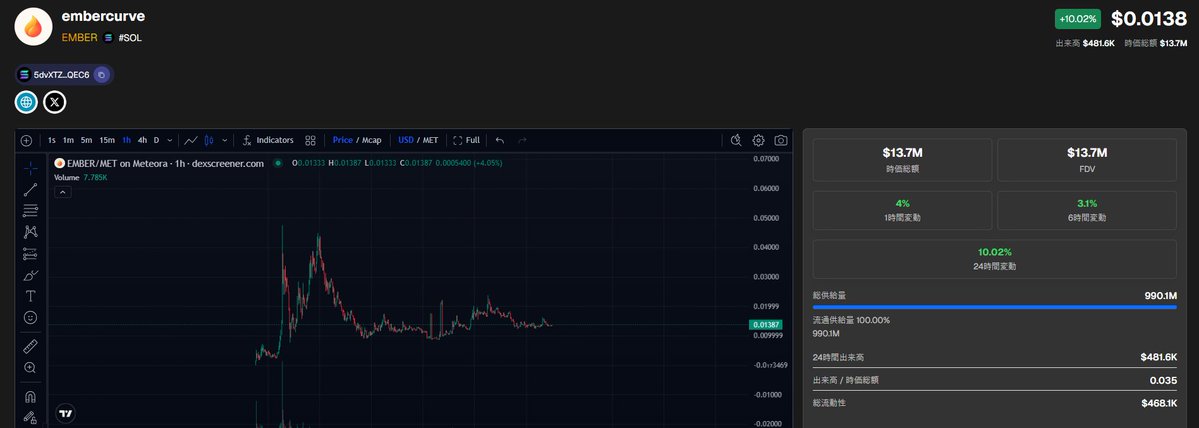
After a long time, the $EMBER / $MET pool is once again leading in fee share.
We’ve fully recovered our position today.
We’re adjusting the pool fee from 0.5% back to 1% (it was originally reduced from 2% to 0.5%).
At the same time, buybacks are increasing from
50% to 80% with the full amount directed toward buyback and burn of $EMBER from the entire ecosystem.
The overall market remains weak.
Many launchpads that once reached $1B market caps are now sitting under $100M after ~90% drawdowns. We see this as an opportunity to strengthen our position.
Ember started as a rewards-sharing system and distributed $321K to holders early on.
We later switched to a burn model while sitting at a $44M market cap, which slowed the burn rate. With the current lower market cap, the higher fee and increased 80% buyback allocation will significantly accelerate burns.
We’re expecting stronger volume next week and a recovery in burn activity.
$EMBER mode one.
@CryptoVonDoom@embercurve Sir, you should suggest and provide guidance. $EMBER should open a group, create a community, and unblock it. The community is still large, it's just blocked! A huge community is enough to make ember take off!