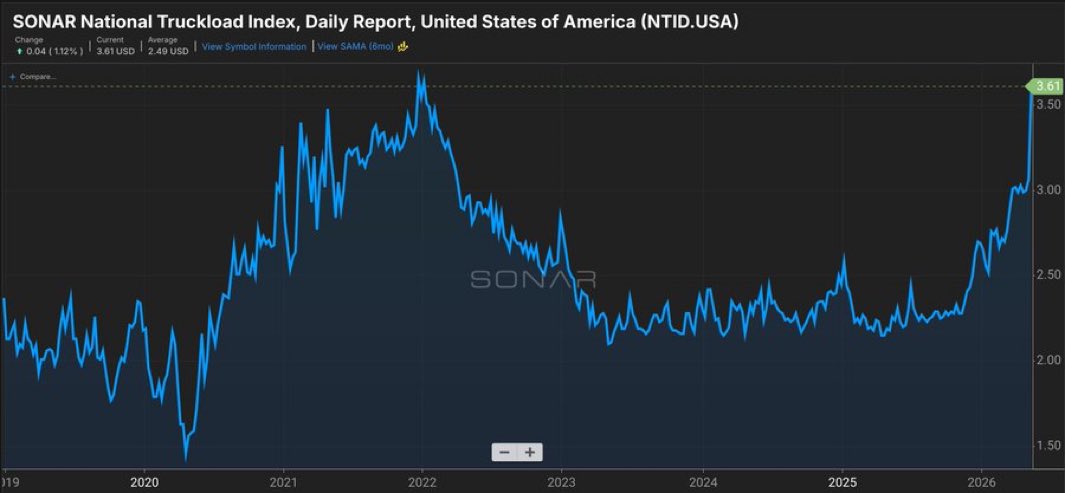
It's a beautiful thing when a company spends most of its existence selecting some of the worst carriers on record to haul freight So they can make more money and then they lose their golden ticket defense and have to do the right thing. This is going to seriously affect the cost of surface transportation. If you want to see who the shippers and brokers were using to haul their freight and what their safety records were this is the site...https://t.co/FFGwWbRAuh
Ferrari has just officially unveiled its first ever all-electric car, called the Ferrari Luce.
• Starting price: $640,000
• Interior co-designed with Apple's former head of design, Jony Ive
• Range: 280 miles (expected EPA)
• Peak charging speed: 350kW
• 122 kWh battery
• 1,050 horsepower
• 0-60mph: 2.4s
• 800v
• Four-door four-seater
• Four electric motors
• OLED screens
• Weight: 4,982 lbs
• Front motors spin to 30,000 rpm, rears hit 25,500 rpm
• Car uses an accelerometer to capture real vibrations from the electric motors & rear chassis. An algorithm filters out unpleasant frequencies and amplifies only the more “musical” sounds. This can be heard inside and outside the car.
• Paddle shifter on steering wheel changes how aggressively torque is delivered, with five different levels
• The trunk has 21.1 cubic feet of space, the largest luggage capacity the company has ever offered
• 197.6 inches long, about as long as a Tesla Model S
U.S. deliveries start in Q2 2027. More photos in the thread below:
EASE Logistics Chief Strategy Officer Ken Adamo on why inaccurate truck pricing destroys brokerage margins.
“If you don’t know what it’s going to cost you to buy the truck, everything else falls apart. It’s basically the butterfly effect. The amount of error you have in your buy-side pricing compounds throughout the entire business.
And I’m not even talking about manpower or technology costs here—just the actual cost of the truck itself.
Because if I can buy the truck cheaper, then my operational costs become easier to manage too. I don’t need as high of a gross profit to make money, which means I can price more competitively and win more freight.
But if you don’t know what it’s going to cost to cover the load, you’re basically just pissing in the wind. There are brokerages out there with 30–40% error rates between what they think they’ll buy the truck for and what they actually end up paying.
So why spend five hours debating whether an RFP should have a 10% or 12% margin when your actual truck cost could swing by 20%? That’s why accurate buy-side pricing is so critically important.” — Ken Adamo, Chief Strategy Officer at EASE Logistics
From today's Freight Gong Friday episode, presented by OTR Solutions.
@FreightAlley We are seeing more carriers bidding on southbound D2D freight than ever before. The threat of losing a B1 visa scares carriers away from taking freight into south Texas that isn’t guaranteed destined for Mexico.
We’re not far away from a Series 7/63 type exam for freight brokers.
What no one’s talking about is that the rep who booked Caribe can walk away to another brokerage tomorrow, no one would have any idea, and CH Robinson as an org is left holding the bag.
The same can’t be said for similar practices on Wall Street.
Brokers I’ve talked with see a path to being more valued partner to their small and medium sized shippers as they collab and work closely to protect shippers from liability through vetting and helping build and maintain “paper trail” of due diligence and manage those relationships w carriers. Many unknowns and gray still though. Interested to see how this affects 4PLs
@atutruckers Carriers aren’t vetting the brokers they work with?! That seems foolish and not something should be waiting for permission to do. If carriers don’t like certain brokers go get the freight they want direct…
We’ve had FMCSA safety ratings for decades. If a carrier has a Conditional rating and stays federally authorized, who’s actually responsible — the broker who hired them, or the agency that kept licensing them?
For years, owner-operators have been screaming about Highway. FreightValidate. MyCarrierPackets. RMIS.
"The brokers won't load me. The vetting is killing small carriers."
The Supreme Court just made it ten times worse.
Montgomery v. Caribe Transport II. 9-0.
Brokers can now be sued in state court when their carrier kills somebody on the road. C.H. Robinson lost this morning.
Every broker general counsel in America is reading that opinion right now and making one decision:
Vet harder. Reject more. Document everything.
Highway and FreightValidate weren't the problem. They were the warm-up act.
What's coming:
— More identity verification layers
— Equipment photos on every load
— Real-time CSA monitoring with auto-disqualification
— Driver-level vetting, not just MC-level
— Insurance minimums that price out single-truck operators
— Safety questionnaires that look like SF-86 background checks
— Onboarding timelines that stretch from days to weeks
Brokers aren't doing this to hurt you. They're doing it because a jury in Illinois is about to decide whether their $75K surety bond was an appropriate response to a dead motorist.
Wrong answer = nine-figure verdict.
You wanted accountability for brokers. You got it. The bill is being mailed to every owner-operator in America in the form of a thirty-page carrier packet.
Adapt or quit. There is no third option.