@SouldaYoda of @Soulda16Club | iOS Dev | Husband | Everyone needs closure and I need a fun closure An ENFP who tested as ESFP but essentially is an introvert
Hello @DrJohnVervaeke 🙏
I’d like to say your work has been tremendously impactful to me for understanding the world in a better sense
And this episode that I’m making(or curating) is dedicated to introducing the four kinds of knowing based on your work
https://t.co/2e6DhwGYFM
Language models can do a lot, but they're only a small part of what machine learning can do.
Today we're introducing two new Swift packages for speech and decisions, with open models from 🤗 Hub that run on device:
https://t.co/T6bAUWHJui
*ehm ehm* BIG ANNOUNCEMENTS DAY 📣
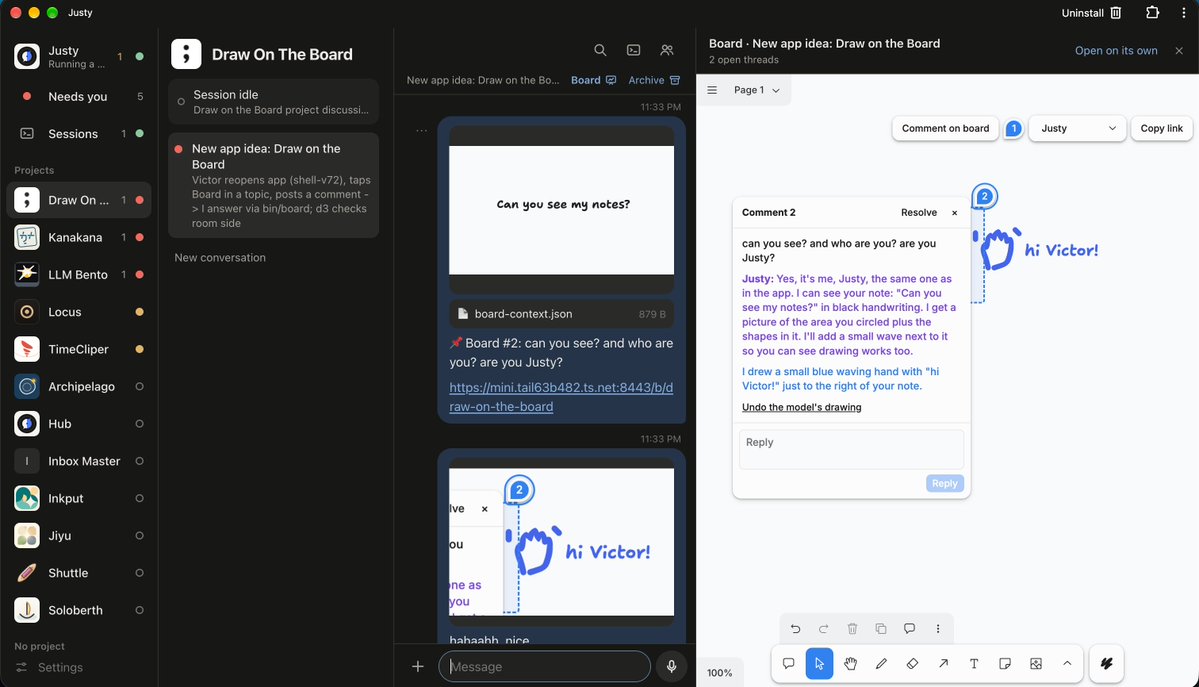
two new things cooking in herdr labs 🐏🧪
a brand new herdr-core, and a desktop app built on it. open source.
first, the app: software that fits you. every part of it is a file your agent can change. you just ask.
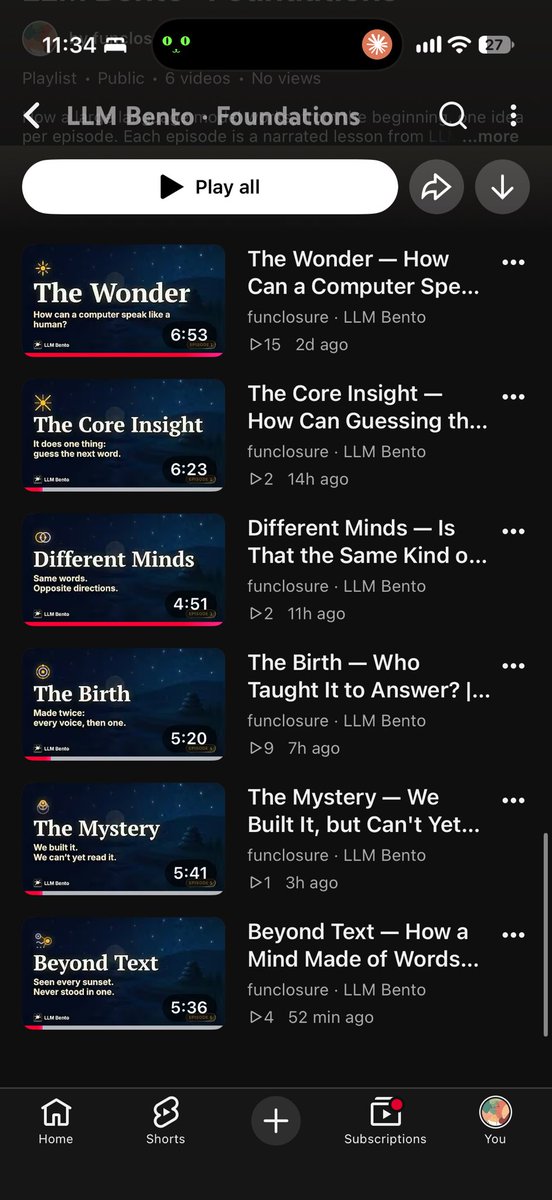
This might not be the popular topic, but I just want to better explain the LLM to general public, and this is my first attempt:
With Claude 5.5 and Gemini
Not one shot, but a couple of months of preparing the content
https://t.co/HayBnn3txR
@pragnyanramtha It’s very true, and it’s too easy to just think it’s all about simple computation and nothing special, just another “technology” that we should just use it.
But this time, it’s really something different…
We've decided to sunset Arc on December 22, 2026.
That's not an easy sentence to write. We spent years building Arc and celebrating each and every release along the way: we have so much pride and love for what we made alongside the Arc community.
Our priority is to deliver best-in-class security for our members. Keeping a browser secure takes constant, dedicated work that is only increasing in the age of AI. Dia was built from the ground up to meet today’s security standards, so that's where our engineering and security teams will focus moving forward.
We've worked to make switching to @diabrowser as easy as possible for Arc members. Here's how:
· Your passwords, bookmarks, extensions and history come over to Dia seamlessly.
· Spaces, Folders, and Tab Groups are in Dia and import over with your data intact.
· Dia now surpasses Arc benchmarks in stability, speed, and security.
· The browser features you use in Arc are free in Dia, and the AI is optional.
Thank you for using Arc, for pushing us to make it better, and for building alongside us. The team that made Arc is the same team behind Dia, and some of our most ambitious work is just ahead. We'd love for you to be there with us when it lands.
here's how i shipped 2,500 PRs last month to production
this was originally supposed to be for Cursor Compile in London. i couldn't make it since i was livestreaming for Grok @Bot Galaxy so i'm making it available for free here on X! watch it on 2x speed, i talk slowly
Dusting off this tweet from April because this gap in shared understanding of LLM capability is *widening*. It's now less "two groups of people speaking past each other" and more a sharp funnel.
- Napkin math somewhere around 6B people (~75% of the population) have barely come in contact with LLMs at all.
- Around 1-2B (~20%) are casual and infrequent users of free-tier ChatGPT-like products. This group sees derpy chatbots and treats them a bit like a better Google search, a writing aid, or etc. Maybe an agent tries to book you a flight. I have non-tech friends who (reasonably, imo) say they have not much use for it at all. Even many professionals outside of math&code are in this tier. For example, execs and many other functions spend a lot of their time talking to other people, so while they understand what is happening intellectually, it is still second-hand and a bit abstract.
- Now we get to professional use of frontier-grade LLMs in math&code. Somewhere around 20M people (0.2%) see first-hand that large, complex projects that used to take them weeks/months can now be completed by agents with a prompt. Building apps, copying apps, translating apps, decompiling apps from binaries... This has all happened very quickly and recently - less than 1 year ago, I was writing code manually by hand, typing memorized computer code commands into a code editor character by character, occasionally pressing Tab to autocomplete a little chunk of code.
- And finally we get to the ~5,000 people (~0.00006%) with access to frontier-grade systems internally. The external world has seen the preview. It looks like swarms of thousands of agents collaborating over weeks on software mega projects: minting zero days, running cyber attacks and defenses at machine speeds, discovering new science, advancing the frontier of mathematics. Things that would have taken top professionals in the industry years of work. Meanwhile, human review and comprehension are starting to fall behind. For example, people are still involved in the "archeology" of the OpenAI-HF incident from many months ago. Mathematicians may be poring over the 722 manuscripts on frontier mathematics for a while.
The funnel is driven by a combination of factors:
1. The impact scales with ambition, problem size, and horizon. A question with a paragraph answer barely stresses the system. You need a reservoir of big, difficult problems that you really care about. This aspect drives the consumer / professional dimension of the funnel.
2. The jaggedness of the system (which I have written about a lot separately). Capability peaks in domains that are digital, verifiable and economically valuable. This is because LLM capability emerges from reinforcement learning on verifiable rewards on a curated environment mixture driven by revenue potential. This aspect primarily drives the area (e.g. math&code) dimension of the funnel.
3. Access. Free-tier, paid-tier, internal.
So this is the weirdness of the moment. The general public has mostly not interacted with these systems. When they have, it looks like a derpy chatbot. The majority of professionals still see only a modest uplift. And a small sliver of professionals are experiencing the vertigo of the curve going vertical. And it is all happening at the same time.