Most documented psychological biases are not irrational, they are highly optimized, energy-efficient shortcuts meant for a biological substrate operating under strict real-time physical constraints and a limited caloric budget
@fchollet One step further, if the world can be well understood in a such clean way, does it indicate our world is engineered by another form of intelligence?
- end-to-end image only JEPA world model training with SIGReg (no teacher-student, no EMA, no problem)
- beats DINO-WM and PLDM
- similar "physics breaking detection" as the VJEPA models through prediction loss
- single hyper-hyparameter
- 50X planning speedup
- all open-source
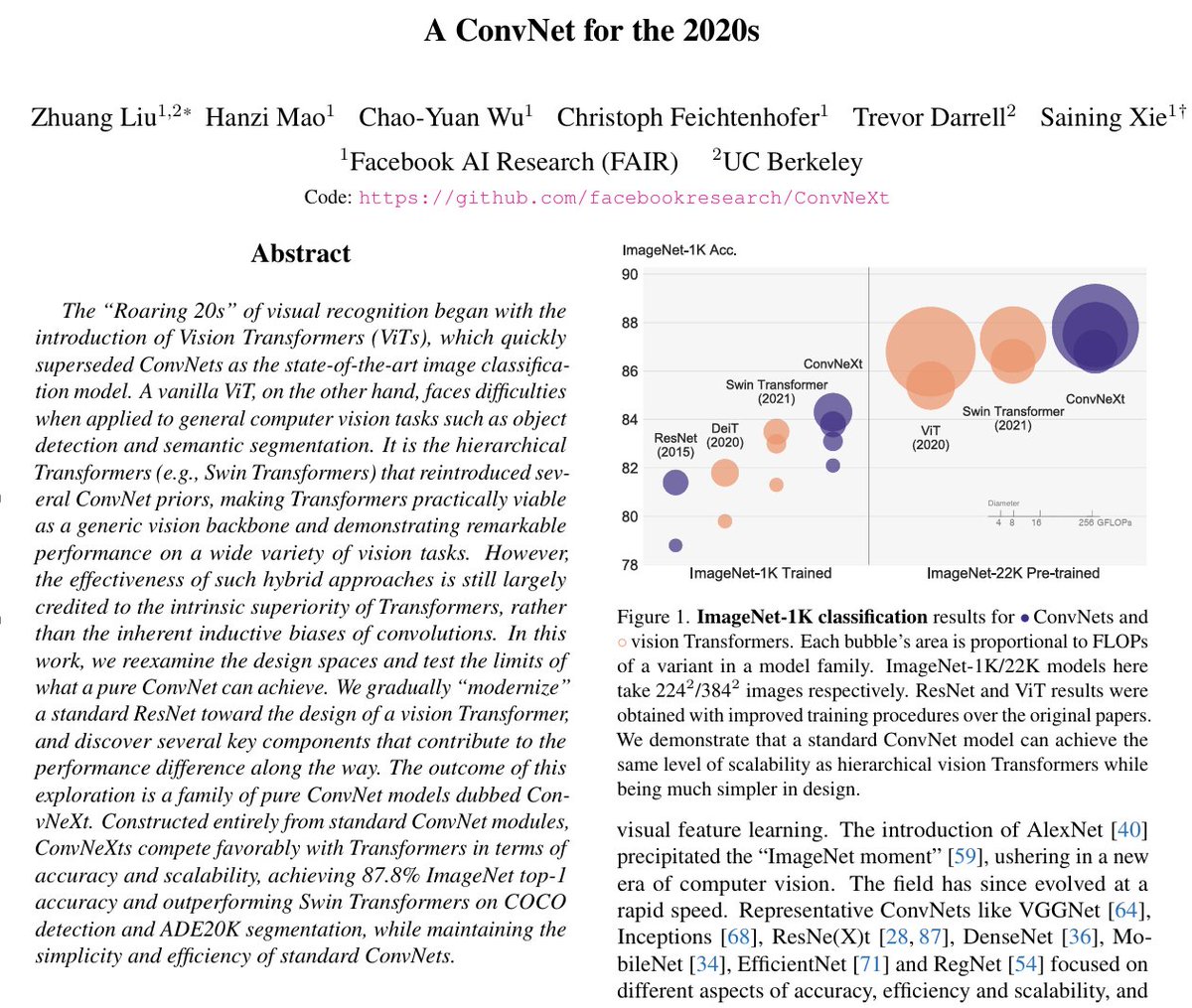
For most of the 2010s, convolutional neural networks (ConvNets) — networks that process images by sliding small filters across them to detect patterns — were the dominant architecture for computer vision. Then transformers arrived.
Transformers, originally designed for text, process input by letting every element attend to every other element simultaneously, and when adapted for images they started outperforming ConvNets on benchmark after benchmark. The general consensus became that transformers were just better, and ConvNets were the old way.
This paper's authors decided to test whether that conclusion was actually justified, or whether ConvNets had simply fallen behind in terms of training recipes and design choices rather than fundamental capability.
They took a standard ResNet and systematically updated it — one change at a time — borrowing design decisions from transformers: things like which activation function to use, which type of normalization to apply, and how to reshape the internal dimensions of each processing block.
Each change was small and interpretable, and the paper tracks the accuracy at every step so you can see exactly what each decision contributes.
The final result is a pure ConvNet that matches or beats transformer-based models of equivalent size on image classification, object detection, and segmentation, by being up to 49% faster.
Read with AI tutor: https://t.co/abh8jEt8A2
Read alone: https://t.co/PH5kBIpl70
Hugo Duminil-Copin, French mathematician and 2022 Field Medalist told me he never participated in math competition and was very bad at it.
Innovative mathematics requires creativity, intuition, intense concentration, and long reflections, sometimes spread over several years.
Good performance at a math olympiad merely tests fast problem solving abilities. AI can do that nowadays.
One of the big activities of a researcher, in mathematics and elsewhere, is not to answer questions but to ask the right questions.
What happens when a skill can be almost fully automated with AI? Do these jobs simply disappear?
Instead of purely speculating we can simply look at concrete examples. Take translators. Translation can be 100% automated with AI, and this capability has been around since 2023. So we have 2-3 years of data.
What we see so far:
- Stable FTE count, but slow hiring or no hiring
- Nature of the job switched from doing it yourself to supervising AI output (post-editing)
- Increased task volume
- Decreased hourly rates
- Freelancers getting cut
We are now starting to see the same pattern with software jobs.
Overall there's definitely some pressure on employment but we're very far from "the jobs just go away". In fact the number of full-time translators is still modestly increasing.
When the economy rebounds from the ongoing "stealth recession" and companies start hiring again, the world will have more professional software engineers than we did before GenAI.
The mass layoffs you're about to see in the tech sector won't be caused by job automation. They will be caused by fears about the economy, like in 2022. It won't be unrelated to AI, mind you, since it ties into big tech capex needs. But it won't be due to automation.
Enlightenment values are what's most unique and distinctive about Western culture. They are its foundations. Human rights, individualism, liberty, free speech, valuing science and reason, strong individual property rights, modern state design (democracy, separation of powers, separation of church and state, rule of law...)
In particular, the West's most precious gift to the world is the radical idea that every human being possesses inherent, unalienable rights. Independently of whether they are members of the restricted in-group or not.
This stuff is the source code of the modern world. We should cherish it and protect it. Throwing it away and denigrating it is the most anti-Western thing you could possibly do.
Over the course of a lifetime, we face only a few moments where the decisions we make and the actions we take will shape our history for years to come. This is one of them.