@BruceThompson51 It would be dumb for Elon to give his money away when he can keep controlling his companies and reinvesting. He gets great ROI and delivers great benefits to customers.
SpaceX’s literally destroyed the cost to orbit so much even you can afford the ticket to ride on it in the future
- For decades, launch cost to low Earth orbit was roughly $18,500 per kg
- Falcon 9 brought that down to around $2,700 per kg
- Falcon Heavy pushed it closer to $1,400 per kg
➝ Now Starship is targeting a 99%+ cost reduction
When the cost of reaching orbit falls by orders of magnitude, space stops being a rare government program and starts becoming industrial infrastructure
Starlink, orbital manufacturing, lunar cargo, AI compute, and Mars all depend on one thing:
getting cost to orbit as close to zero as possible
That is why Starship matters so much....It is not just a bigger rocket
It is the cost reset that opens the next economic frontier
Total number of Immigrants from Europe, Israel, Canada, Australia, and New Zealand:
5.1 million
Number of Immigrant Founders of Billion Dollar companies from these countries:
290
Total number of immigrants from China, India, Mexico, The Philippines and Vietnam:
20.1 Million
Total number of immigrant founders from those Countries:
145
The 20% of immigrants from the most culturally and demographically similar countries to the U.S. supply ~2/3 of our billion dollar company Founders.
The 80% from the other countries mentioned supply just ~1/3.
I'm not saying this is the perfect heuristic to use, BTW. It's not.
You could tweak this to just have captured the 1/3 top immigrants from the similar countries and the top 1/10th from the less similar countries, and you could have reduced the total number of immigrants by ~85% with almost ZERO EFFECT on our recruitment of top immigrant entrepreneurs.
The broader point is that none of our mass immigration is in America's interest.
And none of it is necessary.
Don't believe me. Believe the data generated by mass immigration apologists.
This is utter nonsense. Zucman's mentor Piketty manipulated the UK data to show rising wealth inequality, when it has been flat for decades.
Data duplicity is a clear and recurring pattern for these two Frenchmen.
@SenSanders@CaitlinPacific Both those numbers are fake. The median American in poverty has better consumption—more sq feet to live in, more bathrooms per capita, more likely to have an automobile or A/C or a laundry drier—than the median European, period.
Two other people on the poster stole even more than she did. One took over $1B. How many others stole in the tens of millions or mors and haven't been detected yet?
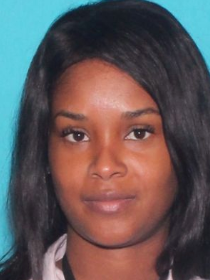
MOST WANTED FRAUDSTER: Elaine Angene Escoe is wanted by the FBI for her alleged role in a scheme to fraudulently obtain over $32 million in federal COVID-19 relief funds. The FBI is offering a reward of up to $150,000 for information leading to her arrest and conviction. Call 1-800-CALL-FBI or go to https://t.co/qrYNBE5wZe with information. Learn more: https://t.co/uWHW1efaBE
Aging is 100% deadly.
The death is usually slow and painful.
Aging tortures both physically and mentally before killing. Sometimes, to a degree that leads to depression and suicide.
Additionally, most people consider aging normal. So you both don't feel well and don't get adequate support and compassion. They wish you health on each birthday, but lowkey expect you to die. If you're crazy enough to think about "not dying" or cryo - you'll be advised to get some pills to calm your aged brain down. Or go into therapy to improve your "relationship with death." You've had a good life, huh?
That's a grim state of affairs. That's the world where our parents live(d). That's where we'll end up unless we find a solution.
China is winning the drug discovery race. There's no better example of this than multiple myeloma.
https://t.co/YaJSUquRoa
It's one of the most painful cancers, destroying bone from within. For decades, patients endured cycles of brutal treatment and relapse. Then came Carvytki: a one-time CAR-T infusion that appears to cure some patients who have failed multiple treatments.
Its development story, beginning in 2016, was an early signal of a shift now making headlines: the US is losing biotech dominance to China. Though the foundational science was largely American, a nimble Chinese company moved faster with a better molecular engineering idea.
Unless the US addresses clinical-trial bottlenecks slowing early in-human data, more breakthroughs will be developed elsewhere, weakening the ecosystem American biopharma depends on.
Some key points from my article for @WorksInProgMag, with my friend Amol Punjabi, of @EvidenceOpen:
1) Multiple myeloma is not only extremely painful in and of itself, but also one of the most brutal cancers to treat. As first-line therapy, patients endure four drugs simultaneously, then a stem cell transplant, followed by continuous maintenance therapy. And most still relapse, with each treatment round carrying worse chances.
2) A drug called Carvykti, approved in 2022, is changing the treatment landscape. Carvytki acts as a single, one-time infusion. It's a CAR-T therapy, part of a new wave of transformative immunotherapies: made from the patient's own immune cells and reprogrammed to hunt cancer. In patients who had already failed 4+ other treatments, 33% were still disease-free after 5 years. The results as earlier line therapy look even more promising.
3) Most of the foundational science was American. Decades of CAR-T research, and in 2013 the NCI showed BCMA-targeted CAR-T cells could kill myeloma in the lab.
4) But the drug that ultimately changed myeloma, Carvytki, originates from China. Carvytki beats Abecma (the American CAR-T for myeloma) by a wide margin: 36 months of progression free survival in heavily pre-treated patients versus Abecma's 9 months.
5) In 2016, Legend Biotech was just beginning clinical trials. This was the same year the American team was publishing their first-in-human results. Legend started later, but moved faster. Clever engineering and China's ability to get drugs into humans quickly gave them the edge. Large American biopharma J&J ended up striking a deal with Legend and developing the therapy.
6) Never underestimate the llama: US-developed Abecma used mouse antibody fragments to target BCMA. Chinese startup Legend used llama nanobodies instead. These are smaller, more stable and bind more cleanly to BCMA. The usage of llama as opposed to mice antibodies is what is believed to lead to Carvytki's superior efficacy.
7) In retrospect, Carvytki should have been an early warning. China is winning the drug discovery race through deliberate policy. Their first-in-human clinical trials can launch in 6 months vs 18+ months in the US, letting them iterate faster between lab and clinic. The @nytimes recently reported that ~50 percent of major drug deals this year involve Chinese-origin drugs, up from nearly zero a decade ago.
8) The US still leads in late-stage development, as shown, but the pipeline feeding it is increasingly Chinese. The worry is that this will mirror what happened in solar, batteries, and EVs, where early-stage dominance eventually became control of the entire chain.
9) A proposal to streamline early stage trial regulatory requirements to keep the US competitive has made it into the President's 2027 budget for the FDA. But Congress has to act to make it a reality.
LA MAYOR RACE: Imagine a voting system where ballots were freely available, could be filled out by anyone, and dropped off in an unsecured/unmonitored box. Checking ID of the person was illegal. No wonder LA Democrats will be able to ‘find’ the votes.
Today a crazy quantum story just got wilder.
On March 31, the Google Quantum AI team published a landmark result on Shor's algorithm for elliptic curve cryptography. Technically, the paper was a bombshell: a dramatic 10x improvement over the state-of-the-art. As a stunt and wakeup call to the blockchain space, those optimisations were illustrated on secp256k1, the elliptic curve underlying Bitcoin and Ethereum signatures.
But perhaps the most striking part of the paper was sociological, not technical. Instead of following standard academic process, the optimisations were kept secret, hidden behind a zero-knowledge (ZK) proof. Google's accompanying blog post mentions they "engaged with the U.S. government". The ZK proof demonstrates the existence of algorithmic improvements without leaking details. Academic censorship with ZK, a historic first!
As a co-author of the Google paper I witnessed some of the context surrounding this censorship. To be honest, multiple aspects of that context don't sit well with me. As much as I believe the general public ought to know more, I am limited in my ability to whistleblow. Though let me be clear about one thing: the Google team's professionalism has been absolutely exemplary, and they deserve nothing but praise.
Censorship has a way of backfiring. The Streisand effect, where an attempt to bury something only draws more attention to it, is exactly what's unfolding today. First, Google's key optimisation has been rediscovered by the French. And in a thrilling turn of events, a collaborative Shor-at-home challenge just launched. The initiative, available at ecdsa[.]fail, breached a new Shor world record in a matter of hours.
Let's start with the rediscovery. Just two months after Google's paper, French quantum expert André Schrottenloher cracks the main secret optimisation. His paper, titled "Optimized Point Addition Circuits for Elliptic Curve Discrete Logarithms", landed on the arXiv today. Big congrats to André, who beat several other nerdsnipped experts to it. In a blog post also published today, Craig Gidney, the world expert on Shor optimisations, revealed that he'd been sitting on this very optimisation for a whole year under censorship pressure.
Interestingly, André missed a handful of minor optimisations, both from Google's original publication and from improvements found since. It's plausible there's still plenty of juice left to squeeze out of Shor, and this is exactly what the ecdsa[.]fail challenge is about. The verifier program developed for the ZK proof does double duty, automatically filtering for valid submissions. Dozens of compounding small and micro improvements are rolling in. As of the time of writing there's an 8.4% improvement to Google's circuit, as measured by the product of logical qubit count and Toffoli gate count. Nice!
The nerdsnipping ran deeper than anyone expected. Over the last few weeks it became clear it extended well beyond André and other quantum experts. Behind the scenes, a small army of amateurs quietly got to work. Inspired by Karpathy-style autoresearch, they turned AI on Shor. Ironically, the verifier program for the ZK proof makes an ideal reward function for AIs. The barrier to entry for this modern style of research is refreshingly low, with several non-experts, even a teenager, finding nice optimisations. Get in touch if you'd like to join a Telegram group with fellow autoresearchers :)
Part 2: neutral atoms and qday
The story doesn't end with Google. On the same day Google went public, a stealthy startup called Oratomic published its own Shor paper in a coordinated release. It made a splash, ultimately becoming the most upvoted paper on scirate[.]com, a website ranking arXiv papers.
Oratomic's claim was wild. By building on Google's logical optimisations and applying custom physical optimisations for neutral atoms, they claimed just 10K physical qubits were sufficient to run Shor's algorithm on secp256k1. That number is mind-bogglingly low.
Knowing essentially nothing about neutral atoms when Oratomic's paper landed, I was intrigued and decided to learn more about the tech. I fell straight down the rabbit hole and spent a couple hundred hours on the topic. I got a little obsessed and watched every YouTube video I could find and spoke to a bunch of experts.
My conclusion? The tech is real, very real. Even Google recently decided to start a neutral atom lab, a notable pivot from their sole focus on superconducting qubits. If you care about qday, i.e. the day a quantum computer will break the first piece of cryptography in production, neutral atoms demand your attention. I shared some of my learnings on Shor and neutral atoms in a 30min talk at the ZKProof cryptography conference. You can find it on YouTube by searching "zkproof neutral atom".
Here's an interesting observation about this duo of breakthrough papers: neither Google nor Oratomic say a word about what their results mean for qday. No timelines. Zero. Nada. That is especially baffling given that the whole point of whitehat quantum cryptanalysis is to inform qday estimations and help the general public make good decisions.
So let me attempt to partially fill the silence, similarly to what Scott Aaronson did in his April 29 post. Given everything I know, including scary non-public information, I now put the odds of qday by 2032 at 50%. 10% by 2030.
Anecdotally, the US government has its own date: 2035. Originating at the NSA and later adopted by NIST, it's when branches of the US government will be disallowed from using quantum-vulnerable cryptography. In plain language: with hindsight, that date is a joke and should be discounted entirely. I don't see how NIST avoids being forced to pull it forward by years.
Part 3: post-quantum cryptography
There are good reasons to sound the alarm today, but please do not panic. Rushing carelessly towards immature post-quantum cryptography is a recipe for disaster. IMO a good target date for migration is 2029, roughly 3.5 years out. 2029 happens to be the date selected by Google, Cloudflare, and the Ethereum Foundation.
These days most of my time goes to safely migrating Ethereum towards post-quantum cryptography as part of the broader lean Ethereum effort. There's a lot to do. We need to rip out and replace BLS signatures at the consensus layer, KZG commitments at the data layer, and ECDSA signatures at the execution layer.
The plan to get there is compelling, and is based on hash-based cryptography. Within the Ethereum Foundation we've developed a Swiss army knife called leanVM (github[.]com/leanEthereum/leanVM) powered by the magic of hash-based SNARKs. Thanks to truly exceptional work by Emile, Thomas, and others, its performance is derisked. Regarding security, leanVM is a jewel, a minimal zkVM crafted for end-to-end formal verification and maximum security.
Want to help? There are two $1M initiatives. First, the Proximity Prize (proximityprize[.]org). Solve a long-standing mathematical conjecture in coding theory, improve hash-based SNARKs, and go home a millionaire. Second, the Poseidon Initiative (poseidon-initiative[.]info), offers $1M for breaking Poseidon, the SNARK-friendly hash function.
Henry Nowak was a white boy, that’s why he was disbelieved.
Young white men look at his murder and are repelled not just by the awful violence, but by knowing it could have been them lying on the ground, drowning in their own blood, with the police standing over them mockingly disbelieving their pleas that *they* were the victim - because how could a young white man possibly be the victim?
This is the society that treated Adolescence as a documentary, in which government information campaigns on everything from sexual harassment to tax dodging only ever depict one demographic as the guilty party.
There must now, finally, be a reckoning for officialdom.
Boudica: "Yes I was flogged and my daughters raped in front of me, but I've been advised by a government-approved psychiatrist to not let division and hatred win. Now, let's stick that Oasis track on and sing to suppress whatever survival instincts we still have left."
Heard in Beijing:
"The Iran war is a geostrategic gift to China. Washington has once again allowed Israeli strategic priorities to override its own national interest, bleeding military power and diplomatic capital into a conflict that serves Tel Aviv, not Washington. The US has become the enforcer for a foreign power's regional ambitions, and that hubris will accelerate its relative decline faster than any Chinese missile could." 💀💀💀
One of the reasons I think people responded so strongly to my work on public disorder is, well, that you're not supposed to notice public disorder.
I don't think, though, that that's just about "wokeness." It's about how disorder doesn't *fit* with our understanding of crime.
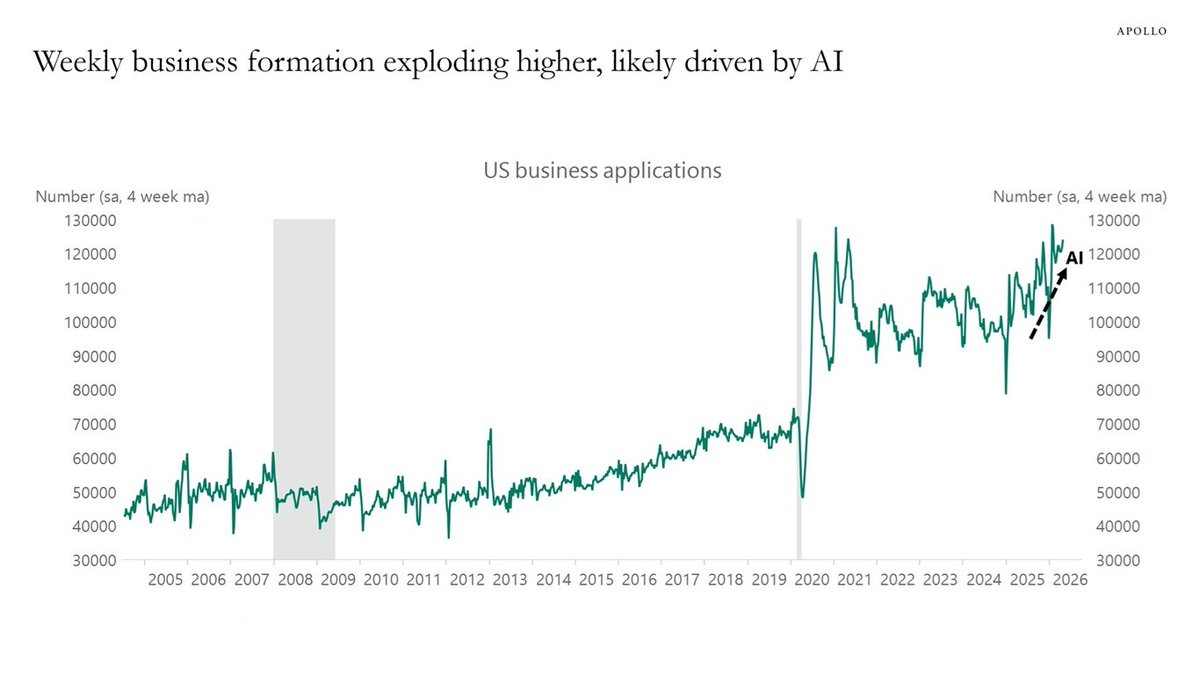
Lots of knowledge about business law, business regulations, book keeping, hiring, liabilities, and much else is now far easier to access for potential business founders. Also, software creation, printed circuit board layout, and much other engineering work is far easier.
'The surge in new US business formation is being fueled by AI and large language models, which are dramatically reducing the cost and complexity of launching a company' @apolloglobal
“For the past few years, I’ve been troubled by a word, and that word is sin. I keep reaching for it, because it seems to be the only term strong enough to describe the new forms of dehumanization that artificial intelligence has introduced… I don’t know what else to call it when companies market digital girlfriends to the heartsick & young. Or when they hawk robot companions to the lonely and old. Or when a billionaire explains that he intends to sell intelligence … back to us as a utility, like electricity or water. These developments are not just wrong. They feel to me like something deeper and darker”
Here he thinks it "dehumanizing" for other humans to get what they want, from firms who sell it to them. For some reason this guy doesn't like that, and he's convinced himself that is due to the universe revealing to him some deep moral order. I see simpler explanations.
https://t.co/vEgxjTSn7f