Another reason I prefer to have crypto wallets on mobile devices equipped with security elements/processors/enclaves (same tech as Ledger) than a “hardware wallet”.
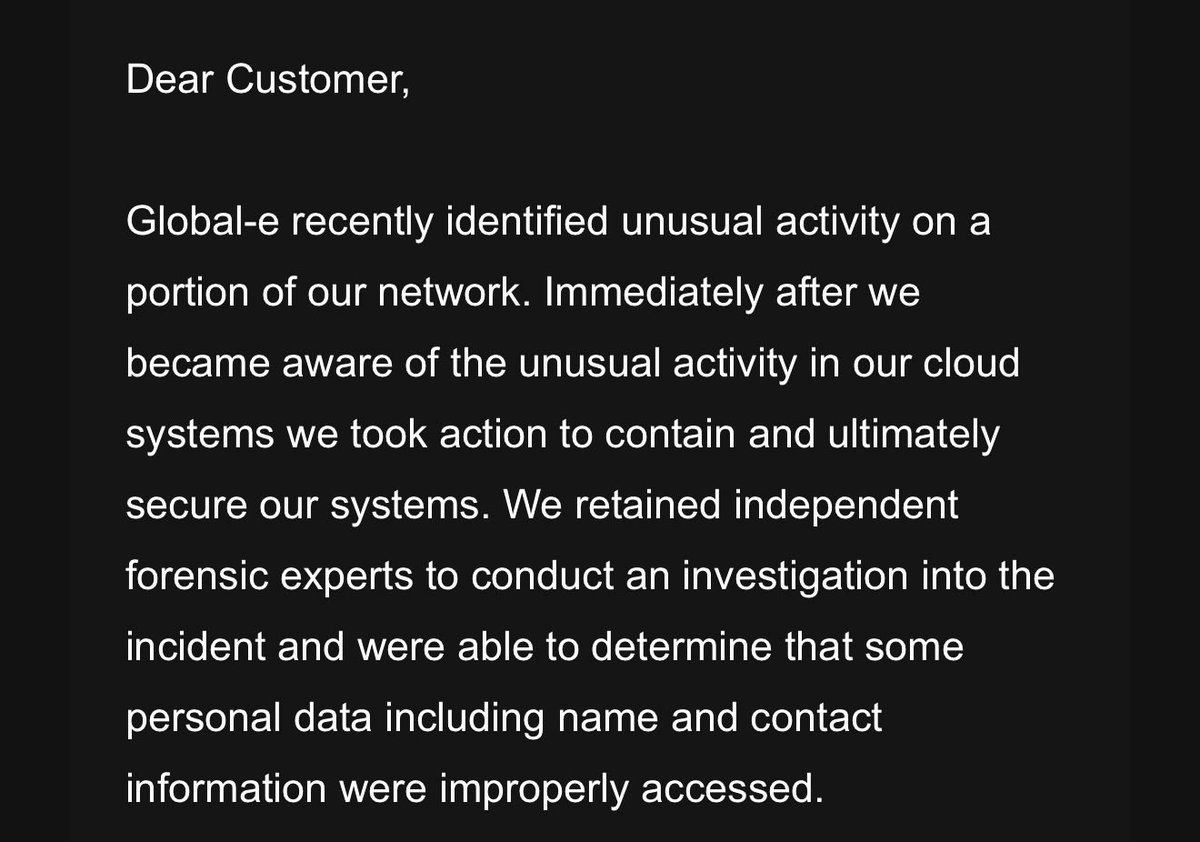
Community alert: Ledger had another data breach via payment processor Global-e leaking the personal data of customers (name & other contact information).
Earlier today customers received the email below.
@0xQuantic Token budget limits? The early days of subsidized AI with fixed subscription fees are coming to an end. With token usage fee structure, many are discovering that running agents is quite expensive.
@SpencerHakimian No one here, that includes the poster and in the comments, have ever been to an music concert with a warning sign about strobe lights at the door. Sad.
AI is not the only long-term threat blockchains need to think about. Quantum computing is another one.
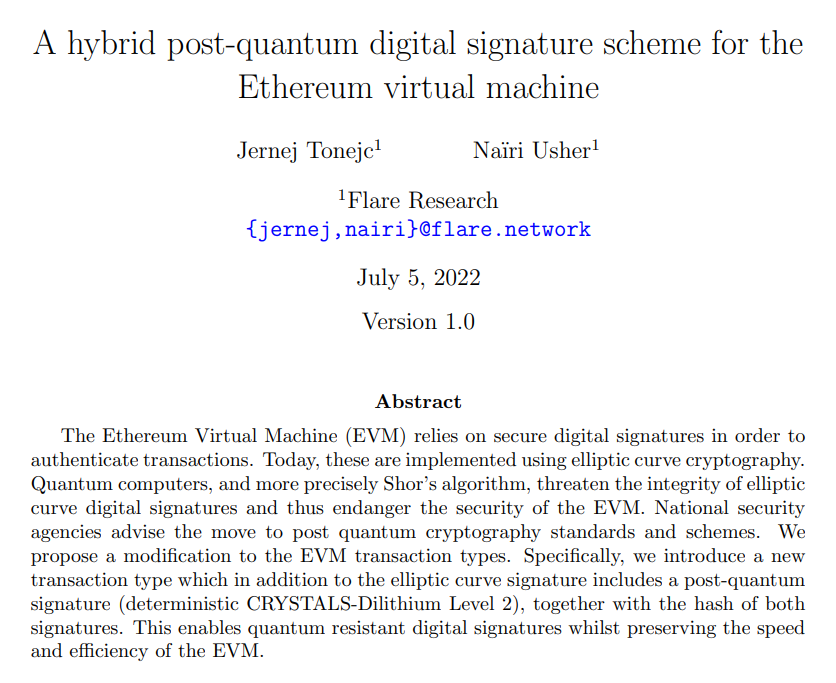
Years before this became a mainstream crypto topic, Flare Research was already looking at how the Ethereum Virtual Machine could migrate toward post-quantum security.
In simple terms, today’s EVM transactions rely on elliptic-curve signatures to prove that the person moving funds is actually authorized to do so. The problem is that sufficiently powerful quantum computers could eventually break those signature schemes, creating a serious risk.
A 2022 Flare Research paper proposed a practical hybrid approach: instead of replacing the existing ECDSA signature model overnight, introduce a new EVM transaction type that includes both the normal ECDSA signature and a post-quantum signature using deterministic CRYSTALS-Dilithium Level 2.
In this scenario the network can verify the full post-quantum signature when the transaction is submitted, but only store a compact hash of the signatures after finality. That means stronger long-term security without permanently bloating blockchain storage.
🔥 FIP.16 & FIRE Explained: “Flare’s Revenue Engine Could Drive Value Into #FLR token” 🚀
@FlareNetworks isn’t just cutting emissions — it’s building a protocol revenue engine where activity can flow back to $FLR.
Value is in the protocol. Watch👇
https://t.co/WqmKQ6lIyM
@boldleonidas You do know that stocks/ETF’s sold as a RWAs on blockchains open up possibilities that are unfeasible for equities held in traditional brokerage account. Right?
@boldleonidas You do know that stocks/ETF’s sold as a RWAs on blockchains open up possibilities that are unfeasible for equities held in traditional brokerage account. Right?
@HugoPhilion Hey Hugo, this chart makes it clear what how FIRE incentivizes those that hold $FLR and put it to work on the network. What’s not obvious is how FIRE incentivizes dApp developers to build on Flare. Can you elaborate?
@julianor@coinspect If you are not using a hardware supported TRNG with 512-bit (and even 768-bit extendable) entropy, you are not truly’ using random numbers.
@sarah_n_crypto@HugoPhilion Of course we all want yield on our digital assets, but there’s a bit more work and due diligence involved by the investors than simply tapping a button on an app.
Having a business model where the premise is that everyone (crypto market as whole) will fail except yourself ($BTC exclusive fund) is not a good business model.
@MinusWells Pardon my scepticism but a new chain or solution has to be audited, deployed, adopted and battle tested with real applications free of hacks/fault before making such claims. Otherwise it’s “trust me bro”.