Major cheat code for life: Become difficult to rush. The world will pressure you to rush into everything. Rushed decisions. Rushed conversations. Rushed relationships. Rushed timelines. There's immense power in rejecting that trend. Slow down. Create space to think clearly.
Career advice nobody told you: There's nothing more valuable than someone who can just figure it out. Do some work. Ask the key questions. Get it done. Repeat. If you do that, people will fight over you.
Very interested in what the coming era of highly bespoke software might look like.
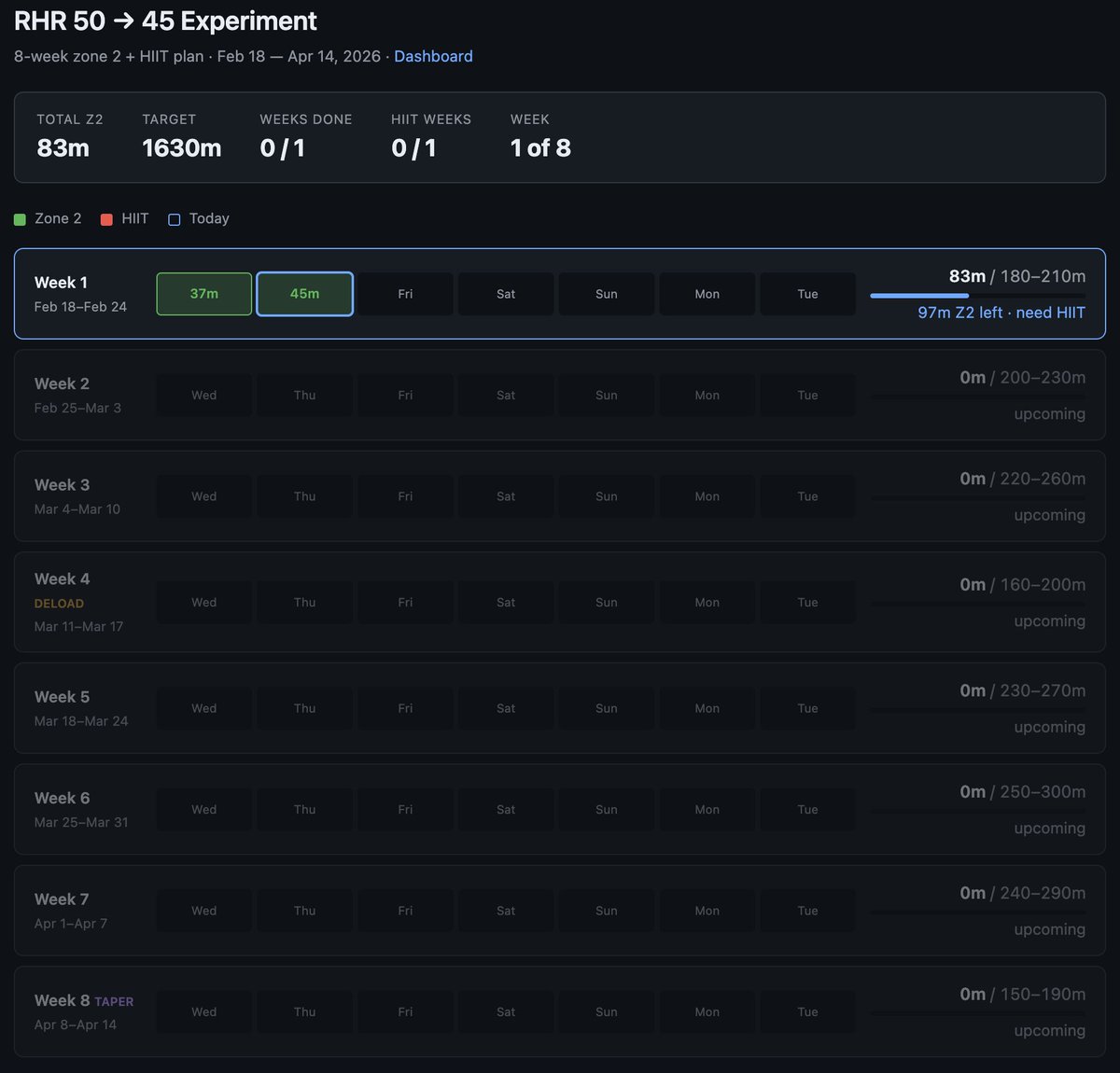
Example from this morning - I've become a bit loosy goosy with my cardio recently so I decided to do a more srs, regimented experiment to try to lower my Resting Heart Rate from 50 -> 45, over experiment duration of 8 weeks. The primary way to do this is to aspire to a certain sum total minute goals in Zone 2 cardio and 1 HIIT/week.
1 hour later I vibe coded this super custom dashboard for this very specific experiment that shows me how I'm tracking. Claude had to reverse engineer the Woodway treadmill cloud API to pull raw data, process, filter, debug it and create a web UI frontend to track the experiment. It wasn't a fully smooth experience and I had to notice and ask to fix bugs e.g. it screwed up metric vs. imperial system units and it screwed up on the calendar matching up days to dates etc.
But I still feel like the overall direction is clear:
1) There will never be (and shouldn't be) a specific app on the app store for this kind of thing. I shouldn't have to look for, download and use some kind of a "Cardio experiment tracker", when this thing is ~300 lines of code that an LLM agent will give you in seconds. The idea of an "app store" of a long tail of discrete set of apps you choose from feels somehow wrong and outdated when LLM agents can improvise the app on the spot and just for you.
2) Second, the industry has to reconfigure into a set of services of sensors and actuators with agent native ergonomics. My Woodway treadmill is a sensor - it turns physical state into digital knowledge. It shouldn't maintain some human-readable frontend and my LLM agent shouldn't have to reverse engineer it, it should be an API/CLI easily usable by my agent. I'm a little bit disappointed (and my timelines are correspondingly slower) with how slowly this progression is happening in the industry overall. 99% of products/services still don't have an AI-native CLI yet. 99% of products/services maintain .html/.css docs like I won't immediately look for how to copy paste the whole thing to my agent to get something done. They give you a list of instructions on a webpage to open this or that url and click here or there to do a thing. In 2026. What am I a computer? You do it. Or have my agent do it.
So anyway today I am impressed that this random thing took 1 hour (it would have been ~10 hours 2 years ago). But what excites me more is thinking through how this really should have been 1 minute tops. What has to be in place so that it would be 1 minute? So that I could simply say "Hi can you help me track my cardio over the next 8 weeks", and after a very brief Q&A the app would be up. The AI would already have a lot personal context, it would gather the extra needed data, it would reference and search related skill libraries, and maintain all my little apps/automations.
TLDR the "app store" of a set of discrete apps that you choose from is an increasingly outdated concept all by itself. The future are services of AI-native sensors & actuators orchestrated via LLM glue into highly custom, ephemeral apps. It's just not here yet.
Software development is undergoing a renaissance in front of our eyes.
If you haven't used the tools recently, you likely are underestimating what you're missing. Since December, there's been a step function improvement in what tools like Codex can do. Some great engineers at OpenAI yesterday told me that their job has fundamentally changed since December. Prior to then, they could use Codex for unit tests; now it writes essentially all the code and does a great deal of their operations and debugging. Not everyone has yet made that leap, but it's usually because of factors besides the capability of the model.
Every company faces the same opportunity now, and navigating it well — just like with cloud computing or the Internet — requires careful thought. This post shares how OpenAI is currently approaching retooling our teams towards agentic software development. We're still learning and iterating, but here's how we're thinking about it right now:
As a first step, by March 31st, we're aiming that:
(1) For any technical task, the tool of first resort for humans is interacting with an agent rather than using an editor or terminal.
(2) The default way humans utilize agents is explicitly evaluated as safe, but also productive enough that most workflows do not need additional permissions.
In order to get there, here's what we recommended to the team a few weeks ago:
1. Take the time to try out the tools. The tools do sell themselves — many people have had amazing experiences with 5.2 in Codex, after having churned from codex web a few months ago. But many people are also so busy they haven't had a chance to try Codex yet or got stuck thinking "is there any way it could do X" rather than just trying.
- Designate an "agents captain" for your team — the primary person responsible for thinking about how agents can be brought into the teams' workflow.
- Share experiences or questions in a few designated internal channels
- Take a day for a company-wide Codex hackathon
2. Create skills and AGENTS[.md].
- Create and maintain an AGENTS[.md] for any project you work on; update the AGENTS[.md] whenever the agent does something wrong or struggles with a task.
- Write skills for anything that you get Codex to do, and commit it to the skills directory in a shared repository
3. Inventory and make accessible any internal tools.
- Maintain a list of tools that your team relies on, and make sure someone takes point on making it agent-accessible (such as via a CLI or MCP server).
4. Structure codebases to be agent-first. With the models changing so fast, this is still somewhat untrodden ground, and will require some exploration.
- Write tests which are quick to run, and create high-quality interfaces between components.
5. Say no to slop. Managing AI generated code at scale is an emerging problem, and will require new processes and conventions to keep code quality high
- Ensure that some human is accountable for any code that gets merged. As a code reviewer, maintain at least the same bar as you would for human-written code, and make sure the author understands what they're submitting.
6. Work on basic infra. There's a lot of room for everyone to build basic infrastructure, which can be guided by internal user feedback. The core tools are getting a lot better and more usable, but there's a lot of infrastructure that currently go around the tools, such as observability, tracking not just the committed code but the agent trajectories that led to them, and central management of the tools that agents are able to use.
Overall, adopting tools like Codex is not just a technical but also a deep cultural change, with a lot of downstream implications to figure out. We encourage every manager to drive this with their team, and to think through other action items — for example, per item 5 above, what else can prevent a lot of "functionally-correct but poorly-maintainable code" from creeping into codebases.