Breaking News!
Code UFB!!!
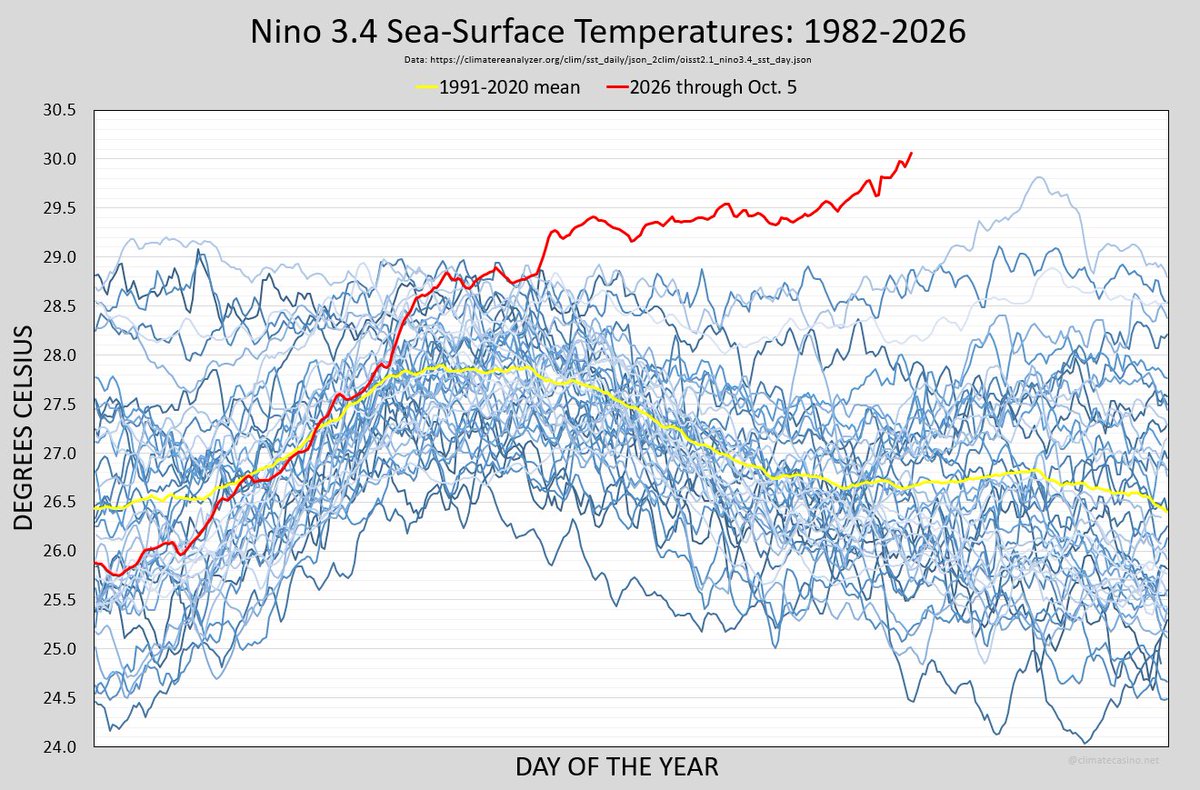
For the first time in recorded history, the Niño 3.4 sea-surface temperature (SST) is above 30.0°C, reaching a preliminary SST of 30.06°C on October 5th.
The Niño 3.4 SST anomaly is now 3.41°C above the 1991-2020 baseline.
Everything is not fine.
BREAKING NEWS
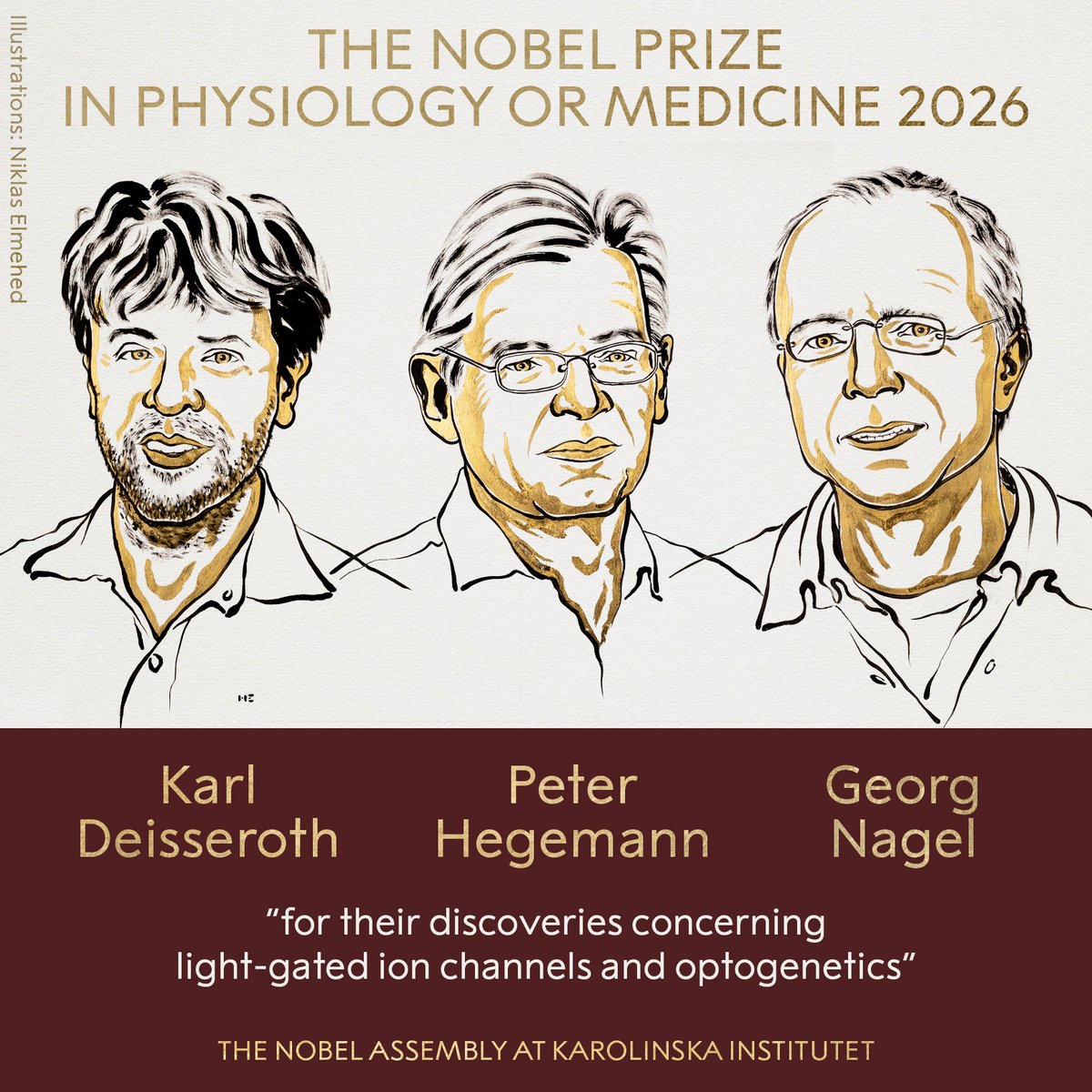
The 2026 #NobelPrize in Physiology or Medicine has been awarded to Karl Deisseroth, Peter Hegemann and Georg Nagel “for their discoveries concerning light-gated ion channels and optogenetics.”
Today in 🤯 science: A team led by @Sergiu_P_Pasca engineered mice to be missing a large swath of their brains. Next, they transplanted human brain organoids, which grew and filled in the void. They're still mice, but with a human-dominated cortex. https://t.co/LWT5IwR01F
Incredibly exciting announcement.
Johns Hopkins University will provide $80M per year for the next two years to support large Life Sciences projects.
(1) Transformational Science Teams awards: >$10M each, $40M/year.
(2) High-impact individual awards: $200-500K each, $40M/year.
Estamos organizando dos cursos Cabbio en la UNTRM, becas integrales para postulantes peruanos. Si te interesa el curso “Secretoma de células madre mesenquimales: producción, caracterización e inmunomodulación para terapias avanzadas”, postula aquí https://t.co/39xS7zgTpI
This is where use of AI writing in published academic papers has increased the most and the least, according to a new study. They tracked the prevalence of words that AI tends to use more than humans, like "juncture" and "delves."
Two economists just published a mathematical proof that AI will destroy the economy.
Not might. Not could. Will — if nothing changes.
The paper is called "The AI Layoff Trap." Published March 2, 2026. Wharton School, University of Pennsylvania. Boston University. Peer reviewed. Mathematically modeled.
The conclusion is one sentence.
"At the limit, firms automate their way to boundless productivity and zero demand."
An economy that produces everything. And sells it to nobody.
Here is how you get there.
A company fires 500 workers and replaces them with AI. A competitor fires 700 to keep up. Another fires 1,000. Every company is behaving rationally. Every company is following the incentives correctly. And every company is building a trap for itself.
Because the workers who were fired were also customers.
When they lose their jobs faster than the economy can absorb them, they stop spending. Consumer demand falls. Companies respond by cutting costs — which means automating more workers — which means less spending — which means more falling demand — which means more automation.
The loop has no natural exit.
The researchers tested every proposed solution. Universal basic income. Capital income taxes. Worker equity participation. Upskilling programs. Corporate coordination agreements.
Every single one failed in the model.
The only intervention that worked: a Pigouvian automation tax — a per-task levy charged every time a company replaces a human with AI, forcing them to price in the demand they are destroying before they pull the trigger.
No government has implemented this. No major economy is seriously discussing it.
Meanwhile the numbers are already tracking the curve. 100,000 tech workers laid off in 2025. 92,000 more in the first months of 2026. Jack Dorsey fired half of Block's workforce and said publicly: "Within the next year, the majority of companies will reach the same conclusion."
Nobody is doing anything wrong. Companies are following their incentives perfectly. That is exactly the problem.
Rational behavior. At scale. Simultaneously. With no mechanism to stop it.
Two economists built the math. The math leads to one place.
Source: Falk & Tsoukalas · Wharton School + Boston University ·
Hoy, entre los bienes que están destinados universalmente a todos, debemos incluir también las nuevas formas de propiedad: patentes, algoritmos, plataformas digitales, infraestructuras tecnológicas, datos. En un contexto en el que la riqueza de las naciones depende cada vez más de conocimientos y tecnologías, cuando estos bienes quedan concentrados en las manos de unos pocos, sin adecuadas formas de compartición y de acceso, se crea una nueva brecha entre quienes pueden participar en la revolución digital y quienes permanecen al margen. #MagnificaHumanitas
Cuando @TheEconomist se vuelve progresista es que la amenaza de la IA es real:
-Impuestos al capital, las ganancias y las herencias;
-Seguros de desempleo masivo;
-Salario básico universal;
-Participación pública en las grandes empresas tecnológicas.
La disrupción es inminente.
600 Fully Funded Graduate Research Scholarships University of Melbourne, Australia 2027 - Fully Funded up to $135,000
Visit: https://t.co/OUI2fzXT5C
Just apply at University of Melbourne. You automatically considered for the Scholarship
Masters/MPhil, Ph.D. Scholarships in any Fields/ Majors available in the University.
Australian / domestic student and International students can apply
Deadline : 31 Oct 2026
3. Purdue Online Writing Lab (OWL)
By far the most comprehensive online resource on academic writing (in English).
Contains detailed instructions on:
• General academic writing
• Graduate writing
• Job search writing
https://t.co/ePbPHG113L
GRAVE. Alrededor de 300 estudiantes peruanos que lograron ingresar a universidades como University of Oxford, Columbia University y University of Manitoba alertan falta de continuidad de la Beca Bicentenario.
https://t.co/cTs97TTaOr
For decades, biology textbooks have enshrined a simple rule: DNA is made by copying a template. After one enzyme unzips a DNA double helix into separate strands, another called a polymerase builds a complementary sequence, base by base, for each strand. Presto: two copies of the original DNA.
But new research into how bacteria defend themselves from viruses now shows this synthesis rule isn’t absolute.
Now, a team describes a bacterial enzyme that synthesizes DNA without a nucleic acid template, using its own structure as a guide.
Learn more: https://t.co/TeUWvyO0OD @NewsfromScience
El curioso caso de las actas gemelas.
Ojo, no estoy aqui para alimentar narrativas de fraude, quiero que las elecciones se lleven a cabo de la forma mas justa posible. Es por eso que me parece importante resaltar este caso.
Encontrado revisando caso por caso.
#Urgente ONPE ha perdido 17 actas en Magdalena. En concreto, ha perdido los USB con las actas digitales de 17 mesas que se crearon usando el nuevo y "más eficiente" sistema STAE 👇
(@RonaldCrossPeru ahí está la respuesta a tu pregunta de por qué falta contar tanto en Magdalena).