There hasn't previously been a treatment vs pancreatic cancer this successful. Striking improved (a > doubling) survival results @NEJM and @ASCO today with daraxonrasib, which also became available via an FDA approved early access program and began shipping to physicians this week @RevMedicines
https://t.co/e04jqJMPw0
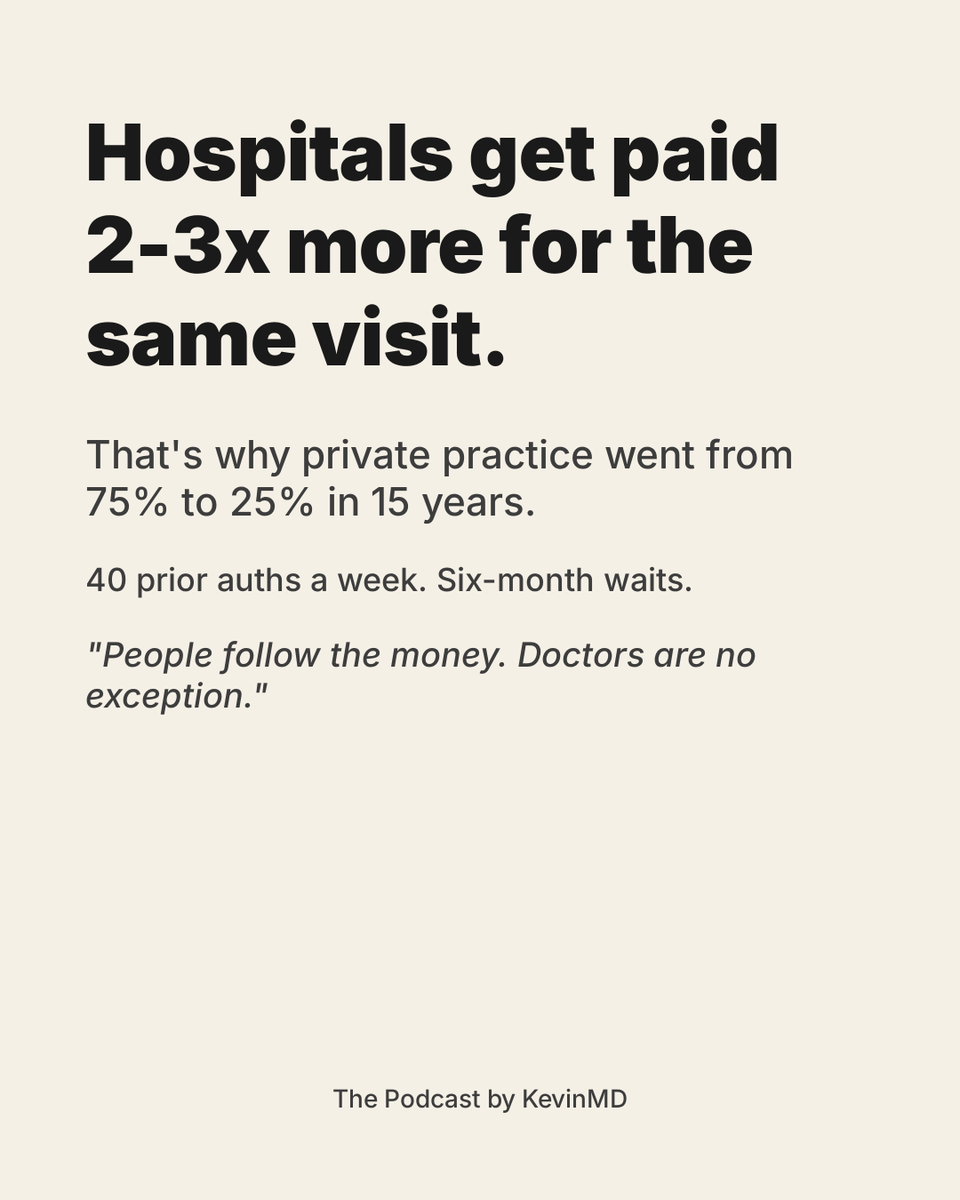
Fifteen years ago, 75 percent of US physicians were in private practice. Today, around 25 percent are.
That is not market evolution. That is a policy outcome.
Hospitals are paid 2 to 3 times more than independent practices for the same office visit. For echo and MRI, 3 to 5 times more. Same physician work. Same diagnosis. Different check, because the door has a hospital logo on it.
Then layer the prior auth burden. The typical small practice now runs about 40 prior auths a week. Generic medications that did not require approval five years ago now require approval. Every MRI requires approval. Most denials are algorithmic, with no specialist on the other end who can actually override anything.
Then layer MIPS, MACRA, and the 2013 Misvalued Code Initiative that cut reimbursements for office-based echo and EMG by more than 50 percent while leaving hospital-employed physicians shielded.
The result, per neurologist Scott Tzorfas on The Podcast by KevinMD, is that wait times in his area now run six to nine months for a specialist and close to a year at the academic hospitals. Not because there are too few doctors. Because the small offices that used to absorb that volume have been driven into hospital systems where payment is higher and overhead is somebody else's problem.
He proposes site-neutral payment, repealing the restrictions on physician-owned hospitals, and applying the qualified business income deduction to physician practices. Reverse the financial incentives that bent the field, and the field bends back.
There is also a perverse premium incentive baked into the ACA. Insurance profits are capped at 15 to 20 percent of premiums, but that is a percentage cap, not a dollar cap. Higher hospital prices push premiums up, which pushes the dollar value of that 15 to 20 percent up too. The system is paying more for the same work and calling the result a market.
The structural fix is not complicated. The structural will is what is missing.
Search "The Podcast by KevinMD" wherever you listen to podcasts. Link in the replies.
What policy lever would actually pull more clinicians back into independent practice?
#ThePodcastbyKevinMD
Dr. Ponce from @BarrowNeuro delivered an excellent session on cranial robotics.
Cranial surgery is moving toward precision-driven workflows where robotics and enabling technologies are not optional, they are becoming infrastructure.
This session focused on:
• Real clinical applications of cranial robotics
• Integration into surgical workflow
• How technology improves accuracy, reproducibility, and operative efficiency
The direction is clear: standardization and precision will define next-generation cranial surgery.
#AANS2026 #Neurosurgery @AANSNeuro #CranialRobotics #SurgicalInnovation
@uckema For scale, in the US, physician salary is 6-8% of total healthcare spend. Capping that would have and has had little effect on healthcare costs. https://t.co/MvR9Pyk39W
Happy #MatchDay! We're excited to announce and congratulate our incoming residents in #neurosurgery, who will join us this summer at the start of the new academic year.
Michael Covell, @gumedicine
Candace Grisham, @vumedicine
Noah Nawabi, @musc_com
Nicole Perez, @harvardmed
Just a reminder for folks, the @AmCollSurgeons recommends clearing a cervical collar in an obtunded patient if the CT is negative.
C collars are not benign. They can cause pressure ulcers and high ICP.
MRI can get tied up with inpatients. Save them for acute cases.
I have seen incidental benign or relatively benign lesions lead to patients losing so much lung they need continuous oxygen
Others have had heart procedures, bypass surgery or even transplant due to complications from work ups!
As a patient, I want my physician unburdened by the trivial anxieties of this world.
I don’t want them thinking about their mortgage when they walk into my exam room.
I don’t want my neurosurgeon annoyed and distracted because the EHR demanded 37 meaningless clicks before they could even scrub.
I don’t want my orthopedic surgeon delayed because someone requires an “H&P Update” that amounts to writing no changes—whether that’s one line on a sheet of paper or another 37 clicks in EPIC.
I don’t want my internist spending half my visit typing like a court stenographer instead of examining, thinking, and, ideally, doctoring.
I want my physicians to own the place where I receive care. I want them in control of the environment. I want them to know the nurses, know the housekeepers, know where the supplies came from, and know that the entire institution is oriented around my health—not around billing codes, compliance checkboxes, or corporate abstractions.
And if that means my physician drives a Ferrari? I hope they have two.
Because a focused, empowered, well-supported physician is worth infinitely more to me than any bureaucrat’s opinion about what a doctor “should” earn.
My life is in their hands—and I’m going to be a little selfish here (it is my life, after all): I want the best of the best.
I had a tailor for years whose slogan was, “Quality is economy.”
Translation: buy cheap, buy twice.
In healthcare, that’s not just expensive—it’s lethal.
Friends, you get what you pay for. And when it comes to my life, the lives of my family, and the people I care about, I want my physicians compensated so well, supported so well, and unburdened so entirely that their focus is 100% on my health and wellbeing.
The cost in our system has never been physicians.The cost is the posers, fakers, and wannabes.
It’s the goobers, the gomers, and the grifters who siphon billions while adding nothing to patient care.
They’re the ones who profit—not the people actually saving lives.
I’m tired of it. And you should be too.
Talking to independent physicians, it's obvious that the big insurance carriers are doing to them, what their PBMs are doing to independent pharmacies.
They deny, underpay, slow pay, clawback, and create administrative mazes, knowing their victims don't have the time or resources to fight.
Why ? By putting financial pressures on physicians and pharmacies, it makes them more likely to sell their businesses to them , close their doors, or refer the business to their captive pharmacy or provider. All benefitting the biggest insurance companies
We need to ditch the concept of "claims" and make every delivery of medications or care as a billable event that must, by law, be paid on a timely basis , with interest charges for any delays. If the physician or pharmacy doesn't deliver , the carrier has plenty of legal options already. As does the patient.
This is not an efficient market. This is the big guy abusing the little guy. It needs to change to better the care we get in this country
@IM_Crit_ Agreed. What do you think the ROI of having “perfect” surgeons would be on overall healthcare outcomes (I.e average lifespan, quality of life, etc)? There are more fruitful ways to focus AI investment (i.e preventative care)
@elonmusk The interest in having AI-enabled autonomous robots doing surgery is probably a bit misguided in the majority of circumstances. The top limiting factors for human longevity likely don’t include surgical outcomes. Of course, improvement in any aspect of healthcare is welcomed.
Bernie, you must not respect your constituents if you think they'll fall for this.
If I may, can we go through a few of the logical fallacies here?
You present a list of national life expectancies to conclude that the US should have your version of single payer: Medicare for All.
Yet, atop your list is a country that doesn't even have a government payer.
There's no equivalent of Medicare in Switzerland. Everyone is covered by private insurance companies there.
So clearly a single government payer isn't the key to a long life span. In fact, among the countries you list, the only one that has something close to the policies in your "Medicare for All" legislation is Canada. All the other nations have robust private options.
You then list Japan as the #2 country. Well, you must have forgotten that, in the USA, Asian Americans have an average lifespan of 85.2 years. Yet, these Asian Americans exist in a system without single payer.
In other words, not every group living under US health care is trapped in the dystopia you describe.
You also neglect to mention that if you erase the deaths due to car accidents, violent crime, drug overdose, and suicide from all those countries, the US rises to the top of the list.
There's a lot wrong with the US healthcare system. I'd never argue otherwise. Yet it does specialized care very well. If you have a heart attack, stroke, trauma, or cancer, the US outcomes are among the best.
Look, I understand the desire to fix an extremly complex healthcare system with something that will fit on a bumper sticker. It's an easy slogan. People would feel good knowing they have some government card guaranteeing they need not pay cash for healthcare services.
But you neglect to mention they'll end up paying in other ways. Like with their time, such as in Canada, where the average wait for an MRI is over 4 months, and in some provinces, it's over a year. Or they may pay with their lives, like the 17,000 Canadians a year who die while on surgical waitlists.
That's what single payer gets us. It won't magically make Americans into safer drivers or less violent individuals. It won't make a dent in our life expectancy.
It will make costs skyrocket, though, be they measured in money, time, or deaths.
As the great Thomas Sowell put it, “It is amazing that people who think we cannot afford to pay for doctors, hospitals, and medication somehow think that we can afford to pay for doctors, hospitals, medication and a government bureaucracy to administer it.”
So, please, Bernie, show us all a little more respect.
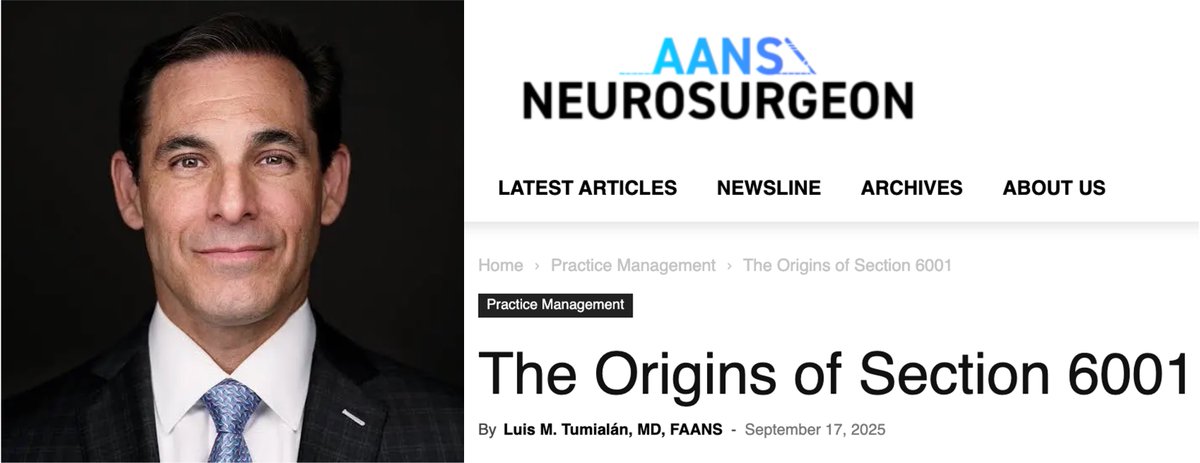
Don't miss this must-read article in @AANSNeurosurg from our current Chair Dr. Luis M. Tumialán, laying bare the true roots of Section 6001 of the Affordable Care Act, which banned physicians from owning hospitals in the United States.
https://t.co/UMEXHGu2MN
For reference, here's a list of surgeries, their value to society in terms of preventing disability, and what the surgeon is paid:
Patellar tendon rupture repair
$1,000,000
$528
Epidural hematoma evacuation
$1,500,000
$1,307
C-section for breech baby
$100,000
$623
Intramedullary nail tibial fracture
$800,000
$856
Fasciotomy compartment syndrome
$1,200,000
$388
Detached retina repair
$500,000
$1,111