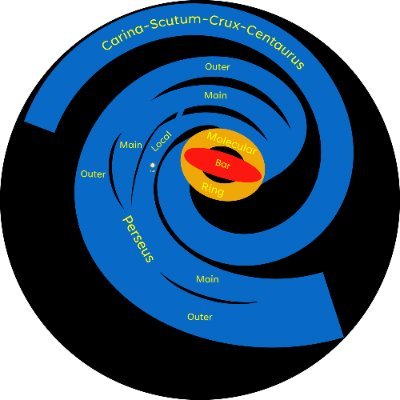
It's often said that spiral arms tend start at the "ends" of the bar in a barred spiral galaxy but in my observation in many galaxies the arms tend to wind around well past the ends.
Raising the bar 🏋️
A brilliant galaxy with a distinctive central bar of stars takes centerstage in this new Hubble view. Called NGC 4394, this galaxy resides about 55 million light-years away: https://t.co/e7W6ZKaAK8
#NASAWebb observed supernova remnant Cassiopeia A, showcasing the clouds of gas and dust that remain following the explosion of a massive star and will eventually seed a new generation of stars and planets. (1/9) 🧵
"En el blog de Terence Tao el comentario que más duele:
Antes, las matemáticas puras eran el campo más justo para la humanidad: una pizarra y una tiza bastaban para que un estudiante pobre pudiera partir de la misma línea de salida que un profesor de Princeton"
I once created a relativistic light sail board game called Achernar with a similar outcome. Launching and braking depended on the luminosity of the star, meaning that OBA stars became key navigation points.
Reducing the interstellar travel time of a solar sail by optimizing its photogravitational braking maneuver against stars at the destination:
https://t.co/92SHwYkDB1
An interesting consequence is that a trip to Sirius A actually becomes shorter than to Alpha Centauri.
Most maps cut the ocean apart to keep the land whole. The Spilhaus projection splits the continents instead, so all of Earth's seawater reads as one body.
A year of surface currents, colored by sea temperature. Now also a print.
#ocean#dataviz
SPHEREx Data Release 1 (DR1) is now available at IRSA. DR1 includes reprocessed spectral images that form a uniformly processed dataset with Quick Release 3 (QR3). It includes an all-sky spectral cube covering 102 spectral channels from 0.75 to 5.0 um. https://t.co/ag6RCZO0Xm
SPHEREx Data Release 1 (DR1) is now available at IRSA. DR1 includes reprocessed spectral images that form a uniformly processed dataset with Quick Release 3 (QR3). It includes an all-sky spectral cube covering 102 spectral channels from 0.75 to 5.0 um. https://t.co/ag6RCZO0Xm
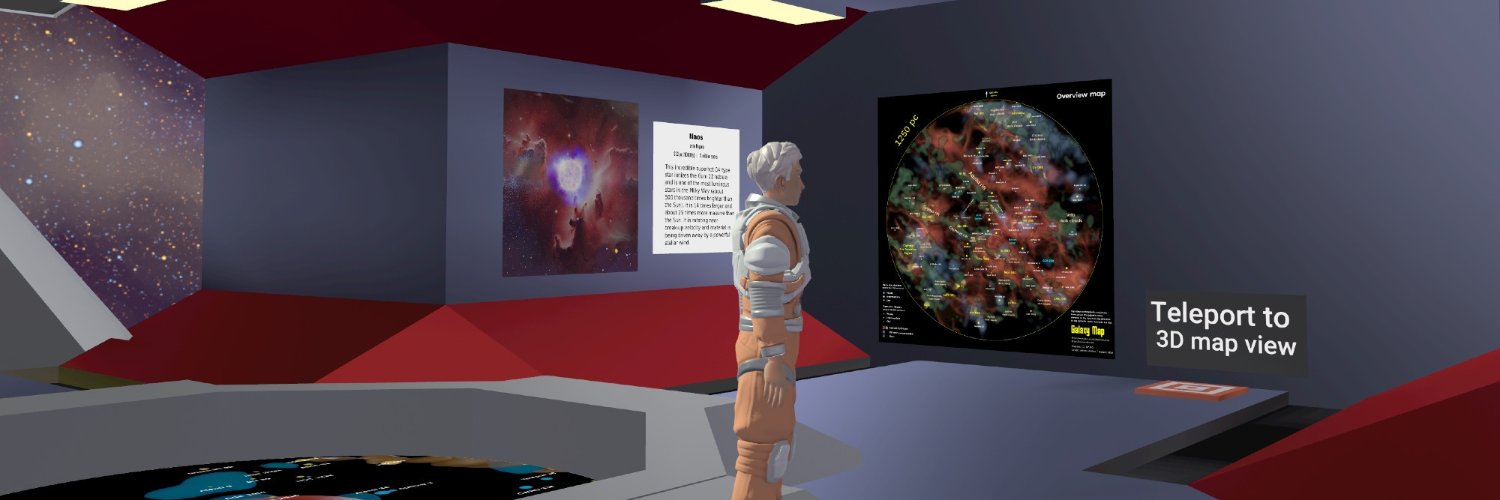
This is the first of a trilogy of star games I designed: Achernar, Guniibuu and Acrux. Sadly I have not found anyone interested in publishing any of them but I might eventually incorporate their ideas into VR experiences.
If you like the idea of the Galactic Explorer, built on real Gaia Mission data (DR3 for now, DR4 in the future), please click on the Like button at the bottom of this page: https://t.co/wq6bYpyxze
I would really appreciate it!
The fastest way to escape the Solar System is to dive toward the Sun first.
This maneuver, called a Solar Oberth Slingshot, begins with a retrograde Jupiter flyby that reduces the spacecraft’s heliocentric speed. The probe then plunges toward the Sun, reaching approximately 356 km/s at just 3 solar radii from its center.
At this enormous speed, a 10 km/s rocket burn produces a much greater increase in orbital energy through the Oberth effect (ΔEₖ = vΔv + ½(Δv)², per unit mass). The spacecraft can then escape on a hyperbolic trajectory with a solar escape excess speed of about 81.4 km/s, nearly five times Voyager 1’s speed.