It's good to hear the admission that this is not about the security council veto.
It's about Ireland being "tied" to the UN, in other words "tied" to international law.
One of the biggest myths of disease transmission is:
"I didn't go within two metres of the sick person, so I must have caught it by touching something they touched or coughed on".
No dingdong. You breathed in the air they breathed out.
Hezbollah warns any post-UNIFIL force without UN authority would be an occupation. Mícheál Martin & Helen McEntee, not the Opposition - put Irish troops at risk by weakening Triple Lock & pushing for participation in the EU Support Mission in Lebanon. Keep the Triple Lock!
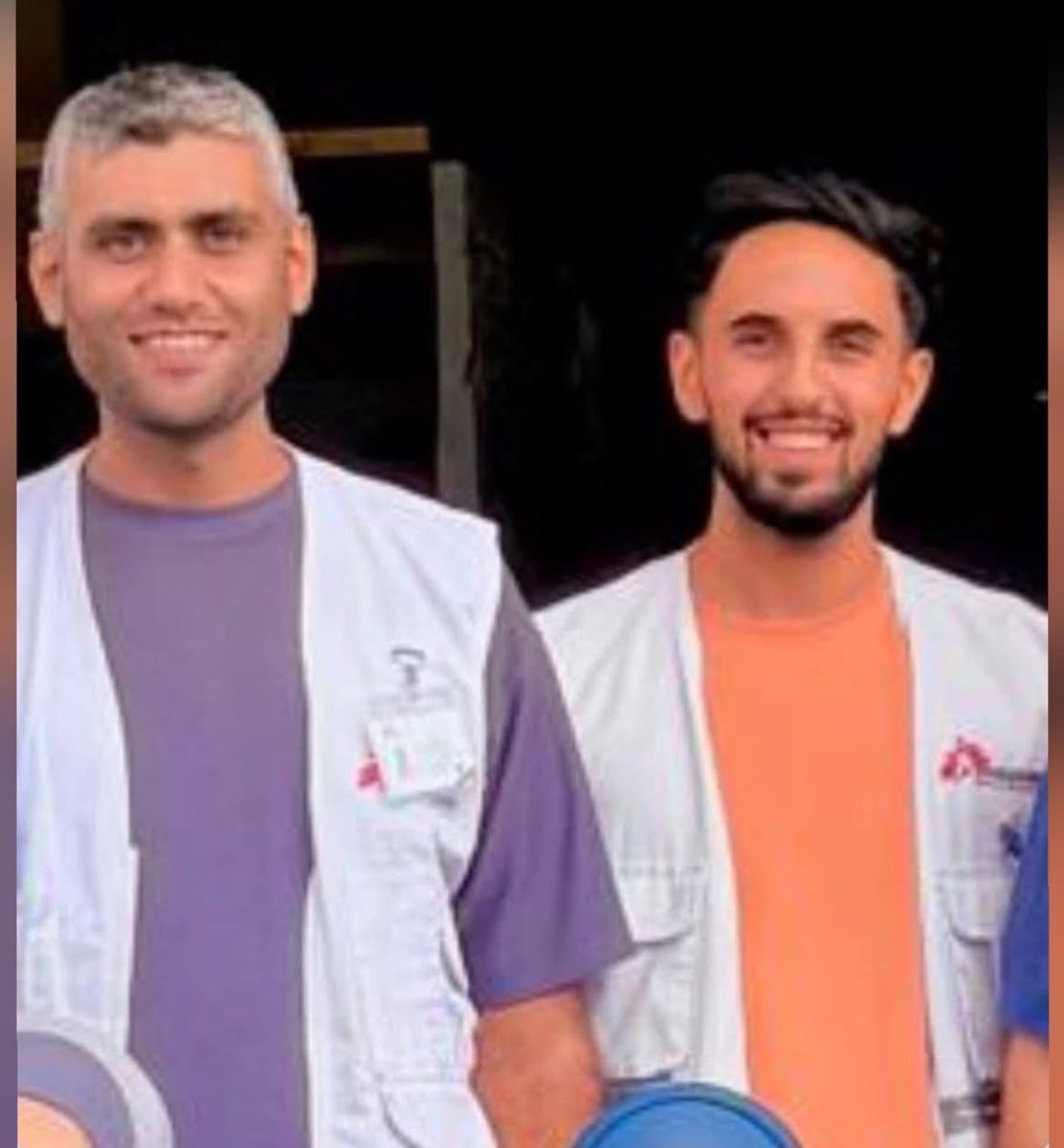
Ahmed Abu Hasira and Moaz Soboh, employees of Médecins Sans Frontières (MSF) Belgium, who were targeted moments ago inside the organisation’s headquarters in Gaza City.
Oh, yeah, “before Putin took over”. Those were the glorious days in US-Russian relations when a drunken buffoon was the leader of Russia and took orders from the US government.
We are perhaps closer to direct conflict between Russia and Europe than I realised.
Previous seizures of Russian shadow fleet tankers in the Baltic have led to Russia deploying naval assets to protect the fleet. From Russia’s perspective the Baltic route is a critical vulnerability – roughly 60% of its oil exports are said to pass through it.
On 30 June, Greenpeace activists in speedboats neared the Kira K, a Panama-registered tanker that is part of the shadow fleet. Believing the boats were German authorities preparing to board the vessel, a Russian warship – the corvette Soobrazitelny – rapidly moved in to intercept them.
The commander of the Soobrazitelny broadcasting a warning over an open radio frequency: “Here speaks Russian warship 531, stay away from the Kira K.”
To protect the campaigners, a nearby German coastguard ship, the Bayreuth (which carries no armaments outside of small arms), manoeuvred between the activists and the Russian vessel.
From what I can piece together, there was initially quite some confusion and tension between the Soobrazitelny and the Bayreuth.
Bayreuth: “What is the Russian warship doing here?”
Soobrazitelny: “We are following the plan.”
Bayreuth: “What plan?”
Soobrazitelny: “The special plan.”
It would seem that Soobrazitelny was initially uncertain of Bayreuth’s explanation that the smaller boats carried peaceful demonstrators with no intention of boarding the tanker.
Bayreuth then told the Greenpeace activists: “The Russian warship says you must leave the vicinity of the tanker Kira K.”
One can see how this type of miscommunication or misunderstanding can quickly result in something very serious. And of course the very reference to a “special plan” raises questions – recalling that Russia’s war on Ukraine is, or at least was, labelled a “Special Military Operation”.
On 30 September, Moscow delivered an extraordinary written note to NATO claiming it had intelligence that the alliance was preparing an air and naval blockade of Kaliningrad and Baltic shipping routes. The memo stated Russia was prepared to launch pre-emptive nuclear strikes – including against “decision-making centres” – to defend its Baltic interests, even without a direct conventional attack on Russian territory.
On 29 and 30 September, the Russian Embassy in Dublin posted a statement that Russia “would be ready to use all its arsenal, including nuclear weapons, to defend its territory if NATO countries try to isolate Kaliningrad region from the rest of the country”.
On 1 October, Putin stated Russia would use “all weapons at his disposal” to protect Kaliningrad.
Many people will dismiss this simply as “nuclear blackmail”, but there are indicators that it may be more than that. Alexander Voloshin, Putin’s onetime chief of staff, has said that a blockade of the Baltic or Kaliningrad could not be prevented by conventional means, and that Russia would have no choice but to respond with immediate, pre-emptive nuclear strikes.
Alexander Stubb – no fool – took matters seriously enough to go to Oslo to meet Norwegian Prime Minister Støre on 8 October, and returned again on 20 October. There was a scramble to defuse the situation. Amongst other things Rutte denied any intention to blockade the Baltic and Finland summoned the Russian ambassador.
But Stubb feared the message wasn’t getting through and reached out to a Russian oligarch who travelled to Norway before returning to Moscow with a message for Putin. Stubb then told Putin directly during a 27 October phone call (with Støre also on the line): “We have no intention of blockading the Baltic in peacetime, you can rely on that”.
Putin has since suggested that “someone” wants to turn the Baltic into another Strait of Hormuz – closed to shipping. Since then Ukrainian drones have attacked Russian shipping in the Baltic (and the Mediterranean).
What has become clearer in recent days is the evident concern among US and European leadership not only about the risk of contagion that could pull Europe into the war, but that Ukraine may deliberately try to bring this about – which, from Kyiv’s perspective, may be its best ultimate hope.
Hours after a joint statement with Rutte that warned only Russia against actions that “intentionally, or unintentionally, expand the War”, Trump published his own version on Truth Social that referred to “the importance of Russia and Ukraine avoiding any actions that intentionally, or unintentionally, expand the War”.
Berlin’s warning came from Foreign Minister Johann Wadephul on Thursday: “I would strongly caution against allowing this conflict to spread geographically.” He described strikes on military targets as legitimate and did not question Ukraine’s right to defend itself, but named shipping and the environment in the Baltic as specific risks.
There is a deeper dilemma here that Europe largely created for itself. It chose early to involve itself in the Ukraine war – first with non-lethal aid, sanctions and diplomatic support. The line then moved steadily: lethal weapons, artillery and air defence, tanks, long-range systems, fighter jets, training and intelligence. Rhetoric shifted with it, from measured support to “as long as it takes” and open talk of Ukrainian victory. Having chosen to insert itself in this way, the progression towards being dragged more directly into the conflict was more or less predictable – especially as Ukraine weakens and, quite logically, seeks to expand the scope of the war with a view to involving others in its ultimate cause.
European backpedalling now comes late. It seems that only now has the realisation started to sink as to the logical progression of matters. European leaders appear to have always assumed they could involve themselves while avoiding the risk of contagion. That assumption, more than anything, suggests nothing was ever really properly thought through.
My reading is that the situation is fragile and there is an uncomfortable degree of risk of “tripping into conflict”, especially if Ukraine tries to maximise this to its advantage. The nuclear dimension is real enough to take seriously – Russia has explicitly tied defence of these routes to possible early nuclear use – but it is still best understood as a dangerous form of signalling rather than an immediate plan. The greater near-term danger remains miscalculation at sea.
Lebanon’s Prime Minister Nawaf Salam has told media that any post UNIFIL-force must “endorsed” by the UN Security Council
They won’t accept the proposed EU force of Kaja Kallas that Helen McEntee want Irish troops on.
This is the exact scenario the Triple Lock protects us from
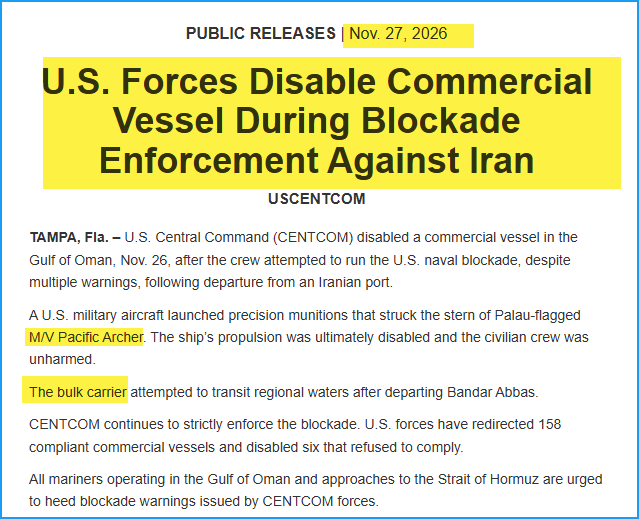
BREAKING: It's now CONFIRMED that the US did the thing Iran said NOT to do, which was strike an Iranian ship running the blockade.
Now we see how Iran responds...
In an investigation aired by Kan 11, Israeli soldiers describe the widespread use of Palestinians as human shields in Gaza, including a 16-year-old boy.
They described sending unarmed civilians ahead of troops to conduct searches, a practice they called the "Mosquito Protocol".