This clip should be made viral. Rahul @RShivshankar@Shehzad_Ind destroyed the propaganda with hard facts. Tehseen didn’t know when E15 started. He didn’t even know E19 existed. Anand’s points were beautifully rebutted by Shehzad
The most talented kid I have met in the last 3 years was from Indore.
Not because he was topping JEE.
Or came from a top IIT.
Because he had failed it twice, taught himself product design on YouTube at night, and had a portfolio that would embarrass most IIT graduates.
He freelances and makes 2L per month.
India does not have a talent problem.
It has an envelope problem.
We only recognize talent when it arrives in the right envelope.
All Paid Courses (Free for First 4500 People).
𝗣𝗮𝗶𝗱 𝗖𝗼𝘂𝗿𝘀𝗲 𝗙𝗥𝗘𝗘 (PART - 1)
1. Artificial Intelligence
2. Machine Learning
3. Prompt Engineering
4. Claude,Chatgpt,Grok
5. Data Analytics
6. AWS Certified
7. Data Science
8. BIG DATA
9. Python
10. Ethical Hacking
(72 Hours only )
Like + RT + comment ' Drive '
Must Follow me so I can DM you.
A MUST. MUST READ.
1942.
Rangoon.
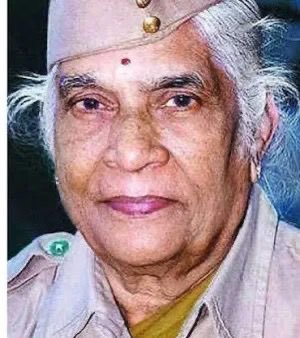
While most Indians remember freedom through textbooks, one 15-year-old girl lived it through sacrifice.
Her name was Saraswati Rajamani.
Born into obscene wealth.
A mansion. Silk dresses. Diamonds. Cars.
Her father owned a gold mine.
But destiny didn’t want her to live behind curtains.
It wanted her in shadows.
That day, Rangoon shook.
Netaji Subhas Chandra Bose stood before the crowd and thundered:
“Give me blood, and I will give you freedom.”
Something ignited inside that teenage girl.
She didn’t clap.
She didn’t cheer.
She removed every ornament from her body — necklace, bangles, earrings — and donated them to the Azad Hind Fauj. On the spot.
The next morning, an army jeep stopped outside her mansion.
Netaji himself stepped out.
He came to return the jewellery.
He thought it was emotion. Impulse. Youth.
Rajamani looked him straight in the eye and said:
“Netaji, I did not give it by mistake.
I gave it to my country.
And I never take back what I give.”
Netaji saw it instantly.
Not a girl.
Steel.
He renamed her “Saraswati.”
And said:
“I don’t want you with a gun.
Your task will be harder.”
Her long hair was cut.
Loose clothes replaced silk.
Saraswati Rajamani became “Mani.”
Her mission: espionage.
At 16, the girl who slept on cushioned beds worked inside British military mess halls, disguised as a boy.
Polishing boots.
Serving tea.
Sweeping floors.
The British officers laughed freely, confident these “local boys” understood nothing.
Right in front of them, they planned bombings.
Supply routes.
INA movements.
Mani listened.
Memorised.
Recorded everything in her mind.
Later, she scribbled notes in washrooms, hid them in shoes and bread, and smuggled intelligence to Netaji.
Day after day.
One mistake away from death.
Then the nightmare struck.
Her partner Durga was captured.
INA’s rule was brutal but clear:
Never be taken alive.
Everyone told Mani to flee.
She refused.
“My friend is captured.
I won’t run.”
At night, disguised again, she entered the British prison.
Drugged the guards.
Stole the keys.
Freed Durga.
As they escaped, alarms screamed.
Searchlights cut through darkness.
Shots rang out.
Mani was hit in the leg.
She didn’t stop.
Stopping meant death.
They vanished into the forest.
Hunted by soldiers and dogs.
They survived by climbing a tree and hiding there for three days — wounded, feverish, silent — while British patrols searched below.
Eventually, they escaped.
Back at INA camp, Mani collapsed.
As doctors removed the bullet, Netaji saluted the teenager and said:
“I didn’t know our army hid such explosives.
You are India’s first woman spy.
You are my Rani of Jhansi.”
He wanted to gift her his pistol.
She wanted only one thing:
Freedom.
India became free in 1947.
And then India forgot her.
No chapter.
No spotlight.
No gratitude.
The girl who gave her youth, blood, and family wealth lived her final years in a small rented room in Chennai.
Her pension delayed.
Her life ignored.
Yet she never complained.
During the 2004 tsunami, when people begged for aid, this old woman — who struggled for her own medicines — donated her savings for relief.
When asked why, she smiled:
“Giving is in my blood.”
In 2018, at 91, Saraswati Rajamani passed away quietly.
No national mourning.
No breaking news.
No outrage.
But remember this:
Free India stands on the courage of a 15-year-old girl who chose the nation over comfort, silence over safety, and sacrifice over recognition.
Her name was Saraswati Rajamani.
History forgot her.
We must not.
1/16
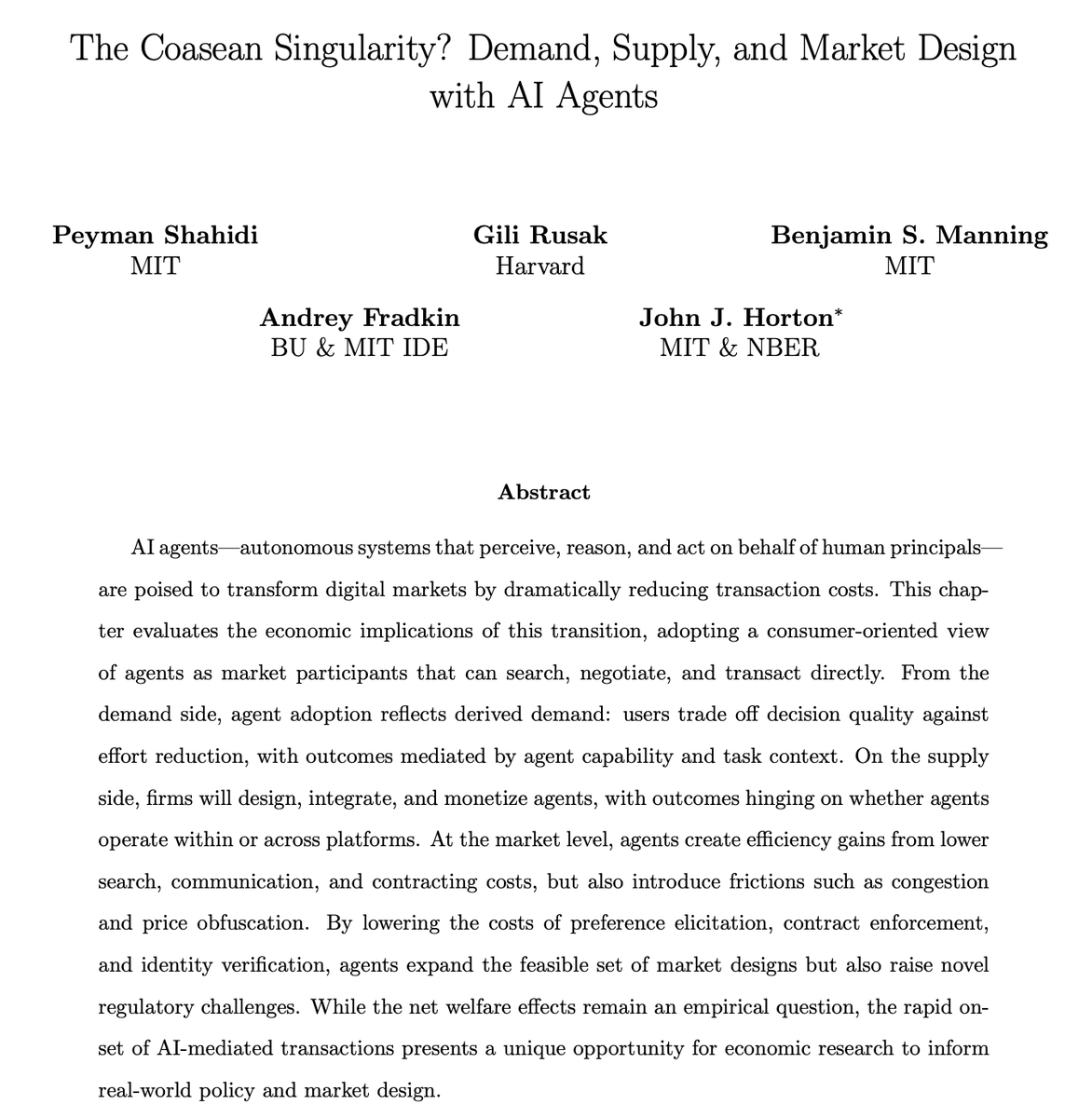
I just fell down a rabbit hole reading a new paper from economists at MIT & Harvard.
Their prediction is wild: We're on the verge of a "Coasean Singularity"—a future where AI agents make markets so efficient that the very idea of a 'company' starts to crumble. 🤯
A thread 👇
2/16
First, a quick 101: Why do companies even exist?
A Nobel-winning economist named Ronald Coase answered this in 1937. He said companies exist because using the open market is a pain.
Finding sellers, negotiating prices, writing contracts… it’s all “transaction cost.” Economic friction.
3/16
It's often easier and cheaper for a firm to just hire people and organize them internally than to deal with that constant market friction.
This friction is also where we, as consumers, lose. We're tired, we're biased, and we don't have time to compare every cell phone plan or read every review for a toaster.
Companies know this.
4/16
Now, enter the AI Agent.
And I don't mean a simple chatbot. The paper describes an autonomous system that acts on your behalf.
Think of it as your own personal, tireless, super-rational economist. It’s immune to marketing tricks and its only goal is to get the best outcome for YOU.
5/16
This is where the "Singularity" happens.
When everyone has an AI agent, those transaction costs that Coase talked about basically drop to zero.
The "friction" that made companies necessary in the first place? It evaporates.
And if the reason for something disappears… so does the thing itself.
6/16
But what does this future actually look like? This is where it gets weird.
Let's take shopping.
Your agent doesn't just browse Amazon. It might contact a manufacturer in another country directly, find 500 other agents whose users want the same thing, negotiate a bulk price, and arrange shipping.
All in milliseconds. The "storefront" becomes irrelevant.
7/16
Or think about hiring.
Instead of you endlessly scrolling LinkedIn, your agent scans the entire market for opportunities. It negotiates salary, benefits, and remote work policies with the company's agent.
You only get involved for the final human-to-human interview. No more cover letter hell.
8/16
But this discovery comes with a huge catch. The paper outlines a fundamental battle for the future of AI:
Will your agent be a "Bring-Your-Own" (BYO) agent that works only for you, across all platforms?
Or will it be a "Bowling-Shoe" agent, provided by the platform (like Amazon or Google), whose priorities might be... conflicted?
9/16
The "Bowling-Shoe" agent is convenient, but it might steer you toward the platform's own products.
The "BYO" agent is loyal to you, but platforms might try to block it or throttle its access.
This tension between user autonomy and platform control will define the next decade of the internet.
10/16
And that's not even the most interesting part. This new world creates bizarre new problems.
Problem #1: Agent Congestion.
What happens when millions of agents can create a perfect, customized resumé and apply for a single job in a nanosecond?
Employers get flooded. The signal is lost in the noise.
11/16
The paper predicts that to solve this, platforms will have to re-introduce friction.
Imagine having to pay a small fee for your agent to submit a job application, just to prove you're serious.
Costless actions will lose their meaning.
12/16
Problem #2: The Identity Crisis.
In a world full of bots, how do you prove you're a unique human? How does a company know it's not negotiating with 1,000 agents all controlled by one person trying to manipulate the market?
This is the "Sybil Attack" problem, and it's a big one.
13/16
This will lead to a boom in "proof-of-personhood" technologies. Systems that cryptographically verify you are one person, without revealing your personal data.
It sounds like sci-fi, but it'll be the essential plumbing for a world of AI agents.
14/16
Here's a new lens to see the world through:
Next time you use Uber (matching drivers/riders), Zillow (matching buyers/sellers), or Upwork (matching clients/freelancers)...
Don't just see an app. See it as a clunky, early prototype for the agent-driven markets of the future.
15/16
This isn't just about better shopping bots or smarter assistants.
It's a potential rewiring of our entire economy, away from the 20th-century model of the centralized firm and toward a 21st-century model of fluid, hyper-efficient, agent-mediated markets.
16/16
The 20th century was defined by the rise of the corporation.
The 21st may be defined by its slow, quiet dissolution.
BIG NEWS 🚨 PM Modi after staying aboard INS Vikrant said :
"Last night, I slept a bit early. Something I never do. Perhaps the reason I slept early was the deep sense of satisfaction I felt after witnessing everything throughout the day" 😊♥️
@ShashiTharoor India has not been a primary mediator (like the U.S., Qatar, Egypt etc.) in negotiations between Israel Hamas. It has not taken strong initiatives or proposals that shape the terms of peace directly. Currently its more of a DT circus - so its right that PM did not attend!!
Very well put! Many of us grew up thinking the Andaman Islands as an English name until I learnt recently while researching that these islands are in fact named after #Hanuman. No one taught me this in my geography class at school or college.
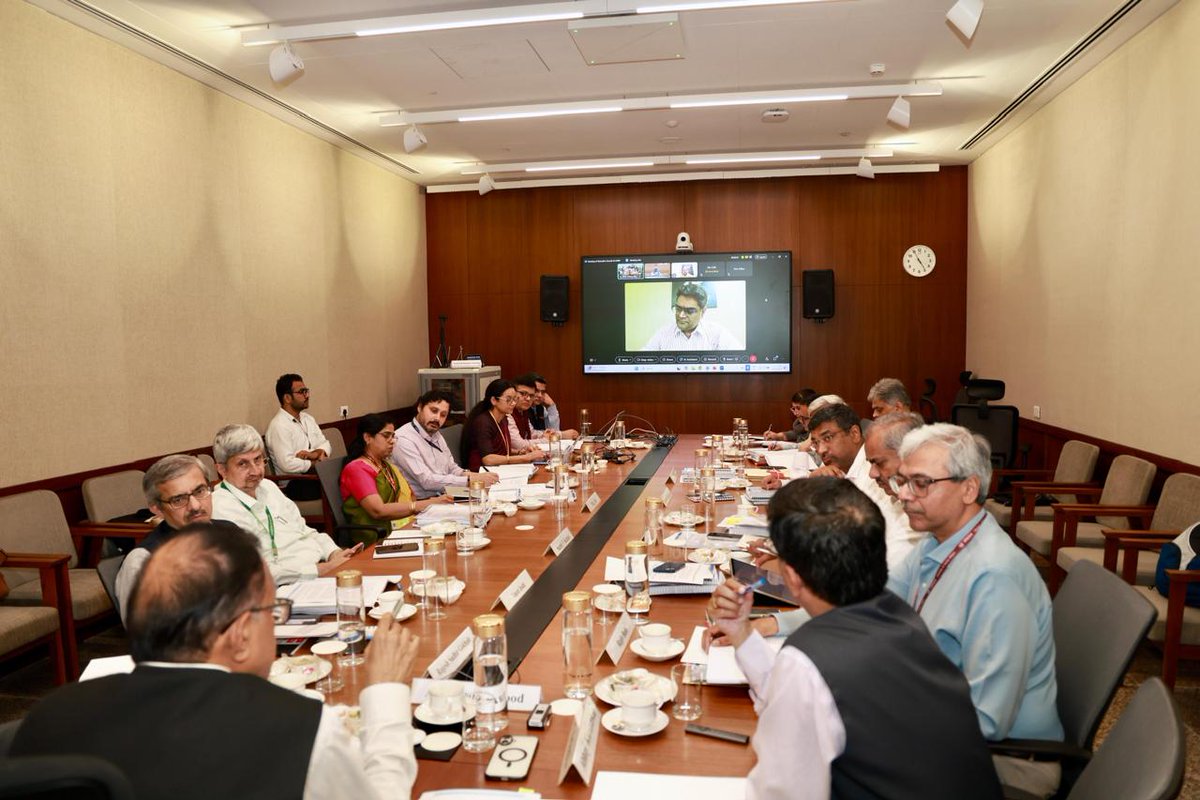
Today, we achieved a significant milestone towards operationalizing the Research, Development and Innovation #RDI scheme. On July 1, the Union Cabinet under the leadership of Hon’ble Prime Minister Shri Narendra Modi ji had approved a historic initiative to set up a ₹1 Lakh Crore (One Trillion Indian Rupees) Research, Development and Innovation #RDI Fund aimed at spurring a private sector-driven R&D ecosystem, with @IndiaDST as the nodal ministry.
#WATCH | At Semicon India 2025, Prime Minister Narendra Modi begins his speech with a light-hearted comment.
PM Modi says. "Last night, I returned to India after concluding my visits to Japan and China. Are you all clapping because I went there or because I returned?"
(Video: DD)
This is crazy...
Alibaba just dropped Wan 2.2, the world's first open-source MoE-architecture video model with cinematic control!
A major upgrade in cinematic quality, smoother movements, and prompt following.
10 mind-blowing examples: