This is great advice.
And you’ll find that as your work to become a more centered, mentally balanced individual, you will naturally always do next right thing (instead of having to ask yourself).
On my way to the office this morning, I passed a group of young people protesting, a Palestinian flag draped over their shoulders.
And I asked myself a question I can't shake: why does this generation always fall into the same trap? No matter the history. No matter the context. Even the ones from wealthy families, who went to the best schools, who were dealt every good card. Always the same trap.
I don't think it's stupidity. I think it's a mechanism. And a mechanism can be taken apart, piece by piece.
A. The observation: everything the state touches becomes unaffordable.
Look at economist Mark Perry's famous chart, the one people call "the chart of the century." It tracks US prices since 2000.
At the top, what explodes: hospital services, college tuition, textbooks, childcare, housing. Increases of +100%, +150%, up to +250%, far above general inflation.
At the bottom, what collapses: TVs, software, phones, toys, clothing. A TV today costs a fraction of what it did in 2000, for an infinitely better product.
Look at what separates the two groups. It isn't technology. It isn't complexity. It's one variable: how much the state is involved.
At the top, sectors that are subsidized, regulated, shielded from competition, where the state funds demand and blocks supply. At the bottom, sectors where companies fight every single morning to serve you better and cheaper.
B. The mechanism: why it's systematic.
When the state subsidizes demand without freeing supply, prices rise. Every time. Guaranteed student loans, and universities raise tuition. Housing aid plus blocked building permits, and rents skyrocket. Administered healthcare, and bureaucracy eats the budget before it ever reaches the patient.
In France it's even more vicious, because the price doesn't disappear: it hides. You never see the hospital bill, you pay it through payroll contributions. You never see the cost of school, you pay it through taxes. Public spending at 57% of GDP, one of the heaviest tax burdens in the world, more than €3.4 trillion in debt. And the result? Overflowing ERs, falling PISA scores, young people who can't afford to live in the city where they work.
The market didn't fail in these sectors. It was never allowed in.
C. Suffering demands a culprit.
A 22-year-old lives all of this in their bones. They can't find a place to live. Their degree either buries them in debt or opens no doors. The future feels blocked. That suffering is real, and I don't deny it for a second.
But human beings can't stand suffering without a culprit. They need a face. A scapegoat.
And this is where everything is decided: who taught them how to read the world?
D. Whoever tells the story picks the villain.
Schools are public. Universities are public. Culture runs on grants. Film goes through funding committees. Public broadcasting shapes the narratives. The people handing down the interpretive framework are, overwhelmingly, paid by the very system that creates the problem.
Do you really think that system is going to name itself as the culprit?
No. It names the capitalist. The boss. The landlord. "The rich." The multinational. The commercial West. Same role, same casting, every time.
E. One lens, a thousand causes.
And this brings me back to that flag. A generation taught to read every situation through a single lens, oppressor on one side, rich, Western, capitalist, oppressed on the other, will apply that lens everywhere. To housing. To climate. To conflicts on the other side of the world. The cause changes, the lens stays. That's why the trap is always the same: it's not the cause that draws them in, it's the way of thinking that was installed in them.
F. The perfect inversion.
Here's the irony. Capitalism is the force that drove down the price of almost everything it touched. The state is the force that blew up the price of almost everything it captured. And young people blame the first for the crimes of the second.
It's like blaming the firefighter for the fire because you saw him at the scene.
G. The ballot box confirms it.
In the US, a few weeks out from the midterms, a large share of urban young voters is getting ready to vote Democrat for more state, more spending, more regulation. New York elected a self-described socialist mayor, carried by young voters, on promises of rent freezes and city-run grocery stores. Rent freezes, the policy that has made housing scarcer everywhere it's been tried. The cure that worsens the disease.
In France, it's the same play in two acts. Part of the youth votes for the radical left, which promises more state. Another part votes for the center, which promises to "manage" the state well, and has dug the debt deeper than ever. Two different ballots, one shared assumption: the problem is the market, the solution is the state.
H. The way out.
These young people aren't stupid. They're right to be angry. They're just aiming at the wrong target.
The day they understand that their rent, their tuition and their hospital are expensive precisely because the state runs them, their anger will change direction. They'll stop protesting against those who create. They'll start protesting against those who capture.
That day, the greatest intellectual scam of our time will be over.
@rajeshsawhney I think there is an aspect of luxury living which these properties can’t address. Clean air all through the year , flooding outside the condos , rash driving and huge traffic. Luxury can’t be defined within 4 walls .
Hospitals are the biggest scam
In any other service the customer can walk out any time
However once admitted in a hospital you are trapped
The most Non Transparent sector in services is the Private Hospital Sector.
Regulation is necessary
The weight of grief bears down on me at the news of the passing of my honoured and cherished friend: Dr Manmohan Singh.
Obituaries, essays and books a plenty there will surely be about this great man, celebrating him as the architect of India’s economic reforms. As Prime Minister, Dr Manmohan Singh was the midwife of India’s emergence as one of the world’s economic giants.
I had the rare privilege of witnessing the early years of these transformative policies first-hand while we both served as finance ministers during the 1990s. We shared a fervent commitment to the war against corruption — even collaborating on unravelling a major case.
The praise that will follow in the days ahead will be truly well-deserved. Dr Manmohan Singh, slightly awkward as a politician but undeniably upright, steadfast and resolute as a statesman, leaves behind a legacy that will inspire generations to come.
To me, he will be all that and much more. Not many people know this, and it is time that I share it with Malaysians: during the years of my incarceration, he extended a kindness that he didn’t have to — one that was neither politically expedient nor, as one can imagine, appreciated by the Malaysian government at that time. Yet, true to his character, he did it anyway. He offered scholarships for my children, particularly my son, Ihsan. Although I had declined the gracious offer, such a gesture undoubtedly showed his extraordinary humanity and generosity, demonstrative, as the Bard would have it, of a man so full of “the milk of human kindness”.
In those dark days, as I navigated the labyrinth of imprisonment, he stood by me as a true friend. Such acts of quiet magnanimity defined him, and they will remain etched in my heart forever.
Goodbye, my mitra, my bhai, Manmohan.
Photo: Getty images
BRICS New Delhi Summit 2026
Leaders who will be present
China: Xi Jinping, President
Egypt: Abdel Fattah El-Sisi, President
Ethiopia: Abiy Ahmed Ali, PM
Indonesia: Prabowo Subianto, President
Iran: Masoud Pezeshkian, President
Russia: Vladimir Putin, President
Saudi Arabia: Prince Faisal bin Farhan Al Saud, FM
Brazil: Mauro Vieira, Minister of Foreign Affairs
South Africa: Matamela Cyril Ramaphosa, President
UAE: Sheikh Khaled bin Mohamed bin Zayed Al Nahyan, Crown Prince of Abu Dhabi and Chairman of the Abu Dhabi Executive Council
کچھ آوازیں صرف الفاظ نہیں ہوتیں، دل کی ترجمانی ہوتی ہیں۔ ❤️
مِیاداد نے عمران خان کے حق میں جو بات کہی، وہ ہر اُس شخص کے دل کی آواز ہے جو حق اور انصاف کے ساتھ کھڑا ہے اور جاوید میاں داد نے آج کھل کر بات کی وہی جو ہر پاکستانی اپنے دل کے اندر رکھتا ہے
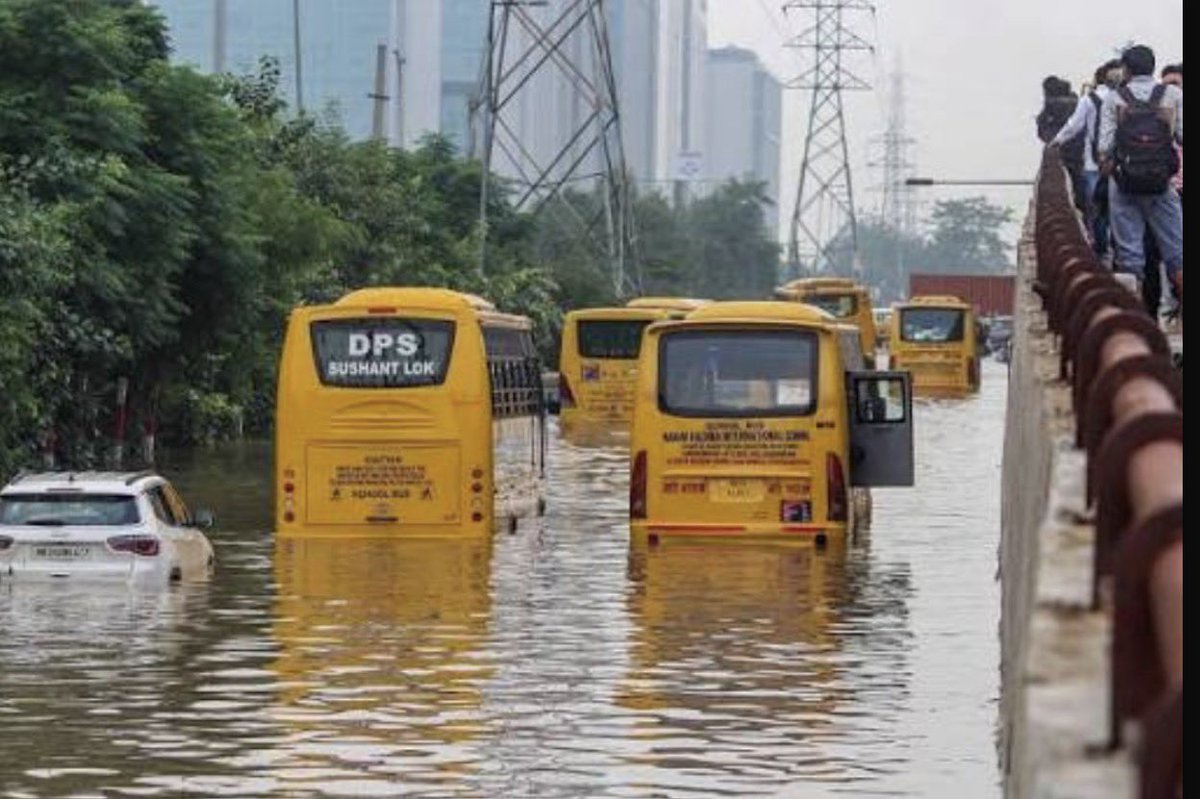
Gurugram Doesn’t Flood. Gurugram Is Drowned. Cause and effect, a thread 🧵 on the issue:
1/11: Flooding in Gurugram cannot be blamed on excess rain. This is not a natural disaster, it’s a man-made one, a government-made one. It’s a tale of geography ignored by greed and governance. The real question isn’t “how much did it rain.” It’s: why does a few hours of rain paralyse a city built in the last 25 years - with money, malls, glass towers, and zero ability to move water from point A to point B. #GurugramFloods
Konarc is a special product for us at Ather. As the first product on our brand new EL platform, it's what we are building our new factory in Chhatrapati Sambhajinagar on and the one with which we are planning to go truly mainstream.
Was a pleasure to share that special milestone with one of our oldest believers at Ather: Dr Pawan Munjal.
He was one of the earliest people to see the potential in EVs with his original investment in @atherenergy in 2016 and @swapniljain89 and I are proud to call him a mentor over the years!
@virenrasquinha India looked flat in
Most matches. Low energy . Too many errors and players looked short on confidence . Squad needs some changes post ag .
A change of government in Israel would not necessarily mean a change in Israeli foreign policy.
That is one of the lessons of the Bennett-Lapid government, the coalition that briefly replaced Benjamin Netanyahu before his return to power. Israel may eventually have a new prime minister, but the strategic assumptions that have defined the Netanyahu era could survive him.
For years, Israeli policy has rested on the assumption that military pressure, covert operations, economic isolation and the credible threat of force can prevent Iran from acquiring a nuclear weapon. But the record deserves much closer scrutiny.
Since President Donald Trump withdrew the United States from the 2015 nuclear agreement, with strong encouragement from Netanyahu, Iran has dramatically expanded its nuclear capabilities. Whatever one thinks of the original agreement, the strategy that replaced it did not produce a stronger deal or a less capable Iran. Tehran moved closer, not farther, to the nuclear threshold.
That should force Israeli policymakers to confront an uncomfortable possibility: pressure intended to stop an Iranian bomb may ultimately strengthen Tehran's incentive to acquire one.
There is a similar problem with the recurring hope that outside pressure can produce regime change in Iran. Military strikes, cyber operations, covert action and information campaigns can weaken an adversary. They cannot manufacture a viable political alternative inside another country.
There is also a practical question that receives far too little attention in Israel: What is the endgame? Israel may be prepared to sustain a prolonged confrontation with Iran. It should not assume that future American administrations will be equally willing.
The American public has little appetite for another open-ended Middle Eastern war. Washington is simultaneously managing competition with China, Russia, commitments in Europe and challenges elsewhere. An Israeli strategy that ultimately depends on indefinite American military participation is therefore not much of an independent strategy at all.
The same problem applies to Israel's long-standing concept of "striking the head of the octopus" retaliating against Iran itself for attacks carried out by Tehran's regional partners.
Suppose Hezbollah launches another major attack on Israel. Would striking Iran deter Hezbollah and end the confrontation? Or could it transform another war in Lebanon into a broader regional conflict involving Iran and multiple armed groups?
Israel undoubtedly possesses the military capability to inflict enormous damage on Iran. But capability is not strategy. The relevant question is what happens afterward.
Is Israel prepared for months or years of attrition with Iran and its regional network if the United States declines to participate directly? And could repeated attacks on Iran ultimately persuade its leadership that acquiring a nuclear deterrent is necessary for the regime's survival?
The next Israeli government should therefore conduct a genuine reassessment of Iran policy rather than simply inherit Netanyahu's assumptions.
Diplomacy should be part of that reassessment. The nuclear agreement was deeply imperfect, but it demonstrated something military pressure has so far failed to demonstrate: that verifiable restrictions can place meaningful limits on Iran's nuclear program. A future diplomatic framework may look very different from the 2015 agreement. But dismissing diplomacy as weakness while treating perpetual military escalation as strategy is not a serious long-term policy.
Yet Iran may not even be the most consequential foreign-policy challenge facing Israel's next government. That distinction belongs to the Palestinian issue.
For Israeli leaders, focusing on Iran has always had a political advantage: it allows Israel to present itself to Washington and the West primarily as a strategic ally confronting a common external enemy. But Israel's international standing is increasingly shaped by Gaza, the West Bank and the absence of any credible political horizon for the Palestinians.
No Israeli government can indefinitely separate those issues from the country's relationship with the United States. Israel's standing among younger Americans and parts of the Democratic coalition has already become considerably more complicated. European governments face growing domestic pressure over their relationships with Israel. Investors and multinational companies also pay attention to political instability, prolonged warfare and international isolation.
That matters especially for any future Israeli leader who promises economic growth, foreign investment and deeper integration with Western markets.
You cannot indefinitely pursue regional escalation abroad, permanent conflict with the Palestinians at home and deeper international integration at the same time. Eventually those objectives collide.
The next Israeli government therefore needs something more ambitious than a different prime minister. It needs a foreign-policy review.
It should ask whether the assumptions that guided Israel over the past decade actually produced the outcomes they promised: Is Iran farther from a nuclear weapon? Are Iran's regional partners less dangerous? Is Israel's international position stronger? Is its relationship with the United States more sustainable? And is Israel closer to resolving, rather than merely managing, the Palestinian conflict?
If the answers are uncomfortable, changing the person in the prime minister's office will not be enough. Israel could enter the post-Netanyahu era while continuing to practice Netanyahu's foreign policy.
#iran
Steve Jobs' son spent his teenage summers in an oncology lab while his father was privately dying of cancer. Twenty years later he runs a $200 million fund with one goal. Make cancer nonlethal.
Reed Jobs was 12 when Steve was diagnosed with a rare pancreatic tumor in 2003. At 15 he took a summer internship in a Stanford cancer lab. Steve told his biographer that his son's interest in medicine was the silver lining of his illness.
Then Steve died in 2011, while Reed was at Stanford as a pre-med. Reed walked away from medicine and switched his major to history.
The detour lasted a decade. He came back to run health at Emerson Collective, his mother's organization, for eight years. Oncology only. In 2023 he spun out his own firm with backing from John Doerr, MIT, and Memorial Sloan Kettering, and named it Yosemite, after the park where his parents were married in 1991, the year he was born.
The structure is the interesting part. Yosemite pairs a venture fund with a philanthropic arm, so it can fund academic research too early for VC money, then build companies out of whatever works. Grants de-risk the science, the fund scales it.
And the target tells you how ambitious this is. Three of his companies are going after p53, the tumor suppressor gene that almost every human cancer has to knock out to exist. Elephants barely get cancer, and one leading theory is that they carry dozens of copies of p53 while humans have one. Nobody has ever successfully drugged it.
His father spent his final years searching for a treatment that didn't exist yet. The son has spent twenty years building the machine to make one.