Introducing Avalanche Treasury Co: the premiere way to get regulated AVAX exposure.
We’re the institutional growth engine for the @avax ecosystem, with an exclusive relationship with Avalanche itself.
Funding builders. Accelerating technologies. Bringing institutions to AVAX.
BlackRock's move toward a Bitcoin buffer ETF is another interesting development in how traditional financial products are evolving to accommodate digital assets.
Buffer ETFs became increasingly popular following COVID. These products use options to provide a degree of downside protection in exchange for limiting upside participation, giving investors another way to gain exposure to an otherwise volatile asset.
For investors who wouldn't otherwise own Bitcoin, I think that's a valuable addition to the market.
It also raises an interesting portfolio construction question. If you're managing a diversified portfolio with discipline, there's an argument for maintaining exposure to that volatility rather than limiting it.
For example, a 2% BTC allocation with systematic rebalancing at predetermined thresholds allows investors to trim exposure following significant appreciation and add following declines. Over time, that volatility can create opportunities within a broader portfolio, although the strategy doesn't guarantee better returns.
Ultimately, different investors have different objectives and risk tolerances. The expansion of products that allow investors to express those preferences is a positive development for the asset class.
@CrossingBroad I get why Villanova leaves the big 5 in a NIL 2026. It’s sad and we’re all nostalgic of Palestra double headers.
But could Kevin Willard come off as more of a loser? Flexing a lot bravado earned by Jay Wright, who did it in a D'Annunzio suit, instead of a hooded sweatshirt.
Kevin Willard Blames Temple For Villanova’s Big 5 Exit, Calls Current Format Stupid While Also Criticizing Philadelphia Inquirer Reporting
https://t.co/UGXof0GBtI
A Visa acquisition of Fireblocks would be incredibly interesting to watch.
1. Stablecoins are the future.
2. Fireblocks is the primary platform for OUSD. So now Visa has has a lot more control over that project which (to me) makes it a lot less interesting.
3. Many of the people that use Fireblocks today probably view Visa as competition (or the enemy) at some level. If Fireblocks is your primary wallet solution, moving away from it is pretty painful, so interesting to see how sticky those customers are.
4. TradFi companies looking to "self custody" with a wallet-as-a-service provider are a lot more likely to trust Visa than a crypto native provider they have never heard of.
https://t.co/T1faHc0Uwt
Thanks again @JennSanasie and the @CoinDesk team for a great conversation yesterday at the @NYSE. Always enjoy talking about how tokenization is gaining momentum as more TradFi firms partner with crypto natives.
@Matt_Hougan "It lacks a strategic role in portfolios other than as a bet on fiat currency expansion or future asset trading on blockchains,"
Should read...
It lacks a strategic role except for the thing it was created to do that is happening in real time.
For years, the conventional wisdom has been that institutional participation creates liquidity in financial markets. Institutional participation is actually the last volume driver in the chain.
The IMF recently found that 80% of tokenized stock trades are for less than one share. To me, that reinforces an important point: retail investors and wealth management flows often create the initial liquidity. Market makers tend to follow, further driving volumes. And then institutions come at scale.
Hyperliquid is an example I often come back to. Retail speculators established liquidity on a decentralized platform that U.S. institutions initially had little need or desire to access. When geopolitical conflict created demand to trade oil over the weekend, institutions suddenly had a reason to enter a market where retail liquidity already existed.
And once that liquidity was established, they didn't leave. Hyperliquid had become a viable venue for weekend trading and smaller positions that traditional markets couldn't accommodate.
This is how markets develop. Retail participation creates initial liquidity, market makers begin competing for order flow, and larger institutions follow. While individual retail trades may be small, collectively that flow adds up quickly.
This will remain relevant to tokenization. Institutions will adopt tokenized assets when liquidity and necessity require them. They aren’t the first mover.
The real opportunity isn't just putting existing assets on new rails. It's creating new access to markets with the liquidity and accessibility that allow for trading across retail, market makers, and institutions at scale. Retail is already starting to show up.
More on the IMF's findings: https://t.co/ExnmXlMSIc
Looking forward to joining @stabledash live today at 12:30pm ET to talk about the state of the market and why @avax is built for institutions coming on-chain.
A signal worth paying attention to.
The IMF is highlighting the demand for after-hours trading, while Bloomberg Terminal’s recent integration of Hyperliquid market data shows traditional finance is taking notice.
The shift toward 24/7 markets is underway, and @avax is building the infrastructure to support it.
One of the most compelling applications of tokenization is improving capital efficiency. Moving from monthly to daily interest distributions could fundamentally change how corporate treasuries manage and deploy capital. Great discussion at #TOKEN2049 on where this is all headed.
Tokenization is unlocking new efficiencies for corporate treasuries.
Great conversation at #TOKEN2049 Singapore, where our CEO @gbartsmith joined Dan Maley of @BlackRock, @HenriArslanian of @9BlocksCap, and @thomasxchen of @BNBChain to discuss the evolution of tokenization and its role in the future of global financial markets.
One key takeaway: For decades, money market funds have typically distributed interest monthly. With tokenization enabling more frequent distributions, potentially moving toward daily payouts as an industry standard, corporate treasuries could put interest income to work sooner, improving capital efficiency, and unlocking new opportunities for productive deployment.
It's a tangible example of how blockchain infrastructure can deliver meaningful benefits to traditional finance.
Ondo’s tokenization of private credit manages to address shortcomings of current market structure and expand the investable universe for many of the hats I wear - retail investor, institutional trader, and an institutional investor.
Companies, like Oracle and Microsoft, used to go public early in their growth. Over the last decade or so, that has changed and some of the most innovative growth periods for companies like Stripe and Anthropic happen while they’re still private. Early access to that growth has largely been limited to institutional investors. With this offering, retail investors should regain access.
Ondo is democratizing private-company investment opportunities by bringing them on-chain. Even as an institutional investor, this should in theory expand the universe of opportunities I can access and evaluate. The real value creation from tokenization isn’t solely from existing assets on new rails but rather creating or expanding opportunities.
More here: https://t.co/kGfH7Fs0YM
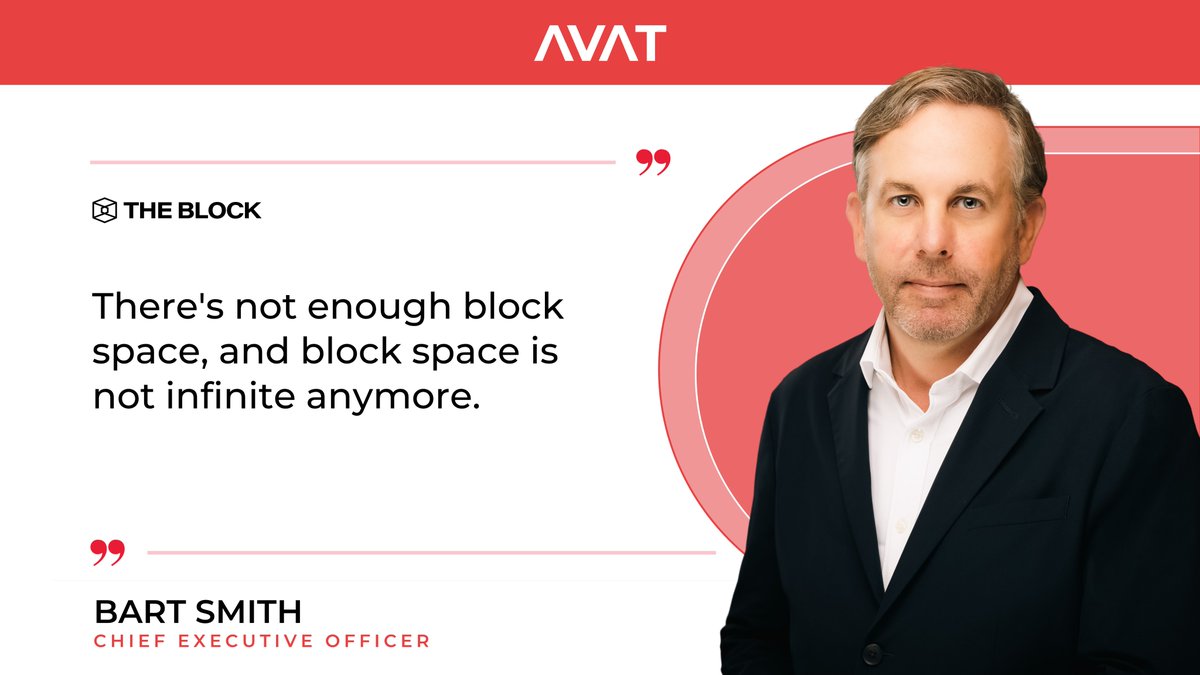
Blockchain scalability isn’t a solved problem.
Our CEO @gbartsmith spoke with @TheBlockCo about why the rise of AI agents in financial markets could make blockchain scalability a defining issue again – and why the technical differences between L1s are about to matter a lot more than they do today.
More from his conversation at the @avax Summit in this week’s Layer One newsletter: https://t.co/pfHFKIJvEp
Great to be back with @paulbarron. We talked about what’s behind @avat_co's recent run, why a permanent capital structure lets @avat_co take the long view on @avax, and why the next 18 months will decide which chains win tokenized stocks, credit and stablecoins.
Listen to our whole conversation: https://t.co/5YHTGyDcwS
“One of the nice parts about owning a treasury is it’s a permanent capital vehicle. I don't have to respond to fear and exuberance in the market. I can take an intermediate to long-term view.”
Our CEO @gbartsmith joined @paulbarron’s show to talk about AVAT’s strategy and unique market position, @avax recent boom, and why exchanges, asset managers and crypto natives alike are building on it.
Listen in: https://t.co/wTefBvV8CQ
In the past 30 days alone, we’ve seen example after example of major institutions choosing @avax infrastructure.
No question in my mind that Avalanche will be one of the very few winners.
Institutional adoption is moving from conversation to real-world deployment.
@GoldmanSachs bringing its flagship Treasury fund into an institutional network built on @avax is another significant example of traditional finance and digital asset infrastructure converging.
This is what adoption looks like in practice.
Read more: https://t.co/kHGX3d1wcf
In such a loud and crowded market cycle, this kind of institutional momentum may not be making headlines, but it’s exactly the kind of signal I’ve learned to pay attention to.
While investor attention and capital have been heavily concentrated around AI this year, blockchain adoption across finance, payments, tokenization, and other real-world use cases has kept advancing.
From global institutions like FIFA and J.P. Morgan to governments like South Korea and the UAE, @avax continues to demonstrate meaningful adoption among serious players – and AVAT exists to provide access to that opportunity.