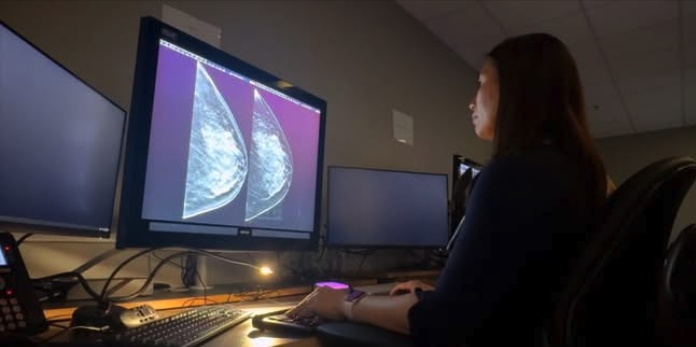
A groundbreaking clinical trial is underway using new AI technology to analyze mammograms and enhance the accuracy of predicting your likelihood of developing breast cancer over the next five years. https://t.co/jx8osXdW6y
Our new study shows adding prior/repeated mammogram images can substantially improve 5-year risk prediction for breast cancer! @gcolditz@rtamimi Debbie Bennett, Bernard Rosner, @washumedicine
https://t.co/w6SlQQNlna
An AI model assessing digital mammograms can accurately predict breast cancer risk in a large and diverse population of women, according to @WashUMedicine researchers at Siteman.
https://t.co/ZeBPHNMpzQ
Nice coverage of our new paper showing consistent performance of our AI based breast cancer risk prediction across women from different backgrounds including Asian heritage https://t.co/f2I6IJOlx9
A risk prediction model generated from both current and prior mammograms showed robust performance across diverse racial and ethnic populations. https://t.co/nU8wblLZd4
Our model including the images from prior screening mammograms validates with robust and superior performance to using only one mammogram. This performs across a cross range of race and ethnic groups including Asian women. Wonderful to complete this work with data umbi
A risk prediction model generated from both current and prior mammograms showed robust performance across diverse racial and ethnic populations. https://t.co/nU8wblLZd4
“Americans die earlier and are sicker than people in other high-income countries. This has been true for a long time, and the trend is getting worse.”
gift link https://t.co/vCU1YFwa0k
Congratulations to Dr. Roheena Panni for receiving the 2025 Young Investigator Award! We are proud to highlight her remarkable achievement in advancing cancer research.
More: https://t.co/QMkchk8yey
#WashUMedicine#WashUSurgery#SSO2025#CancerResearch
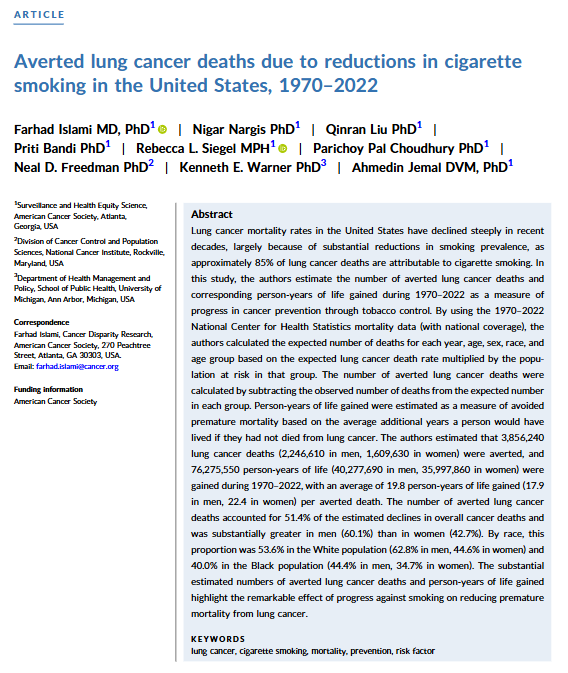
Reduced smoking = fewer cancer deaths. From 1970–2022, reductions in smoking accounted for 51.4% of of the drop in overall lung cancer mortality. Declines in cancer deaths were greater in men (60.1%) than in women (42.7%).
https://t.co/N4ZRryIVXH
@OncoAlert@FarhadIslami
@avidan_michael Thank you so much for sharing. This is beautifully put reflecting you to the core as I have been so fortunate to watch your career blossom, and it is so deeply moving and guiding for us all.
Our new study shows adding prior/repeated mammogram images can substantially improve 5-year risk prediction for breast cancer! @gcolditz@rtamimi Debbie Bennett, Bernard Rosner, @washumedicine
https://t.co/w6SlQQNlna
ACCERT Center funded by NCI. Our Division – working closely with Siteman @SitemanCenter has received a $9.3M, 5-year grant to advance cancer control equity through community-engaged multilevel interventions that address the impact of social determinants of health on cancer.
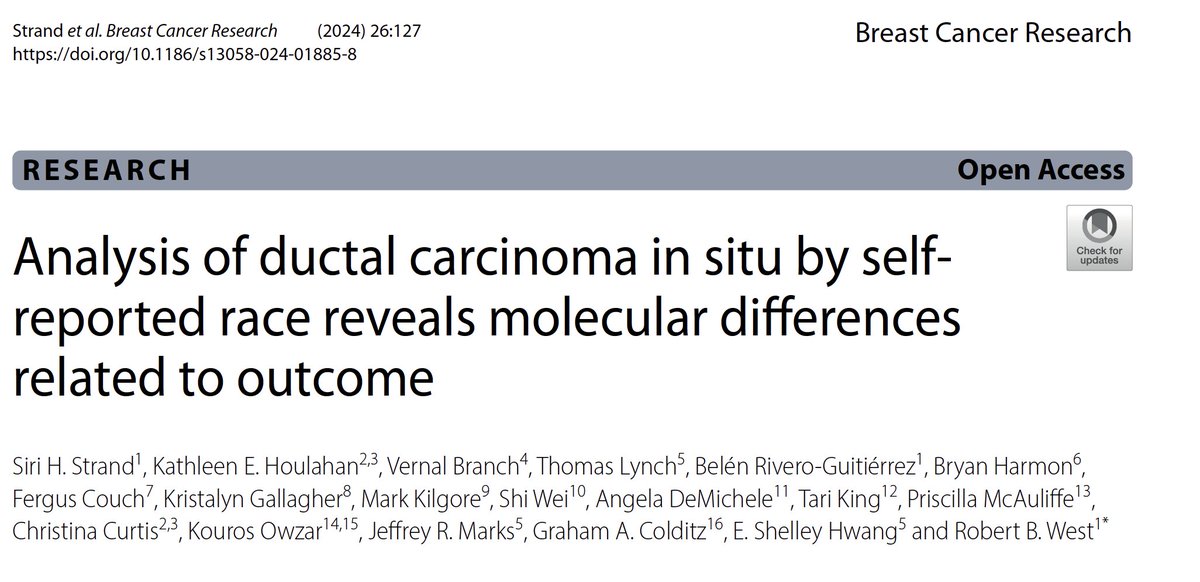
Wonderful to have another paper from the breast precancer atlas out! Data suggest different molecular mechanisms drive initiation and subsequent ipsilateral breast events in Black vs. White women.
The Cancer Screening Research Network investigates how to identify cancers earlier. The @USUhealthsci and the @DeptVetAffairs, along with several NCI-supported institutions, will evaluate emerging technologies for cancer screening. https://t.co/VW0gB9oL0R #NCRM24#CancerMoonshot
Research involving global audits of plastic pollution from 2018 to 2022 has revealed that 52% of the nearly 2 million inventoried items had no discernible branding and could not be traced back to producers. https://t.co/ihFXnZ8rfn
Section Chief Matthew Mutch, MD, @WUSTLphs's Adetunji Toriola, MD, PhD, MPH, and international colleagues compared quality of life between young adult and older colorectal cancer survivors in the ColoCare study. Read the abstract here: https://t.co/mQSYn10Mtm
.@WashUSurgRes's Nicole Santucci, MD, MS, will be spending her research year in the lab of @WashUPedSurg Chief Colin A. Martin, MD, as part of the Clinical Research Training Center’s TL1 Translational Sciences Doctoral Program. Congratulations, Dr. Santucci!
Recently published in @TheLancetHaem: Ana Baumann, PhD, researchers, and implementation scientists worked to address differences in health care transition services for patients with sickle cell disease. https://t.co/Q50A2TBFu4