I'm excited to share Oliva Voice Assistant 🗣️
An agent that helps retrieve information from @qdrant_engine database using @langchain 🦜 and @superlinked
Oliva is open source, check it out 👉https://t.co/dAAFASFhg6
You can now fine-tune Qwen3.8-27B for free with our notebook! 🔥
Local training works on 24GB VRAM.
Unsloth trains Qwen3.8-27B 1.5x faster with 50% less VRAM.
GitHub: https://t.co/aZWYAtakBP
Qwen3.8-27B Notebooks + Guide: https://t.co/3GE3WVWIOY
Qwen3.8 is launching and going open-weight soon!🌐
With a massive 2.4T parameters, this model is continuously evolving. We believe it’s one of the most powerful model available today, compatible to leading frontier AI models , second only to Fable 5.
You don't have to wait to test it. Just now, the Qwen3.8-Max-Preview made its debut on Alibaba’s Token Plan, Qoder, and QoderWork. Be among the very first to try it out.
Can't wait to hear what you build. Stay tuned! 🚀
Token Plan
international:https://t.co/YRvcGdB9Bv
China:https://t.co/PKMUNwUuRp
Voice AI without the wait! ⏱️
Thanks to Hugging Face and Cerebras, developers can now use the Gemma 4 31B model as the brain for voice AI at ultra-fast inference speeds. Add it to a fully open-source, cascaded speech-to-speech stack that can be used to power existing voice apps! 🗣️
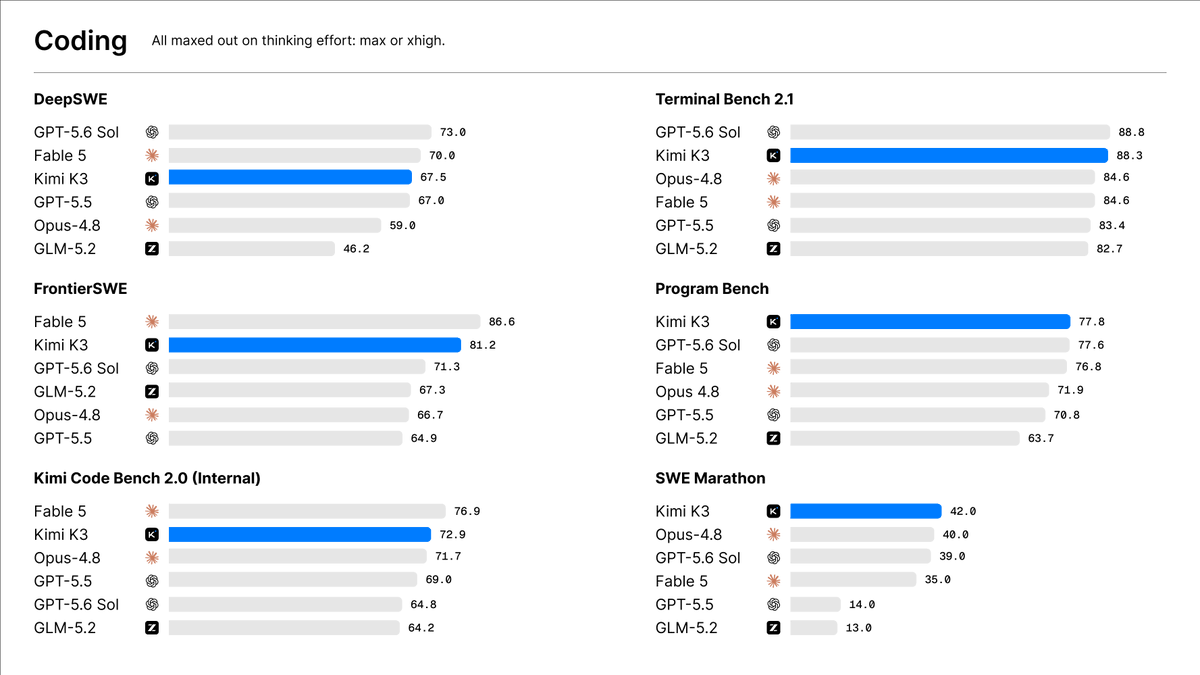
Introducing Kimi K3: Open Frontier Intelligence
🔹 2.8 Trillion Parameters, 1 Million Context, Native Multimodal
🔹 Kimi Delta Attention enables up to 6.3x faster decoding in million-token contexts
🔹 Attention Residuals deliver ~25% higher training efficiency at <2% additional cost
🔹 Built for long-horizon agentic coding and self-evolving workflows
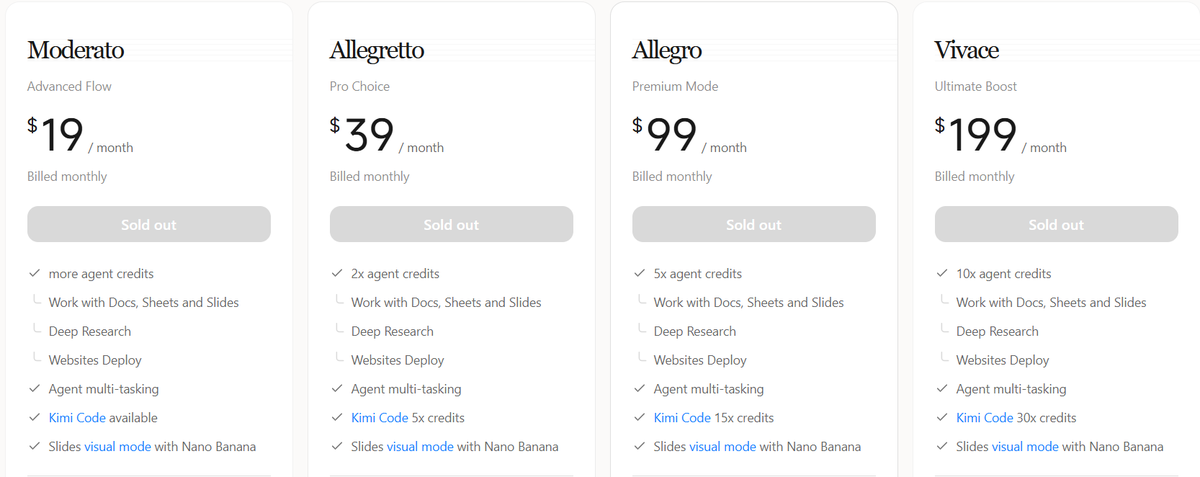
Kimi K3 is now live on on https://t.co/zrk6zZxZUo, Kimi Work, Kimi Code, and the Kimi API.
Open Weights by July 27, 2026.
🔗 API: https://t.co/XCrgjXAqMw
🔗 Tech blog: https://t.co/YTfiMSNM1f
LLM Knowledge Bases
Something I'm finding very useful recently: using LLMs to build personal knowledge bases for various topics of research interest. In this way, a large fraction of my recent token throughput is going less into manipulating code, and more into manipulating knowledge (stored as markdown and images). The latest LLMs are quite good at it. So:
Data ingest:
I index source documents (articles, papers, repos, datasets, images, etc.) into a raw/ directory, then I use an LLM to incrementally "compile" a wiki, which is just a collection of .md files in a directory structure. The wiki includes summaries of all the data in raw/, backlinks, and then it categorizes data into concepts, writes articles for them, and links them all. To convert web articles into .md files I like to use the Obsidian Web Clipper extension, and then I also use a hotkey to download all the related images to local so that my LLM can easily reference them.
IDE:
I use Obsidian as the IDE "frontend" where I can view the raw data, the the compiled wiki, and the derived visualizations. Important to note that the LLM writes and maintains all of the data of the wiki, I rarely touch it directly. I've played with a few Obsidian plugins to render and view data in other ways (e.g. Marp for slides).
Q&A:
Where things get interesting is that once your wiki is big enough (e.g. mine on some recent research is ~100 articles and ~400K words), you can ask your LLM agent all kinds of complex questions against the wiki, and it will go off, research the answers, etc. I thought I had to reach for fancy RAG, but the LLM has been pretty good about auto-maintaining index files and brief summaries of all the documents and it reads all the important related data fairly easily at this ~small scale.
Output:
Instead of getting answers in text/terminal, I like to have it render markdown files for me, or slide shows (Marp format), or matplotlib images, all of which I then view again in Obsidian. You can imagine many other visual output formats depending on the query. Often, I end up "filing" the outputs back into the wiki to enhance it for further queries. So my own explorations and queries always "add up" in the knowledge base.
Linting:
I've run some LLM "health checks" over the wiki to e.g. find inconsistent data, impute missing data (with web searchers), find interesting connections for new article candidates, etc., to incrementally clean up the wiki and enhance its overall data integrity. The LLMs are quite good at suggesting further questions to ask and look into.
Extra tools:
I find myself developing additional tools to process the data, e.g. I vibe coded a small and naive search engine over the wiki, which I both use directly (in a web ui), but more often I want to hand it off to an LLM via CLI as a tool for larger queries.
Further explorations:
As the repo grows, the natural desire is to also think about synthetic data generation + finetuning to have your LLM "know" the data in its weights instead of just context windows.
TLDR: raw data from a given number of sources is collected, then compiled by an LLM into a .md wiki, then operated on by various CLIs by the LLM to do Q&A and to incrementally enhance the wiki, and all of it viewable in Obsidian. You rarely ever write or edit the wiki manually, it's the domain of the LLM. I think there is room here for an incredible new product instead of a hacky collection of scripts.
We heard you. And we agree.
In light of recent developments in physical media, GitHub is proud to announce that you can now obtain your public repo on CD-ROM.
Keep it. Lend it to friends. Pass it on to your children.
Your code is physically yours, forever. Until you lose it, let's be real.
Order yours today.
https://t.co/z041pdMH7h
When you build a voice AI agent, one of the first problems you hit is: 𝐰𝐡𝐚𝐭 𝐡𝐚𝐩𝐩𝐞𝐧𝐬 𝐰𝐡𝐞𝐧 𝐦𝐨𝐫𝐞 𝐭𝐡𝐚𝐧 𝐨𝐧𝐞 𝐩𝐞𝐫𝐬𝐨𝐧 𝐢𝐬 𝐬𝐩𝐞𝐚𝐤𝐢𝐧𝐠?
Automatic speech recognition (ASR) models are trained on clean audio, the happy path.