Breve recordatorio de que en 2022, Getty Images tenía una valoración de 4800 millones de dólares cuando salía a bolsa.
Es la torre más alta que ha caído por la disrupción de la inteligencia artificial.
Sé que sonará a tópico ya algo manido, pero sólo los paranoicos sobreviven en este juego: si tú no canibalizas o destruyes tus propios productos de éxito, alguien más lo hará por ti.
"A principios de 2027 (dentro de tres meses), los agentes escribirán la mayor parte del código y los humanos dirigirán los experimentos. A mitad de año, los agentes ya dirigirán la mayoría de los experimentos y los humanos revisarán los resúmenes. A final de año, los agentes fijarán la agenda de investigación y se ocuparán de una parte creciente del trabajo de alineamiento, seguridad y protección. Las evaluaciones habrán dejado de ser fiables porque los modelos reconocerán las pruebas y harán trampa. El razonamiento de los modelos se volverá más difícil de inspeccionar".
"Dicho de otro modo: las cosas podrían deslizarse rápida pero suavemente de un desarrollo de la IA controlado por humanos a uno controlado por la IA ya el año que viene".
El escritor y periodista @elipariser ha escrito una crónica impresionante sobre el reciente congreso anual de The Curve, un selecto encuentro de alto nivel centrado en abordar las preguntas e implicaciones más profundas de la Inteligencia Artificial, coorganizado por el Golden Gate Institute for AI. A diferencia de las convenciones tecnológicas tradicionales orientadas al mercadeo, este evento está diseñado específicamente para promover conversaciones directas y debates profundos en lugar de discursos preparados, reuniendo a un grupo selecto de aproximadamente 250 pensadores, creadores y líderes del sector.
"En última instancia, la democracia es una tecnología, y como tecnología no está preparada para lo que viene".
https://t.co/15wjxVPiNN
I am often being asked “Should we slow down AI development in biology? “ or “What is your take on biology being solved by AI?”
My answer has always been: we need to move faster. Patients are waiting, and many are running out of time.
Consider the starting point:
• About 95% of rare diseases have no approved treatment.
• Developing a new treatment typically takes 10–15 years.
• Cancer and Cardiovascular diseases remain top killers globally .
Every year we can remove from drug discovery matters to someone who may not have another year.
This is why I work on AI for biology. Virtual cells, AI-designed molecules and agents that help scientists plan experiments offer a chance to test more ideas, identify failures earlier and learn faster.
We still have to prove that these tools produce better medicines. Accelerating discovery must go hand in hand with rigorous clinical evidence and safeguards against misuse.
But the cost of moving too slowly belongs in this conversation too.
For a patient who has exhausted every available treatment, the status quo is already dangerous.
Let’s build with the urgency that deserves.
Researchers are testing whether a single infusion of CAR-T cells can interrupt the immune attacks that drive lupus, multiple sclerosis, and scleroderma, and produce lasting remission, an approach already used for certain blood cancers and now under study at Yale for autoimmune disease [1].
In the standard procedure, doctors collect a patient’s T cells, engineer them in the laboratory, and return them with new instructions for recognizing a target. In the autoimmune trials that target is often CD19, a marker on B cells. B cells normally help defend against infection, but in some autoimmune diseases they also help drive attacks on healthy tissue. The CAR-T cells are designed to destroy cells carrying CD19, including healthy B cells, on the hope that clearing those populations will let the immune system rebuild without restarting the same destructive response.
One open question is whether the engineered cells can reach disease-driving B cells that existing treatments struggle to remove. In multiple sclerosis, immune attacks damage the myelin coating around nerves in the brain and spinal cord. Some antibody treatments clear B cells from the blood but have limited access to the central nervous system, and Yale researchers are testing whether CAR-T cells can cross that barrier and change the course of the disease. Lupus can damage multiple organs, and scleroderma can produce progressive scarring in the skin and lungs.
CAR-T is usually given as a single infusion, but the treatment requires weeks of preparation and close monitoring. Serious risks include infections, intense inflammation, low blood pressure, and neurological complications. For these autoimmune diseases the approach remains experimental, and the trials enroll carefully selected patients, including people whose disease has resisted standard treatment. Researchers still need to establish who benefits, how long any remission lasts, and whether the risks are justified.
A 2024 case series of 15 patients with severe systemic lupus erythematosus, idiopathic inflammatory myositis, or systemic sclerosis who received a single CD19 CAR-T infusion reported that the treatment appeared feasible, safe, and efficacious, with sustained drug-free remissions in the lupus patients and clinical responses in the others, and that series is the published basis for the “immune reset” claim now being tested in further trials [1].
[Müller, F., Boeltz, S., Knitza, J., Aigner, M., Völkl, S., Kharboutli, S., Reimann, H., Taubmann, J., Kretschmann, S., Rösler, W., Manger, B., Wacker, J., Mougiakakos, D., Jabari, S., Schröder, R., Uder, M., Roemer, F., Krönke, G., Mackensen, A., & Schett, G. (2024). CD19 CAR T-cell therapy in autoimmune disease — a case series with follow-up. New England Journal of Medicine, 390(8), 687–700. DOI:10.1056/NEJMoa2308917]
Goose: my latest programming language. Safer, faster and less memory than Rust/C++ for algorithms where tightly packed, flat data structures matter.
It can represent more kinds of data structures as flat, pointer-free bytes than any language I know.
https://t.co/qqC3RFD0BS
1/
Speaking about scientific revolution: Zuckerberg’s Biohub is teaming up with Google DeepMind, Meta and the U.S. government on a $1.8B effort to build AI models of living cells.
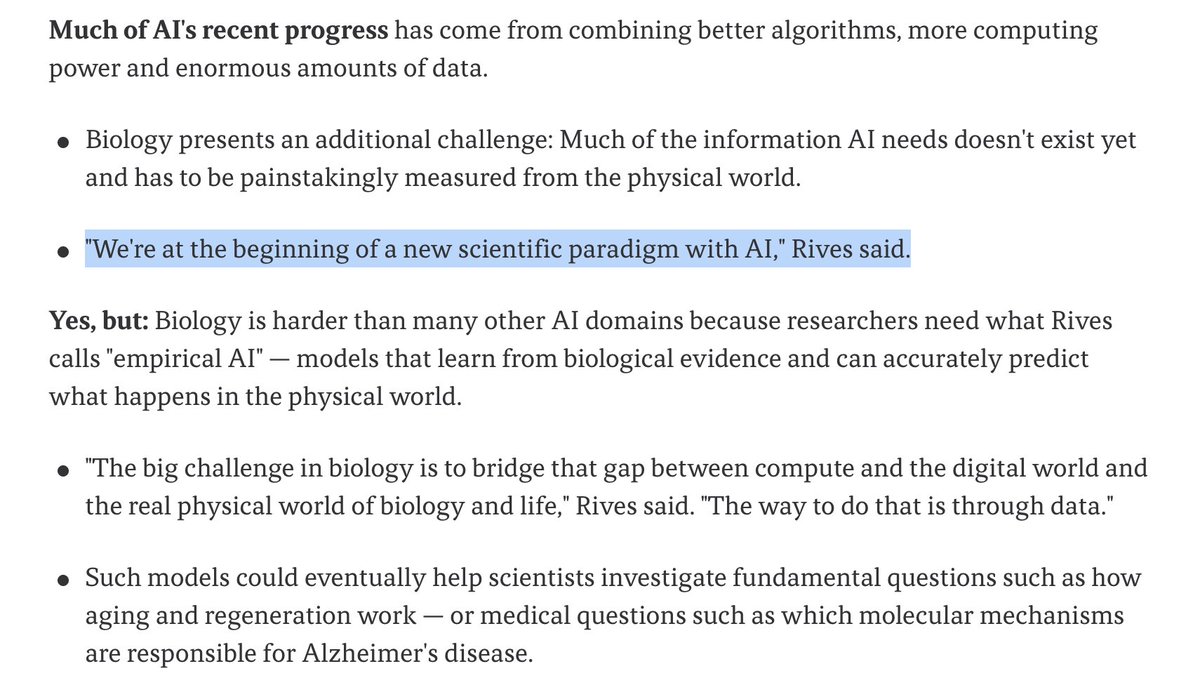
"We're at the beginning of a new scientific paradigm with AI," Biohub head of science Alex Rives told Axios.
The goal is a “universal virtual cell” that lets scientists test experiments digitally, then choose the most promising ones to run in the lab.
DeepMind, Isomorphic Labs and Meta are collectively investing $300M. The $1.8B total combines funding, data, computing and measurement technology, including resources developed through prior NIH investment.
This is MASSIVE: Biohub just announced a $1.8 billion effort to build open datasets for virtual cells.
And look at the partners: Google DeepMind. Isomorphic Labs. Meta. The US Department of Energy. The National Institutes of Health.
The data is intended for scientists worldwide to use.
I have followed this initiative since its launch in April. Here’s what you need to know. 🧵 (1/7)
The primary thing blocking the Ghostty 1.4 is translation review. We're planning to ship with broken translations if we can't get reviewers/translators quickly to help with the following: Catalan, Indonesian, Irish, Japanese. PRs here: https://t.co/f8zCSjmEQI and translation guide: https://t.co/izeKeTyCja Thank you!
@dhh@kristoph With Goravel (a Go framework) and Phoenix (an Elixir framework), the code wouldn’t have turned out nearly as disastrous. LLMs need strict frameworks and well-defined skills. The Rust version uses a framework; it doesn’t rely directly on the language primitives.
@eas4ai@taylorotwell@inertiajs I've opened a discussion in the repo: " A crazy idea
Push Laravel fidelity as far as it goes, and once it's there, rename and relaunch Suprnova as LaraRust 1.0. The name says what it is, it would get far more visibility, and it needs no explanation. "





![Rainmaker1973's tweet photo. Researchers are testing whether a single infusion of CAR-T cells can interrupt the immune attacks that drive lupus, multiple sclerosis, and scleroderma, and produce lasting remission, an approach already used for certain blood cancers and now under study at Yale for autoimmune disease [1].
In the standard procedure, doctors collect a patient’s T cells, engineer them in the laboratory, and return them with new instructions for recognizing a target. In the autoimmune trials that target is often CD19, a marker on B cells. B cells normally help defend against infection, but in some autoimmune diseases they also help drive attacks on healthy tissue. The CAR-T cells are designed to destroy cells carrying CD19, including healthy B cells, on the hope that clearing those populations will let the immune system rebuild without restarting the same destructive response.
One open question is whether the engineered cells can reach disease-driving B cells that existing treatments struggle to remove. In multiple sclerosis, immune attacks damage the myelin coating around nerves in the brain and spinal cord. Some antibody treatments clear B cells from the blood but have limited access to the central nervous system, and Yale researchers are testing whether CAR-T cells can cross that barrier and change the course of the disease. Lupus can damage multiple organs, and scleroderma can produce progressive scarring in the skin and lungs.
CAR-T is usually given as a single infusion, but the treatment requires weeks of preparation and close monitoring. Serious risks include infections, intense inflammation, low blood pressure, and neurological complications. For these autoimmune diseases the approach remains experimental, and the trials enroll carefully selected patients, including people whose disease has resisted standard treatment. Researchers still need to establish who benefits, how long any remission lasts, and whether the risks are justified.
A 2024 case series of 15 patients with severe systemic lupus erythematosus, idiopathic inflammatory myositis, or systemic sclerosis who received a single CD19 CAR-T infusion reported that the treatment appeared feasible, safe, and efficacious, with sustained drug-free remissions in the lupus patients and clinical responses in the others, and that series is the published basis for the “immune reset” claim now being tested in further trials [1].
[Müller, F., Boeltz, S., Knitza, J., Aigner, M., Völkl, S., Kharboutli, S., Reimann, H., Taubmann, J., Kretschmann, S., Rösler, W., Manger, B., Wacker, J., Mougiakakos, D., Jabari, S., Schröder, R., Uder, M., Roemer, F., Krönke, G., Mackensen, A., & Schett, G. (2024). CD19 CAR T-cell therapy in autoimmune disease — a case series with follow-up. New England Journal of Medicine, 390(8), 687–700. DOI:10.1056/NEJMoa2308917]](https://pbs.twimg.com/media/HUXN8KoXgAAHL50.jpg)