Proud to share this publication by our postdoc, Shweta Devi! It offers new insights into the interaction capabilities of the TPR domain to EEVD-like motifs in nonchaperone proteins.
https://t.co/fOcVT8Z9Y0
Excited to share the work done by @taiawu and Zach Gale-Day on DSFWorld: an online open-source software that streamlines the planning and analysis of DSF experiments!
https://t.co/T5g731xMfk
Interested in learning how dyes might help in characterizing protein activity?
We're excited to share the development of a protein-adaptive DSF platform (paDSF), a dye-based method used to interrogate stability, dynamics, and ligand binding!
https://t.co/uTANww2Vwc
First woman to graduate from MIT was a chemist. She applied chemistry to issues like nutrition - a pioneer ahead of her time in many different ways #WomenInSTEM
An alum of Prof. Jeff Kelly's lab, Nicholas Yan looks forward to a postdoc position in @UCSF's @GestwickiLab and @SouthworthLab, where he'll use cryo-electron microscopy to explore the structural basis of small molecules that target amyloid fibrils. More: https://t.co/uTCkTLIcza
Congratulations to our amazing postdoc @proteins_emma on winning a poster award at the Protein Folding Dynamics Gordon Research Conference!!! It��s a well-earned testament to her brilliance & creativity!
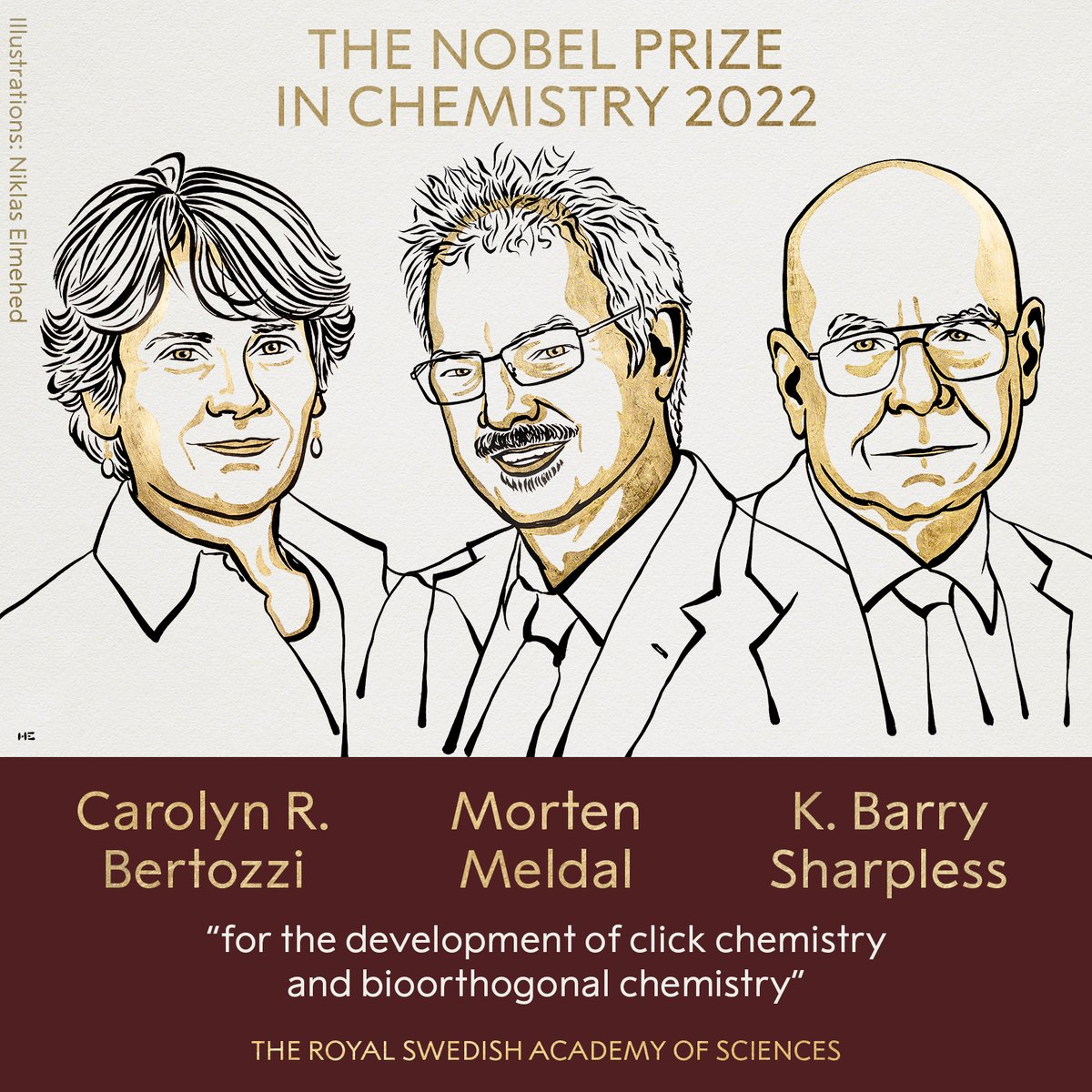
BREAKING NEWS:
The Royal Swedish Academy of Sciences has decided to award the 2022 #NobelPrize in Chemistry to Carolyn R. Bertozzi, Morten Meldal and K. Barry Sharpless “for the development of click chemistry and bioorthogonal chemistry.”
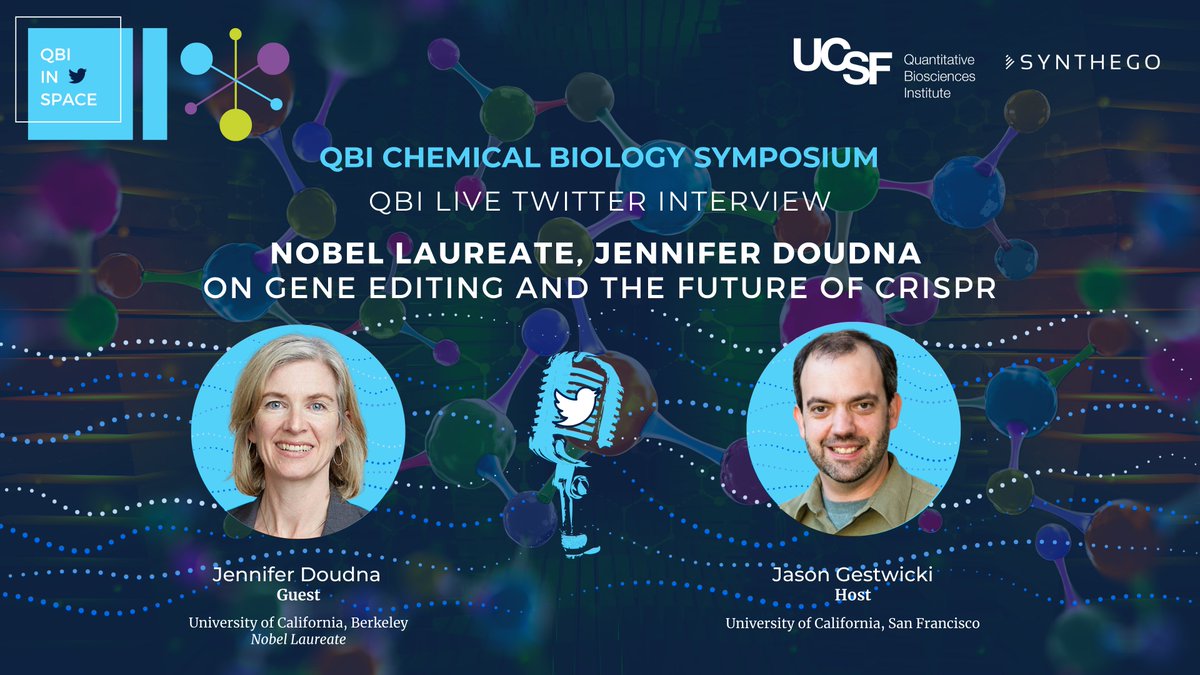
As part of the #QBIChemBio22 Symposium today, @jadoudna, Nobel Laureate, co-inventor of #CRISPR-Cas9 & Professor at @UCSF/@UCBerkeley will participate in a Twitter Space hosted by Jason Gestwicki. Tune in at 1:30 PT to hear about her work!
https://t.co/Juigimzrqj
Jumping around the mutation alphabet to hit cancer! Our new work covalent targeting of KRAS G12S is online: https://t.co/GWj1Wzcugq Interested in more? The Zhang lab (https://t.co/Fm4hoDMWpP) at @UCBerkeley is recruiting:)
Chaperones are needed for so many processes! How do you make process-specific or disease-specific chaperone inhibitors that are not generally toxic? A great collaboration with @GestwickiLab shows the way...https://t.co/6DwCRX1WS8
Chaperones are needed for so many processes! How do you make process-specific or disease-specific chaperone inhibitors that are not generally toxic? A great collaboration with @GestwickiLab shows the way...https://t.co/6DwCRX1WS8
I concur. I confirm that new PIs will do everything to make their mentees successful! I contend that other hashtags are also cool. I also confess that I’m a new PI @UCB_Chemistry and we are recruiting https://t.co/AVQsBE2WaO
Happy to share the @biorxivpreprint for my first bit of work w/ @aliceyting. Together with @heegwangroh, we built a simple and versatile single-component luminescent biosensor for detecting the SARS-CoV-2 spike protein.
https://t.co/GPU8D4MwlA
Check out our latest review article on non-canonical Hsp70 interactions—out now in Cell Stress & Chaperones! With the recent explosion of studies mentioning them, @oletaknowsstuff & Jason thought this timely. We hope it inspires new important research! https://t.co/cOsNn1v7J0